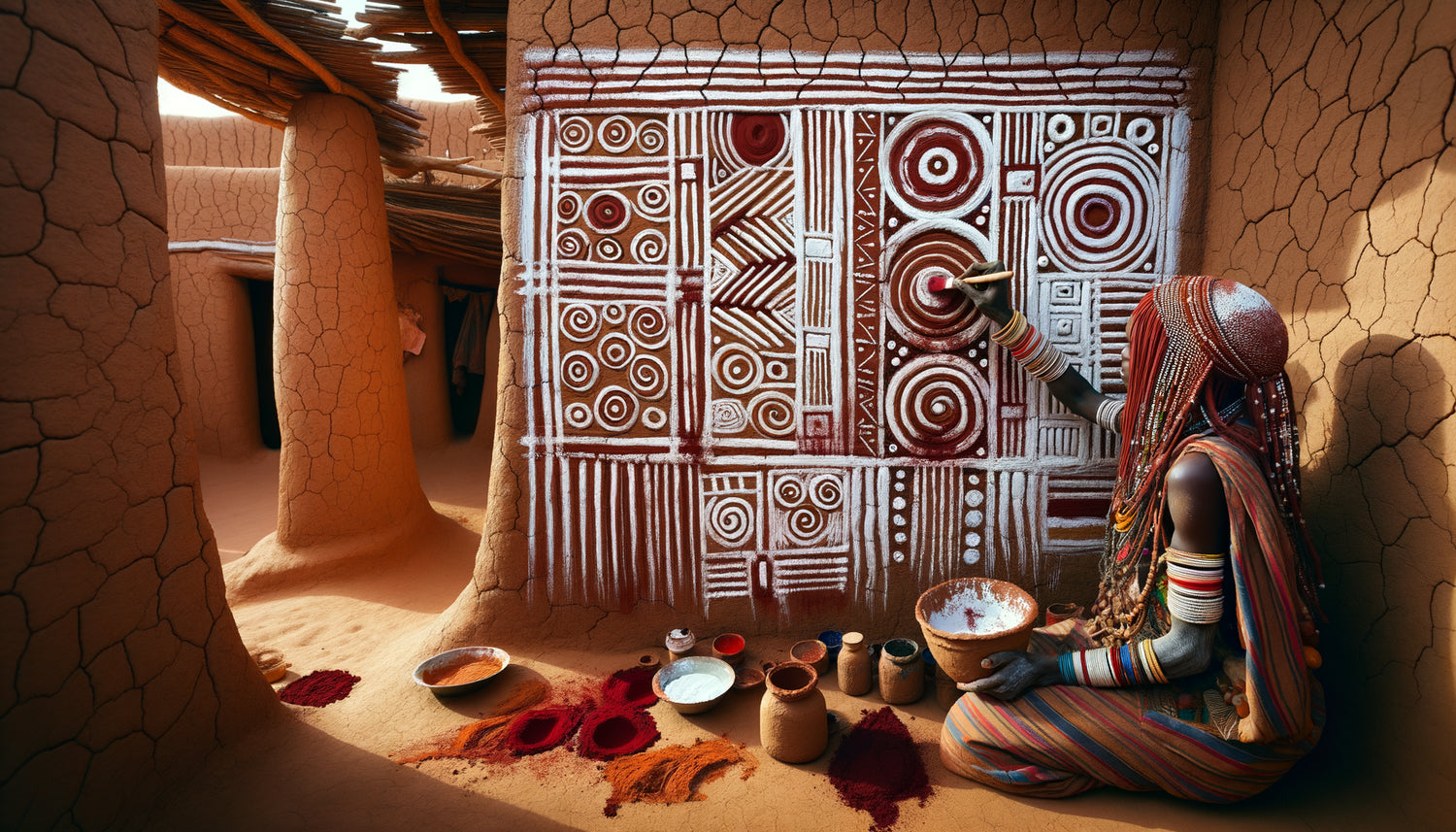
In a courtyard of packed earth in southwestern Burkina Faso, the hands of a woman trace geometric patterns on the wall of a house. These are not mere decorations, but a millennial visual language that accompanies the passage of souls to the afterlife. The murals of the Lobi transform each home into a living sanctuary, where funeral ceremonies become dialogues between the living and ancestors.
Here's what this tradition brings: a deep spiritual connection with the deceased, an artistic expression that protects and guides the soul of the departed, and a cultural heritage that unites the community in mourning. These frescoes are not art for art’s sake, but sacred bridges between two worlds.
You may have wondered why some African cultures give such a central place to visual arts in their funeral rituals, while others prioritize music or dance. This misunderstanding often comes from a Western vision that separates aesthetics from the spiritual.
Rest assured: understanding the meaning of Lobi murals does not require being an anthropologist. It is enough to observe how art becomes language, how color becomes prayer, how the painter's gesture becomes ritual.
In this article, you will discover why these murals are inseparable from Lobi funeral ceremonies, how they guide souls, and what this ancestral tradition reveals about our universal relationship with death and memory.
Sacred architecture: when the house becomes a funeral temple
Among the Lobi of Burkina Faso, housing is never neutral. The soukala, these fortified earth houses, are living organisms that breathe with their occupants. When a family member dies, the house itself enters mourning and must be prepared for funeral rites.
Murals then appear as a spiritual necessity. They are applied to exterior and interior walls, creating a liminal space where the deceased can complete their earthly journey. The geometric patterns – triangles, diamonds, zigzags – are not decorative but symbolic: they represent the paths that the soul must take, the obstacles it must overcome, the protections it needs.
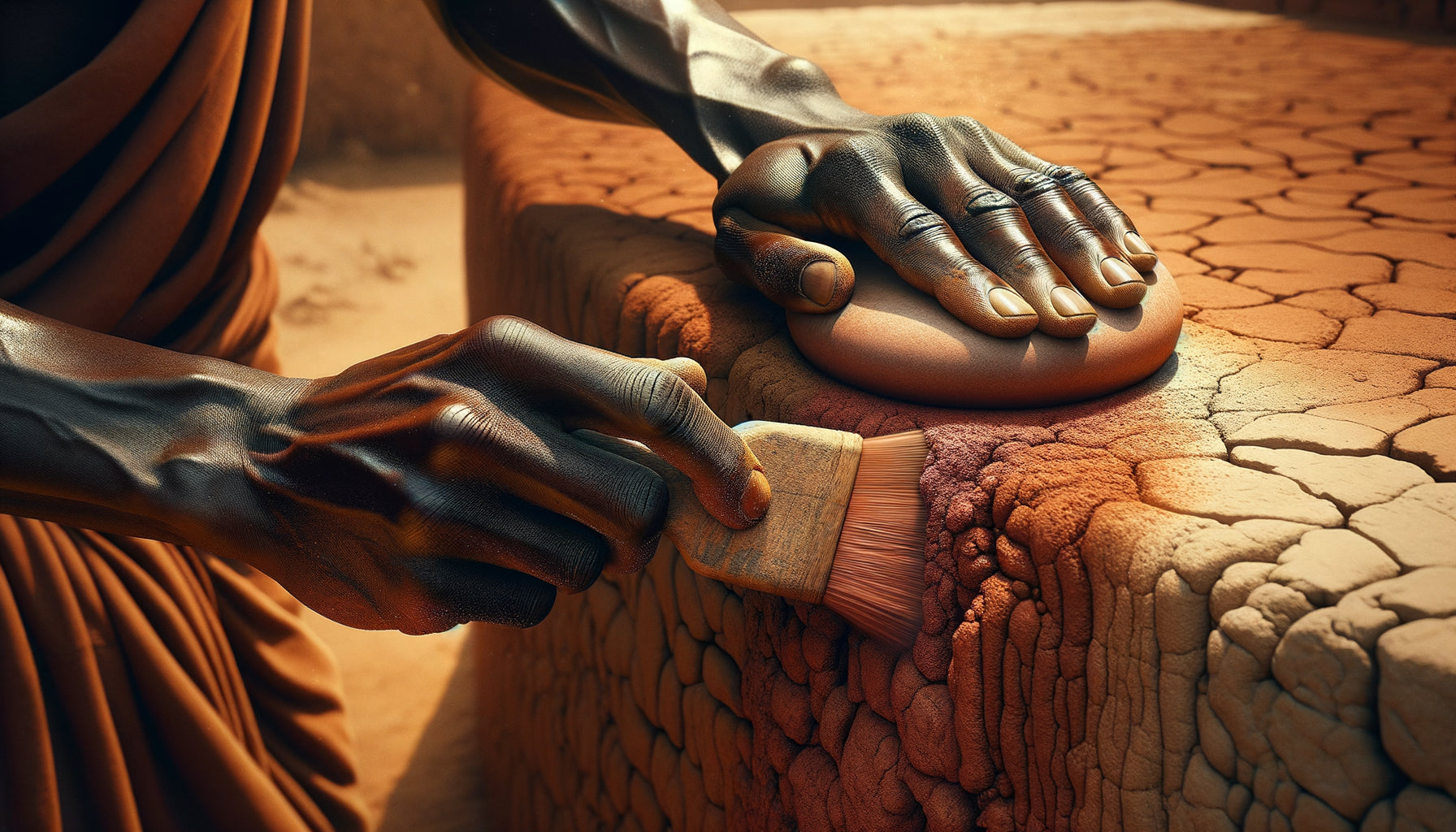
This transformation of ordinary architecture into a funeral sanctuary begins as soon as the death is announced. Women, guardians of this pictorial tradition, prepare their natural pigments: red ochre extracted from laterite, charcoal black, kaolin white. Each color has a specific function in the funeral protocol.
The pigments of transition: symbolism of funeral colors
Black dominates the funeral murals. It represents the earth that welcomes the body, but also the night through which the soul travels before reaching the world of ancestors. Lobi women apply this deep black in wide vertical bands symbolizing passage, a door between two dimensions.
The kaolin white follows, traced in precise patterns. This sacred color evokes the purity necessary for the soul to join the ancestors. It also protects the living from negative influences that could accompany the deceased. The aligned white dots form invisible but effective spiritual barriers.
The red ochre, used sparingly, recalls vital blood, the life force that has left the body but persists in collective memory. These three colors converse on the walls, creating a funeral fresco that tells the story of the passage and guides the ceremonies to follow.
Pigment preparation: a ritual in itself
The manufacture of pigments for funeral wall paintings follows strict rules. Women must prepare them in a state of ritual purity, often after observing certain dietary prohibitions. The grinding of ochre, the dilution of kaolin, the preparation of the binder based on vegetable decoctions: each step is accompanied by ritual words that charge the material with spiritual intention.

When patterns tell the story of the soul's journey
Lobi funeral wall paintings are never abstract in their intention, even if their forms may seem geometric to the untrained eye. Each motif encodes a stage of the deceased’s post-mortem journey.
The horizontal zigzags represent the obstacles that the soul must overcome: invisible rivers, spiritual mountains, guardians who must be appeased. During funeral ceremonies, elders point to these motifs while reciting the formulas that will help the deceased overcome these trials.
The checkerboards and grids symbolize the different worlds that coexist: that of the living, that of recent ancestors, that of founding ancestors. Their superposition on the walls recalls that these dimensions are not separate but intertwined, accessible to those who know the passages.
The concentric circles, more rare, indicate places of spiritual power within the house. Offerings will be placed in front of these motifs, and the most powerful invocations will be pronounced. The wall paintings thus create a sacred cartography that orchestrates the entire ceremony.
The painters of the invisible: guardians of tradition
Unlike many African artistic practices dominated by men, Lobi funeral wall paintings are the exclusive domain of women. They hold the knowledge, they pass on the techniques, and they decide on the appropriate motifs according to the status of the deceased.
An experienced painter possesses a repertoire of dozens of motifs, each adapted to specific circumstances: death of a child, an elder, a chief, a woman in childbirth. She must also know the prohibitions: some motifs can only be traced at night, others only after certain sacrifices.
This female transmission of funeral wall paintings creates a parallel lineage of spiritual power. Young girls learn from adolescence by observing their mothers and grandmothers, but only those who show particular sensitivity will be initiated into the profound meanings. The hand that paints must be guided by an intimate understanding of the invisible world.
The ritual gesture: painting in a light trance
When a painter creates funeral frescoes, she often enters an altered state of consciousness. The repetitive movement of the hand, the murmured chants, the intense concentration create a light trance that allows the deceased himself to guide certain motifs. The Lobi believe that the most effective wall paintings are those where the hand of the living and the spirit of the dead collaborate.

Beyond aesthetics: social and therapeutic function
Funeral wall paintings play a crucial role in the collective mourning process. Their creation, which can take several days, mobilizes the community. Women gather together, discuss, cry together while preparing pigments, moistening walls, tracing the first motifs.
This collective dimension transforms individual grief into a shared experience. The elders tell of past funerals, recall the qualities of the deceased, evoke other disappeared people. Wall paintings thus become a narrative support that weaves continuity between generations.
For close relatives, seeing the walls covered with sacred motifs offers a materialization of the passage. Death, an abstract and terrifying concept, takes shape in these lines and colors. It becomes a visible process, stages to be crossed, a path that can be accompanied. This therapeutic function of wall paintings explains why their absence would make ceremonies unbearable for the community.
Fleeting Memory: The Cycle of Renewal of Murals
Unlike Western funerary monuments designed to last, Lobi murals are ephemeral. The rains of the wet season gradually erase them, the harmattan winds erode them, and the sun fades their colors. This impermanence is not a flaw but an essential characteristic.
The natural erasure of the frescoes symbolizes the progressive detachment between the living and the deceased. As the patterns fade, the soul departs, definitively joining the world of ancestors, ceasing to interfere with the daily lives of the living. The murals thus function as a visual countdown of mourning.
When new funeral ceremonies occur, new motifs are applied over the old traces. These mural palimpsests create a stratification of family memory, where each layer tells a departure, a pain, a transformation. The Lobi house becomes a living history book, constantly rewritten.
Let African art transform your space into a place of spiritual connection
Discover our exclusive collection of African paintings that capture the essence of ancestral traditions and bring depth and meaning to your interior.
The Contemporary Legacy: Between Preservation and Evolution
Today, the practice of Lobi funeral murals is undergoing transformations. Urbanization, religious conversion, and the influence of imported funeral customs threaten this tradition. Yet, even in cities, some Lobi families maintain the use of symbolic motifs during deaths, sometimes adapted to cement walls.
Ethnographic documentation initiatives are attempting to preserve knowledge before it disappears with the last traditional mural painters. Museums in Burkina Faso and Europe exhibit reproductions of these funerary frescoes, although removing them from their ritual context diminishes much of their power.
Some contemporary Burkinabè artists reinterpret these motifs in their work, creating a bridge between funeral tradition and modern expression. They recall that these murals are not frozen relics but a living language, capable of evolving while preserving its spiritual essence.
The question is no longer whether these practices will survive, but how they will reinvent themselves. For beyond the techniques and motifs, Lobi funeral murals carry a universal truth: we need visible rituals to accompany invisible passages, beauty to confront pain, art to give meaning to death.
Conclusion: When Walls Become Gateways
Wall paintings accompany Lobi funeral ceremonies because they are much more than art: they are spiritual maps, collective therapy, living memory. They transform domestic architecture into a temporary temple where the living can have one last dialogue with those who leave.
This tradition reminds us that art has not always been created for galleries and museums, but for crucial moments of existence. It invites us to reflect on our own funeral rituals, often stripped of their artistic and community dimension.
Observe your own living space: what place do you give to objects and images that carry memory and meaning? Perhaps it is time to reintroduce this sacred function of art into our interiors, this ability of forms and colors to connect us to something beyond ourselves.
FAQ: Understanding Lobi Funeral Wall Paintings
Who can create the funeral wall paintings among the Lobi?
Exclusively women, and specifically those who have been initiated into this spiritual practice. It is not simply a technical skill but a sacred responsibility passed down from mother to daughter. A woman cannot begin to paint for funerals until she has observed and learned for years, and only if the elders recognize her sensitivity to the invisible world. Men participate in funeral ceremonies through other means – sacrifices, chants, construction – but the walls remain the exclusive domain of female painters. This gendered division of the funeral ritual reflects a cosmology where women are considered naturally closer to forces of transformation and passage.
How long do the funeral wall paintings last?
Impermanence is intentional: Lobi funeral wall paintings are designed to last between a few months and two years maximum, depending on exposure to the elements. This limited duration corresponds to the mourning cycle during which the soul of the deceased remains close to the living before permanently joining the world of ancestors. The progressive erasure of motifs symbolizes this necessary detachment. Unlike societies that build eternal tombs, the Lobi understand that memory must also know how to let go. When the frescoes completely disappear, it is a sign that the mourning work is accomplished. The house can then welcome new paintings if another death occurs, creating successive layers of memory.
Can these wall paintings be photographed or reproduced?
The question is delicate and reveals a clash between cultural approaches. For traditional Lobi people, funerary wall paintings contain a spiritual charge linked to a specific deceased person and their family. Photographing them without permission can be seen as stealing a soul or disrupting the journey of the dead. Some communities now accept documentation for the purpose of cultural preservation, but with strict protocols: prior offerings, authorization from elders, presence of the painters. Reproducing these patterns for decorative purposes without understanding their meaning is considered dangerous, because these symbols are not neutral but activate spiritual forces. That is why contemporary artists who draw inspiration from these traditions take care to transform the motifs sufficiently so as not to create unintentional ritual interference.