When I first arrived in the alleys of Kibera, the largest slum in East Africa, my gaze was captured by a huge portrait of a woman painted on a corrugated iron wall. Her eyes, deep black, seemed to tell a thousand stories. Around her, slogans in Swahili and English proclaimed messages of resistance, hope and dignity. It was seven years ago, during my first documentary immersion stay in Nairobi. Since then, I have traveled through dozens of informal Kenyan neighborhoods, camera in hand, to capture this urban artistic expression that transforms precariousness into a visual manifesto.
Here's what the slum wall art of Nairobi brings to neighborhoods: a powerful voice to denounce social injustices, a tool for community resilience in the face of adversity, and an aesthetic redefinition of marginalized spaces. These murals are not mere decorations: they are the beating pulse of an African youth that refuses silence.
For many, urban art remains associated with Western galleries or trendy neighborhoods in European capitals. It is difficult to imagine that in the heart of the most difficult living conditions, on makeshift walls, such powerful and articulate creativity can emerge. Yet, the slum wall art of Nairobi constitutes one of the most authentic and politically engaged artistic movements on the African continent.
Let me guide you through this universe where each brushstroke becomes an act of resistance, where bright colors contrast with the harshness of everyday life, and where walls speak louder than any political discourse. You will discover how these works transform our understanding of contemporary African art.
When Walls Become Open-Air Newspapers
In Nairobi's slums, mural art functions as an alternative medium for communities deprived of access to traditional communication channels. In Mathare, Korogocho or Mukuru, I photographed murals that document with surgical precision the daily realities: police corruption, forced evictions, lack of drinking water, electoral violence.
Local artists, often self-taught, use the slum wall art of Nairobi to create a visual chronicle that no one can censor. Unlike official media, these walls tell the story from the perspective of residents. I met Swift, a young artist from Kibera who painted a series of portraits of victims of the 2007 post-election violence. 'These faces must not be forgotten,' he told me while mixing his pigments on a piece of cardboard. 'Our walls have a longer memory than politicians.'
This documentary function transforms mural art into a living archive. The murals evolve with events: during the COVID-19 pandemic, dozens of new works appeared, illustrating queues for food, sanitary masks becoming symbols of survival, inequalities in access to care. Art becomes immediate testimony, reactive, viscerally rooted in the present.
The Visual Codes of an Urban Resistance
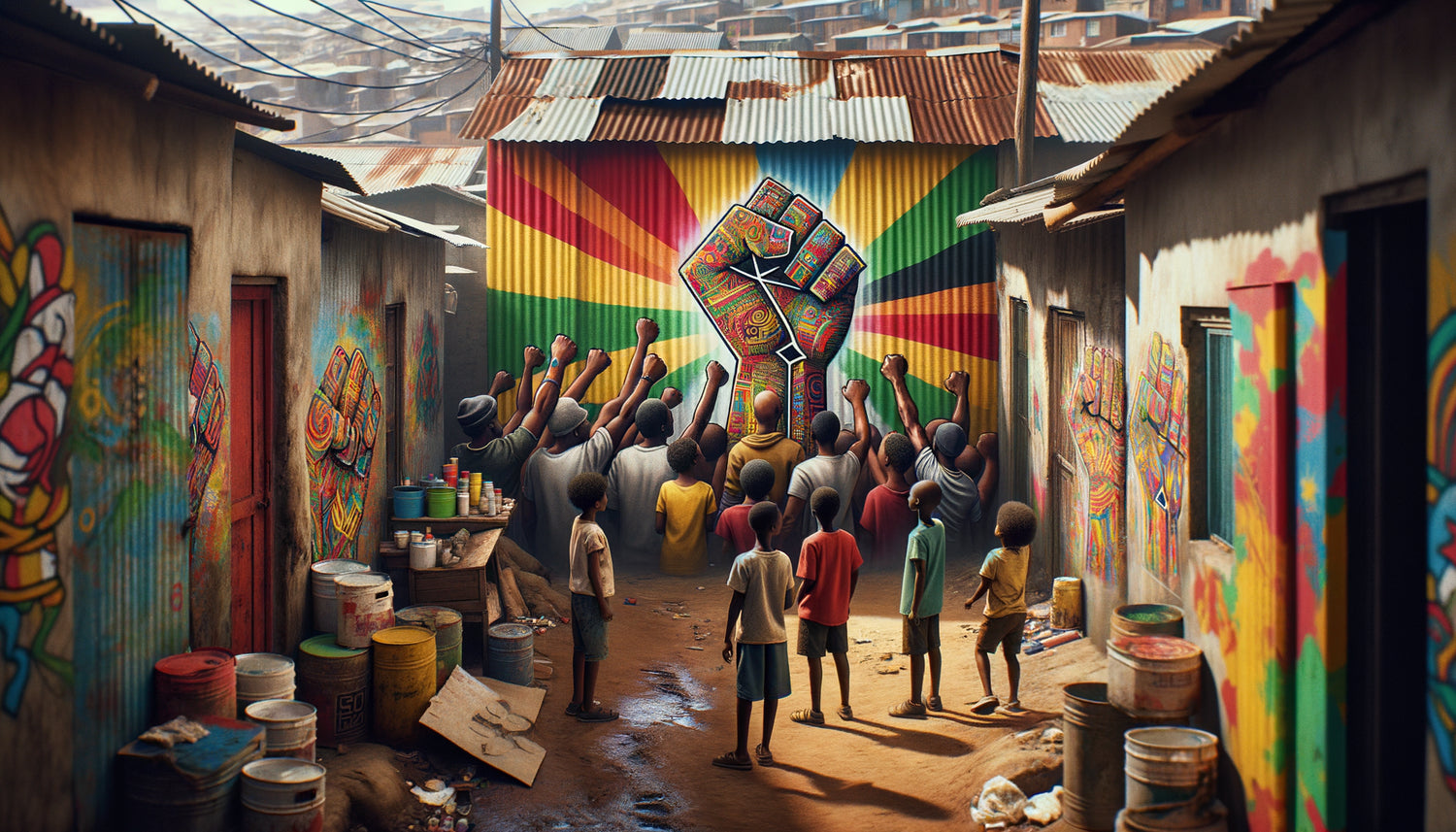
What struck me most about Nairobi slum wall art is its sophisticated visual language. Artists develop a symbolic vocabulary that residents instantly decode. The lion represents collective strength, broken chains symbolize social emancipation, and raised hands evoke community solidarity.
The colors themselves carry political meanings. The green, red, and black of the Pan-African flag appears frequently, anchoring these works in a continental political consciousness. I observed how artists integrate traditional Kikuyu, Luo, or Kamba motifs into resolutely contemporary compositions, creating a hybrid aesthetic that claims both cultural heritage and urban modernity.
In the Dandora district, a monumental mural depicts young people wearing gas masks facing the toxic dump that poisons their daily lives. The visual irony is striking: these artificially protected bodies contrast with the actual vulnerability of residents. Wall art thus becomes a subtle but relentless weapon of denunciation.
Reappropriating symbols of power
Artists in the slums excel at subversion. I documented several murals where official Kenyan symbols of power are reappropriated with biting irony. Harambee ('let's pull together,' national motto) becomes 'harambee ya wanyonge' ('let's pull together for the oppressed'). Portraits of politicians are repainted with hyena or vulture features.
This visual subversion constitutes a particularly effective form of cultural resistance in a context where direct criticism can be dangerous. Nairobi slum wall art operates in this gray area between authorized expression and provocation, using artistic ambiguity as a protective shield.

Artist-activists serving their community
During my years in the field, I realized that slum wall art cannot be dissociated from its community roots. These artists do not work for galleries or collectors; they create for and with their neighbors. The creation process is often collective, involving public discussions about the subjects to be represented.
I attended a painting session in Mathare where about twenty residents debated the message to convey on a community wall. Women wanted a mural on access to water, young people preferred to address unemployment, and elders wished to pay homage to victims of forced demolitions. The final compromise produced a layered work, integrating these three dimensions into a complex composition.
This co-creation transforms wall art into a democratic process. Artists become facilitators of collective expression, visual translators of community concerns. Bankslave, a collective from Kibera, regularly organizes 'mural dialogues' where residents can propose themes, vote on designs, and participate physically in the creation.
The aestheticization of poverty or the affirmation of dignity?
A question constantly arises in discussions about slum wall art in Nairobi: do these works artificially beautify misery or allow residents to reaffirm their dignity? This tension runs through all my documentary reflection.
Some critics, often external to the communities, accuse these artistic projects of 'aestheticizing poverty' without addressing the underlying causes of injustice. But this reading seems to miss the point. In my conversations with residents, I constantly heard that wall art allows them to control their own narrative.
'Before, people from Nairobi only saw Kibera as a dirty and dangerous place,' explained Mercy, a local tour guide trained by a community arts project. 'Now, thanks to the murals, they also see our creativity, our organization, our beauty. We are not just victims.' This reconfiguration of the external gaze constitutes a major political issue for populations constantly stigmatized.
Beyond tourist 'poverty porn'
It is true that slum wall art now attracts tourists, creating a new economy around 'slum tours'. This touristification raises legitimate ethical questions. I have nevertheless observed that the most respected artistic collectives maintain strict control over these visits, ensuring that financial benefits remain within the community and that tourists leave with a nuanced understanding, not with sensationalist photos.
The best wall art projects in Nairobi integrate this educational dimension. The murals are accompanied by explanatory texts in several languages, creating an 'open-air museum' which educates as much as it impresses. Art thus becomes a tool for cultural mediation between slum residents and the rest of Kenyan society.

Recurring Themes: A Striking Social Portrait
After hundreds of hours spent documenting the wall art of Nairobi’s slums, I have identified several dominant themes that draw a portrait social of remarkable consistency.
Criticism of economic neo-colonialism appears frequently, with murals denouncing the appropriation of land by multinational corporations or national debt. In Korogocho, I photographed a masterful work showing a Kenyan child pulling a cart filled with natural resources towards Western skyscrapers.
The emancipation of women is another central theme. Portraits of strong, educated, entrepreneurial women abound, contrasting with dominant patriarchal representations. In Mukuru, a series of murals celebrates the 'mama mbogas' (vegetable sellers) as pillars of the informal economy.
Police violence is denounced with rare frankness in public Kenyan space. Raised hands facing uniforms, bodies on the ground, slogans like 'Uhai Sio Bei' ('life has no price') transform walls into memorials for victims of extrajudicial killings.
Hope and resilience form the necessary counterpoint to these denunciations. Murals show children playing football, musicians, students, entrepreneurs, affirming that life in the slums is not just about survival but also includes joy, creativity, ambition.
International Influence and Artistic Exchanges
The wall art of Nairobi’s slums now belongs to a global network of urban artistic practices. I have observed fascinating cross-influences: the New York graffiti style meets Mexican mural techniques, while the Afrofuturist aesthetic of South African artists inspires young Kenyan creators.
Several international projects have facilitated these exchanges. The Nubian Mwalimu Tour organizes residencies where artists from different countries come to paint alongside local muralists. These collaborations enrich the visual vocabulary without diluting the local roots of the works.
What fascinates me is that wall art from Nairobi also exports its own aesthetic codes. Artists trained in Kibera are invited to Berlin, London or São Paulo, where they bring their particular approach to engaged art. This bidirectional circulation contradicts the traditional North-South influence scheme.
African art transforms spaces and elevates awareness
Discover our exclusive collection of African paintings that capture this creative energy and social commitment, to transform your interior into a space of reflection and inspiration.
Towards institutional recognition?
The question of the institutional legitimization of Nairobi slum wall art raises passionate debates. Some artists aspire to recognition from galleries and museums, while others fiercely claim their status as outsiders.
The Nairobi National Museum recently organized an exhibition on slum urban art, provoking mixed reactions. For some, it was a necessary validation; for others, a recovery by cultural elites of an art born precisely against these institutions.
My position, after years of observation, is that wall art can coexist in multiple spaces without losing its authenticity. A mural can remain in the slum where it belongs while being documented, studied, and celebrated elsewhere. The important thing is that artists control this process and benefit financially from it.
The challenges of preservation
A major problem emerges: how to preserve slum wall art in environments constantly threatened with demolition? I have seen magnificent murals disappear overnight, swept away by government bulldozers during urban sanitation operations.
Several initiatives are attempting to systematically document these ephemeral works. Photographers, researchers, and digital archivists are creating databases so that these visual testimonies survive their physical support. But this solution raises a philosophical question: does wall art torn from its context retain its meaning?
Imagine in a few years, when you drive through Nairobi, slowing down voluntarily to contemplate these walls that tell stories. You will no longer see slums, but open-air galleries where each work dialogues with your own understanding of social justice. You will understand that Nairobi slum wall art does not beautify poverty: it denounces it, documents it, transforms it into political force.
Start by learning about ethical guided tours in Kibera or Mathare, organized by the residents themselves. Or support local artists' collectives by purchasing their prints and reproductions. Every gesture counts to amplify these voices that refuse to be silenced.
The Nairobi Slum Wall Art reminds us of a fundamental truth: human creativity emerges everywhere, especially where it is least expected. These painted walls are much more than decorative art; they constitute the visual archives of a struggle for dignity, justice and recognition. Contemplating them, we are not engaging in compassionate tourism: we are witnessing one of the most powerful and authentic artistic movements of our time.
FAQ: Understanding the Nairobi Slum Wall Art
Can one visit the Nairobi slums to see the wall art safely?
Yes, absolutely, provided certain ethical and practical rules are respected. Several community organizations such as Kibera Tours or Mathare Community Arts organize guided tours by trained locals. These tours guarantee your safety while ensuring that money benefits communities directly. I strongly recommend not visiting alone without a local guide, not only for safety reasons but above all out of respect for the inhabitants who are not tourist attractions. Allow 2-3 hours for a complete visit, wear discreet and comfortable clothing, and always ask permission before photographing. These precautions transform the visit into an enriching cultural exchange rather than voyeurism. The best times are in the morning or late afternoon when the light enhances the colors of the murals.
How does the Nairobi slum wall art differ from Western street art?
The fundamental difference lies in the social and political function of art. While Western street art was often born out of a young counterculture seeking to provoke or beautify urban space, the Nairobi slum wall art responds to urgent community needs: documenting injustices, preserving collective memory, claiming dignity in the face of stigmatization. Aesthetically, Kenyan art integrates more African cultural symbols, local languages (Swahili, Sheng) and references to colonial and post-colonial history. The creation process is also different: where a Western artist may paint clandestinely at night, muralists in Nairobi generally work during the day, with the agreement and often the participation of the community. The themes are less conceptual and more directly rooted in daily struggles: access to water, police brutality, forced evictions. Finally, unlike the lucrative market for Western street art with its Banksys and million-dollar auctions, slum wall art remains largely outside traditional commercial circuits, although this is changing gradually with increasing international recognition of these artists.
How can we support artists from Nairobi’s slums from abroad?
Several options are available to you to concretely support these artists without falling into charity. Firstly, buy their works directly: many collectives like Maasai Mbili or Wajukuu Art Project sell prints, canvases and derivative products via their websites or social media pages. Secondly, support organizations that fund community art projects such as Pawa254 or Nafasi Art Space through donations or patronage. Thirdly, disseminate their work on your own platforms while always correctly crediting the artists and providing the context of creation. Fourthly, if you are in the cultural sector, organize or support artist residencies, exhibitions or international exchanges that give visibility to these creators. Absolutely avoid dubious intermediaries who appropriate the work of these artists without fairly remunerating them. Always prefer direct contact or through organizations recognized by the communities themselves. Your financial support, even modest, makes a considerable difference for artists who create in difficult material conditions, and your genuine interest legitimizes their work in an art world that has long ignored them.