The first time I placed my hand on a painted wall in a Dogon village in Mali, I felt a strange vibration. As if these red ochres and geometric symbols carried within them a millennial memory. Later, while studying the rock paintings of the Tassili n'Ajjer, the evidence struck me: these two mural universes, separated by millennia and thousands of kilometers, spoke the same visual language.
Here is what the influence of Saharan rock art brings to sub-Saharan mural traditions: a symbolic continuity that transcends time, pigmentary techniques passed down from generation to generation, and a sacred conception of wall space that transforms each surface into a spiritual portal. This artistic lineage constitutes one of the most fascinating cultural heritages of the African continent.
Perhaps you wonder how to connect your contemporary interior with this ancestral richness without falling into cliché or awkward cultural appropriation. How to honor this historical depth while creating a space that resembles you?
Rest assured: understanding this influence does not require a doctorate in archaeology. It simply takes opening your eyes to the invisible connections that unite the first Saharan artistic expressions with living mural practices today. This knowledge will transform your view of African art and enrich your decorative choices with an authentic dimension.
I propose you a journey through 10,000 years of African wall history, to discover how Sahara artists shaped the aesthetics of sub-Saharan walls.
When the Sahara was green: at the origins of African mural art
10,000 years ago, the Sahara was not the merciless desert we know. It was a verdant savanna traversed by rivers, inhabited by herders who left on the rocky walls one of the most extraordinary open-air galleries in the world. The sites of Tassili n'Ajjer in Algeria, Ennedi in Chad or Aïr in Niger preserve thousands of rock paintings.
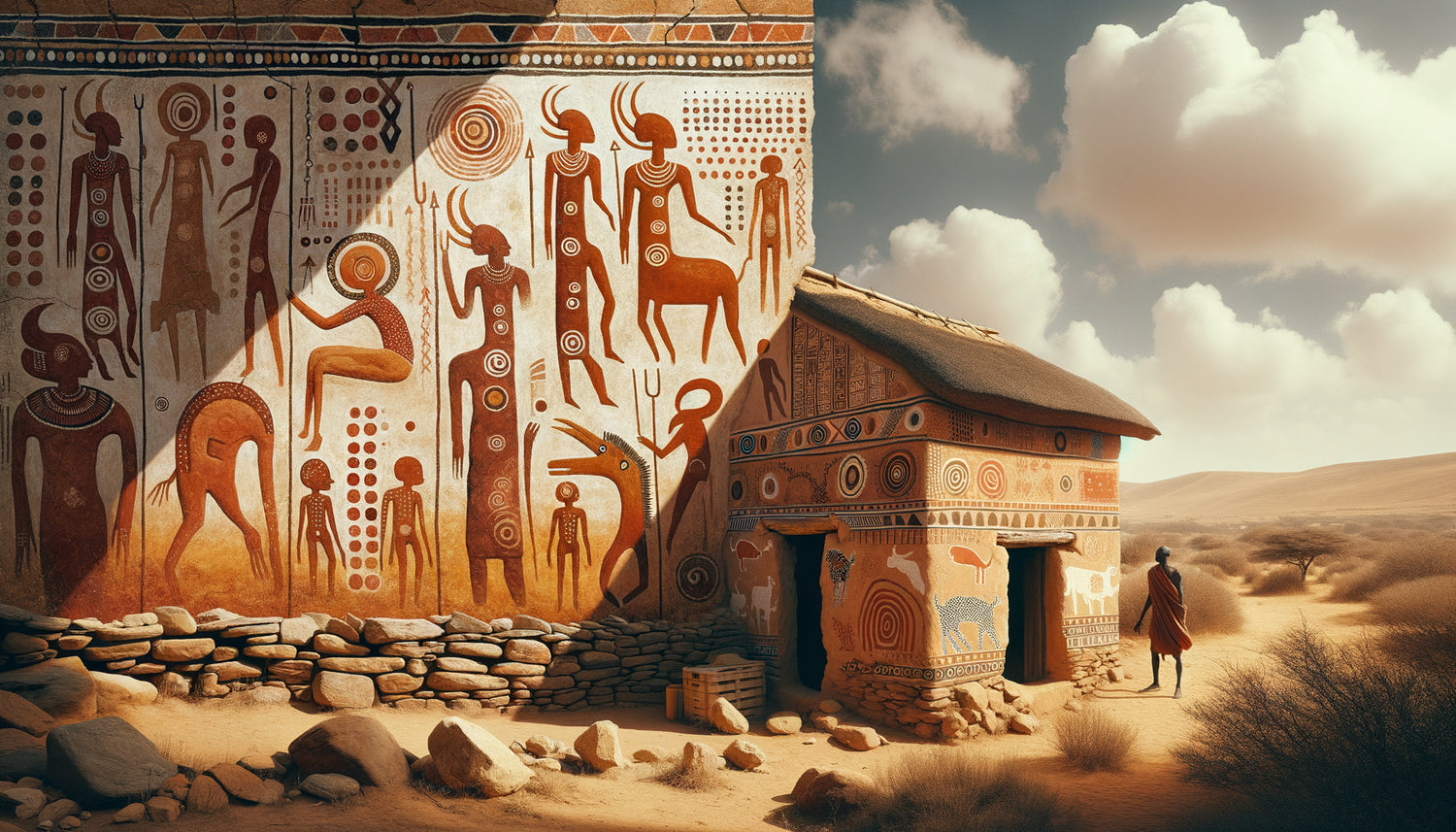
These Saharan rock artists developed a visual repertoire of astonishing richness: hunting scenes, herds of cattle, stylized human figures, geometric motifs. But beyond simple representation, they invented a symbolic language based on repetition, stylization and the ritual use of red ochre, white and black.
When the climate shifted towards aridity about 5,000 years ago, these populations gradually migrated south, carrying with them their techniques, symbols and sacred vision of mural painting. This Saharan diaspora seeded sub-Saharan Africa with an artistic heritage that would germinate in a thousand different ways.
The three fundamental heritages transmitted to the sub-Saharan traditions
Ochre as a sacred pigment
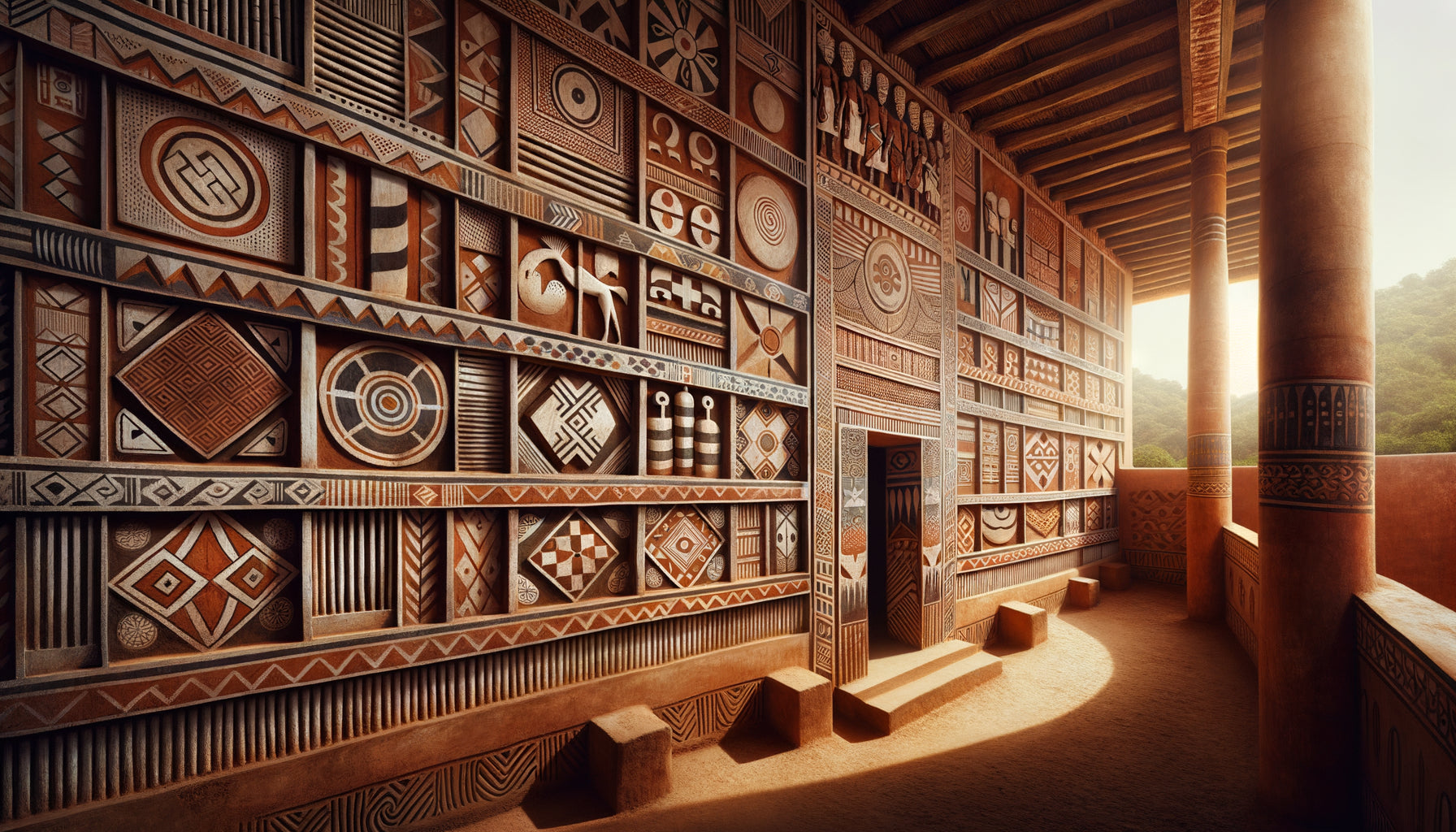
In Saharan rock art, red ochre was not simply a colorant. It was the blood of the earth, carrying life and spiritual power. This design has crossed centuries. Even today, the murals of kassena houses in Burkina Faso or the nankani dwellings in Ghana use this same red earth as the basis of their chromatic palette.
I observed a kassena woman preparing her pigments according to a precise ritual: extracting red clay from a specific location, letting it dry in the sun, grinding it finely, then mixing it with natural binders. Each gesture repeated knowledge passed down from the painters of the Neolithic Sahara, creating this pigment continuity that unites rock art and contemporary mural traditions.
Geometry as a universal language
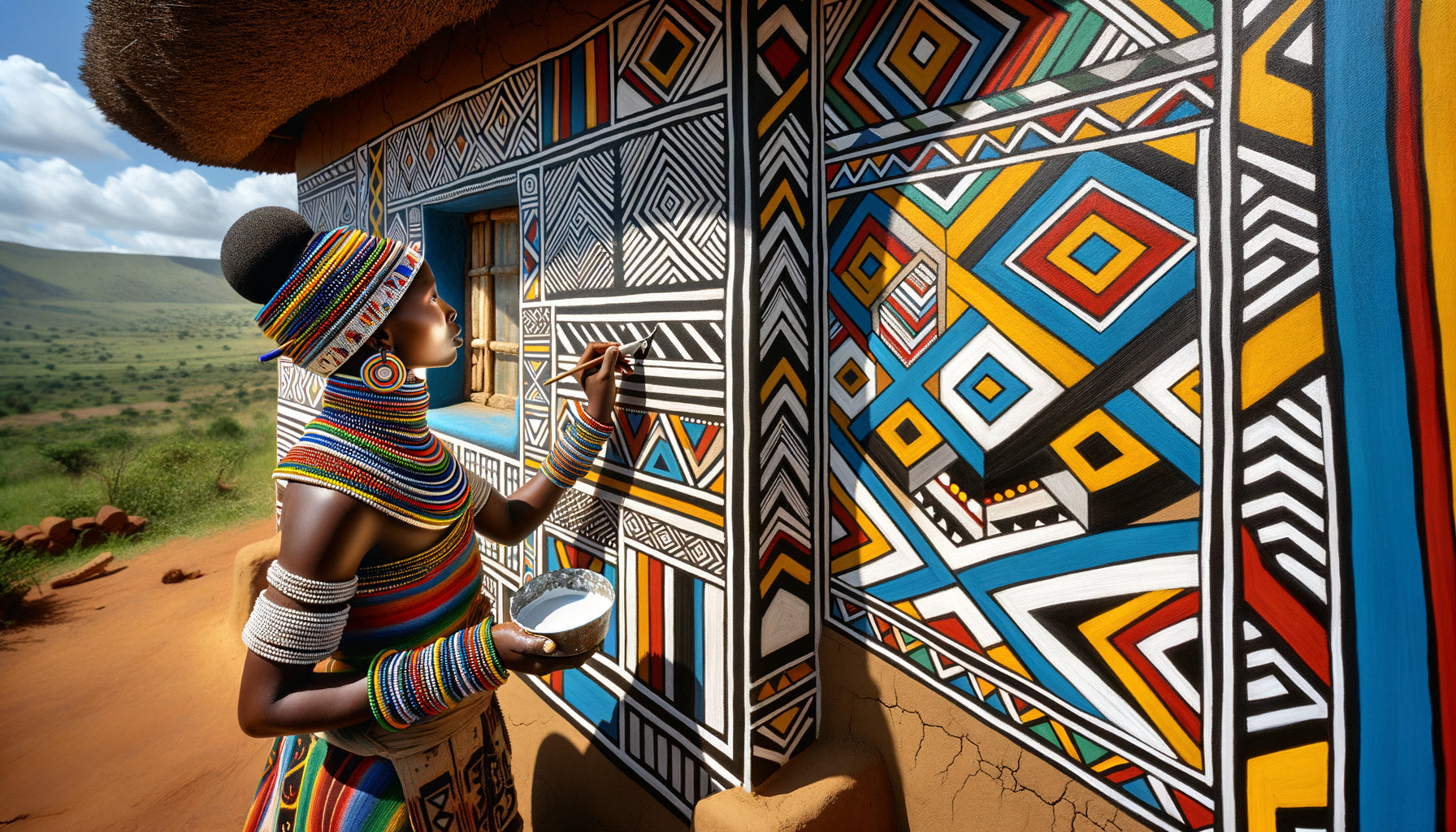
Observe the rock paintings of the Sahara: you will discover spirals, chevrons, checkerboards, undulating lines. These same geometric motifs now adorn the walls of ndebele houses in South Africa, the painted facades of tiébélé in Burkina Faso, or the mural decorations of peul and haoussa cultures.
This geometry is not purely decorative. It structures space according to cosmological principles: the circle represents the cycle of life, triangles evoke the sacred mountain or the feminine principle, parallel lines symbolize the long-awaited rain. The influence of Saharan rock art manifests in this symbolic conception of form that transcends pure aesthetics.
The wall as a spiritual interface
In the rock shelters of the Sahara, artists did not choose their surfaces at random. Some walls were considered places of passage between the visible and invisible worlds. This sacralization of space has been perpetuated in sub-Saharan traditions.
The dogon murals specifically adorn sanctuaries and chiefs' houses. The motifs are not mere decorations: they protect, they bless, they communicate with ancestors. This spiritual dimension of mural art, directly inherited from Saharan rock art, explains why these traditions have survived modernization.

From the caves of Tassili to painted houses: mapping an influence
The influence of Saharan rock art on sub-Saharan mural traditions manifests in a fascinating way across different cultural areas. In Mali, the Bandiagara cliffs house both ancient rock paintings and Dogon villages whose granaries and sanctuaries perpetuate an astonishingly similar wall aesthetic.
In Burkina Faso, the Kassena and Gourounsi country has developed one of the most sophisticated mural decoration traditions in Africa. Women repaint their houses every year with complex geometric patterns using natural pigments. The resemblance to some Saharan rock paintings is not coincidental: it testifies to a millennial cultural transmission.
Further south, in Nigeria, the Yoruba osogbo sanctuaries feature murals whose stylization and use of ochre recall the visual conventions of Saharan rock art. In East Africa, the wall paintings of Maasai or Samburu huts also use this ochre-red-white-black palette inherited from the first Saharan artists.
This mapping reveals that the influence has not diluted with distance or time. On the contrary, it has diversified, each culture adapting the Saharan heritage to its own symbolic universe, creating an extraordinary visual polyphony.
Shared techniques: from the Saharan Neolithic to today
What amazes me most about this artistic lineage is the continuity of techniques. Rock artists in the Sahara already used the stencil technique: they placed their hand on the wall and blew pigment around it, creating these moving negative hands. This same technique can be found in some West African mural traditions.
The grinding of mineral pigments still follows the same principles as it did 8,000 years ago: extraction of colored earths, calcination to modify shades, addition of organic binders such as gum arabic, egg or vegetable resins. The Kassena women who prepare their paints perpetuate, without knowing it, a Neolithic know-how.
The use of plant tools to apply color is another point of continuity: feathers, plant fibers, chewed sticks. In the villages of Burkina Faso, I saw mural artists using guinea fowl feathers exactly as painters in the Tassili probably used ostrich feathers.
This technical persistence is not conservatism. It is the recognition of a millennial effectiveness: these methods produce paintings that resist the weather, breathe with clay walls, age with dignity.

Why this influence resonates in our contemporary interiors
You might think that this millennia-old story has nothing to do with your modern living room. A profound mistake. The influence of Saharan rock art on sub-Saharan mural traditions now offers us an authentic visual vocabulary to create spaces with depth.
When you choose a work inspired by these African mural traditions, you are not simply hanging a decorative object. You invite into your space a lineage of aesthetics 10,000 years old, a conception of the wall as a living and symbolic surface, a color palette rooted in the very soil of the African continent.
The most daring contemporary designers draw inspiration from this influence. They reinterpret the geometric patterns inherited from Saharan rock art, they use textures that evoke clay plasters, they create mural compositions that dialogue with this heritage without servilely copying it.
In a world saturated with ephemeral visual references, these traditions rooted in the depth of time offer a radical alternative: decoration as spiritual and historical connection, the wall as a place of memory and beauty.
Transform your walls into a tribute to 10,000 years of African art
Discover our exclusive collection of African paintings that celebrate this millennial aesthetic lineage and bring depth and authenticity to your interior.
How to integrate this heritage into your decor
Consciously integrating the influence of Saharan rock art into your decor begins with a choice of palette. Favor red ochres, sienna earths, creamy whites, deep blacks. These are not “trendy” colors: they are the fundamental pigments of African mural art since the Neolithic.
Next, look for works that use symbolic geometry rather than figurative representation. Spirals, interlocking triangles, checkerboards, chevrons are not just shapes: they carry a symbolic charge inherited from rock and mural traditions.
Think of your walls as active surfaces rather than simple supports. In African design, inherited from Saharan rock art, the wall dialogues with space, structures energy, and tells a story. A strong, even contemporary, wall composition can carry this intention.
Ultimately, prioritize works that demonstrate a respect for heritage. The best contemporary creations inspired by this influence do not copy: they converse with tradition, reinterpret it, and create a bridge between Saharan rock art, sub-Saharan mural traditions, and our current sensibilities.
A living memory awaits you
The influence of Saharan rock art on the mural traditions of sub-Saharan Africa is not an archaeological curiosity. It's a millennial conversation that continues today, in villages where women repaint their houses each season, in artists’ workshops reinventing these legacies, and potentially on your own walls.
Imagine your living room transformed by a work carrying this temporal depth. Each morning, while enjoying your coffee, you would contemplate not just decoration, but a fragment of the oldest human history. Your guests would feel this particular presence, this light gravity conferred by objects connected to something greater than themselves.
This transformation does not require great means, only a conscious intention: that of choosing works with a story, which are part of a lineage, which honor human creativity over time. African wall art, enriched by 10,000 years of evolution since the first artists of the Sahara, offers you this rare possibility.
Start modestly: one well-chosen work, placed where your gaze naturally rests. Let it deploy its presence. Observe how it subtly changes the energy of your space. Then, gradually, build your own dialogue with this millennial tradition.
Frequently asked questions about the influence of Saharan rock art
How can you be sure that a contemporary work is truly inspired by this tradition?
Excellent question which demonstrates a desire for authenticity. Look for several visual clues: the use of the characteristic ocher-red-white-black palette, the presence of symbolic geometric patterns rather than purely decorative ones, a composition that structures space rather than simply adorns it. Serious artists working in this lineage can generally explain their references and approach. Don’t hesitate to ask questions: the story behind the work is an integral part of its value. A creation authentically inspired by the influence of Saharan rock art on sub-Saharan mural traditions always carries a cultural intention, not just aesthetic.
Can I mix these African references with my modern Scandinavian furniture?
Absolutely, and the result can be magnificent! The influence of Saharan rock art shares several fundamental values with Scandinavian aesthetics: the simplicity of forms, the use of natural materials, an earthy color palette. The ochres and earth tones of African wall art blend wonderfully with the light woods and neutral tones of Nordic design. The contrast between the symbolic warmth of African art and the functional sobriety of Scandinavian style creates a stimulating visual tension. Simply avoid overloading: in a minimalist interior, one or two striking pieces inspired by this tradition are enough to create a powerful focal point. African wall art brings the spiritual and historical dimension that is sometimes lacking in overly refined Scandinavian interiors.
Have these mural traditions influenced other arts beyond painting?
Yes, in a fascinating way! The influence of Saharan rock art has spread far beyond walls. It can be found in African textiles: the geometric patterns of kente, bogolan or kuba fabrics often take up compositions similar to those of cave and mural paintings. Pottery also presents these legacies, with incised or painted decorations that dialogue with the wall repertoire. Even body scarification and traditional tattooing sometimes use related geometric motifs. Masks and sculptures also bear traces of this influence in their stylization and use of pigments. This diffusion is a testament to the founding power of Saharan rock art: it did not only create a mural tradition, it shaped a visual grammar that irrigates all sub-Saharan African aesthetics.