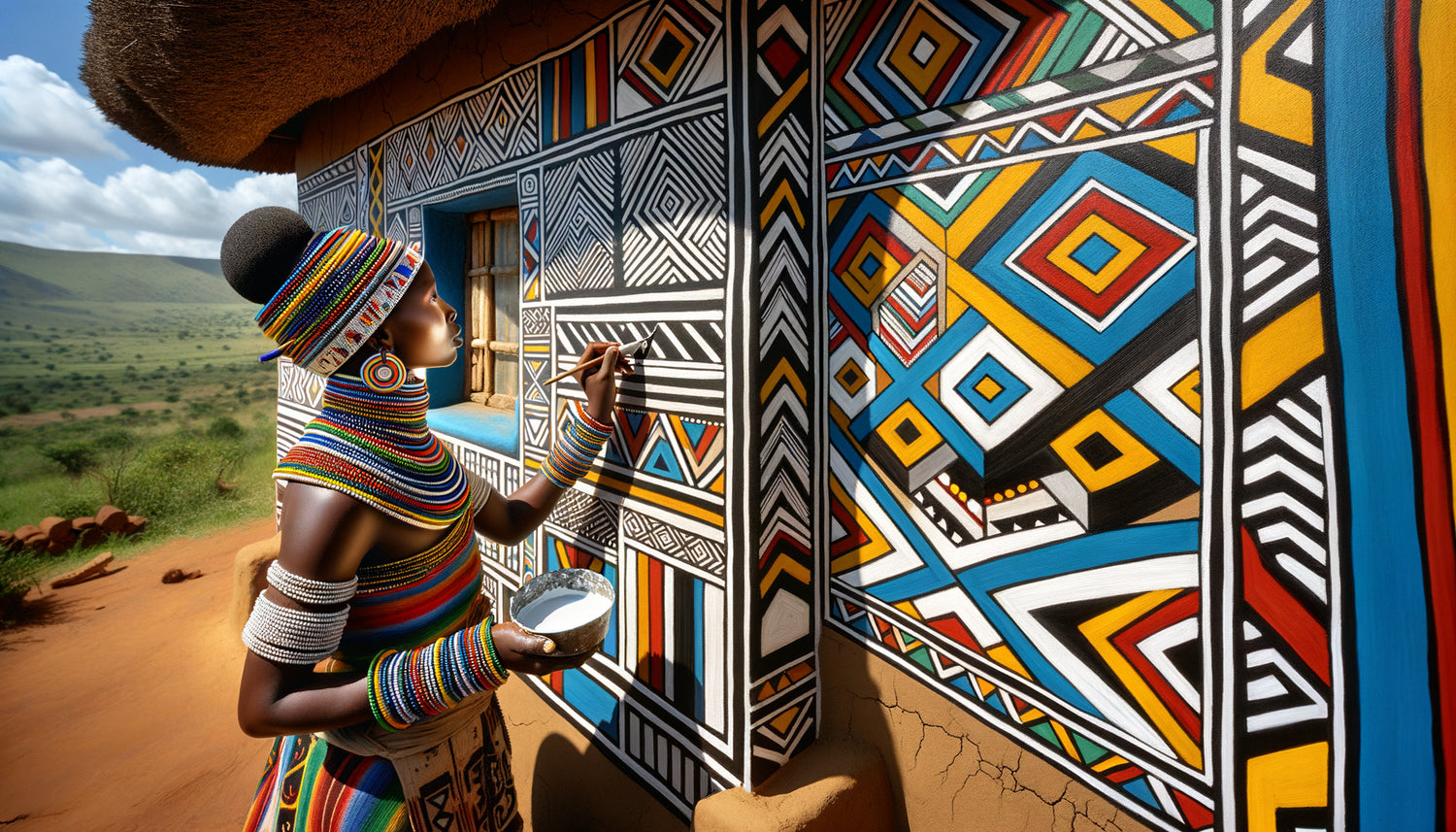
When I first unpacked my bags in a Ndebele community, I was literally dazzled by these vibrant facades of geometric colors. But it wasn't until weeks of observation and exchange that I understood: these patterns were not mere decorations. Each line, each color, each shape told an intimate story - a marriage, a birth, a mourning, a social status. These women, armed with their pigments and ancestral knowledge, transform walls into veritable pages of a living journal. In a world obsessed with social networks, they have been practicing for centuries the art of communicating visually with their community, creating a pictorial language of fascinating sophistication.
Here's what Ndebele murals teach us: the art of conveying complex messages without words, the ability to create a unique collective visual identity, and the power to transform everyday architecture into a cultural manifesto. These creations are not frozen in time - they evolve, reinvent themselves, while preserving their communicative essence.
Yet, faced with these spectacular facades, many stop at pure aesthetics. They admire the bright colors, photograph the symmetrical patterns, but miss the essential: the secret code hidden behind each stroke. It's like looking at a text in Chinese without knowing the characters - beautiful, but incomprehensible.
Rest assured: this visual language, however complex it may be, obeys principles that we can decipher. And once you have grasped the keys to this wall communication, you will never look at decorative art the same way again. You will discover how architecture becomes narration, how color becomes message, and how each house tells its story to those who know how to read it.
Walls that speak: understanding the Ndebele visual language
Ndebele women do not paint to decorate - they write on walls. This distinction is fundamental. Each mural follows a precise system of coding, passed down from mother to daughter for generations. Geometric patterns - triangles, diamonds, chevrons, rectangles - constitute a visual alphabet where each shape has its own meaning.
Triangles pointing upwards evoke masculinity, protection, the sacred mountain. Rounded shapes refer to femininity, fertility, the cycle of life. Horizontal lines symbolize earth, stability, while verticals represent growth, spiritual aspiration. The arrangement of these shapes creates visual sentences that the entire community can decipher.
Let's take a concrete example: when a young girl reaches marriageable age, her mother repaints the facade of the house with specific patterns including stepped shapes and particular horizontal bands. This visual code announces to the whole community that the family has a daughter to marry, without a single word being spoken. It is a public communication, but elegant and respectful of social codes.
The color palette as a social marker
Colors in Ndebele murals are never chosen at random. Historically limited to natural pigments—ochres, earths, kaolin whites—the palette was enriched in the 20th century with the arrival of industrial paints. But this technological evolution has not diluted the coding system: it has amplified it.
Deep blue, traditionally rare and precious, signals a high family status. Bright red evokes strength, courage, sometimes blood shed during rites of passage. White represents purity, spirituality, ancestors. Black defines, structures, gives weight to messages. Women Ndebele orchestrate these colors like a composer arranges his notes, creating visually harmonious compositions full of meaning.
A facade dominated by white and sky blue will announce a spiritual or religious celebration. Vigorous red and black motifs can signal that a young man has completed the initiation rites. The combinations are endless, and each region, each clan possesses its dialectal nuances in this chromatic language.
The cycles of life inscribed in matter
One of the most fascinating aspects of Ndebele murals is their ephemeral and cyclical nature. In contrast to Western art, which seeks permanence, these creations are intended to be regularly erased and repainted. This impermanence is not a weakness—it is at the heart of the communication system.
Each major event—birth, marriage, death, social promotion—justifies a new painting. The house becomes a living palimpsest, where each layer tells a stage in the family's history. Neighbors, by observing the changes, remain informed about the life of the household without direct intrusion. It is a form of chosen social transparency, controlled by women who decide what they reveal or conceal.
I observed a grandmother teaching her granddaughter the art of coding a mourning message into the mural painting. The motifs became more subdued, the colors more muted, some sections were deliberately left unfinished—symbolizing interrupted life. This transmission of knowledge does not pass through manuals: it is learned by observation, practice, and the kind correction of elders.
Motifs of pride and identity affirmation
During apartheid, when Ndebele culture was repressed, mural paintings became an act of cultural resistance. Women intensified their creations, making the motifs more daring, the colors more vibrant. They coded not only family events in their paintings but also their rejection of assimilation, their attachment to their identity.
Geometric patterns have become more complex, sometimes subtly incorporating references to modernity - shapes reminiscent of light bulbs, windows, fences - while retaining the traditional vocabulary. This ability of the Ndebele visual language to adapt demonstrates its vitality: it is not fossilized in the past, but evolves to express contemporary realities.
Today, some Ndebele artists encode messages in their murals about girls' education, women's rights, and environmental preservation. The communication system has expanded, but the fundamental principles remain: use geometry and color to convey values, tell stories, affirm an identity.

Architecture as a narrative support
Ndebele women do not paint anywhere on the facade. The position of the patterns on the wall is an integral part of the message. Sections near the main entrance tell the information that the family wants to share with visitors and passers-by. More peripheral areas, on the sides or at the back, contain more intimate messages intended for loved ones.
The height of the patterns also counts. Eye-level paintings are the most communicative, those that directly address you. Motifs near the roof often evoke a spiritual dimension, a connection with ancestors. Those near the ground can represent foundations, stability, family roots. Each square centimeter of wall thus becomes a potential semantic space.
I was struck by how a simple border around a door could announce a change in social status. A young woman returning with a university degree will see her house adorned with specific patterns celebrating education - often shapes rising upwards, stylized books integrated into traditional geometric motifs. The community thus honors its members who progress.
The threatened transmission of ancestral knowledge
Despite the growing recognition of this art - some Ndebele creations now adorn international museums - the traditional coding system faces major challenges. Urbanization is distancing younger generations from villages where this art is practiced. Modern houses, with their industrial materials, are no longer as naturally suited to these murals.
Yet, remarkable initiatives are emerging. Intergenerational workshops bring grandmothers and granddaughters together to document the meanings of each motif, create visual lexicons. Contemporary artists adapt the Ndebele language to new supports - fabrics, ceramics, installations - while preserving the logic of codification.
What fascinates me particularly is the ability of this system to reinvent itself. South African designers collaborate with Ndebele artists to create collections that respect traditional codes while speaking to an international audience. Ndebele murals now inspire contemporary architecture, graphic design, fashion - proving that this visual language transcends cultural boundaries.
Transform your interior into a narrative space
Discover our exclusive collection of African artworks that capture the essence of ancestral visual traditions and infuse your decor with authentic cultural depth.

Decipher to better appreciate
Understanding the coding system of Ndebele murals radically changes our relationship with decorative art. It reminds us that any visual creation can carry multiple meanings, that aesthetics and communication do not oppose each other but enrich each other.
For the contemporary designer or decorator, this tradition offers valuable lessons. It demonstrates how seemingly simple elements - geometric shapes, limited palette - can generate an infinite narrative complexity. It proves that repetition and variation create a language, that color can structure a discourse, that architectural space is a natural medium for telling stories.
Ndebele women also teach us patience. Creating a complete mural takes weeks. Each stroke must be precise, each color applied with care. This intentional slowness contrasts with our era of rapid production and planned obsolescence. They remind us that messages that really matter deserve time, attention, care.
Inspiration for our interiors
You don't need to live in South Africa to be inspired by this approach. The idea of encoding personal messages into your interior decoration can take a thousand forms. A specific color palette for each room, reflecting its use and atmosphere. Geometric patterns that tell the story of your family. Objects arranged according to a narrative logic rather than purely aesthetic.
I often encourage my clients to think of their interiors as a visual communication space, not just a functional or beautiful place. What do your walls say about you? What messages do you send to your guests? How does your decoration evolve with the stages of your life? These questions, at the heart of Ndebele practice, can transform our relationship with our habitat.
Integrating elements inspired by Ndebele murals - geometric textiles, colorful artworks, patterned wallpapers - not only brings a strong aesthetic dimension but also cultural and narrative depth. Each room becomes an opportunity to tell a story, celebrate an identity, affirm values.
When wall art becomes a statement
Watching a Ndebele artist repaint the facade of her house after her son's wedding, I understood something fundamental: these women are not just artists or decorators. They are keepers of collective memory, communicators, historians. Each mural is a social document, an act of pride, a bridge between past and future.
The coding system they master represents centuries of observation, refinement, transmission. It has survived colonization, apartheid, forced modernization. It survives today by adapting, dialoguing with the contemporary world, inspiring new generations of artists and designers.
What makes these murals so powerful is that they are never univocal. The same motif can be read differently depending on the observer, their age, their position in the community. This multiplicity of readings enriches the message rather than diluting it. It's a lesson in humility for us Western creators often obsessed with absolute control of meaning.
Imagine your space transformed into a narrative gallery, where every element contributes to telling your unique story. Imagine welcoming your guests into an interior that communicates your values, celebrates your journey, honors your roots. That's exactly what Ndebele women have been doing for generations - and that's exactly what we can learn from them.
So, the next time you choose a color for a wall, a pattern for a cushion, an arrangement for your objects, ask yourself this question: what message am I encoding? What story am I telling? Because your interior already speaks - give it a voice that truly resembles you.
Frequently Asked Questions about Ndebele Murals
Why do only Ndebele women create these murals?
This exclusively female tradition is rooted in the Ndebele social division of labor, where women are considered the guardians of the home and family identity. Wall paintings are their domain of artistic and social expression, passed down from mother to daughter. It's also a form of power: they control the public image of the family, decide on messages to communicate, and keep alive an ancestral knowledge that confers status and respect upon them. This female exclusivity is not a limitation, but a culturally valued specialization. Men have other areas of artistic expression, such as sculpture or forging. This division allows each gender to develop deep expertise in their field, creating a cultural balance where everyone possesses unique and respected skills.
Can Ndebele motifs be used in decoration without cultural appropriation?
The question is legitimate and deserves a nuanced answer. Appropriation becomes problematic when one appropriates the symbols of a culture without understanding their meaning, without giving credit, and above all, without the original creators benefiting from it. Respectful appreciation, on the other hand, is possible and even encouraged by many Ndebele artists. Prioritize works created by authentic Ndebele artists, fairly compensated. Learn about the meanings of the motifs you choose - some are reserved for specific contexts. Always credit the cultural origin when you talk about them. And above all, consider these elements as masterpieces that deserve respect and context, not just decorative motifs. By purchasing from Ndebele artist cooperatives or ethical galleries, you participate in preserving this tradition while enriching your interior consciously and respectfully.
How are Ndebele wall paintings evolving with modernity?
Far from being frozen in tradition, Ndebele wall paintings demonstrate a remarkable ability to adapt. Contemporary artists integrate new symbols – telephones, cars, modern buildings – while respecting the traditional visual grammar. They use industrial acrylic paints that expand their color palette without abandoning the principles of color coding. Some now create on canvas, ceramics or textiles, making their art portable and commercially viable internationally. Collaborations with designers produce collections of furniture, wallpapers and fabrics inspired by these motifs. This evolution is not a betrayal of tradition, but its natural extension: like any living language, the Ndebele visual vocabulary enriches itself with new words to describe a changing world. The essential remains intact: the ability to communicate complex social messages through geometry and color, creating a bridge between ancestral heritage and contemporary expression.