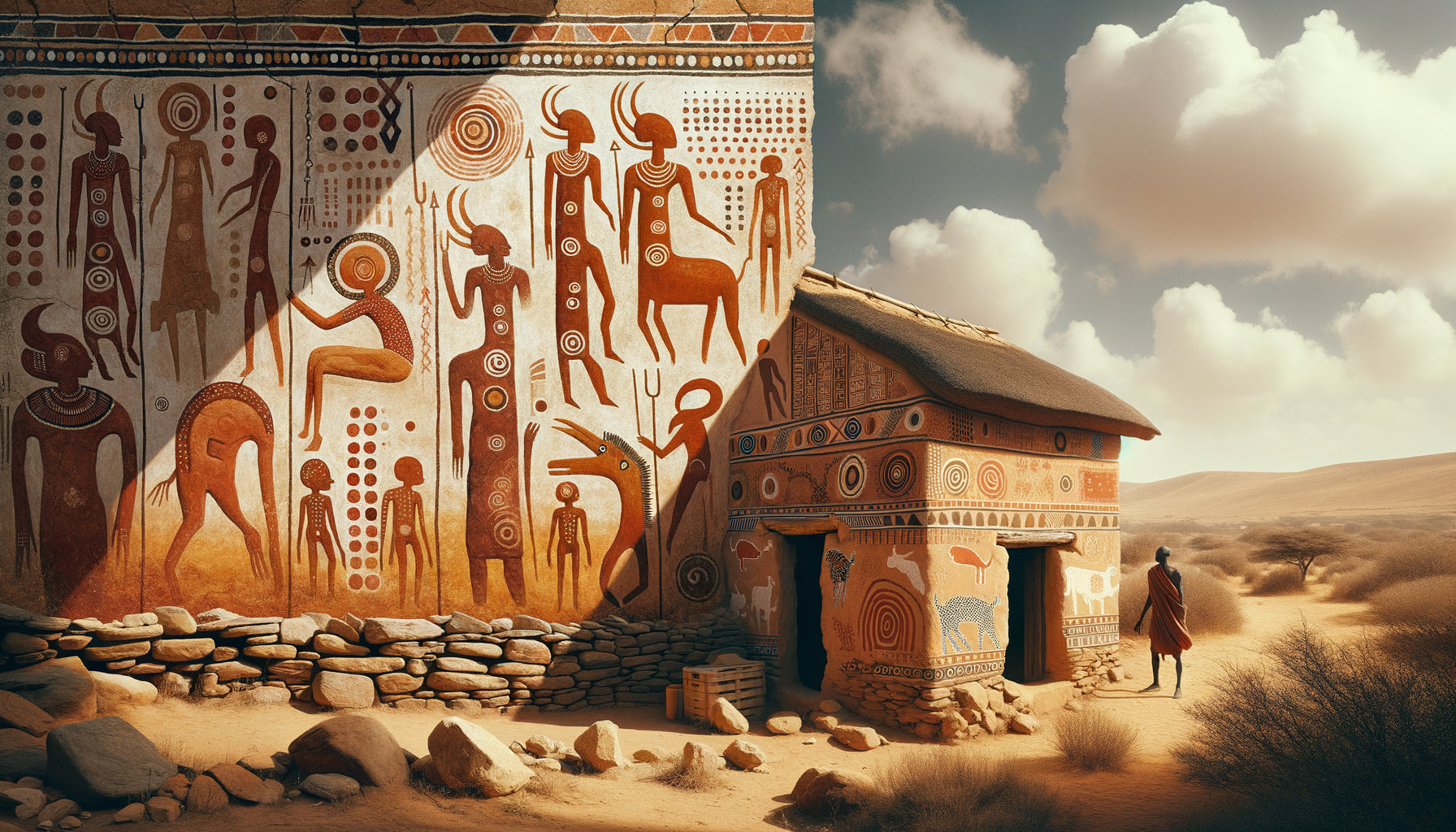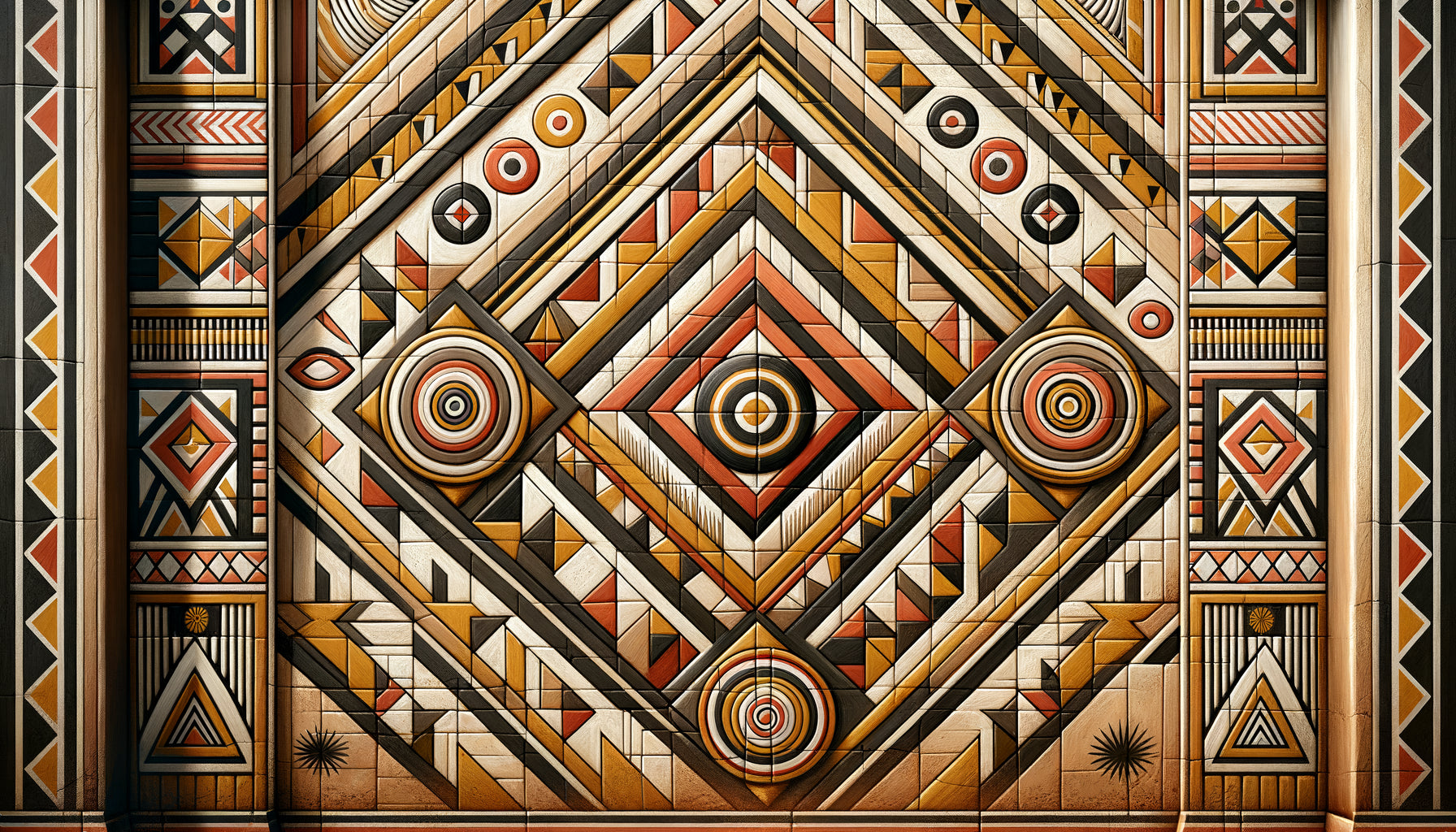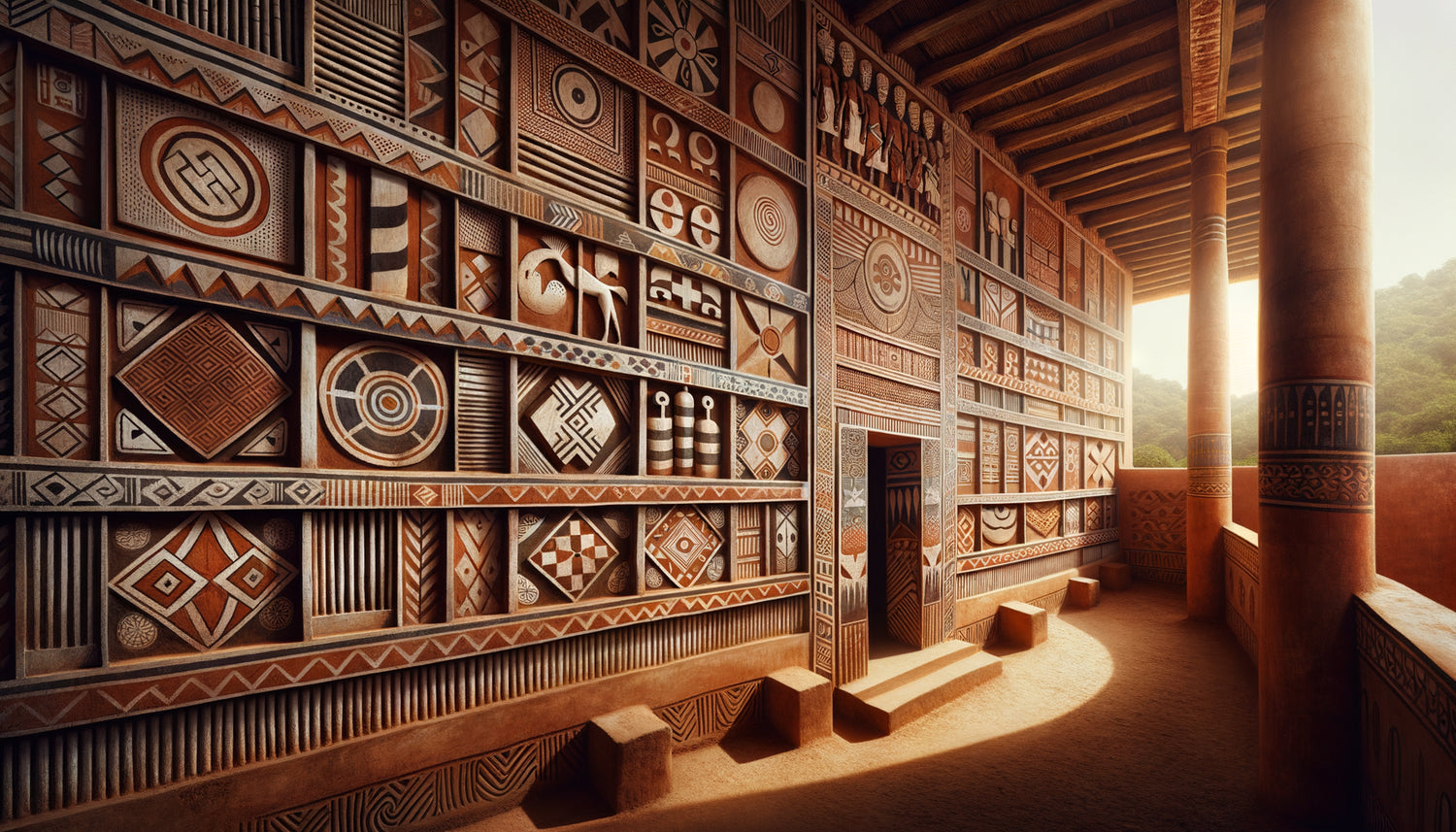
When I first crossed the threshold of a reconstructed Ashanti palace in Kumasi, I was struck by an obvious truth: these walls were not simply telling stories; they asserted a truth. Every symbol painted on the ochre and white facades proclaimed an authority that transcended generations. These murals were not mere decorative ornaments – they constituted the visual language of power, a sophisticated communication system that Ashanti kings had perfected over centuries to establish their divine and political legitimacy.
Here's what these murals brought to Ashanti rulers: they visually materialized their connection to the spiritual world, transforming palaces into living sanctuaries; they documented royal exploits, creating a permanent and undeniable chronicle of their grandeur; and they educated the people, transmitting the values and history of the dynasty to every visitor who looked up at these speaking walls.
Today, our fascination with African wall art often clashes with a fundamental misunderstanding. We admire the aesthetics without grasping the profound political function of these creations. These Ashanti paintings were not intended to beautify – they existed to legitimize, intimidate and educate. Without this understanding, we miss one of the most brilliant manifestations of African political genius.
Rest assured: decoding this symbolic language does not require years of study in anthropology. The principles underlying these murals reveal surprisingly modern visual communication strategies. Let's discover together how Ashanti rulers transformed their palaces into architectural manifestos of absolute power.
Sacred architecture: when walls become altars
Ashanti palaces – called ahemfie – were never simply residences. Their very design reflected a cosmology of power where every architectural element served a political and spiritual purpose. Murals fit into this overall logic, transforming facades into interfaces between the visible and invisible worlds.
The geometric motifs that adorned the walls of the inner courtyards followed strict rules. The colors – mainly red ochre, kaolin white and charcoal black – were never chosen at random. Red evoked the blood of ancestors and sacred earth, white symbolized spiritual purity and contact with deities, while black represented maturity and ancestral wisdom.
Each courtyard of the Ashanti palace received a specific pictorial treatment according to its function. Public spaces, where the king dispensed justice, displayed symbols of strength and authority: stylized leopards, crossed swords, representations of the sika dwa kofi (the sacred golden stool). These images constantly reminded visitors that they were standing before a power both earthly and celestial.
Adinkra symbols: an alphabet of power
Adinkra symbols occupied a central place in these murals. Contrary to popular belief, these motifs were not uniformly used throughout the Akan kingdom. Some symbols were strictly reserved for royalty, and reproducing them without authorization constituted a serious crime.
The gye nyame (supremacy of God) frequently appeared on the walls of the king's private chambers, reminding that even the sovereign answered to a higher authority. This demonstration of divine humility paradoxically strengthened his power: by positioning himself as the intermediary chosen by the gods, the Akan king consolidated his legitimacy.
The mural chronicle: painting history to control memory
The murals in the Akan palaces functioned as official visual archives. In a society with primarily oral traditions, these frescoes constituted the written – or rather painted – history of the kingdom, a permanent and controlled version of major events.
Military victories occupied a prominent place. Akan artists developed a sophisticated narrative style to represent battles: pictorial sequences that read from left to right, showing the progress of a military campaign. Defeated enemies were represented smaller, in postures of submission, while the Akan king reigned in the center, disproportionately large.
This visual manipulation of scale was not naive – it constituted a deliberate political strategy. When visiting the palace, vassals, ambassadors and subjects subconsciously integrated this hierarchy. The murals created what we would now call a visual narrative, a story told by the victors and etched in lime.
Genealogical portraits: legitimacy by blood
The walls of the audience halls often presented stylized representations of the king's predecessors. These portraits were not realistic in the Western sense – they followed Akan symbolic conventions where certain attributes (the size of the stool, the complexity of the headdress, the number of servants represented) indicated the status and achievements of each sovereign.
By displaying this mural genealogy, the current king inscribed himself in an undeniable dynastic continuity. This visual strategy responded to a crucial political need: in a system where power was transmitted along a matrilineal line (from the maternal uncle to the nephew), proving his legitimate lineage was essential to avoid challenges.

Symbols of prosperity: painting abundance to manifest it
Akan mural paintings did not only glorify military strength – they also celebrated economic prosperity as proof of good governance. Motifs representing kola nuts, gold weights, cowrie shells and precious fabrics adorned the walls of commercial areas within the palace.
This iconography of abundance served a specific purpose: to demonstrate that the king's reign brought wealth and stability. In Akan thought, a good sovereign maintained cosmic harmony, which manifested in fertile lands and successful commerce. The mural paintings therefore functioned as visual proof of this harmony.
Markets held near the palaces allowed merchants to glimpse these frescoes. The psychological effect was calculated: by visually associating the king with symbols of wealth, a mental connection between royal authority and collective prosperity was created. To challenge the king was to risk disrupting this beneficial balance.
When walls teach: the educational function of paintings
Beyond political propaganda, Akan mural paintings fulfilled a fundamental educational mission. In outdoor courtyards accessible to the public, frescoes illustrated Akan proverbs – this collective wisdom that structured social life.
A popular Akan proverb says: 'Se wo were fi na wosan kofa a yenkyiri' (It is not shameful to return and get what you forgot). This concept was often represented by the sankofa bird, turning its head backward, a recurring motif on palace walls. By displaying these moral lessons, the king positioned himself as guardian of ancestral wisdom.
Children accompanying their parents to the palace grew up contemplating these images. The mural paintings functioned as an invisible curriculum, transmitting Akan values from generation to generation. This visual education reinforced social cohesion while normalizing the established political order.
Ritual scenes: documenting the sacred
Some mural paintings depicted religious ceremonies and royal rituals – the Adae (ancestor worship), the Odwira (purification festival), or the coronation itself. These images served several simultaneous objectives.
Initially, they documented the correct ritual procedure, creating a visual reference for future generations. Then, they reminded the people of the king’s ceremonial obligations – responsibilities that justified his privileges. Finally, by showing the king in these sacred contexts, the frescoes reinforced his dimension as a priest-king, an indispensable intermediary between the people and their ancestors.

The maintenance of paintings: an annual political ritual
A fascinating aspect of these murals lies in their intentional ephemerality. Natural pigments and the lime painting technique meant that the frescoes deteriorated with tropical rains. Far from being a flaw, this impermanence served a subtle political purpose.
Each year, before the major ceremonies, the akan palace was completely repainted. This ritual renewal achieved several things: updating the visual chronicles by adding the king’s new exploits, mobilizing the community in a project reinforcing unity, and demonstrating the king's ability to mobilize necessary resources.
The specialized artists who created these paintings formed a privileged corporation serving exclusively at court. Their expertise was passed down from master to apprentice, creating artistic lineages sometimes as prestigious as noble lineages. This professionalization of royal mural art guaranteed the quality and symbolic coherence of the frescoes.
Transform your interior with the power of akan symbols
Discover our exclusive collection of African paintings that capture the essence of this millennial artistic tradition and bring to your spaces the cultural depth of great African civilizations.
The visual heritage: what these walls teach us today
The mural paintings of the akan palaces remind us of a truth that our era is rediscovering: visual space is always political. These frescoes show us how a sophisticated society used art not as decoration, but as an infrastructure of power.
Their integrated approach – where aesthetics, spirituality, history and politics inextricably intertwined – contrasts sharply with our modern tendency to compartmentalize these areas. The Akan understood that controlling the image is controlling the collective imagination, and shaping the imagination is governing more effectively than force alone.
This Akan visual wisdom finds surprising echoes in our contemporary world saturated with images. The visual communication strategies developed on these palace walls – symbolic repetition, hierarchy of scales, visual narratives, association of images – constitute the basic vocabulary of all modern political communication.
When contemplating these Akan murals, we are not simply looking at the past – we are observing the universal foundations of visual power, principles that continue to operate in our own environments, whether physical or digital. The difference? The Akan made explicit what our societies prefer to keep implicit.
Imagine tomorrow morning, entering your living space, and looking up at a wall that tells not the story of a distant king, but your own narrative, your values, your heritage. That is exactly what these Akan paintings did: they transformed architecture into collective autobiography. What stories do your walls tell about you? What symbols would you choose to legitimize your own existence? These questions are not anecdotal – they touch on our fundamental need to anchor our identity in the space we inhabit. Start simply: choose an Akan symbol that resonates with your values, understand its deep meaning, and consciously integrate it into your decor. You will only be imitating a millennial practice of intentional creation of meaningful environments.
Frequently asked questions about Akan murals
Do Akan murals still have an influence today in Ghana?
Absolutely, and more vividly than you might imagine. Although the surviving traditional palaces are fewer in number, the tradition of Akan mural painting is experiencing a remarkable revival in contemporary Ghana. Many public buildings – schools, cultural centers, government buildings – now incorporate frescoes inspired by this historical aesthetic. Adinkra symbols that once adorned exclusively royal walls are now found on the facades of hotels, restaurants and private residences, testifying to a conscious cultural appropriation. This renaissance is not mere nostalgia: it reflects a political will to decolonize the Ghanaian visual space by restoring indigenous forms of expression. Several contemporary Ghanaian artists, such as Ibrahim Mahama or El Anatsui, are directly inspired by this Akan mural tradition in their monumental installations exhibited internationally. The influence therefore endures, transformed and adapted to contemporary issues.
Can we visit akan palaces with their original murals?
Visiting these historical sites is possible, but requires realistic expectations. The Manhyia Palace in Kumasi, residence of the Asantehene (king of the Ashanti people, the main akan ethnic group), offers the most accessible experience. Partially transformed into a museum, it presents faithful reconstructions of traditional mural paintings, although most of the original frescoes have disappeared due to the combined effects of the tropical climate, British colonization and modernization. Some regional chiefs' palaces in the Ashanti region still preserve fragments of original paintings, particularly those that were restored with the help of UNESCO in the 1990s-2000s. For a successful visit, I recommend contacting the Ghanaian Tourism Office which organizes specialized cultural tours including several akan sites. The best time? During traditional festivals (August-September), when palaces are repainted using ancestral techniques, allowing you to observe artisans at work – an infinitely more rewarding experience than a simple museum visit.
How to integrate the aesthetics of akan mural paintings into a modern decor?
Excellent question, as this integration requires discernment to avoid superficial appropriation. The key lies in understanding the principles rather than copying the forms. Start by familiarizing yourself with the adinkra symbols and choose those whose meaning authentically resonates with your personal values – not just for their aesthetics. A symbol like dwennimmen (the ram's horns, representing strength and humility) can inspire a wall pattern in an office or gym, creating a deliberate daily reminder of these qualities. Prioritize collaborations with Ghanaian artists or diaspora who master this tradition – several now offer contemporary creations respectful of heritage. For a more subtle approach, adopt the akan color palette (ochres, kaolin whites, deep blacks) in your decor, creating an aesthetic resonance without literal reproduction. Finally, consider the educational dimension: accompany any akan decorative element with an explanatory card for your guests, transforming your interior into a cultural transmission space – exactly the role these paintings played in the original palaces.