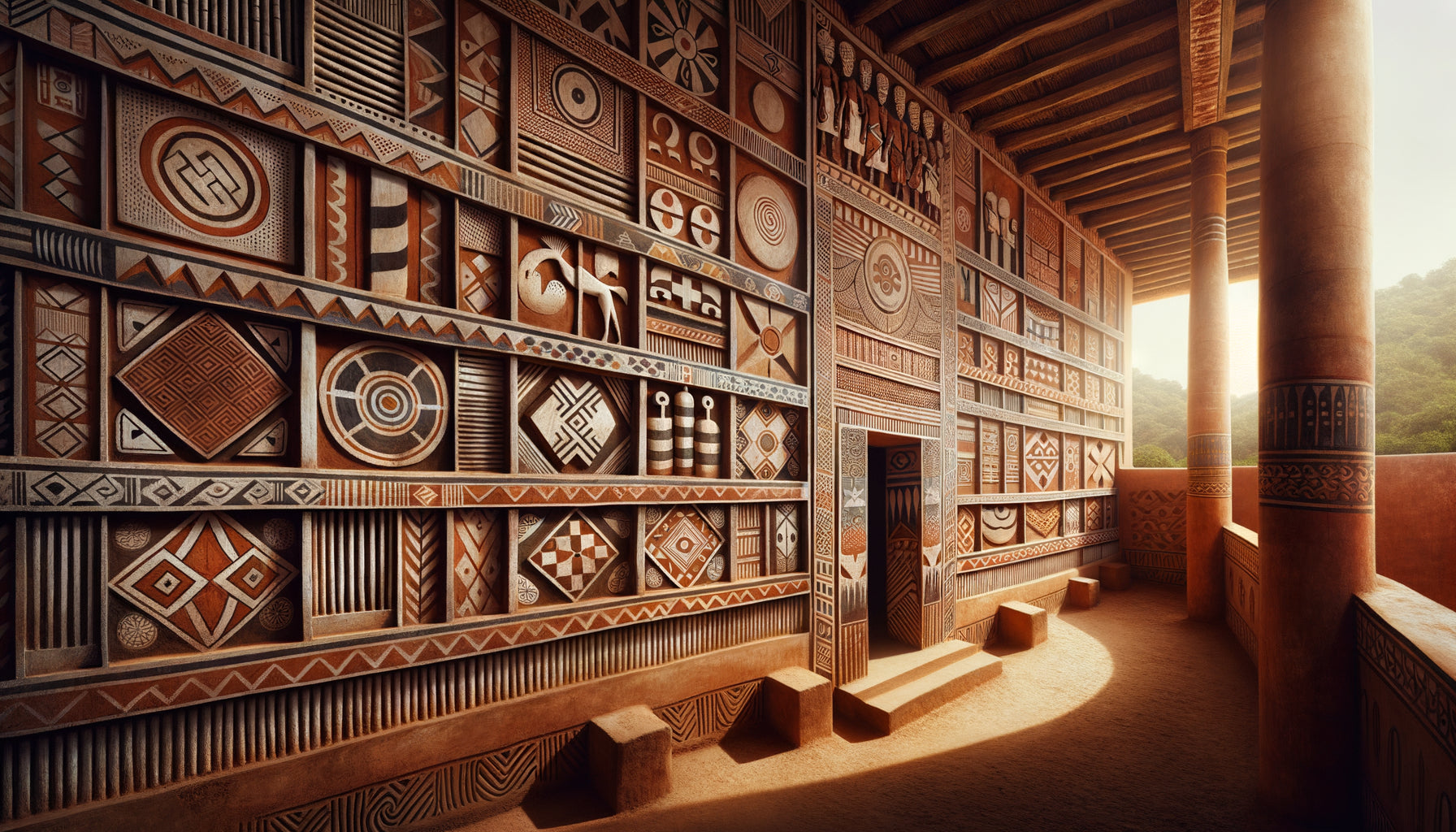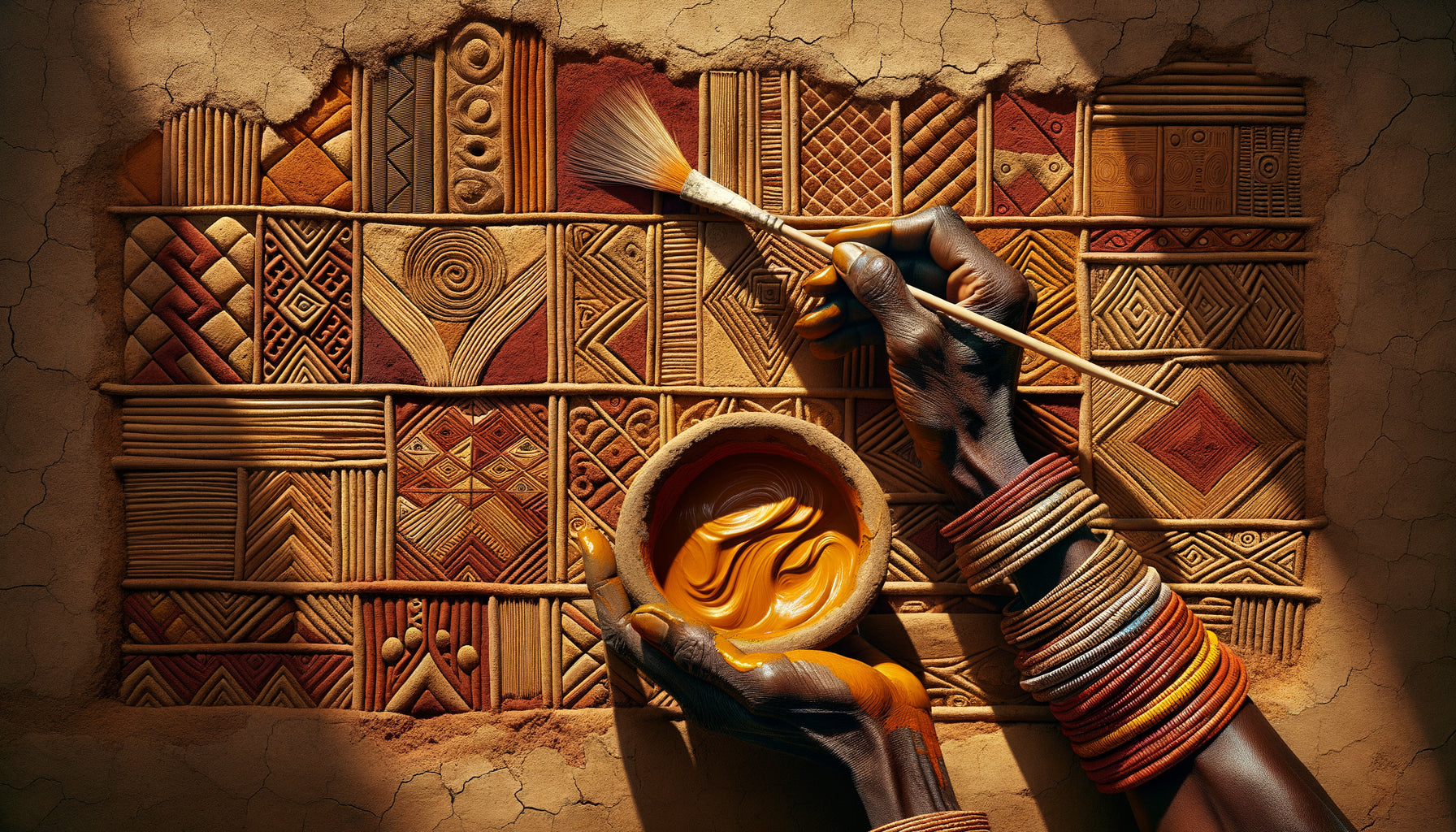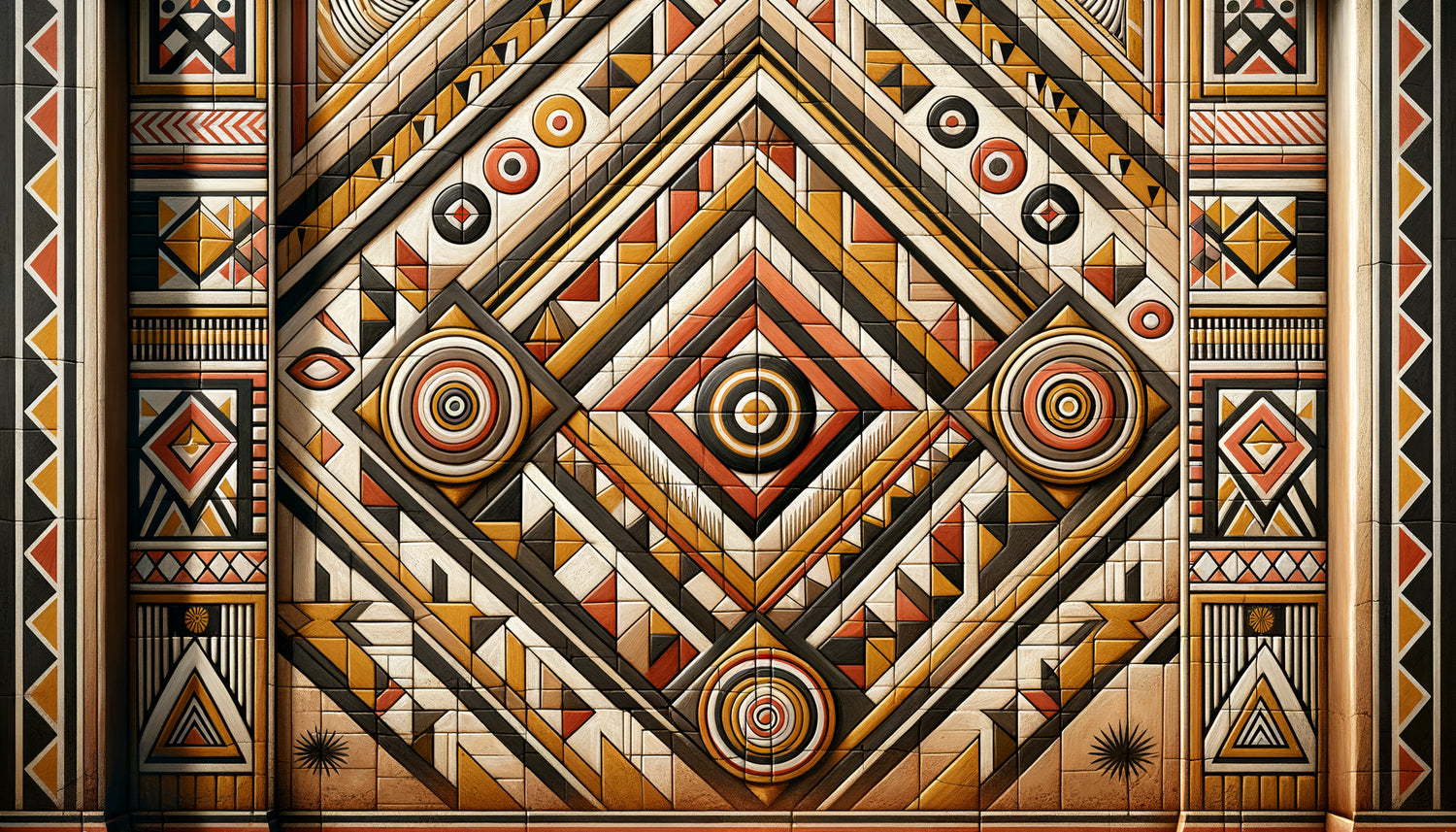
The first time I placed my hands on a Ndebele wall in a community near Pretoria, I felt that particular vibration. Under my fingers, the perfectly aligned triangles told a millennia-old story, a sacred geometry perpetuated by Ndebele, Sotho and Tswana women for centuries. Each angle, each point, each repetition carries an ancestral code that the world of contemporary decoration is rediscovering today with fascination.
Here's what the triangular patterns of Southern African wall art bring to our modern interiors: a symbolic depth that transforms a wall into a cultural narrative, a visual dynamic that guides the eye and structures space, and a timelessness that transcends ephemeral trends to anchor your decoration in a living tradition.
You may have come across these enigmatic triangles on Pinterest or Instagram, admiring their graphic power without understanding their origin. Why does this specific geometric shape dominate the artistic expression of so many peoples of Southern Africa? The answer goes far beyond aesthetics: it delves into cosmology, social structure and a worldview where every line counts.
You don't need to be an anthropologist to grasp this beauty. I invite you on a journey where traditional wall art reveals its secrets, where each triangle becomes a key to enriching your own living space.
By the end of this article, you will not only understand why these triangular patterns have fascinated for so long, but above all how to integrate their symbolic power into your contemporary decoration.
Sacred geometry: when the triangle becomes language
In Ndebele, Sotho and Tswana traditions, the triangle is never accidental. It embodies the sacred mountain, that spiritual elevation which connects earth to sky. Each point directed upwards symbolizes aspiration, connection with ancestors, that invisible bridge between worlds.
The women who paint these triangular patterns on facades are not decorating: they are writing. Their brush traces a visual alphabet where each triangular configuration communicates a specific message. A single triangle can represent an unmarried young woman. Three interlocking triangles evoke the extended family. Rows of alternating triangles tell the cycle of seasons, the succession of generations.
This geometry goes far beyond aesthetics. It structures a complete cosmology where the universe itself rests on triangular balances: the triad earth-water-sky, the triangular relationship between man-woman-community, the trilogy past-present-future. Wall art thus becomes a cartography of the sacred, visible to all but readable by those who possess its codes.
The colors that amplify the triangular message
Traditional pigments transform these triangles into vibrant statements. Ochre red evokes fertile land and ancestral blood. Pure white purifies and protects. Black anchors and structures. When a Ndebele woman combines these hues in her triangular patterns, she composes a visual score where each color amplifies the meaning of each shape.
The architecture of power: triangles and social hierarchy
During my research in the villages of Mpumalanga, I discovered that the density and complexity of triangular patterns on a house directly indicates the social status of its inhabitants. The more triangles there are, intricate, sophisticated, the more influence, spiritual and material wealth the family possesses.
This visual hierarchy transforms each facade into a social identity card. The houses of chiefs and traditional healers exhibit compositions of triangular complexity that require days of meticulous work, with perfect symmetries. Conversely, modest dwellings present simpler triangular patterns, but never absent: even the most humble home deserves its connection to the sacred.
This distinctive function of triangular wall art has a deeply protective dimension. Triangles act as visual talismans that define private space, establishing a symbolic boundary between the secure interior and the potentially threatening exterior. They are the geometric guardians of the home.

Matrilineal transmission: the art of women guardians
Here's a fundamental element: in most southern African ethnic groups practicing wall art, it is exclusively women who create these triangular patterns. This tradition is passed down from mother to daughter, from grandmother to granddaughter, in a learning ritual where each generation adds its own interpretation while preserving ancestral codes.
I was privileged to witness this transmission during an initiation ceremony. The young initiate for the first time received the right to paint her own triangles on the family home, under the watchful eye of the matriarchs. Each brushstroke was corrected, adjusted, until the geometry reached the required perfection.
This feminine dimension of triangular wall art is not insignificant. In these societies, women are perceived as guardians of cultural memory, weavers of social bonds. Their murals thus become the visible expression of an ancestral feminine power that structures domestic space and, by extension, the entire community.
The cyclical renewal of patterns
The triangular motifs are never fixed. Each year, after the rainy season, women repaint the facades entirely. This annual regeneration symbolizes renewal, the community's ability to reinvent itself while maintaining its foundations. The triangles thus become living entities that evolve subtly from year to year.
Why the triangle rather than the circle or the square?
This question has haunted me for years. Why this absolute predominance of the triangle in Southern African wall art, when other regions of Africa favor spirals, circles or undulating lines?
The answer lies in the geography itself of southern Africa. The landscapes are dominated by spectacular mountain formations: the Drakensberg, the Maluti, the reliefs of Lesotho. These sacred mountains, with their distinctive triangular profiles, have shaped the visual imagination of the people who live there. The triangle thus becomes the geometric signature of the territory itself.
But there's more. The triangle has a unique structural stability. In traditional architecture, the conical roofs of dwellings draw triangles. Agricultural tools, spears, ritual instruments: all incorporate this angular shape. The triangular mural echoes an omnipresent form in all aspects of daily life.
Finally, mathematically, the triangle is the simplest polygon after the line. This simplicity allows for infinite variability: it can be repeated, inverted, nested, fragmented to create compositions of astonishing richness from a basic element. It's the paradox of the triangle: elementary yet inexhaustible.

From tradition to modernity: wall art reinvented
Today, these triangular motifs are experiencing a spectacular renaissance. Contemporary South African artists like Esther Mahlangu have propelled the Ndebele aesthetic onto the international stage. BMW even commissioned her to create an Art Car entirely covered in traditional triangles, a striking fusion of heritage and modernity.
In Johannesburg and Cape Town galleries, young creators are reinterpreting these ancestral triangular codes with neon palettes, digital supports, monumental installations. They prove that this millennial geometry perfectly dialogues with the minimalist and graphic aesthetic of our time.
For interior designers, this rediscovery is a revelation. The triangular motifs of Southern Africa offer a powerful alternative to Scandinavian or Mediterranean patterns that saturate our interiors. They bring a unique directional energy, a verticality that literally elevates space, and a narrative depth that no purely decorative pattern can match.
Integrating these triangles into your decor
A large wall canvas with Ndebele triangular motifs instantly transforms a neutral living room into a space of character. Position it on a focal wall, let its geometry visually structure the room. Triangles naturally create guidelines that guide the eye and organize space without partitioning.
Pair these triangles with sleek, contemporary furniture. The contrast between traditional graphic richness and modern simplicity creates a sophisticated visual tension. Triangular patterned textiles – cushions, throws, rugs – allow you to introduce this aesthetic in a more subtle way if you prefer a progressive approach.
Ready to anchor your interior in a millennial tradition?
Discover our exclusive collection of African paintings that captures the essence of these sacred triangular motifs to transform your space into an authentic cultural connection place.
Your space, reinvented by sacred geometry
The triangular motifs of Southern African wall art dominate because they transcend simple decoration. They are cosmology, identity, protection, transmission. Each triangle carries centuries of condensed wisdom in a pure form.
By integrating this aesthetic into your interior, you are not simply choosing a style: you are connecting to a worldview where beauty and meaning are one. Your wall becomes a carrier of history, your space gains narrative depth.
Start simple. Observe how a single element with triangular motifs transforms the energy of a room. Let these angles guide your gaze, structure your perception of space. You will discover that these millennial triangles speak a universal language that your eye understands instinctively.
Sacred geometry awaits you. Your walls too.
Your questions about Southern African triangular motifs
Do these triangular patterns suit all decoration styles?
Absolutely, and that's their amazing strength. The Southern African triangular motifs possess a geometric universality which dialogues with almost every style. In a minimalist interior, they bring the touch of character and cultural warmth that avoids coldness. In a bohemian or maximalist space, they visually structure without weighing down. Even in a classic decor, a Ndebele triangle painting creates a fascinating contemporary contrast. The secret lies in balance: let the triangles be your statement element and keep the rest of the decoration relatively clean to avoid visual cacophony. These patterns have crossed centuries precisely because they possess this rare adaptability that transcends fleeting trends.
How to choose the right triangle colors for my space?
The traditional palette – ochres, whites, blacks, with touches of blue and green – naturally integrates into most contemporary interiors. If your decoration favors neutral tones (grey, beige, white), opt for triangular motifs in bright colors that will become your focal point. Conversely, if your space already contains a lot of color, choose triangles in a more restricted palette, perhaps monochrome with variations in tone. Observe the natural light in your room: warm-colored triangles (reds, ochres, oranges) warm up north-facing spaces, while palettes including blues and greens refresh very sunny rooms. Don't be afraid of color: these patterns have existed for centuries precisely because their strong geometric structure can support intense chromatic contrasts without ever appearing garish.
What size of triangular pattern painting should I choose for my living room?
The general rule in wall decoration applies: your painting should cover about two thirds to three quarters of the width of the furniture it surmounts (sofa, console, buffet). For triangular patterns specifically, prioritize formats that allow you to see the repetition and complexity of the patterns – generally from 80x80 cm for a real impact. A format too small will not do justice to the intricacy of these traditional compositions. If you have a large blank wall, dare the monumental format: 120x180 cm or more. Triangles, with their directional dynamics, beautifully support large formats without overwhelming the space. For a gallery wall, combine several paintings of varying sizes but maintain consistency in the colors or style of triangles to create visual harmony. Always measure before buying and visualize with adhesive tape on the wall.