In the winding alleys of Salvador de Bahia, an explosion of colors catches my eye. A face with African features emerges from a crumbling wall, surrounded by geometric patterns that seem to dance to the rhythm of candomblé. I am a cultural anthropologist specializing in Afro-Atlantic diasporas for twelve years, and each visit to these favelas reveals a new layer of meaning. The mural art of Salvador's favelas does not simply decorate these neighborhoods: it tells, claims, and celebrates the Yoruba heritage that pulses through the veins of this city.
Here's what the mural art of Salvador’s favelas brings: a living connection with the Yoruba deities who protect and guide communities, a cultural resistance against historical erasure, and a powerful aesthetic that transforms urban space into an open-air sanctuary. This encounter between contemporary painting and ancestral tradition creates something unique in the global artistic landscape.
Many believe that the Yoruba heritage belongs to the past, locked away in terreiros and museums. They imagine frozen traditions, disconnected from the daily lives of the favelas. This vision is not only reductive; it ignores how residents of Salvador reinvent their cultural heritage every day through mural art.
Yet, it suffices to look up in the neighborhoods of Pelourinho, Liberdade, or Itapuã to understand that the Yoruba heritage constantly dialogues with contemporary art. The walls become pages of a sacred book open to all, where the orixás meet graffiti, and adinkra symbols blend with spray paint.
In this article, I take you into the favelas of Salvador de Bahia to decode this fascinating dialogue between mural art and Yoruba spirituality, and understand how this fusion creates a unique visual identity that inspires designers and decorators around the world.
The orixás possess the walls
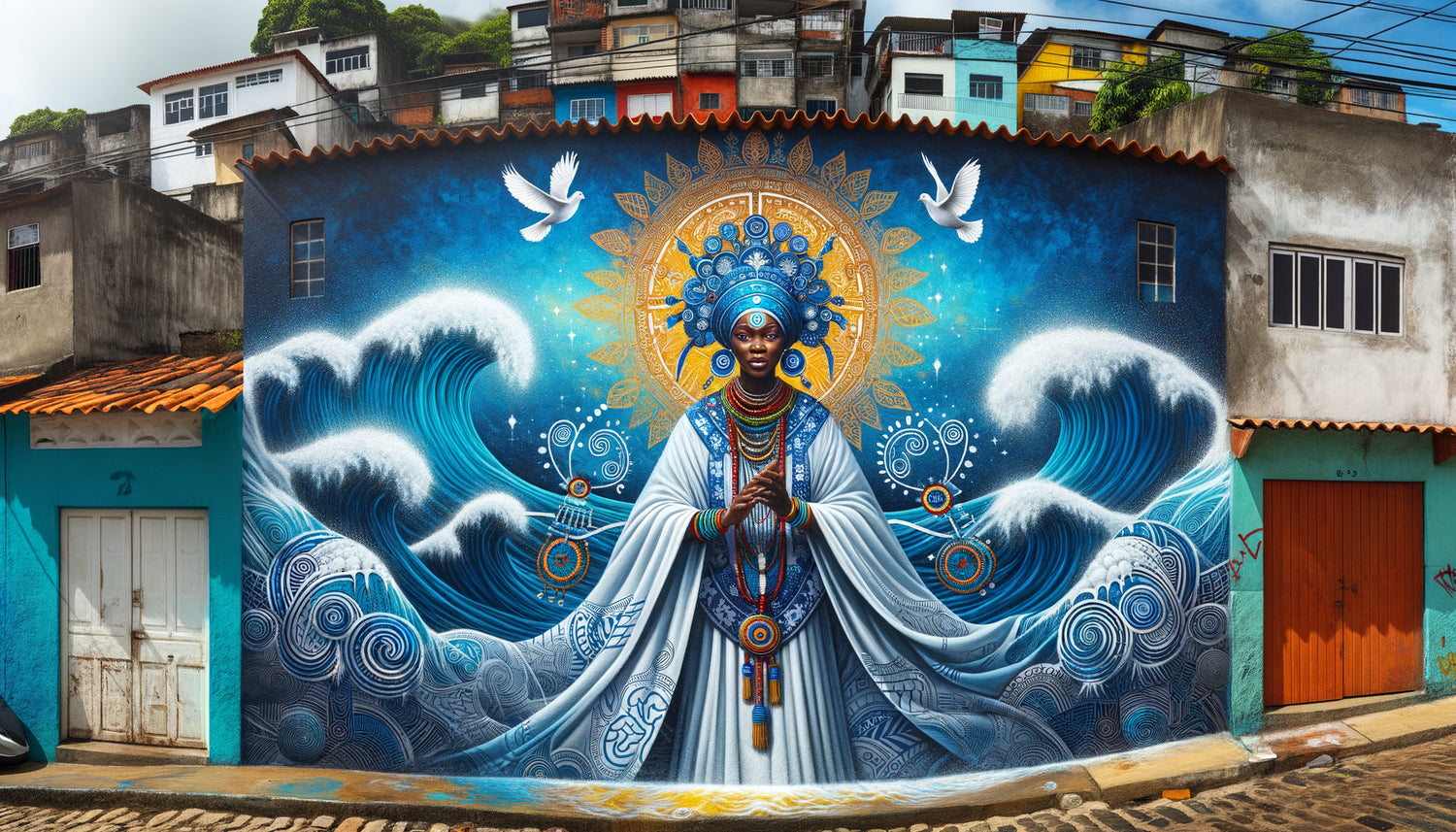
As I walk through the favelas of Salvador, I immediately recognize the faces of the orixás. Iemanjá, the queen of the oceans, appears in her blue and white robe, her hair transforming into waves that flood an entire facade. Ogum, the warrior blacksmith, brandishes his metal sword in a protective gesture above a neighborhood entrance. Oxóssi, the hunter of the forests, aims his arrow towards the urban horizon.
The mural art of Salvador’s favelas does not represent the orixás as museum figures. Artists embody them with contemporary bodies, urban clothing, and sometimes even modern accessories. I photographed a portrait of Exu wearing sneakers and holding a smartphone – a bold reinterpretation that makes the elders smile while speaking to younger generations.
The Yoruba palette: much more than colors
Each orixá has its ritual colors, and the muralists of Salvador respect them with remarkable precision. The golden yellow of Oxum illuminates walls like a solar blessing. The immaculate white of Oxalá brings purity and peace to dilapidated facades. The red and white of Xangô evokes justice and power.
This chromatic coding transforms wall art into a true system of spiritual communication. Residents instantly know what energy protects their street. A wall dominated by deep blue signals the protection of Iemanjá. The green and blue tones of Oxóssi indicate abundance and prosperous hunting.
Adinkra symbols and sacred geometry: when Africa speaks in patterns
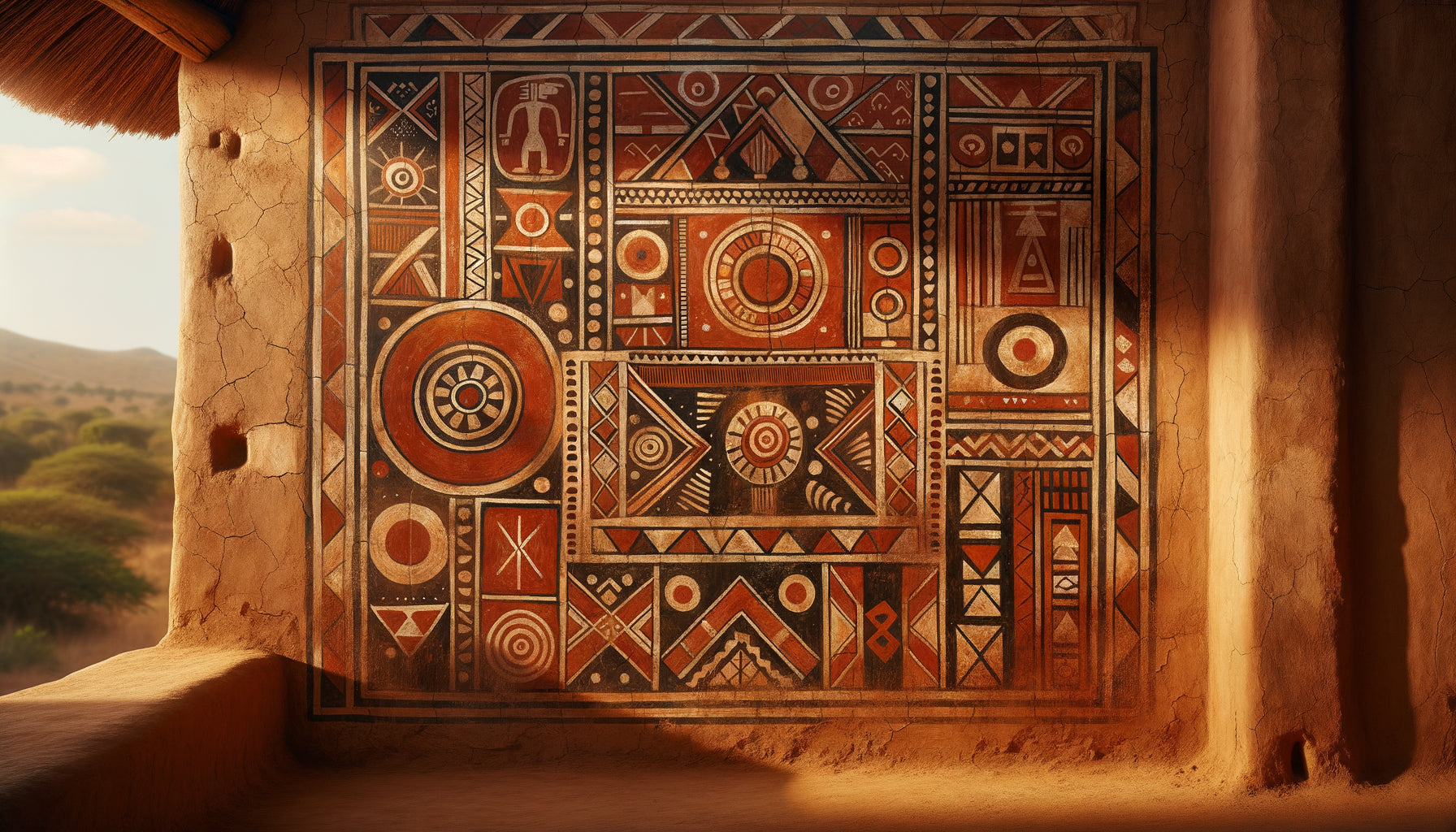
Beyond portraits of orixás, wall art in the favelas of Salvador incorporates a wealth of geometric symbols from the Yoruba heritage and Akan traditions. Adinkra symbols – these pictograms loaded with wisdom – adorn the borders of frescoes, creating frames that resemble painted kente fabrics.
I spent hours cataloging these motifs: the Gye Nyame (the supremacy of God), the Sankofa (the bird looking back, symbolizing the importance of knowing one's past), the Dwennimmen (horns representing strength and humility). Each symbol dialogues with the Yoruba heritage creating a pan-African visual language that descendants of slaves have reconstructed piece by piece.
The spirals, chevrons, concentric circles are never purely decorative. They evoke ritual scarifications, patterns woven into traditional pagnes, drawings traced on the ground during candomblé ceremonies. Wall art thus becomes a living archive, a horizontal museum that everyone can consult.

Candomblé is written on the facades
Candomblé, this Afro-Brazilian religion directly heir to Yoruba cults, deeply permeates the wall art of Salvador. Artists reproduce complete ritual scenes: the dances of the iaôs (initiates) in trance, offerings arranged at crossroads, atabaques (sacred drums) whose patterns seem to vibrate on concrete.
In the Liberdade neighborhood, I discovered a monumental fresco depicting an entire terreiro – a candomblé temple – with its pillars, altars, garlands of sacred leaves. The artist had even painted the riscados points, these mystical symbols drawn in chalk to invoke spiritual entities. Wall art literally became a sacred space accessible to everyone, even those who would never enter a terreiro.
Walls as urban altars
One practice particularly touched me: some of Salvador’s murals receive actual offerings. Locals deposit flowers, candles, sometimes ritual food platters at the foot of orixás' portraits. Wall art transcends its decorative function to become an urban altar, a point of contact between the visible and invisible worlds.
This sacralization of public space by art deeply dialogues with the Yoruba heritage, where the boundary between sacred and profane remains porous. The streets of the favelas become extensions of the terreiros, the walls supports for collective devotion.
Cultural Resistance and Identity Affirmation
The wall art of Salvador’s favelas is never politically neutral. Each portrait of an orixá, each Yoruba symbol constitutes an act of cultural resistance. For centuries, the Yoruba heritage has been repressed, demonized, caricatured. Practitioners of candomblé were persecuted, their terreiros destroyed, their beliefs ridiculed.
Today, occupying public space with monumental murals celebrating this heritage represents a major symbolic victory. The artists of the favelas proclaim: we are still here, our culture is alive, our aesthetic is legitimate. The walls cry out what voices could not always say.
I met Jaime, a twenty-eight-year-old muralist whose works cover several neighborhoods of Salvador. He confided in me: 'When I paint Xangô on a wall, I’m not just doing decoration. I mark the territory of my culture. I tell the children of the neighborhood that they come from a lineage of African kings and queens.' Wall art dialogues with the Yoruba heritage by transforming it into a visible identity manifesto.

An Aesthetic That Inspires Contemporary Design
The influence of this Yoruba-Brazilian wall art extends far beyond Salvador de Bahia. Designers worldwide are inspired by this unique fusion between ancestral spirituality and contemporary urban expression. The color palettes inspired by the orixás – these bold combinations of solar yellows, oceanic blues, fiery reds, and immaculate whites – are found in furniture collections, textiles, wallpapers.
The geometric patterns that adorn the wall art of the favelas also influence interior architecture. These symbols laden with meaning bring a narrative depth that simple decorative forms cannot offer. A cushion adorned with adinkra symbols is not only beautiful: it tells a story, it conveys values, it connects the domestic space to millennial wisdom.
Bringing Salvador Home
Integrating this aesthetic into your interior doesn't require transforming your living room into a terreiro. It’s more about understanding the aesthetic philosophy that underlies Salvador’s mural art: color as a vector of spiritual energy, geometry as symbolic language, art as a bridge between visible and invisible.
A simple painting representing Iemanjá can bring the soothing energy of the ocean into a space. Cushions with patterns inspired by Yoruba symbols create conversation points rich in meaning. A palette of colors borrowed from the orixás structures the ambiance of a room according to principles that dialogue with centuries of spiritual wisdom.
The Future of This Cultural Dialogue
The mural art of Salvador’s favelas continues to evolve. Young artists are integrating digital techniques, creating dizzying trompe-l'œil effects, and experimenting with innovative materials. But the dialogue with the Yoruba heritage remains the backbone of this creativity.
Remarkable initiatives are emerging: guided tours led by the artists themselves, workshops where residents learn to decode Yoruba symbols in urban art, collaborations between terreiros and graffiti collectives. Mural art becomes a pedagogical tool that transmits the Yoruba heritage to new generations in an accessible and captivating way.
This dynamic inspires other Brazilian and diasporic cities. In Rio, Lagos, Cotonou, Havana, artists are creating their own dialogues between urban art and Yoruba traditions. Salvador remains nevertheless the most fertile laboratory of this fusion, where the concentration of candomblé practitioners and the vitality of the urban artistic scene create ideal conditions for innovation.
Let the energy of the orixás transform your interior
Discover our exclusive collection of African paintings that capture the spiritual and aesthetic essence of the Yoruba heritage to create in your home a space full of meaning and beauty.
Conclusion: When Walls Become Living Memory
The mural art of Salvador’s favelas in Bahia does not dialogue with the Yoruba heritage in an abstract or nostalgic way. It embodies it, reinvents it, propels it into the present with astonishing vitality. Each fresco is an act of cultural transmission, each color a prayer, each symbol a fragment of collective memory reconstructed.
This dialogue creates a unique aesthetic that inspires the world: one of art deeply rooted in spirituality, politically conscious, visually explosive, and always serving the community. The walls of the favelas become more than just surfaces to be painted – they are guardians of a history that slavery sought to erase, heralds of a culture that refuses to disappear.
The next time you choose a piece for your interior, consider this narrative power. Opt for pieces that tell a story, convey an energy, and dialogue with millennial traditions. Your space will then become more than just decor: a place where the echoes of ancestral civilizations resonate, where art transforms everyday life into a spiritual experience.
FAQ: Understanding Yoruba Wall Art from Salvador
Do I need to practice Candomblé to appreciate wall art inspired by the Yoruba heritage?
Absolutely not. The favela wall art of Salvador is for everyone, believers or not. Its visual beauty, symbolic richness, and narrative strength touch even those who know nothing about Candomblé or Yoruba spirituality. These works function on several levels: pure aesthetics, cultural curiosity, spiritual quest. Many people incorporate paintings inspired by this art into their decor simply for their vibrant colors and positive energy, without adhering to the beliefs that underpin them. The essential thing is to approach these works with respect and openness, recognizing that they carry a deep meaning for the communities that create them. This respectful attitude enriches your aesthetic experience rather than limiting it.
How can I recognize Yoruba symbols in contemporary wall art?
Yoruba symbols in Salvador's wall art have several recognizable characteristics. First, coded colors: each orixá has its distinctive shades (blue for Iemanjá, yellow for Oxum, red and white for Xangô). Then, iconographic attributes: each deity holds specific objects such as Oxóssi's bow or Ogum's sword. Repetitive geometric patterns – spirals, chevrons, concentric circles – evoke ritual scarifications and traditional fabrics. Adinkra symbols, often placed on the border, resemble stylized pictograms. With a little research and observation, you will quickly develop an eye for these visual codes. Start by identifying the dominant colors of a work, then look for symbolic objects, and finally decode the geometric patterns. This progressive reading reveals layers of meaning.
Can I incorporate the aesthetic of Yoruba wall art into a minimalist or contemporary decor?
Absolutely, and it's even one of the most interesting trends in current design. Yoruba art from Salvador, despite its symbolic richness, can be integrated into minimalist spaces through clever strategies. Opt for a bold statement piece – a large painting depicting an orixá or Yoruba symbols – on an otherwise clean and white wall. This approach creates a dramatic focal point without overwhelming the space. You can also extract only the Yoruba color palette (combinations of two or three colors) and apply it to simple, contemporary geometric shapes. From cushions with stylized adinkra patterns on a neutral sofa, to a yellow Oxum shelf against a white wall, to thin frames encasing minimalist Yoruba symbols – all these approaches honor the heritage while respecting the clean aesthetic. The dialogue between rich tradition and minimalist modernity creates a fascinating visual tension.