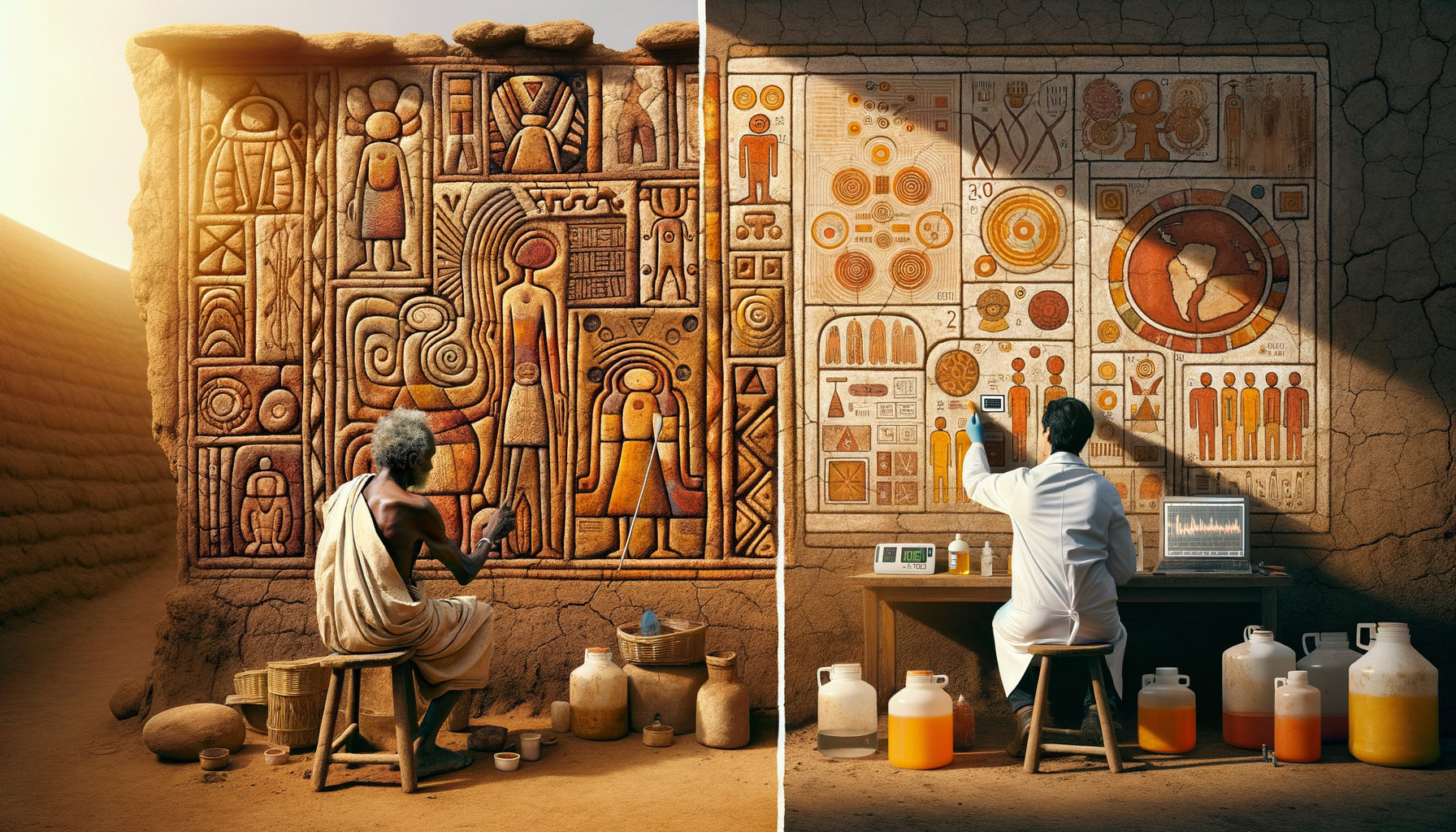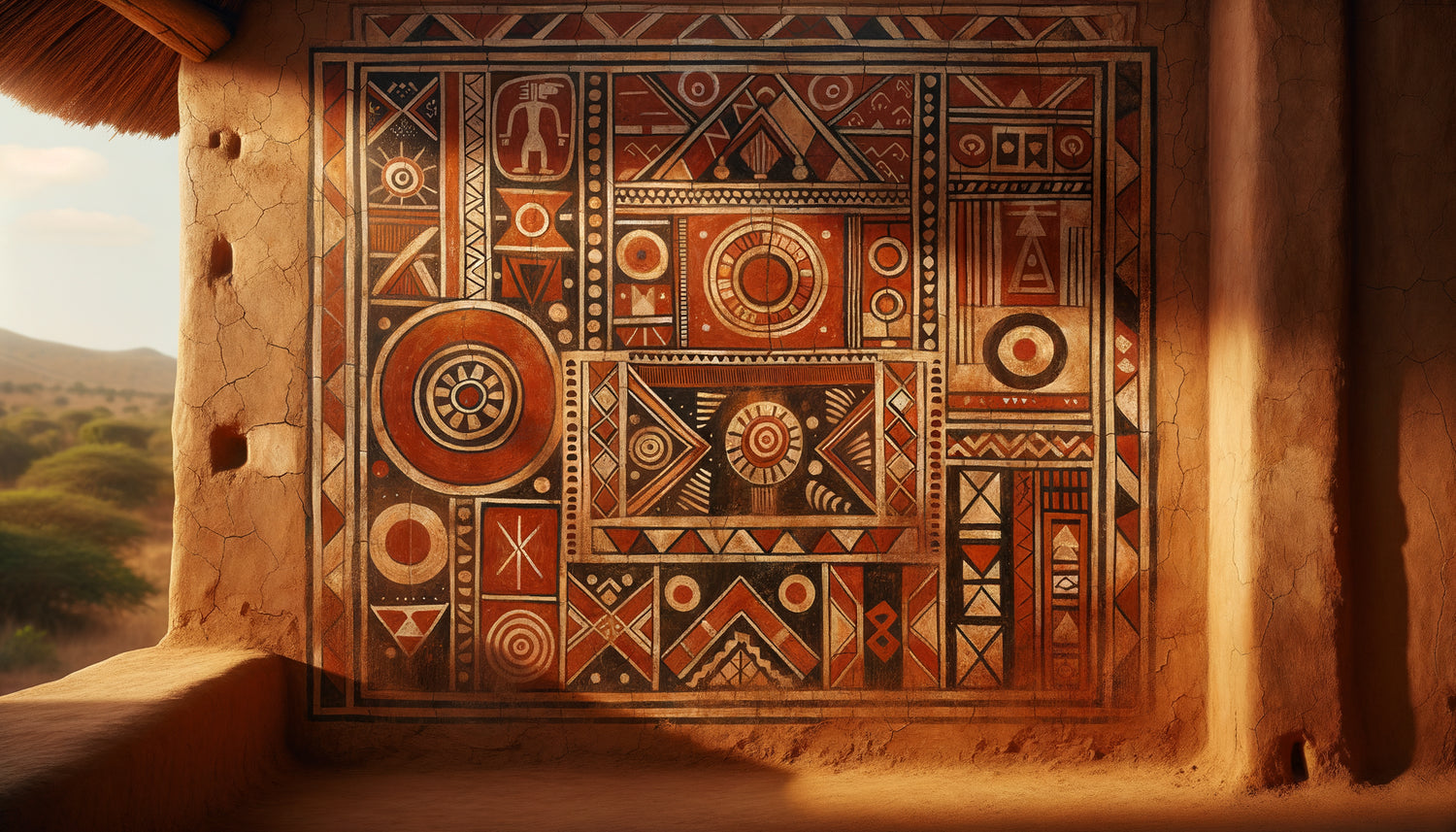
Facing an ochre wall in a village in Burkina Faso, I placed my hand on geometric patterns traced over four hundred years ago. The painting, with its astonishing chromatic richness, seemed to have been applied the day before. How did these African murals survive through the centuries when our modern paintings sometimes flake off within decades? This question obsessed me during my fifteen years of research into ancestral decoration techniques. The answer lies in a fascinating alchemy between traditional knowledge, natural materials, and maintenance rituals passed down from generation to generation.
Here's what the longevity of African murals reveals: exceptional technical mastery of natural pigments, a deep understanding of architectural supports, and ritualized maintenance practices that ensure their constant regeneration.
We admire these works in museums or on social networks, frustrated by our inability to understand their secret of longevity. We try to reproduce these warm tones in our contemporary interiors, but our colors fade, our plasters crack. Rest assured: these millennial techniques are not magic, but a body of empirical knowledge with remarkable scientific precision. By understanding their principles, we can transform our approach to color and decorative durability.
The alchemy of pigments: when earth becomes eternal
African murals owe their exceptional longevity to the very nature of their pigments. Unlike modern synthetic paints, traditional artists use colored earths and mineral oxides that practically do not degrade over time. These materials are chemically stable, resistant to UV rays, and undergo no organic alteration.
In the Sahel region, red ochre comes from clays rich in iron oxide, the same compound that colors the Martian landscapes. This molecule is one of the most stable in the universe. White is obtained from kaolin or lime, black from charcoal or manganese. Each pigment is finely ground according to precise techniques, often passed down orally, creating particles with an optimal grain size for adhesion.
Natural binders play a just as crucial role. Vegetable gums, extracted from acacias in particular, encapsulate the pigments without ever yellowing or becoming fragile. Curdled milk, egg white, or even decoctions of local plants create protective matrices that allow the wall to breathe while permanently fixing the color. This controlled porosity avoids moisture problems that condemn our modern paints.
The living support: why traditional architecture preserves its decorations
The durability of African murals cannot be understood without analyzing their support. Walls made of banco (raw earth) or limestone create a symbiotic relationship with the pigments. The earth plaster, applied in several layers and polished by hand, offers a slightly absorbent surface that literally anchors the paint within its structure.
This architecture, built from natural materials, breathes. Humidity circulates without creating condensation, and temperature variations are gradual. Mineral salts do not migrate to the surface as they do in modern cement constructions. I have been able to observe frescoes on granaries in Mali: the walls naturally regulate hygrometry, creating a stable microclimate that preserves both harvests and decorations.
The composition of the preparatory plaster makes all the difference. Mixed with vegetable fibers, calibrated sand, and sometimes animal droppings, it creates a surface that is both flexible and resistant. These walls absorb the movement of the building without cracking, unlike modern rigid supports which crack and take the paint with them.

The maintenance ritual: regeneration as a cultural practice
Here is the most unknown secret of the durability of these wall paintings: they do not survive despite time, but thanks to a ritualized maintenance. In many West African cultures, women ritually repaint facades before the rainy season or during important ceremonies. This is not a restoration in the Western sense, but a regeneration.
Each new layer, applied according to ancestral gestures, chemically bonds to the previous ones. Pigments accumulate in translucent strata, enriching chromatic depth. Some frescoes thus count dozens of superimposed layers over several centuries, creating a texture and luminosity impossible to reproduce in a single application.
These maintenance practices are never trivial. They are part of a sacred or social calendar, mobilizing the community. The geometric motifs are redrawn freehand according to a visual memory passed down orally. This living, performative dimension guarantees the transmission of technical knowledge as much as the material preservation of the work.
Natural protection: climate and chemical composition
The Sahelian climate, reputed hostile, paradoxically protects these wall paintings. The absence of prolonged humidity prevents the proliferation of microorganisms that degrade painted surfaces. Brief but intense rains wash away dust without penetrating deeply into the support thanks to the slight hydrophobicity of natural binders.
Intense heat promotes the natural polymerization of some organic binders, making them progressively more resistant. Gums harden, kaolin partially recrystallizes. It is an aging process that strengthens rather than alters. I analyzed samples of paintings over three centuries old: their mechanical cohesion was superior to that of recent samples of the same material.
Mineral pigments are also resistant to biological attacks. No bacteria, no fungus can metabolize iron oxide or kaolin. This biological inertness, combined with the natural alkalinity of some lime plasters, creates an environment hostile to the agents of degradation that ruin our contemporary paintings in just a few years.

The lesson of the ancients for our modern interiors
These ancestral techniques now inspire a revolution in sustainable decoration. European artisans are rediscovering earth paints, lime washes, mineral patinas. These finishes offer depth and durability unmatched by industrial acrylic paints.
In my renovation projects, I systematically integrate these principles: prioritize mineral pigments, use natural binders, prepare the surfaces with breathable plasters. The result? Walls that age gracefully, developing a patina rather than defects. Colors remain bright for decades, evolving subtly instead of fading abruptly.
African geometric patterns, beyond their beauty, also teach the importance of repeated gesture. Each line drawn freehand carries the energy of the artisan. This mastered imperfection brings life to the decor, where our stencils and masking tapes produce a mechanical coldness. Relearning controlled spontaneity is reconnecting with decorative authenticity.
When color tells the story of the territory
The durability of these wall paintings reveals a profound philosophy: use what the earth offers locally. Each region of Africa has its specific palette, dictated by its geology. The reds of the Sahel differ from the ochres of the Maghreb, the whites of the West do not resemble those of the East.
This territorial approach not only guarantees the continued availability of materials for maintenance, but also creates a natural chromatic harmony between architecture and its environment. Buildings seem to emerge from the ground rather than sit on it. This ecological coherence partly explains why these constructions appear so right, so timeless.
Transposing this principle into our modern interiors means prioritizing local materials, the soils of our region, the stones of our quarries. This approach reduces the carbon footprint while creating authentic atmospheres rooted in a place. Your walls then tell a geological story, not an industrial catalog.
Let the soul of Africa transform your spaces
Discover our exclusive collection of African paintings that capture the timeless power of these millennial pictorial traditions.
Conclusion: The living heritage of African walls
The extraordinary longevity of African murals is not a miracle, but the result of refined technical intelligence over millennia. Inalterable mineral pigments, breathable natural binders, living earth supports, ritualized maintenance: each element contributes to this durability. Moreover, these frescoes teach us that sustainable decoration does not fight time, but integrates with it gracefully.
Imagine your walls bearing colors that, in fifty years, will have gained character instead of degrading. Visualize warm tones that do not need to be repainted every five years. This ancestral knowledge is accessible and adaptable to our contemporary contexts. Start with a small project: a wall painted with earth paint, some motifs inspired by the Saharan traditions. Touch the pigments, feel the clay, experience the slow gesture. You will discover that living sustainably begins by relearning how to color our spaces as the wisest builders have always done.
Frequently Asked Questions
Can we use paints based on natural pigments in our modern interiors?
Absolutely, and it is increasingly recommended! Earth paints, mineral pigments and lime are experiencing a remarkable revival in Europe. Contrary to popular belief, they can be applied to most supports (plaster, plaster, even prepared gypsum board) and offer an extraordinarily rich color palette. Their main advantage: they naturally regulate the humidity of the room, do not release any toxic VOCs and develop a noble patina over time. Many craftsmen have specialized in these techniques, and brands now offer ready-to-use natural paints. Start with a test room: you will be surprised by the depth of the colors and their exceptional durability. These paints sometimes require a different application (with a wide brush rather than a roller), but the result is well worth learning this more artisanal gesture.
Do African murals require a lot of maintenance?
This is the paradox: they require regular maintenance, but it is extremely simple and contributes to their longevity. In the traditional context, women reapply a thin layer of paint before the rainy season, a gesture that takes a few hours and uses the same local materials. This annual or bi-annual regeneration prevents the accumulation of degradation and gradually enriches the surface. Translated to our interiors, this means that a light refresh every five to ten years (compared to three to five years for classic acrylic paints) is enough to maintain the brilliance. Above all, these natural materials allow for invisible local touch-ups, whereas synthetic paint often requires repainting the entire wall to avoid color differences. Maintenance then becomes a soothing ritual rather than a chore, a reconnection with your living space.
Why are natural pigments more durable than modern paints?
The answer lies in the chemical nature of the materials. The mineral pigments used in African murals (iron oxides, kaolin, colored earths) are already in their final oxidation state: they cannot react chemically with their environment. Conversely, the organic synthetic pigments in modern paints contain complex molecules that gradually degrade under the effects of UV rays, oxygen and humidity. That's why your walls yellow or fade. Natural binders (lime, casein, vegetable gums) also exhibit remarkable stability and allow walls to breathe, avoiding moisture problems that cause acrylic paints to blister. Finally, the slight porosity of these natural finishes allows them to evolve harmoniously: they develop a patina instead of flaking off. This is the difference between a material that ages and a material that matures, gaining character over the decades.