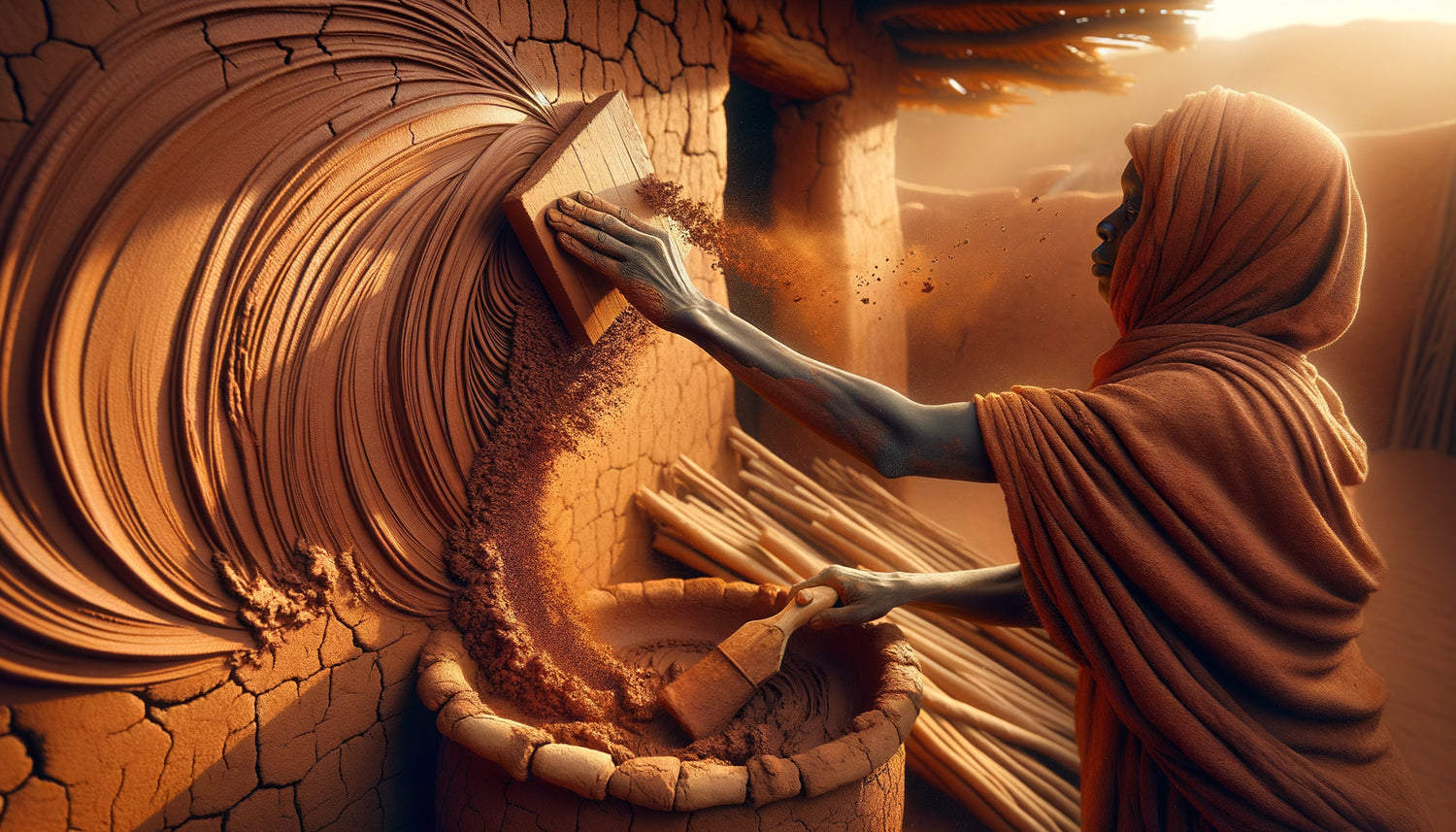
The first time I placed my hands on a plastered wall in Timbuktu, I understood that I was touching something sacred. The surface, as soft as mineral silk, literally breathed under my palms. For twelve years, I have traveled through the villages of the Sahel documenting and restoring these earth architectures, and each time, the same revelation: these millennial plasters are masterpieces of natural chemistry that our modern laboratories are still trying to understand.
Here's what the composition of traditional Sahelian plasters reveals to us: exceptional thermal regulation which maintains coolness inside even under 45°C, water vapor permeability which naturally eliminates humidity, and surprising durability against sand winds and violent rains. Three benefits that contemporary architecture rediscovers with amazement.
You may be looking to integrate authentic materials into your interiors, to understand these ancestral techniques that inspire eco-construction today, or simply to grasp why these ochre surfaces captivate designers so much. Yet, the chemical complexity of these plasters remains little known, lost between technical vocabulary and oral knowledge passed down from generation to generation.
Rest assured: behind the apparent simplicity of these walls lies a precise formulation, the result of millennia of observation in the field. I will reveal the secrets of these compositions that transform raw earth into a noble surface, and how this knowledge influences our most contemporary decorative choices today.
Lateritic clay: the magical binder of Sahelian lands
At the heart of each traditional plaster in the Sahel is lateritic clay, this red-orange earth that colors the West African landscapes. Its chemical composition makes it unique: rich in iron oxides (15 to 30% of Fe₂O₃), it also contains kaolinite, gibbsite and aluminum oxides (10 to 25% of Al₂O₃). This combination creates a natural binder of remarkable power.
Unlike tempered clays, lateritic clay has a particular crystalline structure formed over millions of years of tropical leaching. Intense rainfall has dissolved soluble silicates, concentrating iron and aluminum hydroxides. The result? A material that hardens considerably when drying, creating quasi-cementitious bonds without firing.
In the Dogon villages of Mali, I observed women meticulously selecting their plaster soils. They seek the layer located between 40 and 80 cm deep, where laterization is optimal. Too superficial, the clay lacks cohesion; too deep, it becomes brittle. This empirical knowledge corresponds precisely to areas where the iron content reaches its ideal balance.
Dune sand: the filler that makes all the difference
Saharan plaster would never contain only clay. Finely calibrated dune sand represents 40 to 60% of the total composition. This sand, consisting mainly of quartz (SiO₂ at more than 95%), plays a fundamental structural role. Its specific grain size – mostly between 0.1 and 0.5 mm – creates a mineral skeleton that limits shrinkage during drying.
The chemistry here is subtle: quartz grains act as microscopic reinforcing bars in the clay matrix. They prevent cracks from propagating, while maintaining micropores that allow the wall to breathe. I analyzed plasters centuries old: their sand-clay ratio varied by less than 5% over time, proof of a mastery passed down with scientific precision.
In Burkina Faso, artisans sometimes add river sand containing traces of feldspar and mica. These alumino-potassium silicates (KAlSi₃O₈) provide additional slight plasticity and create micro-reflections that illuminate facades at sunset. A natural decorative effect that now inspires contemporary wall texture creators.

Plant fibers: the invisible organic matrix
Here is the best kept secret of Saharan plasters: the addition of plant fibers which create a real three-dimensional framework. Millet straw, sorghum stems, baobab fibers – each region has its preferences. These organic materials, composed mainly of cellulose ((C₆H₁₀O₅)n), lignin and hemicellulose, act as micro-reinforcement cables.
Their chemical role goes beyond the simple mechanical function. As they decompose very slowly, these fibers create nano-cavities that improve thermal insulation. Cellulose, naturally hygroscopic, also regulates relative humidity by absorbing and releasing water vapor according to atmospheric conditions. A natural air conditioning system of remarkable efficiency.
I measured fiber rates in traditional plasters ranging from 3 to 8% by dry weight. This precise proportion maintains cohesion without creating points of weakness. Too much fiber, and the plaster becomes spongy; not enough, and it cracks. The artisans I interviewed dose with a handful, but their measurements exactly match the optimums that our laboratories have taken years to determine.
Natural additives: when plant chemistry sublimates earth
The sophistication of Saharan plasters reaches its peak with the addition of natural additives with extraordinary chemical properties. The most iconic? Gum arabic, an exudate of acacia harvested throughout the Sahel region. This soluble resin, composed of complex polysaccharides (arabinogalactan), acts as a natural superplasticizer and complementary binder.
In aqueous solution, gum arabic forms colloids that encapsulate clay and sand particles, improving their dispersion and adhesion. It reduces the surface tension of the mixing water, allowing for smoother plaster work. When dried, it creates polymeric bridges between mineral grains, significantly reinforcing the surface mechanical strength.
In Senegal, I discovered the use of néré juice (Parkia biglobosa), whose mucilages rich in proteins and complex polysaccharides improve impermeability. In Niger, some villages add curdled milk: precipitated casein forms a protein network that densifies the surface layer. These organic additives, containing amino acids and lipids, create a protective patina that ages beautifully.
Shea butter: the millennium-old waterproofer
The most spectacular addition remains undoubtedly shea butter as a finish. Rich in fatty acids (stearic acid, oleic acid), triglycerides and unsaponifiables, it creates a natural waterproof layer. Applied warm and polished with pebbles, it penetrates the micropores of the plaster and slowly polymerizes upon contact with air and UV rays.
This technique, observed particularly in Burkina Faso and Mali, produces surfaces of deep black luster that evoke Moroccan tadelakt. Shea butter esters form a lipid film that repels water while allowing the wall to breathe. A chemical balance that industry tries to reproduce with synthetic waterproofing agents, without ever equaling the nobility of the natural patina.

Mineral pigments: the chemical palette of the Sahel
The color of Saharan plasters is never arbitrary. It results from a precise selection of earth pigments with distinct chemical compositions. Ochers, omnipresent, owe their hues to iron oxides: hematite (Fe₂O₃) for reds, goethite (FeO(OH)) for yellows, magnetite (Fe₃O₄) for deep browns.
In some regions, I have identified the use of kaolinitic white clays (Al₂Si₂O₅(OH)₄) to lighten plasters and create geometric patterns. North of Mali, grey-blue plasters contain traces of manganese (MnO₂). These chromatic variations are not merely decorative: they modify solar and thermal absorption of buildings.
Intense blacks sometimes come from vegetal soots (amorphous carbon) mixed into the plaster or applied as a glaze. This practice, observed in mosques and meeting houses, creates surfaces of extraordinary visual intensity. Chemically inert, the carbon guarantees exceptional color stability: these blacks last through decades without fading.
When modern science rediscovers Sahelian wisdom
Eco-construction laboratories are now analyzing these plasters with fascination. Their carbon footprint is almost zero: no firing, local materials transported over a few kilometers, manual implementation. Their purely mineral and vegetable composition makes them totally recyclable, even compostable for the organic fraction.
Even more surprisingly: their hygrothermal performance surpasses that of many modern plasters. Controlled porosity, resulting from the combination of clay-sand-fibers, creates a material with hydric phase change. It absorbs excess moisture and releases it when the air dries, maintaining remarkable indoor comfort.
Contemporary architects who draw inspiration from these compositions obtain wall textures of an authenticity impossible to reproduce industrially. This subtle roughness, these tonal variations, this ability to capture and diffuse light – that's what fascinates today designers and decorators in search of real materials, surfaces that tell a chemical and human story.
Be inspired by the mineral soul of Africa
Discover our exclusive collection of African artworks that capture the ochres, lands and authentic textures of the Sahel to sublimate your contemporary interiors.
Conclusion: walls that breathe life
Traditional plasters from the Sahel teach us that a great composition does not require hundreds of ingredients, but a deep knowledge of just a few fundamental materials. Lateritic clay, dune sand, vegetable fibers, natural gums: this elementary chemistry produces surfaces of unparalleled nobility.
By integrating this ancestral knowledge into our contemporary decorative choices, we are not simply reproducing techniques. We reconnect with a material wisdom where each element plays its role in a perfect balance. These walls that breathe, age gracefully, and carry the tactile and visual memory of a culture – this is what Saharan chemistry offers us.
Start simple: observe earthy textures in your next decorative project. Look for natural ochres, authentic mineral surfaces, patinas that tell time. You will discover that the most beautiful chemical composition remains one that honors the sophisticated simplicity of the earth.
FAQ: Your questions about Saharan plasters
Can these plasters be reproduced in our European climates?
Absolutely, and many eco-builders are already doing so successfully! The chemical composition remains valid in all latitudes, although some adjustments may be necessary. As pure lateritic clay is rare in Europe, it is replaced by local clays (montmorillonite, illite) adjusting the proportions of sand to compensate for differences in plasticity. The fundamental principle remains: a soil-sand-fiber mixture with natural additives. The more constant humidity of our climates sometimes requires slightly increasing the proportion of aerial lime to accelerate setting, but vegetable fibers (straw, hemp) and gums (arabic available in organic stores) work perfectly. I have personally supervised sites in Brittany where these plasters have been performing remarkably for ten years. The key lies in understanding the chemical mechanisms rather than blindly copying the recipe. Adapt local materials according to the same principles of grain size, binder-filler ratio, and natural adjuvantation.
Are these plasters really durable against the weather?
Their exceptional durability is precisely a testament to the intelligence of their chemical composition. The mosques of Timbuktu, coated using these techniques, cross the centuries – certainly with regular maintenance, but what architecture does not require it? The key to their resistance lies in three properties: permeability to water vapor (which prevents delamination by freezing or moisture accumulation), flexibility provided by vegetable fibers (which absorbs micro-movements of the support), and progressive cohesion through natural carbonation of trace amounts of limestone compounds. Faced with rain, the surface layer can erode slightly, but this controlled erosion is part of the material's life cycle. It also creates that patina so sought after in contemporary decoration. For our interiors, protected from direct weather conditions, these plasters cross decades without alteration. Outdoors, an annual casein or gum arabic wash is sufficient to protect them. Their durability does not rival concrete – it surpasses it in aging elegance.
How to integrate the aesthetics of these plasters into a modern decoration?
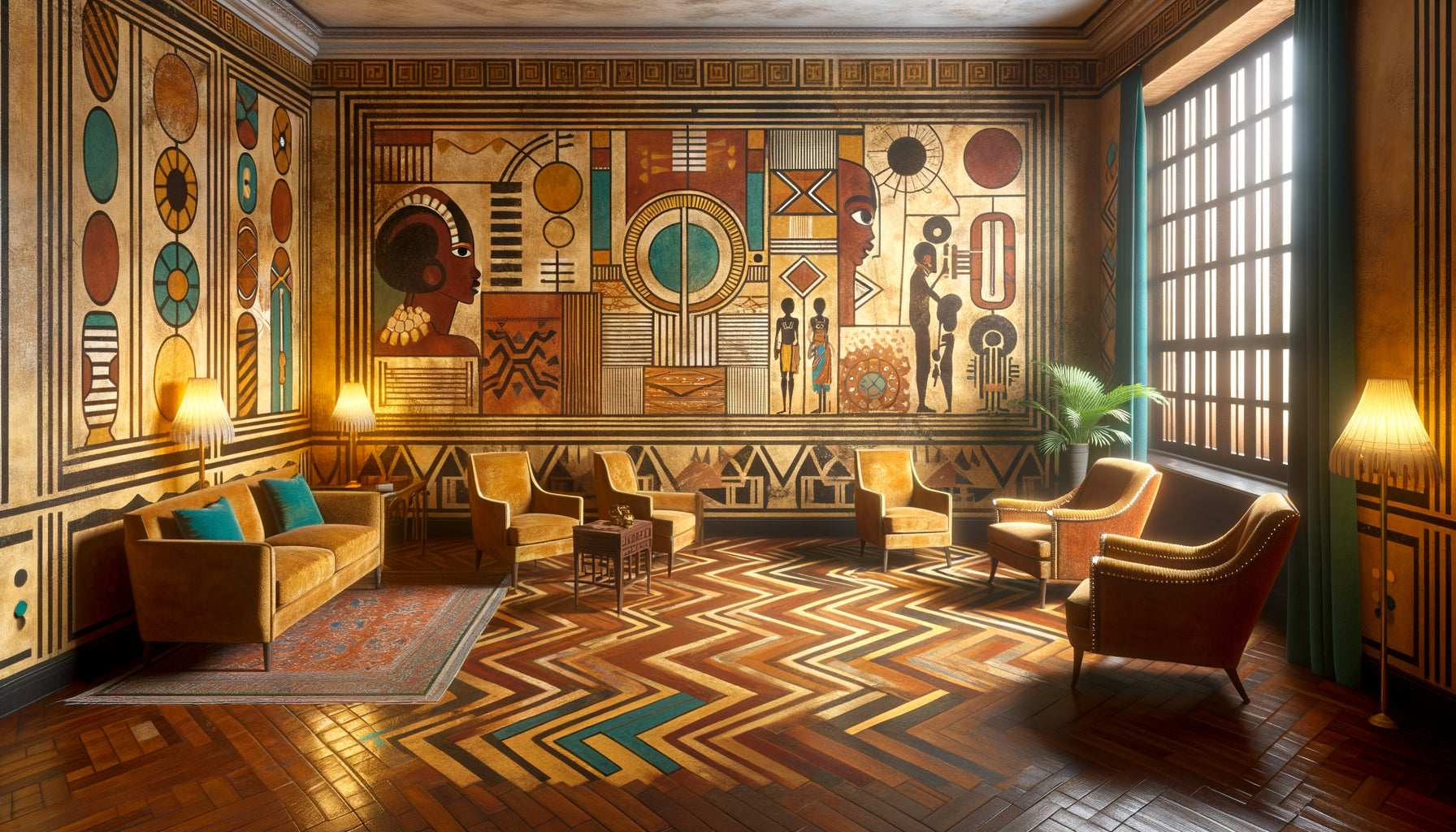
The authentic textural qualities of Sahelian plasters harmonize wonderfully with contemporary minimalism. Rather than reproducing the technique entirely (which requires specific know-how), start by incorporating their aesthetic codes: ochre and terracotta tones, matte surfaces and slightly irregular textures, play of light on subtle reliefs. Many manufacturers now offer lime plasters tinted with natural pigments that evoke this materiality. For a more authentic effect, call upon a craftsman specializing in earth techniques who will reproduce the gesture and composition on an accent wall – the investment is worth the beauty. The most accessible approach? Combine clay paints (available in specialty stores) with authentic African decorative objects: pottery, bogolan fabrics, wickerwork. Paintings inspired by Saharan art also create this dialogue between the modernity of your interior and the cultural depth of these ancestral techniques. Coherence comes from the mineral color palette and the valorization of imperfect natural materials.