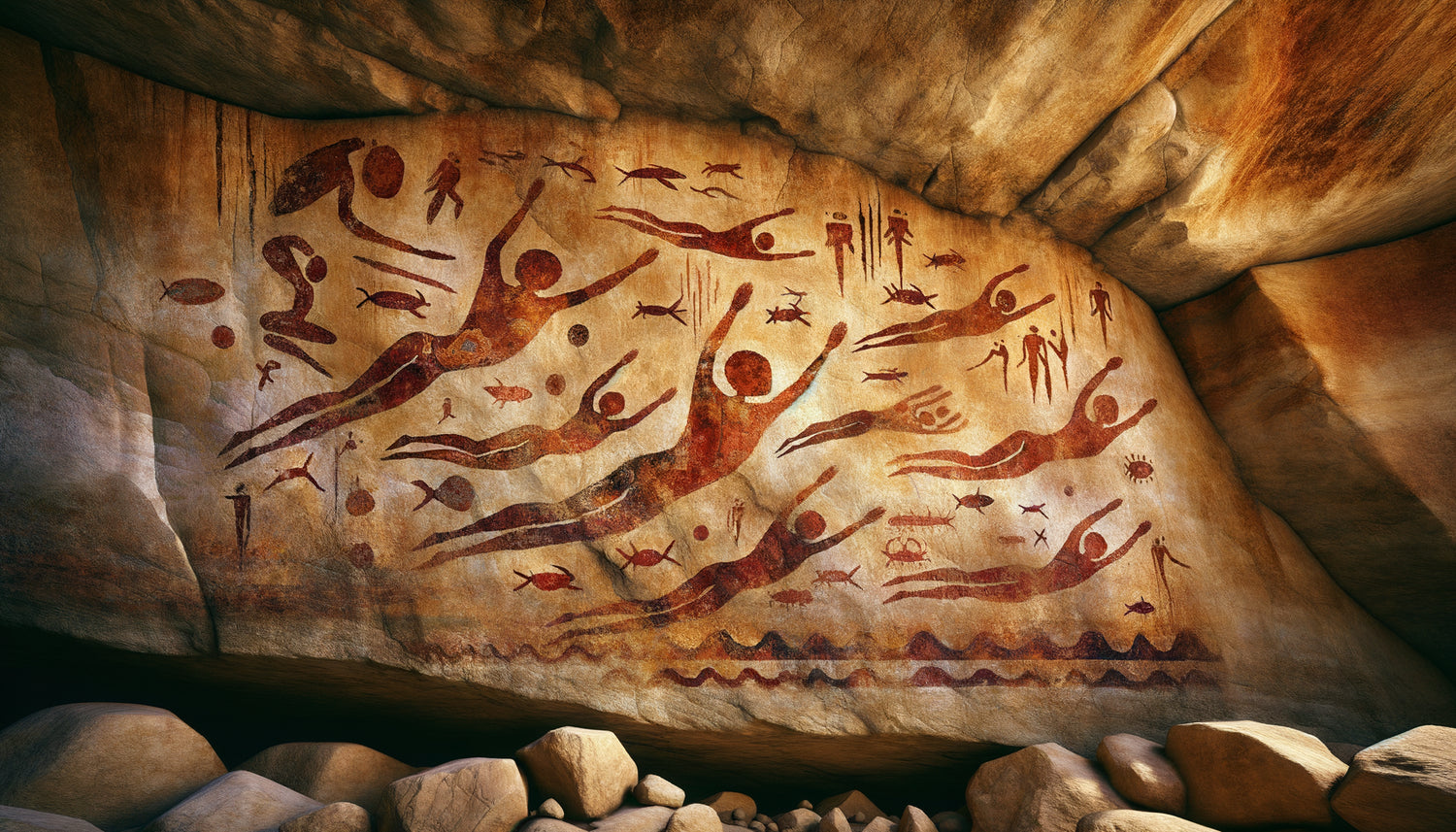
Imagine a moment: in the heart of the Egyptian Sahara, on the walls of a lost cave, human figures swim in water that no longer exists for millennia. These mysterious frescoes from the Gilf Kebir plateau, discovered in the 1930s, tell a fascinating story: that of a desert that was once a watery paradise. How can these rock paintings transform our view of the spaces we inhabit today?
Here's what the Sahara swimmers reveal to us: the impermanence of landscapes reminds us to honor every environment, the memory of places enriches our intimate connection to spaces, and ancestral beauty inspires a decoration full of meaning. These millennial frescoes are not just an archaeological mystery – they are an invitation to rethink our relationship with time, nature and art in our interiors.
You may be looking to create spaces that tell an authentic story, that carry depth beyond ephemeral trends. You feel the need to anchor your decor in something greater, something truer. The Gilf Kebir paintings offer precisely this resonance: they reconnect us to natural cycles and the long memory of humanity.
Through this journey between archaeology and decorative inspiration, you will discover how a Saharan mystery dating back 10,000 years can nourish your aesthetic sensitivity and transform your vision of interior design.
When the Sahara was a garden of water
The rock paintings of the Gilf Kebir plateau, located on the border between Egypt and Libya, depict astonishing scenes: human figures in swimming positions, giraffes, antelopes, crocodiles. These frescoes bear witness to a bygone era, between 10,000 and 5,000 years before our era, when the Sahara benefited from a humid subtropical climate.
This period, which paleoclimatologists call the African Humid Period, transformed what is now the largest hot desert in the world into a vast region dotted with lakes, rivers and lush meadows. The rock swimmers immortalized on the walls of the Swimmers' Cave – the most famous on the plateau – are not an artistic fantasy, but direct evidence of a disappeared hydrological reality.
The ochre and red pigments used by these Neolithic artists have crossed the millennia, preserved by the current extreme aridity. Ironically, it is the desert that now protects the memory of its own aquatic past. This permanence of art in the face of colossal climatic upheavals reminds us of the power of creation: to fix the beauty of a moment for eternity.
The mystery of the swimmers: several fascinating theories
Why do these figures seem to be swimming? Archaeologists are still debating the exact interpretation. Some see them as literal representations of swimming in ancient Saharan lakes. Others suggest that they may be ritual dances, arms raised evoking ceremonial movements rather than aquatic strokes.
A third hypothesis, more spiritual, suggests that these rock engravings symbolize a shamanic journey, a navigation between the visible and invisible worlds. The elongated postures, extended limbs could represent a trance state, a metaphorical floating in the collective unconscious.
What fascinates about these Sahara paintings is precisely this ambiguity. Like the greatest works of art, they resist a single interpretation. They invite each observer to project their own imagination, to create their own narrative. This semantic openness echoes contemporary decoration trends: favoring pieces that stimulate contemplation rather than univocal objects.

The decorative inspiration of lost civilizations
Integrating the memory of ancient civilizations into our interiors creates an emotional depth that fleeting trends cannot offer. The rock motifs – these stylized silhouettes, these warm ochres, these minimal compositions – resonate surprisingly with contemporary aesthetics.
The earthy tones of the Gilf Kebir paintings – these oxidized reds, these burnt ochres, these chalky whites – harmonize perfectly with the natural palettes sought after today. These colors carry within them the warmth of millennia-old sun, the texture of Saharan sandstone, the vital energy of disappeared nomadic populations.
The narrative minimalism of these prehistoric frescoes is also inspiring: a few lines are enough to suggest movement, emotion, life. This economy of means recalls that decorative power does not lie in accumulation, but in the precision of the gesture. A single meaningful piece can transform an entire space.
How to integrate this Saharan memory into your home
Creating a space that dialogues with the heritage of rock paintings does not mean literally reproducing these motifs – it would be missing their essence. It is rather about capturing their spirit: the connection to nature, the long temporality, the discreet spirituality.
Raw and mineral materials
Favor authentic materials: natural stone, terracotta, raw linen, patinated wood. These textures evoke the cave, the rocky wall, the natural shelter. They create a tactile sensoriality that anchors the space in materiality, far from the contemporary digital immateriality.
Artistic representations of the continent
Contemporary or traditional African artwork naturally extends the legacy of Saharan frescoes. They carry this same deep memory, this connection to the elements, this symbolic storytelling. An authentic piece becomes a meditative focal point, a daily reminder of the cultural richness that precedes and transcends our individual existences.
The balance between emptiness and presence
The walls of the Cave of Swimmers are not saturated: the figures float in space, surrounded by vast empty areas. This visual breathing is essential. In your decor, dare to embrace inhabited emptiness: clear walls that allow a few essential pieces to breathe and shine.

The ultimate lesson: the impermanence of landscapes
The swimmers of Gilf Kebir confront us with a dizzying truth: nothing is permanent. An aquatic paradise has become desert in just a few millennia. Our current environments – even those that appear most stable – are part of this same fluidity.
This awareness of impermanence may seem melancholic, but it is profoundly liberating. It invites us to honor each configuration of our habitat as a precious moment, to emotionally invest our spaces without the illusion of eternal fixity. Decorating then becomes an act of conscious presence: celebrating the present while honoring the past.
The Saharan rock paintings survive precisely because they were created with intention, with noble materials, in an approach that went beyond mere utility. They teach us that authentic aesthetic choices, rooted in a deep vision, cross time with a grace that superficial trends will never know.
Create your own spatial narrative
Every space we inhabit tells a story – consciously or unconsciously. The prehistoric frescoes show us that our Neolithic ancestors already understood this principle: places must carry memory, tell stories, bear witness. They transformed their shelters into narrative sanctuaries.
You can apply this ancestral wisdom to your contemporary decor. Choose objects that carry a story: a handcrafted piece whose origin you know, a work that resonates with your values, materials that bear witness to their transformation. These choices create an invisible but powerful emotional architecture.
Ancestral African motifs, in particular, offer this double dimension: immediate formal beauty and symbolic depth that unfolds gradually. They do not exhaust themselves at first glance – they invite constant rediscovery, like the walls of Gilf Kebir reveal new details with each visit.
Let the memory of the Sahara inspire your walls
Discover our exclusive collection of African paintings that capture the essence of ancestral civilizations and transform your interior into a space full of meaning.
Your space as a testament to the long passage of time
The paintings of Gilf Kebir ultimately offer us a lesson in temporal perspective. In an era of planned obsolescence and constant renewal, they embody the permanence of beauty. They invite us to design our interiors not as ephemeral decorations, but as strata that enrich over time.
Imagine your living room in ten years, in twenty years. Which pieces will have gained patina, depth? Which ones will seem dated, superficial? This mental projection naturally guides you towards more authentic, more durable choices – not out of ecological constraint, but out of desire for authenticity.
The swimmers of the desert, frozen in their eternal movement, remind you every day that true beauty transcends circumstances. That a dried-up lake cannot erase the grace of a gesture, that a changing climate cannot destroy the memory of life. Your space can carry this same poetic resilience: be a timeless refuge amidst contemporary turbulence.
Frequently asked questions about the rock paintings of the Sahara
Can you visit Gilf Kebir’s Swimmers Cave?
Yes, but access is very complex. The Gilf Kebir plateau is located in a remote area of the Egyptian desert, accessible only by 4x4 expedition with specialized guides and government permits. The journey takes several days from Cairo. However, you can admire high-definition photographic reproductions and documentaries that beautifully capture these millennial frescoes. To bring their spirit into your home, contemporary artistic interpretations offer an accessible alternative that also preserves these fragile sites from overtourism.
How did the Sahara transition from a humid region to a desert?
This fascinating transformation is the result of natural climatic cycles linked to variations in the Earth's orbit. Between 10,000 and 5,000 years BC, the African Humid Period brought abundant monsoons to the Sahara. Then, gradually, these precipitations decreased. Vegetation disappeared, exposing soils to wind erosion, creating a vicious cycle of aridification. This process unfolded over several millennia – populations had time to migrate progressively, leaving behind these rocky testimonies that immortalize their vanished world. This story reminds us of the fragility of environmental balances and the importance of our conscious relationship with the spaces we inhabit.
Why incorporate ancestral references into modern decor?
Ancient cultural references create a temporal depth that contemporary trends alone cannot offer. They anchor your space in a human continuity that transcends the present moment. Psychologically, these connections to the past provide a sense of stability and meaning particularly valuable in our era of rapid change. Aesthetically, African ancestral motifs – such as those inspired by rock paintings – bring an immediately perceptible visual authenticity. They dialogue wonderfully with contemporary design: the clean lines, stylized shapes, and natural palettes of tribal arts resonate perfectly with current aesthetic research. It's about creating a bridge between eras that enriches your daily life with a narrative and contemplative dimension.