In the stifling silence of Sudanese mortuaries, I first felt that temporal vertigo. Faced with these millennial frescoes adorning Kushite tombs, it is impossible to remain indifferent. Between Kerma and Napata, two cities separated by centuries and a few hundred kilometers along the Nile, a fascinating aesthetic revolution unfolds. These murals, silent witnesses to a little-known African civilization, tell more than just an artistic evolution: they reveal the profound transformation of an empire.
Here's what these Kushite frescoes bring to your understanding of ancient African art: a unique color palette that foreshadows modern expressionism, iconography that blends local traditions and Mediterranean influences, and above all, a new window into the funerary beliefs of a kingdom long eclipsed by neighboring Egypt. Many believe that Nubian art is merely a pale imitation of Egyptian art. Monumental error. These frescoes possess their own soul, a distinct visual identity that deserves our full attention. Allow me to guide you on this pictorial journey between Kerma, capital of the ancient Kingdom of Kush, and Napata, seat of power of the 25th Dynasty.
The frescoes of Kerma: the authenticity of a nascent kingdom
The tombs of Kerma date from 2500 to 1500 BC, a period when the Kingdom of Kush asserted its power against Egypt's Middle Empire. In these primitive burial chambers, the frescoes present a troubling graphic spontaneity. The artists of Kerma worked directly on the terracotta walls, applying natural pigments extracted from local ochres, charcoal and ground minerals.
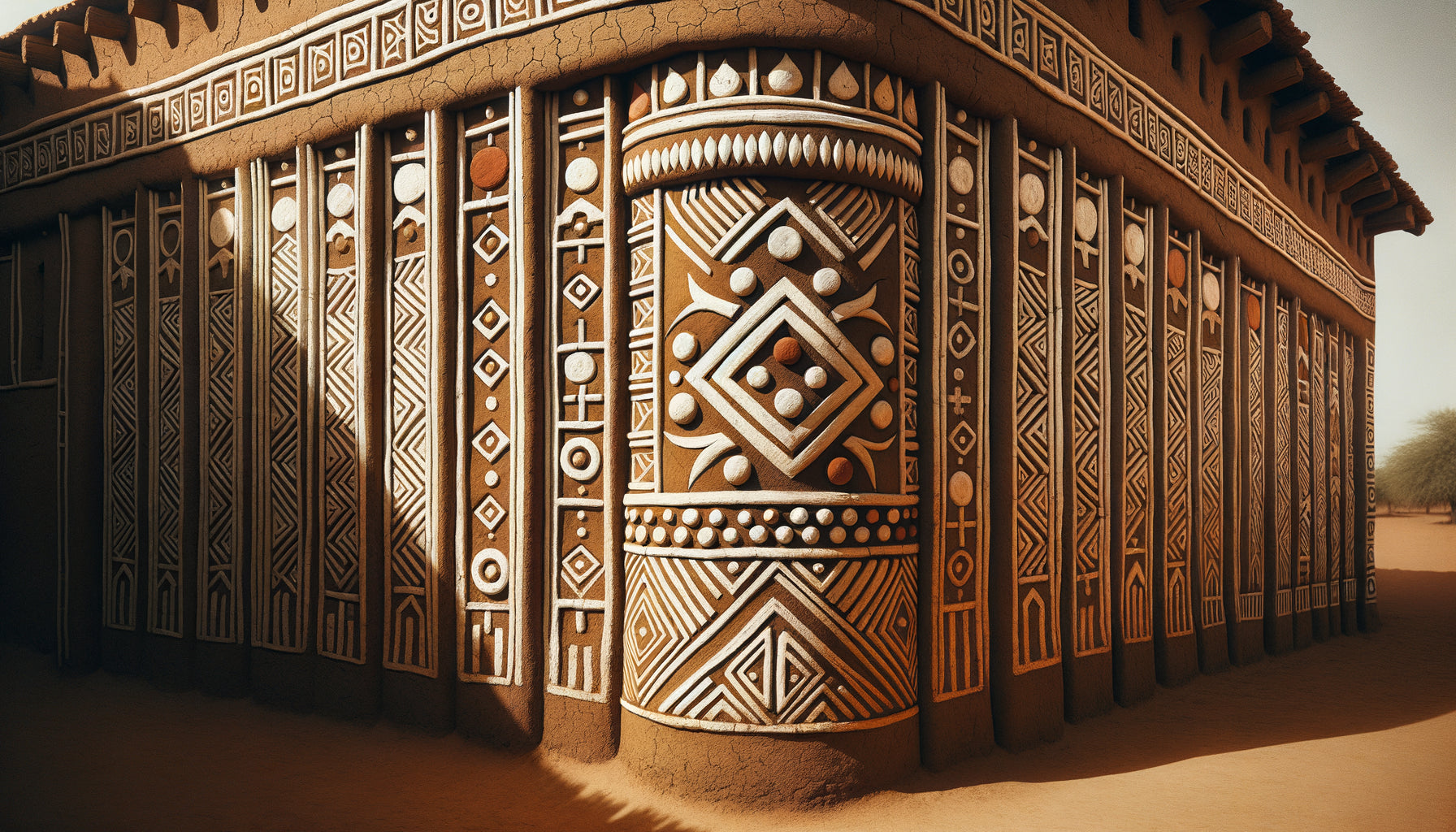
What immediately strikes is the predominance of geometric motifs. Unlike the figurative Egyptian art that would later dominate in Napata, the frescoes of Kerma favor abstraction: colored horizontal bands, concentric spirals, ocher and black checkerboards. This geometric aesthetic is not the result of technical incapacity, but a deliberate choice rooted in sub-Saharan African artistic traditions. The rare representations of humans or animals appear stylized, almost totemic, with free proportions that ignore Egyptian canons.
A mineral color palette
The pigments used in Kerma reflect the immediate desert environment: red and yellow ochres, deep blacks, chalky whites. No lapis lazuli blue, no malachite green like in Egypt. This chromatic sobriety gives the frescoes of Kerma a raw intensity, almost primitive in the most noble sense of the term. Kushite artisans exploited contrasts rather than gradations, creating graphic compositions of surprising modernity.
Napata: when Kush conquers Egypt and its visual vocabulary
Let's advance several centuries. We are now in Napata, around 750-300 BC, when the Kushite kings rule Egypt as pharaohs of the 25th Dynasty. The political context radically transforms artistic expression. The tomb frescoes of Napata, particularly those at the nearby sites of Nouri and El-Kurru, massively adopt Egyptian iconographic codes.
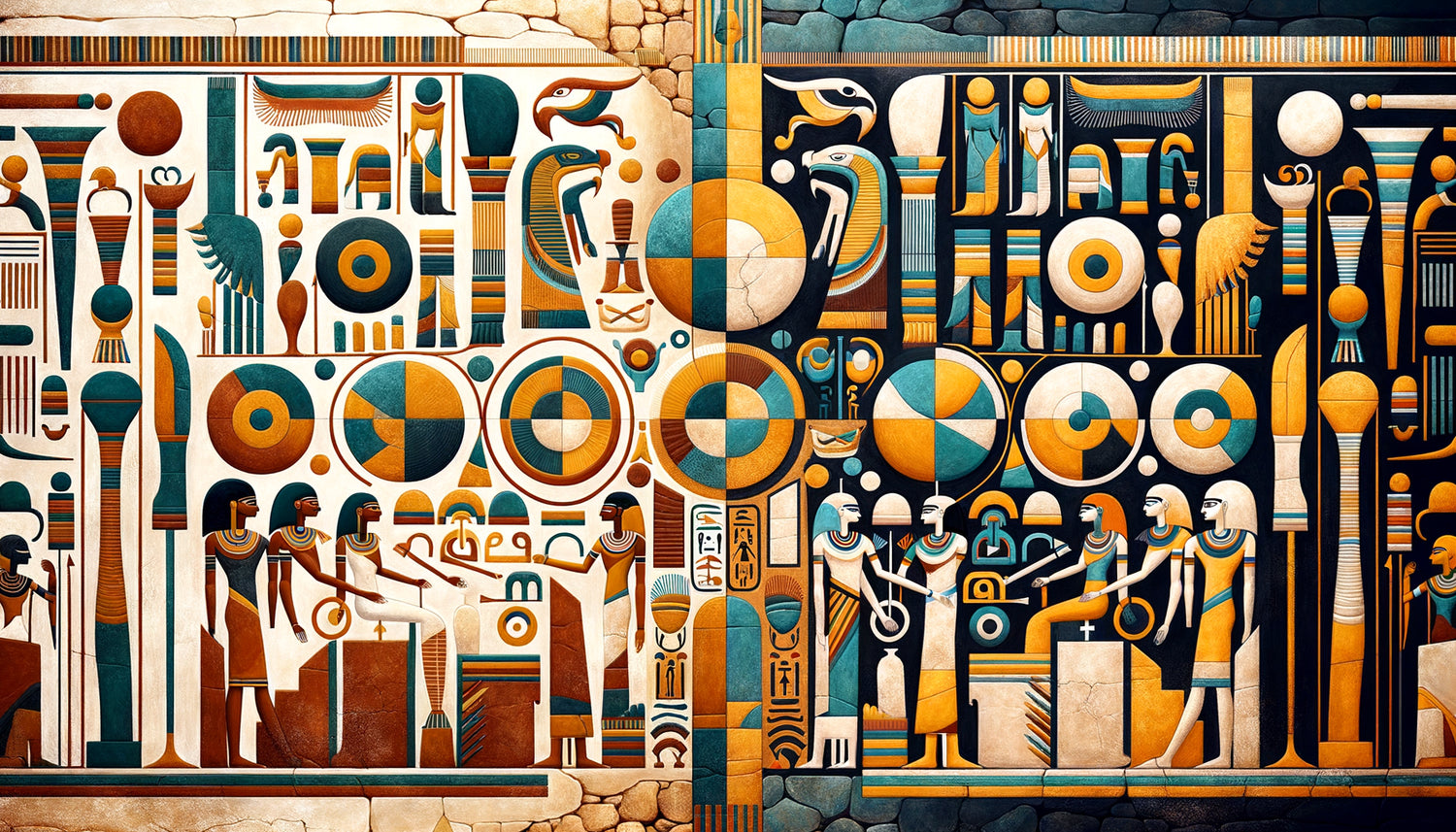
In these more monumental burial chambers, the walls are covered with complex narrative scenes. Egyptian deities appear: Anubis guiding the deceased, Osiris presiding over the court of the afterlife, Isis spreading her protective wings. Human proportions follow the classic Egyptian canon, with the head in profile, the eye facing forward, and the torso three-quarters view. Hieroglyphs systematically accompany the images, something almost absent at Kerma.
A subtle cultural fusion
But be careful: to say that Napata simply copies Egypt would be reductive. The frescoes of Napata reveal a sophisticated hybridization. Certainly, the narrative structure follows the Theban models, but details betray the Kushite identity. The facial features of the deceased display an assumed negroidity, with full lips and flared noses never represented in classic Egyptian art. Jewelry, hairstyles, and clothing blend Nubian and Egyptian traditions. Some scenes introduce local deities absent from the Egyptian pantheon.
The color palette is considerably enriched. The artists of Napata have access to refined Egyptian pigments: vibrant Egyptian blues, copper greens, vermilion reds. Backgrounds often become sky blue or gold, contrasting with the mineral sobriety of Kerma. This chromatic explosion testifies to intensified trade and a desire to assert a pharaonic status equivalent to that of the Egyptian dynasties.

Techniques and materials: two philosophies of conservation
The technical difference between Kerma and Napata is fundamental. In Kerma, the frescoes were applied directly to walls of raw bricks, sometimes coated with a thin layer of clay plaster. This rudimentary technique explains the fragility and scarcity of preserved frescoes. Pigments partially penetrated the porous support, creating a characteristic matte finish.
In Napata, Egyptian influence introduces the technique of painted stucco. Stone walls are covered with a fine, polished plaster coating, offering an ideal surface for meticulous details. Pigments are mixed with organic binders, allowing better adhesion and more vibrant colors. This technical sophistication reflects access to Egyptian expertise and superior material resources.
The dimensions of the compositions also evolve. The frescoes of Kerma, constrained by modest burial spaces, rarely measure more than two square meters. In Napata, royal burial chambers reach pharaonic proportions, with frescoes sometimes covering the entire walls, including ceilings, on surfaces exceeding twenty square meters.
Funerary symbolism: from animism to Egyptian eschatology
The very function of the frescoes undergoes a radical transformation between the two periods. In Kerma, geometric motifs and rare animal representations seem to fulfill a protective function rather than a narrative one. These paintings create a symbolic environment intended to accompany the deceased, without explicitly telling their post-mortem journey. The approach remains animistic, rooted in ancestral African beliefs where abstraction possesses an intrinsic magical power.
In Napata, frescoes become veritable visual guides to the afterlife. They illustrate the Book of the Dead, describe the weighing of the heart, show the trials that the soul must traverse. This didactic dimension reflects the adoption of complex Egyptian eschatology. The Kushite deceased in Napata now aspires to become an Osiris, to navigate the solar barque of Re, to pronounce the magical formulas inscribed on the walls.
The role of the elite in this transformation
This artistic evolution is not merely aesthetic: it reveals a social transformation. In Kerma, funerary frescoes remained relatively uniform, suggesting a society where elites shared the same symbolic universe as the people. In Napata, the iconographic complexity and material richness of royal frescoes create a visual gap between aristocratic tombs and common burials. Funerary art becomes a marker of social distinction, mimicking the extreme hierarchical organization of Egyptian society.

Influences and rayonnement: two moments in the history of African art
The Kerma frescoes are part of a continuum of sub-Saharan African artistic expression. Their geometric motifs echo in Berber art, contemporary Nubian pottery, and the decorative traditions of the Sahel. This pan-African aesthetic reveals little-known networks of influence, often obscured by Egyptian dazzle.
The Napata frescoes, on the other hand, are fully integrated into ancient Mediterranean art. They engage in dialogue with Theban tombs, likely influenced later Meroitic art, and bear witness to those fascinating moments when cultural boundaries become porous. Some art historians even see distant prefigurations of Coptic art that would emerge in Christian Egypt.
This difference in radiation paradoxically explains why Napata is better known than Kerma. Egyptian-style frescoes easily find their place in Western academic classifications, while the more abstract aesthetic of Kerma confuses some specialists trained exclusively on Mediterranean canons.
Let the soul of Kush invest your spaces
Discover our exclusive collection of African artworks that capture this ancestral visual power and bring authentic cultural depth to your interior.
The timeless lesson of these millennial frescoes
Standing before these painted walls, separated by centuries but united by the same Nubian land, we measure the extraordinary cultural plasticity of the kingdom of Kush. The frescoes of Kerma and Napata are not simply different: they embody two artistic philosophies, two relationships with the world, two definitions of identity.
Kerma reminds us that abstraction and geometry are not modernist inventions, but millennial visual languages, bearers of a profound spirituality. Napata shows us that borrowing is not betraying, that cultural assimilation can be an act of power rather than submission. Between these two poles, the genius of Kush fully expresses itself.
For those seeking inspiration in ancient African art, this duality is a treasure. It teaches us that authenticity does not require purity, that traditions evolve without denying themselves, that each era finds its own visual codes to say what is essential: we were there, we lived, we believed, we created.
Frequently asked questions about Kushite frescoes
Can we still see these frescoes today?
Yes, but with specific conditions. Kerma frescoes are extremely fragile and few have survived the millennia. The Kerma Museum in Sudan preserves a few precious fragments. For Napata, the royal tombs of El-Kurru and Nouri are sometimes accessible to visitors, although political conditions in Sudan complicate tourism. The Boston Museum and the British Museum also possess exceptional photographic reproductions made during the early excavations. If you cannot travel, look for exhibition catalogs dedicated to ancient Nubia: they offer high-definition reproductions that reveal details invisible to the naked eye in the gloom of the tombs. It is essential to keep in mind that these works remain threatened by humidity, looting and regional instability. Each documentation is therefore precious for posterity.
How do archaeologists date these frescoes with precision?
The dating of Kushite frescoes combines several complementary methods. First, stratigraphic analysis: the position of tombs in necropolises and their relationship with other dated structures provide a chronological framework. Then, the study of associated funerary objects, including ceramics whose stylistic evolution is well documented in Nubia. Hieroglyphic inscriptions at Napata sometimes mention the names of pharaohs, allowing for absolute dating. More recently, carbon 14 applied to the organic binders of pigments or plant remains in tombs refines these estimates. Finally, comparative stylistic analysis with independently dated Egyptian art helps to place the frescoes of Napata. For Kerma, the absence of writing complicates matters, but comparisons with ceramics and architectural developments allow for relatively reliable dating, within a few decades. This combination of methods explains why chronologies are sometimes revised as new discoveries are made.
Why is the art of Kerma so little known to the general public?
Several factors explain this unfair invisibility. First, Western Egyptomania since the 19th century has monopolized scientific and media attention, relegating neighboring cultures to the status of peripheries. Secondly, Kerma was excavated much later than major Egyptian sites, mainly in the 1910s-1920s and from the 1970s onwards. The frescoes, already rare and fragile, have less fueled spectacular Western museum collections. Their abstract aesthetics also confuse an audience accustomed to Egyptian or Greco-Roman figurative representations. Finally, the political situation of modern Sudan has limited archaeological tourism and international media coverage. However, the importance of Kerma is now recognized by specialists as the capital of one of the first African states. Recent academic publications and a few major exhibitions are beginning to correct this historical injustice. The art of Kerma fully deserves its place in museums and imaginations alongside Egyptian art.