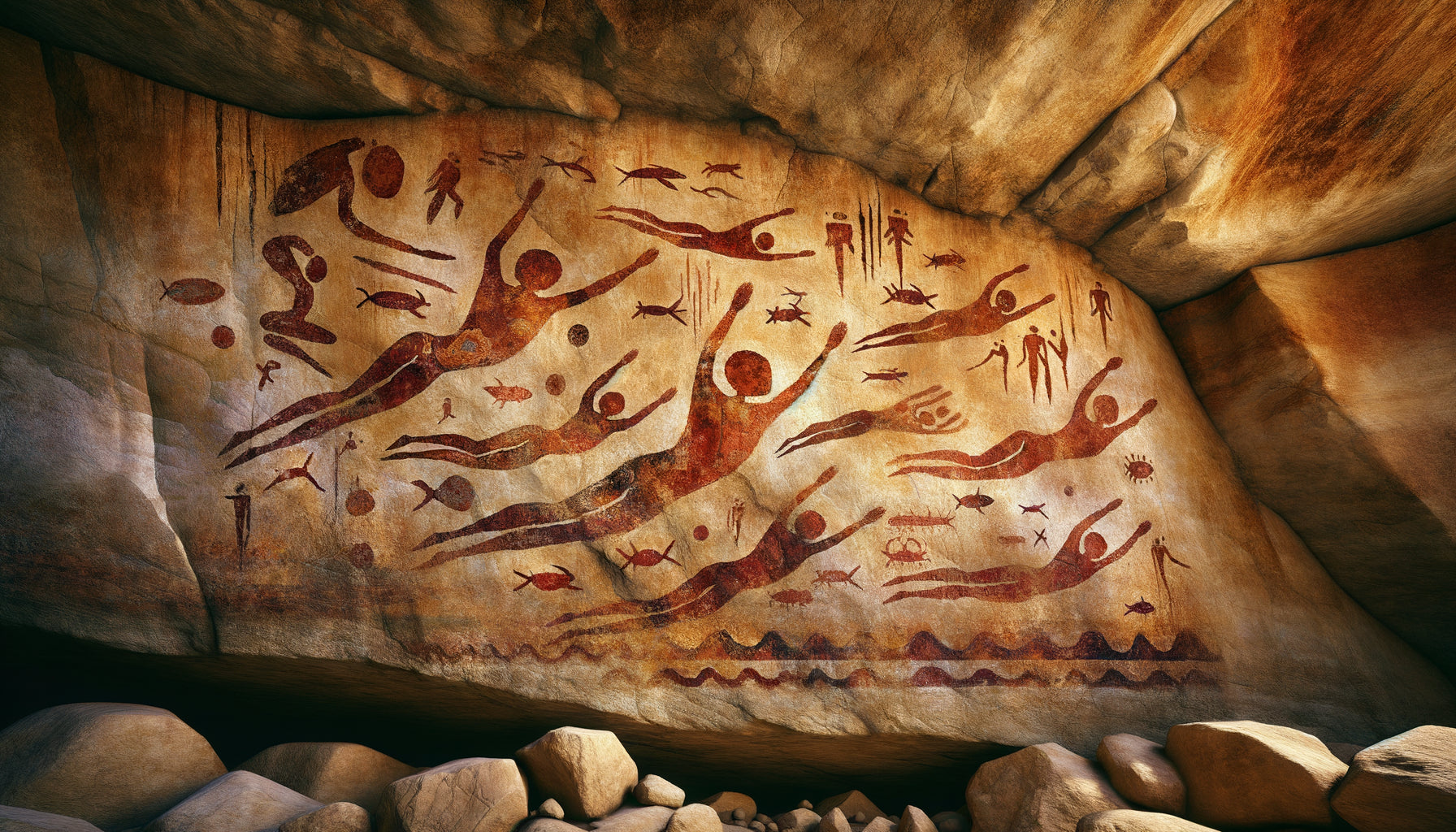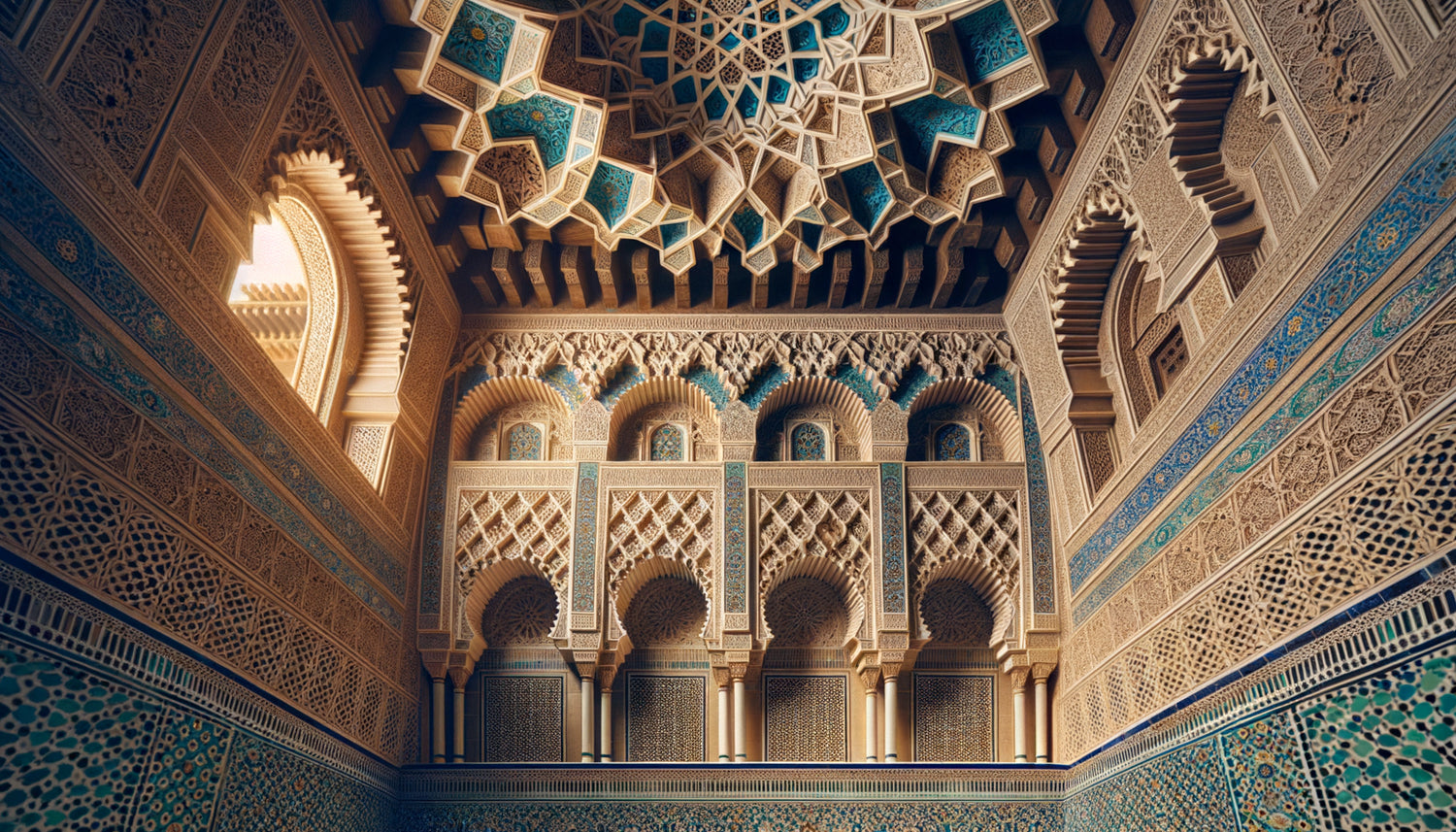
Imagine yourself in the patio of a Moroccan riad, your eyes raised to these geometric mosaics so perfect they seem to defy the laws of mathematics. These arabesques that wind along the walls, these sculpted stuccoes that capture the light... Every detail tells a millennial story, that of an artistic exodus which forever transformed Moroccan wall art. When Muslims and Jews fled Christian Spain between the 13th and 15th centuries, they did not only take their possessions: they transported architectural and decorative know-how that would transform Morocco.
Here's what the incorporation of Andalusian influences after the Reconquista brought to Moroccan wall art: unparalleled geometric sophistication, a mastery of sculpted stucco reaching heights of refinement, and a harmonious fusion between Berber traditions and Iberian innovations which still defines Moroccan aesthetics today.
You admire these Moroccan interiors in decorating magazines, you dream of recreating this enchanting atmosphere at home, but you wonder where this particular aesthetic really comes from? How to distinguish what is authentically Moroccan from what comes from elsewhere? This confusion is legitimate, because Moroccan wall art is precisely the result of an extraordinary cultural mix.
Rest assured: understanding this history requires no expertise in Islamic architecture. I will guide you through this fascinating journey that begins in the palaces of Granada and ends in the medinas of Fès and Marrakech. You will discover how and when these Andalusian influences penetrated Moroccan wall art, forever transforming its visual language.
At the end of this article, you will be able to identify these Andalusian elements in Moroccan wall art, understand their chronology of appearance, and integrate this knowledge into your decorative choices with authenticity and relevance.
The silent exodus that changed everything: 1248-1492
The story truly begins with the gradual fall of the Muslim kingdoms of Spain. Contrary to what is often imagined, Moroccan wall art did not wait until 1492 and the final fall of Granada to receive its Andalusian influences. The process began as early as the mid-13th century, with successive waves of migration.
In 1248, the conquest of Seville by Ferdinand III triggered the first major exodus of Muslim artisans to Morocco. These master craftsmen, maalems in Moroccan tradition, bring with them unprecedented techniques: sophisticated geometric zellige work, sebka motifs (a network of crisscrossed lozenges), and above all a mathematical approach to wall decoration that Moroccan wall art had never known with such precision.
Between 1248 and 1492, each Christian victory provokes a new migratory wave. The artisans of Cordoba, Toledo, Valencia flock to Fès, Tetouan, Rabat and Marrakech. Moroccan wall art gradually absorbs these contributions, creating a unique synthesis where Berber robustness meets Andalusian delicacy.
Early Manifestations: The Bou Inania Madrasa
If you are looking for the first masterpiece fully embodying these Andalusian influences in Moroccan wall art, visit (or contemplate photos of) the Bou Inania Madrasa in Fès, built between 1350 and 1357. Here, the walls bear witness to an aesthetic revolution: zellige panels reach a geometric complexity never before seen in Morocco, carved stucco reproduces the ataurique (vegetal arabesques) motifs characteristic of the Alhambra, and Kufic and cursive calligraphies intertwine in a sophisticated visual dance.
This madrasa marks a turning point: Moroccan wall art no longer merely decorates, it mathematizes space, creating these endless games of symmetry and repetition that still fascinate designers and decorators today.
1492: The Peak of Artistic Fusion
The year 1492 represents a cultural cataclysm but a golden age for Moroccan wall art. The fall of Granada triggers the mass exodus of thousands of Andalusian artisans, among whom are the greatest masters of Nasrid art. These artists carry within them the living memory of the Alhambra, that palace which represents the absolute peak of Western Islamic art.
They mainly land in Tetouan, Chefchaouen, Rabat and Salé, transforming these cities into new centers of excellence for Moroccan wall art. Tetouan becomes particularly the conservatory of Andalusian techniques: its white houses with interior patios reproduce Grenadine architecture, while its walls are adorned with extraordinarily fine sculpted stucco.
What characterizes this post-1492 period in Moroccan wall art is the systematic introduction of mocárabe (these suspended honeycomb structures) and painted wooden ceilings (artesonado) which reproduce Mudéjar craftsmanship. The palaces of the Saadian sultans in Marrakech, built in the 16th century, perfectly embody this synthesis: the central pavilion of the Saadian Tombs features a mocárabe ceiling of vertiginous complexity, directly inspired by Grenadine techniques.
The Visual Vocabulary Transformed
After 1492, Moroccan wall art considerably enriches its vocabulary. To the traditional Berber motifs (broken lines, protective symbols, earthy colors) are added the Andalusian refinements: elaborate epigraphic cartouches, polylobed and overhanging arches, twisted columns, and above all this obsession with geometrized nature which transforms every wall space into a mathematical garden.
The colors also evolve: deep cobalt blue, emerald green, pure white become dominant, reproducing the palette of the Alhambra. Moroccan wall art gains in luminosity and contrast, creating those atmospheres that we seek so much today in our interiors.

How to identify Andalusian influences in Moroccan wall art
To the untrained eye, all Moroccan wall art may seem homogeneous. However, certain clues make it easy to spot the post-Reconquista Andalusian contributions.
The most obvious Andalusian signatures:
Eight-pointed zellige star : Before Andalusian influences, Moroccan wall art favored simpler compositions. The complex rosettes with eight, twelve or sixteen branches come directly from Cordoba and Granada workshops.
Epigraphic friezes in cursive naskhî : Traditional Moroccan wall art mainly used angular Kufic script. Elegant cursive writing, where the letters stretch and dance, arrives with Andalusian calligraphers.
Painted coffered ceilings : Typically Andalusian, these alfarjes made of cedar wood painted with polychrome geometric patterns are absent from pre-Andalusian Moroccan wall art. Their presence systematically signals Iberian influence.
The sebka (diamond network) : This characteristic motif, which covers entire walls, comes directly from the Giralda in Seville and spread to Moroccan wall art after 1248.
Cities witnessing this transformation
If you want to visually understand this evolution of Moroccan wall art, certain cities are veritable open-air museums. Tetouan remains the most Andalusian, with its houses featuring understated facades but sumptuous interiors echoing Grenadine codes. Fes presents the first successful synthesis, as early as the 14th century. Marrakech offers the culmination with the Saadian palaces of the 16th century, where Moroccan wall art reaches its most refined form.
Each of these cities illustrates a different stage in the incorporation of Andalusian influences into Moroccan wall art, creating a fascinating historical continuum.
The living heritage in contemporary decoration
This millennial history is not just a museum memory. Moroccan wall art imbued with Andalusian influences inspires today's leading international decorators. Yves Saint Laurent's houses in Marrakech, riads transformed into luxury guesthouses, collections of contemporary wallpapers... all draw on this visual vocabulary born from the Reconquista.
When you integrate a zellige panel into your bathroom, a mirror with carved stucco framing in your entryway, or geometric-patterned cushions in your living room, you extend this extraordinary story. You create a bridge between the workshops of the Alhambra from the 15th century and your interior from the 21st century.
Moroccan wall art, enriched by its Andalusian influences, offers an inexhaustible decorative palette: historical authenticity, visual sophistication, symbolic depth. It is precisely this blend that seduces decoration enthusiasts seeking to move beyond fleeting trends to anchor their interiors in a timeless aesthetic.
Adapting Moroccan wall art to your interior
You don't need to transform your apartment into a riad to benefit from the beauty of Moroccan wall art. A few strategically placed elements are enough: a zellige panel as a headboard, wrought iron sconces reproducing sebka motifs, or a tiled wall fountain creating that characteristic water and light play.
The important thing is to understand the underlying logic: Moroccan wall art with Andalusian influence relies on harmonious repetition, sacred geometry and the horror vacui. Every square centimeter deserves attention, every surface becomes a support for contemplation. It is this maximalist decorative philosophy that creates these interiors that are both enveloping and soothing at the same time.
Are you fascinated by these stories of artistic migrations and their visual legacies?
Discover our exclusive collection of African paintings that celebrate other cultural migrations and extraordinary artistic fusions, to transform your walls into captivating visual narratives.

Your gaze will never be the same
From now on, when you contemplate a photograph of a Moroccan interior in a decoration magazine, you will no longer simply see « pretty patterns ». You will identify the eras, recognize the influences, and understand that these walls tell the poignant story of a people in exile who transformed their pain into beauty.
Moroccan wall art, imbued with Andalusian influences, born between the 13th and 15th centuries of the Reconquista, represents much more than a decorative style: it is living testimony to humanity's ability to create splendor in adversity, to fuse traditions rather than oppose them.
This week, take the time to observe a Moroccan decorative element in your home or public space. Look for clues: is it a complex geometric pattern suggesting an Andalusian influence? A cursive calligraphy? A coffered ceiling? Let your gaze linger on these details that you previously skimmed over. This is how history comes alive, and how your interior gains depth and meaning.
Frequently Asked Questions
Can you really differentiate Moroccan wall art from before and after Andalusian influences?
Absolutely, and it's easier than you might think. Pre-Andalusian Moroccan wall art, mainly inspired by Berber culture, favored simpler geometric patterns, earthy colors (ochres, reds, blacks), and a less systematic decorative approach. After the arrival of Andalusian artisans between the 13th and 15th centuries, Moroccan wall art gained considerably in complexity: geometric compositions become mathematically sophisticated, colors lighten and diversify (deep blues, emerald greens, pure whites), and above all, decoration becomes total, leaving no space empty. Sculpted stucco reaches a fineness comparable to lace, impossible to achieve without the techniques brought from Granada and Cordoba. If you see a Moroccan interior where every centimeter of wall is worked with the precision of a goldsmith, you are certainly contemplating the Andalusian heritage in Moroccan wall art.
Did these Andalusian influences affect all of Morocco in the same way?
No, and that's what makes Moroccan wall art so fascinating in its diversity. The cities of the north, particularly Tetouan, Chefchaouen and the coastal areas between Tangier and Rabat, received Andalusian influences massively and directly, as they were the first ports of arrival for refugees. Tetouan is even nicknamed the “daughter of Granada” so powerful is the Andalusian imprint there. Fez and Meknes, great intellectual and artistic capitals, integrated these influences more gradually but in a very sophisticated way, creating a unique synthesis. Marrakech and the south received these contributions later, often via itinerant artisans, which explains that Moroccan wall art from the south sometimes retains a more asserted Berber identity, with the use of raw earth (pisé) contrasting with the sophisticated zelliges of the north. This geography of influences means that Moroccan wall art is not monolithic: each region has developed its own interpretation of the Berber-Andalusian fusion.
How to authentically integrate these Moroccan wall art elements into your home without falling into kitsch?
The key lies in understanding the principles rather than literal copying. Moroccan wall art with Andalusian influence rests on three pillars: sacred geometry, harmonious repetition, and articulation between ornamented spaces and breathing spaces. Rather than overloading all your rooms with zellij tiles and stucco, choose a strong focal point: an authentic zellij panel in a bathroom, a mirror framed with stucco in an entrance hall, or a series of paintings with geometric patterns inspired by Moroccan wall art in a clean living room. Respect the original color palette (deep blues, greens, whites, golds) but adapt it to your lighting. Authenticity also comes from choosing materials: prioritize genuine artisanal zellij over industrial imitations, real stucco over molded resins. Finally, remember that Moroccan wall art traditionally created introspective and soothing spaces: avoid mixing it with too many other decorative influences. A successful interior allows each cultural tradition it welcomes to breathe. Moroccan wall art, with its seven centuries of Andalusian influences, deserves this dedicated space for contemplation.