

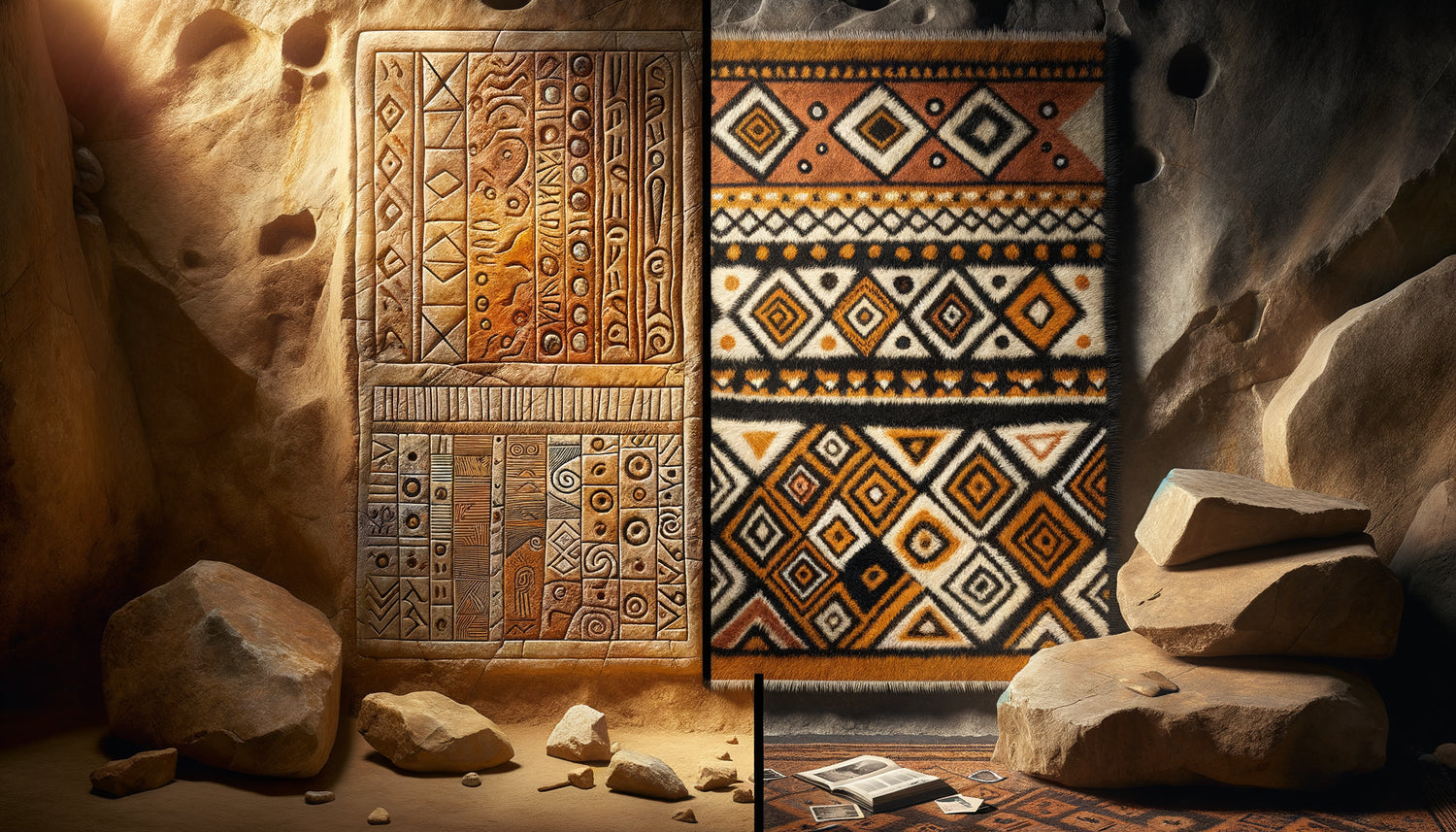
The first time I laid eyes on an antique Berber rug in a gallery in Marrakech, I felt a strange disturbance. These interlocking lozenges, these broken lines, these geometric symbols... I had seen them before. Not in another souk, but in the caves of Lascaux, thousands of kilometers and centuries away. How could such similar motifs arise in cultures separated by time and space? This question obsessed me for years, pushing me to explore the invisible bridges between Berber wall art and European prehistoric signs. Here's what these similarities reveal: a universal visual grammar rooted in the human psyche, a genetic heritage shared through ancient migrations, and a common symbolic vocabulary born of the same existential needs. You may be fascinated by tribal art without understanding why these shapes speak to you so deeply. Rest assured: this connection is not random, but the result of a millennial history that we will decipher together. Prepare to see your wall differently.
The universal language of signs: when the human brain speaks the same language
Neuroscience has confirmed it for us: certain geometric shapes emerge spontaneously in all cultures because they correspond to fundamental neural structures. The zigzag motifs, the spirals, the concentric lozenges that are found both in Berber wall art and in the caves of Pech Merle or Altamira are not coincidences. They reflect what researchers call phosphenes – those luminous shapes we perceive when we close our eyes tightly or during altered states of consciousness.
In prehistoric shamanic rituals as well as in Berber spiritual traditions, these trance states produced geometric visions that were then translated onto cave walls or woven into textiles. The human brain, whether it belongs to a Paleolithic Homo sapiens or a contemporary Amazigh weaver, generates the same visual archetypes. This universality explains why a modern Westerner feels an immediate familiarity in front of a Berber rug: his nervous system instinctively recognizes these primordial forms.
Forgotten migrations: when DNA tells another story
But there is more than just a simple neurological coincidence. Population genetics research has revealed unsuspected migratory flows between North Africa and prehistoric Europe. Iberomaurusian populations of North Africa, ancestors of today's Berbers, maintained contact with human groups in southern Europe as early as the Upper Paleolithic period, more than 20,000 years ago.
These exchanges were not limited to genes: they included symbolic systems, artistic techniques, shared mythologies. The scale patterns found engraved in the rock shelters of the Maghreb are strikingly similar to the scaly signs of the Pyrenean caves. The negative handprints of Chauvet cave echo the fingerprints adorning some Saharan rupestrian sites. This cultural continuity suggests a collective memory transmitted through generations, crystallized in persistent visual forms.
Berber wall art is therefore not solely a local tradition, but the heir to a much larger Mediterranean Paleolithic heritage, whose prehistoric European motifs are also descendants.

Symbols of survival: the common vocabulary of essentials
Beyond neurological and genetic explanations, there is a profoundly pragmatic reason for these similarities: the same existential challenges produce the same symbolic responses. Whether you are a Magdalenian hunter-gatherer or a Berber nomadic shepherd, your survival depends on your ability to read and represent your environment.
The ubiquitous chevron motifs in Berber wall art and prehistoric engravings probably represent water – a vital resource in both contexts. Interlocking lozenges often symbolize fertility, reproductive cycles, generational continuity. Broken lines evoke paths, migratory routes, territorial boundaries. This functional visual grammar transcends cultures because it responds to universal human needs: to orient oneself, to reproduce, to transmit.
In my comparative analysis, I was struck by the recurrence of the labyrinth motif: present in the Neolithic petroglyphs of Galicia as in traditional Berber tattoos, it symbolizes the initiation journey, inner transformation. These societies separated by time used the same language to express the same metaphysical questions.
The line and the point: when simplicity becomes eternity
There is something fascinating about the economy of means shared by Berber wall art and prehistoric parietal art. No sophisticated perspective, no subtle gradations – just the line, the point, the surface. This reduction to essentials is not a technical limitation, but a deliberate aesthetic choice that maximizes symbolic impact.
Berber artists, like their Paleolithic forebears, intuitively understand that geometric repetition creates a meditative state in the viewer. Alternating triangle friezes, diamond grids, series of chevrons generate a hypnotic visual rhythm that transcends decoration to touch on ritual. This minimalist aesthetic has endured for millennia because it corresponds to a fundamental truth: the impact of an image does not depend on its complexity, but on its ability to resonate with deep mental structures.
It is precisely this apparent simplicity that makes these patterns so adaptable to our contemporary interiors. A Berber rug naturally dialogues with minimalist architecture precisely because it shares with it this philosophy of less-is-more, this confidence in the power of pure form.

The ochre color: the pigment that crosses ages
We cannot ignore the strangely similar color palette between Berber wall art and prehistoric paintings. This dominance of ochres, earths, charcoal blacks, kaolin whites is not only a material constraint – it is a profound aesthetic choice that anchors the work in the earth itself.
In the caves of Lascaux as in the weavings of the Middle Atlas, these natural pigments create a visceral connection with the landscape. Red ochre comes from the soil beneath our feet, black from the wood that burned in our hearths, white from the chalk that structures our mountains. Using these telluric colors is to assert a belonging to a territory, to inscribe the work in a geological continuity that transcends human beings.
This chromatic sobriety also produces a particular psychological effect: it rests the eye saturated by the artificial colors of our modern environment, it creates a space for soothing contemplation. Integrating a piece of Berber wall art into a contemporary interior is to reintroduce this primitive palette that speaks directly to our limbic system, short-circuiting cultural filters.
Decoding similarities: what your wall can teach you
When you hang a piece of Berber wall art in your living space, you are not simply making a decorative choice – you are establishing a connection with a millennial cultural memory. These patterns that seemed exotic to you reveal their true nature: archetypal forms that resonate with your unconscious because they are part of the visual heritage of humanity.
Understanding the similarities between Berber wall art and prehistoric European motifs transforms our perspective. We cease to see these objects as ethnographic curiosities to understand them as temporal bridges, fragments of a universal visual language. This perspective greatly enriches the aesthetic experience: each lozenge becomes a meditation on human continuity, each broken line tells an ancestral migration.
In my practice, I always encourage my clients to dialogue with these pieces rather than simply exhibiting them. What emotion does this zigzag evoke? Why does this triangular motif attract you? These questions open doors to unsuspected layers of meaning, revealing how our modern psyche remains connected to the concerns of our distant ancestors.
Reconnect with 20,000 years of human history
Discover our exclusive collection of African paintings, which carry within them the visual memory of humanity and transform your walls into portals to our collective heritage.
Integrating this millennial wisdom into your daily life
The similarities between Berber wall art and prehistoric European motifs teach us a valuable lesson: the borders between cultures are porous, traditions intertwine, and humanity shares a common visual vocabulary forged by millennia of experience. Welcoming these forms into your interior is to honor this continuity, to create a space that dialogues with long time rather than with ephemeral trends.
Imagine yourself every morning facing these ancestral geometries, these timeless symbols that have guided, protected and inspired countless generations. Imagine how this daily presence can recalibrate your relationship with time, space, your own history. These motifs do not only decorate your walls – they create a visual sanctuary where the present and the Paleolithic meet, where your urban apartment becomes an extension of sacred caves and nomadic tents.
Start simply: choose a piece whose patterns speak to you instinctively, without intellectualizing. Let your primitive brain recognize these forms that have been familiar to it since time immemorial. You will discover that these millennial similarities are not cold objects of study, but living companions who silently enrich your daily life, weaving invisible threads between you and the immense chain of human experience.
Frequently Asked Questions
Do these similarities mean that the Berbers descend from prehistoric Europeans?
No, it's much more complex and fascinating! The similarities between Berber wall art and prehistoric European motifs result from multiple converging factors: ancient bidirectional migrations (North Africa also influenced Europe), the universality of human neurological structures, and similar symbolic responses to comparable environmental challenges. Berber populations have their own distinct genetic lineages, while sharing a distant African ancestor with Europeans. These patterns are more evidence of an interconnected humanity than of direct lineage. What's wonderful is that these forms prove that different cultures can develop similar visual languages while retaining their unique identity. When you admire a Berber rug, you celebrate this fascinating dialectic between universality and cultural specificity.
How to be sure that these patterns suit a contemporary interior?
It's precisely their antiquity that makes them eternally modern! The geometric motifs of Berber wall art work perfectly in contemporary interiors because they share the same aesthetic principles: economy of means, structured repetition, restrained palette, maximum visual impact with minimal forms. Scandinavian design, Japanese minimalist style, and contemporary architecture all prioritize these values. A Berber rhombus naturally dialogues with an Eames chair or a Muji sofa because they all respond to a quest for formal purity. Unlike decorative trends that quickly date, these millennial patterns possess temporal neutrality: they were modern 10,000 years ago, they are modern today, they will be in a century. Trust your intuition: if a prehistoric pattern touches you, it's because it responds to something essential within you.
Is it necessary to know the exact meaning of the symbols to appreciate them?
Absolutely not – and it might even be better not to intellectualize everything! The beauty of the similarities between Berber wall art and prehistoric patterns is that they communicate at a preverbal level. Your nervous system recognizes these forms before your intellect analyzes them. The artists who created these patterns were not writing theoretical manifestos: they were responding to deep creative impulses, spiritual intuitions, ritual necessities. You can perfectly welcome these works into your home by letting yourself be guided by the emotional resonance they evoke. Of course, knowing the cultural context enriches the experience, but that knowledge should remain at the service of feeling, not the other way around. Start with emotion: which pattern soothes you? Which energizes you? Which creates a sense of mysterious connection? Then, if you wish, explore possible meanings – you will often find that your initial intuition was surprisingly accurate.


