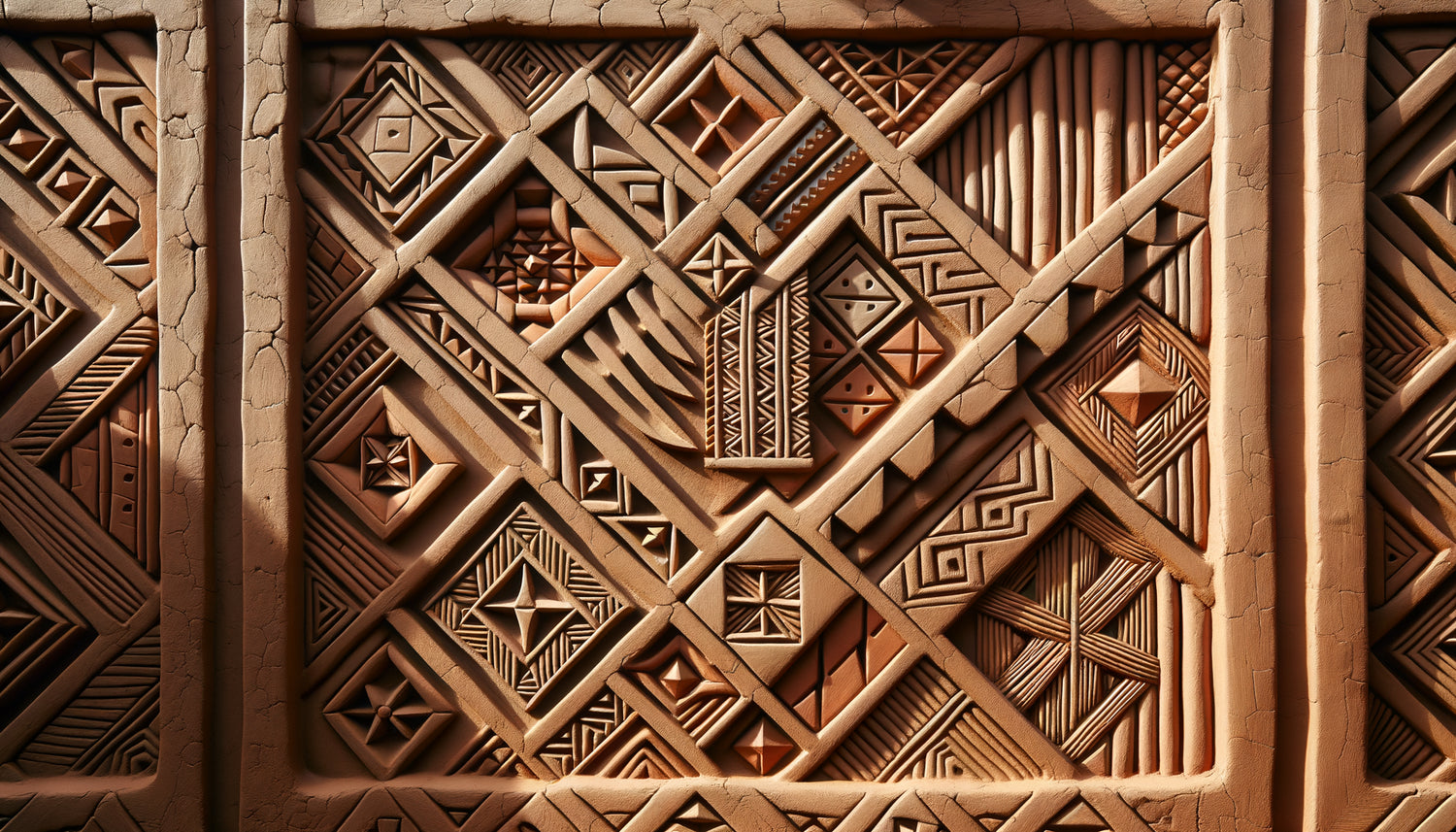
The first time I laid eyes on the Hausa facades of northern Nigeria, I thought I was hallucinating. Entire walls sculpted like lace, covered in geometric patterns of incredible finesse, shining under the Sahel sun in a palette of earth tones ranging from deep ochre to brick red and off-white. How did these women, armed with simple gourds and their expert hands, transform clay into living architectural masterpieces? This millennial tradition, known as zane (pronounced 'za-né'), is revolutionizing our perception of vernacular architecture and inspiring contemporary creators around the world.
Here's what colored clay brings to Hausa wall decorations: exceptional resistance to extreme climates thanks to stabilizing natural pigments, a sophisticated geometric aesthetic passed down from mother to daughter for centuries, and an evolving decorative system where each annual refurbishment becomes a new work of art.
The problem? Our Western interiors desperately lack this tactile and chromatic authenticity. We accumulate mass-produced decorative objects, devoid of soul or history, while exceptional ancestral techniques remain unknown. Worse still, this remarkable tradition is gradually disappearing in the face of modernity, whereas it holds secrets of durability and color harmony that our contemporary architects are only just rediscovering.
Good news: understanding the principles of Hausa wall decoration opens up fascinating perspectives for reinventing our living spaces. By exploring this technique where clay becomes structure, color and ornament all at once, you will discover timeless, ecological and deeply poetic decorative solutions. I take you to the heart of the villages of Kano and Zaria, where walls have been telling colorful stories for generations.
Hausa clay: much more than just a decorative material
In the Hausa world, clay is never neutral. Women – because they traditionally master this art – distinguish several types of clay according to their origin and properties. Lateritic red clay, extracted from the deep layers of the soil, offers a resistant base naturally pigmented. White kaolin clay, rarer and more precious, comes from specific deposits and creates those characteristic bright contrasts of festive facades.
But the real magic lies in the preparation. Each family has its secret recipes, passed down like treasures: the clay is mixed with millet husk to prevent cracking, enriched with vegetable decoctions to stabilize it, sometimes added with ash to modify its hue. This alchemy transforms an ordinary earth into a wall plaster capable of resisting torrential rains and 45°C.
The natural chromatic palette of the Sahel
The natural pigments used create a surprisingly sophisticated color range. The deep black comes from soot recovered from cooking pots or manganese oxide found in some soils. The bright white is born of pure kaolin or lime obtained by calcining seashells. Ochres, from pale yellow to brick red, depend on the iron oxides naturally present in different geological layers.
This seemingly limited palette generates extraordinary visual richness thanks to contrasts and superimpositions. An ochre background will receive white relief patterns, themselves outlined with black lines. Each color also has a cultural significance: white evokes purity and celebrations, red symbolizes protection, black defines and structures the visual space.
Wall decoration techniques: a know-how passed down from generation to generation
Watching a Haoussa decorator at work is like witnessing a millennial choreography. Crouching in front of her freshly plastered wall, she dips her hand into a gourd of colored clay and begins to model directly onto the surface. No preparatory sketch, no ruler or compass: everything is in gestural memory, in the precision of movement repeated since childhood.
The main technique is called 'zane and combines several approaches. First, the application of a base coat of red or beige clay to the entire wall. Then, while this layer remains slightly damp, the artist applies relief patterns by layering thicker ropes of clay. These reliefs, only a few centimeters high, create spectacular plays of shadows under the grazing morning and evening light.
The sacred geometric repertoire
The geometric patterns are never random. Each shape has a name and meaning. The 'checkerboard' (rubutu) evokes the Koranic tablets and knowledge. The 'nested triangles' (matsayi) represent the sacred mountains. The 'wavy lines' (rafi) symbolize rivers and fertility. The 'rosettes' (fure) embody the universe and its cosmic organization.
This decorative grammar is organized according to rigorous composition principles: a horizontal frieze always defines the base, visually protecting the bottom of the wall from splashes. A middle zone concentrates the most elaborate patterns, at eye level. The top of the wall, often less accessible, receives simpler but rhythmic decorations. This visual hierarchy creates a remarkable architectural harmony.

When architecture becomes ceremonial: festival houses
In the Hausa villages, not all houses are decorated in the same way. Ordinary homes receive a simple plaster, renewed annually. But during major events – weddings, baptisms, pilgrimages returns – facades transform into spectacular visual manifestos.
These ceremonial decorations mobilize several women from the family for weeks. They coordinate their efforts to cover the entire facade, sometimes on two levels, with patterns of astonishing complexity. The most precious colors – pure white, deep black – are reserved for these occasions. Some families even add mica flakes in the final plaster, creating a fairy-like shimmer at sunset.
The social dimension of this practice is fundamental. Decorating an adobe house with colored clay constitutes a collective female act, a moment of knowledge transmission, conversations and strengthening community ties. Young girls learn by observing their elders, test their first patterns on less visible areas, progress to master the most prestigious central compositions.
The unsuspected durability of decorative clay
You might think that these clay decorations remain fragile in the face of bad weather. Think again. The Hausa plasters develop remarkable resistance over time thanks to several ingenious factors. First, the preparation of clay with vegetable fibers creates a reinforced internal structure, like a vegetal reinforced concrete at a microscopic scale.
Next, the technique of applying in successive layers generates exceptional adhesion. Each new layer partially penetrates the previous one still slightly moist, creating a molecular fusion rather than a simple superposition. This interweaving makes peeling almost impossible.
The annual refurbishment cycle: creative maintenance
The real intelligence of the system lies in its regular maintenance. Rather than waiting for complete degradation, the Hausa consider annual refurbishment as a normal ritual, generally carried out after the rainy season. This preventive maintenance keeps the wall in excellent condition while offering an opportunity to renew the decor.
Each year, patterns can evolve according to trends, family events or simply the creative desire of the decorator. Some particularly successful compositions are preserved and simply refreshed. Other areas are completely redesigned. This permanent evolution transforms homes into architectural palimpsests where family history is inscribed.

Contemporary inspiration: when design rediscovers Haoussa clay
Today, architects and designers around the world are rediscovering Haoussa decorative principles. In Burkina Faso, the renowned architect Diébédo Francis Kéré incorporates references to traditional colored plasters into his contemporary projects. In Europe, several creators are experimenting with pigmented clay plasters to create wall textures that are both ecological and aesthetically powerful.
This renaissance can be explained by several factors. First, the quest for material authenticity in the face of saturation of plastic and industrial materials. Colored clay offers an incomparable tactile and visual presence, a chromatic depth that synthetic paint cannot reproduce. Secondly, environmental concerns: local, unprocessed clay is one of the most sustainable building materials.
For our interiors, the influence translates in multiple ways: walls made of pigmented earth in contemporary living rooms, geometric friezes inspired by Haoussa patterns, earthy color palettes that warm up minimalist spaces. European artisans now offer workshops to learn these ancestral techniques, adapted to our climates and habitats.
Want to integrate the soul of traditional Africa into your decor?
Discover our exclusive collection of African paintings that capture the chromatic richness and geometric sophistication of ancestral decorative arts.
Preserving and transmitting: the challenges of a living tradition
Despite this renewed interest, the Haoussa tradition of clay wall decorations faces serious threats. Rapid urbanization favors construction with cinder blocks and cement, perceived as more modern. Younger generations, educated and attracted to other careers, are learning these techniques less systematically from their elders.
Yet, promising initiatives are emerging. Cultural NGOs document traditional skills, create training workshops, and organize wall decoration contests that revitalize this practice. Some tourist villages in Niger and Nigeria use their decorated facades as an attractive feature, generating income that encourages the perpetuation of tradition.
The challenge goes beyond simple heritage conservation. These earth architecture techniques offer concrete answers to current climate challenges: local materials without transport, remarkable thermal inertia, total biodegradability, zero carbon emissions. Learning from these ancestral skills is not about looking back but ecological intelligence.
Next time you contemplate a white and smooth wall in your interior, imagine it transformed by these millennial techniques. Imagine your hands plunging into fresh clay, feeling its cool and malleable texture. Imagine tracing geometric patterns that dialogue with daylight, creating a work that will evolve over the seasons. The colored clay of the Hausa villages reminds us that a wall is never just a neutral surface: it is a living canvas, a skin of the house that can tell stories, celebrate beauty, and reconnect us to the essential gestures of inhabiting.
Start modestly: a small area of your interior, a pigmented clay plaster, a few simple patterns inspired by Hausa friezes. Let your hands rediscover the tactile pleasure of shaping the material. You are not simply decorating: you are participating in a human tradition that crosses centuries and continents, transforming humble earth into architectural poetry.