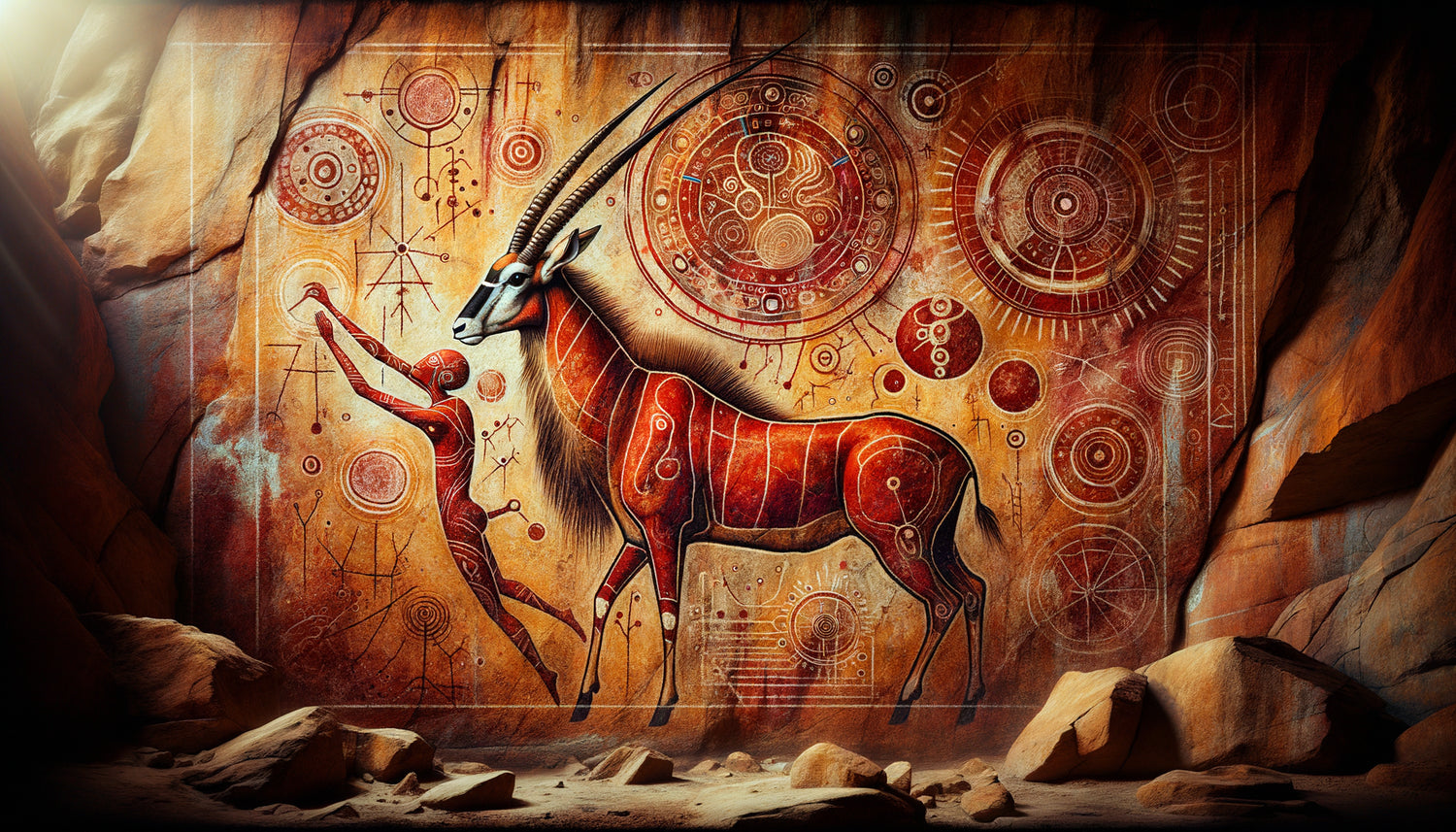
In the twilight of a South African cave, an ochre antelope seems to leap from the rocky wall. Its hind legs transform into human legs, its horns radiate a mysterious light. This image, thousands of years old, is not just a representation: it's a window onto the invisible, a moving testimony of a civilization that saw in each animal a messenger between our world and the beyond.
Here’s what the animal representations in Southern African rock art reveal: a shamanistic cosmology where the animal embodies spiritual transformation, a codified symbolic language that structures an entire society, and a powerful aesthetic that continues to inspire contemporary African art.
Perhaps you have admired these images in history books or documentaries, fascinated by their enigmatic beauty. But their deep meaning eluded you, drowned in academic explanations that transform these living works into mere archaeological vestiges. This distance is frustrating: how can one connect with an artistic expression so distant in time?
Yet, understanding these frescoes does not require a doctorate in anthropology. By decoding the recurring motifs, the transformations represented and the creation contexts, their symbolic language becomes surprisingly accessible. And this understanding enriches not only our view of ancestral art but also our way of inhabiting our spaces with a deeper awareness of the sacred.
I invite you on a journey to the heart of these rock sanctuaries, where each eland, each serpent, each hybrid creature tells a story of metamorphosis and cosmic connection.
The sacred eland: when the antelope becomes a spiritual portal
In the mountains of the Drakensberg and the caves of the Cederberg, one animal dominates all representations: the eland. This imposing antelope appears in nearly 40% of animal frescoes, often in impossible postures, with hooves that transform into human hands or a body traversed by lines of luminous energy.
For the San, these hunter-gatherers who painted these frescoes for nearly 20,000 years, the eland was not simply a valued prey. It was the animal of potential, that whose abundant fat symbolized concentrated spiritual power. San shamans entered trance to travel in the spirit world, and the eland represented this moment of passage, this transformation where humans access superhuman perceptions.
The frescoes often show elands dying or bleeding from the nose – a crucial detail. Because this nasal bleeding exactly reproduces what happens to shamans in deep trance. The animal thus becomes a mirror of human spiritual experience, a visible representation of an invisible state.
Hybrid creatures: mapping an inner journey
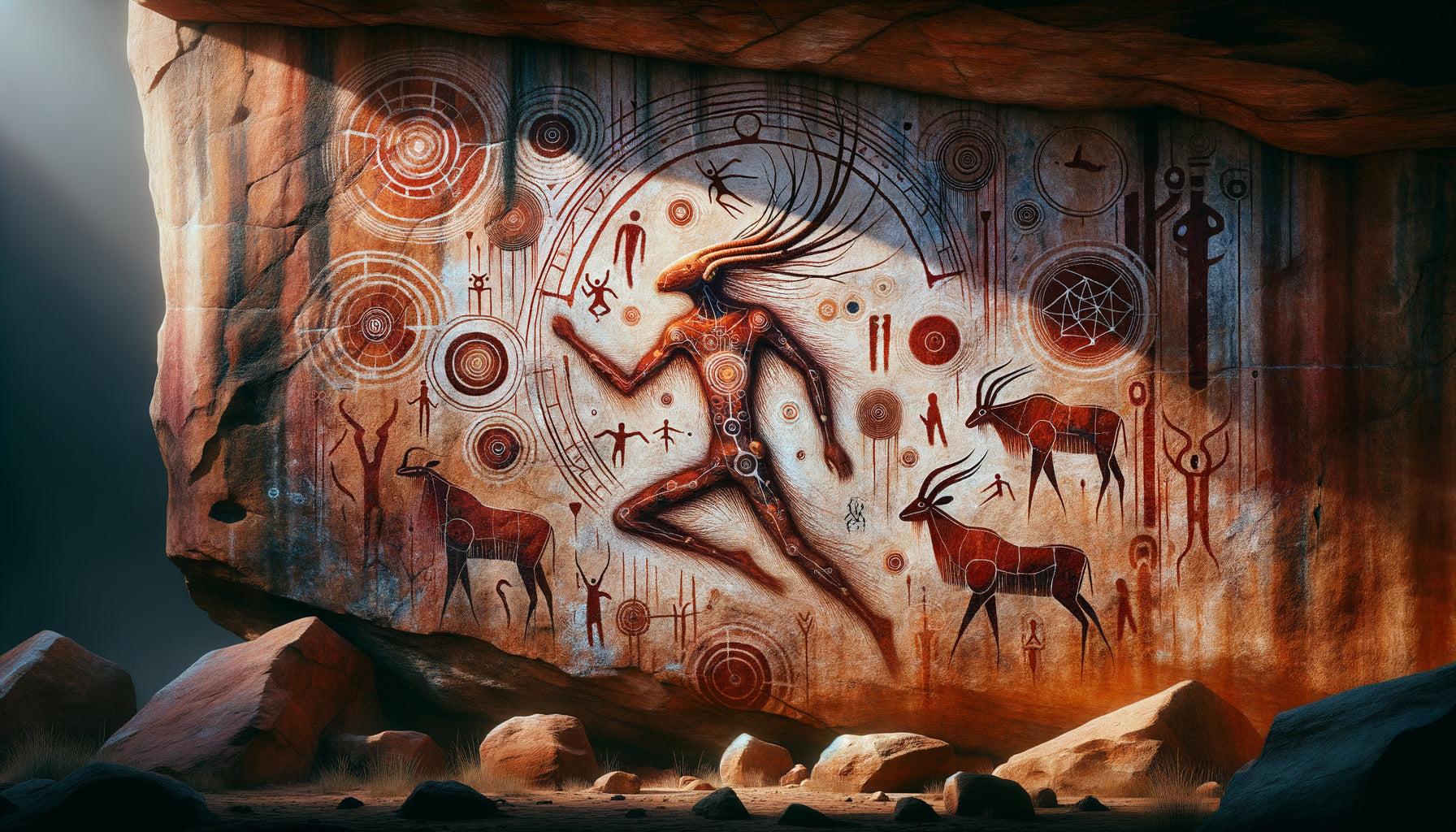
But the most fascinating animal representations are these impossible beings: antelope bodies with human heads, a four-hoofed creature carrying a hunter's bag, silhouettes that merge man and feline. These hybrids do not belong to the realm of fantasy, but to a precise mapping.
They document the stages of shamanic transformation. The spiritual practitioner, entering into trance, feels his body change: his legs become heavy as hooves, hair prickles on his nape, his vision sharpens like that of a predator. The frescoes fix these sensory metamorphoses with disturbing anatomical precision.
The bestiary of power: decoding the language of species
Each animal species represented carries a coded meaning in the San cosmology. The serpent, undulating along the rocky walls, embodies the longed-for rain in these semi-arid regions. Shamans « captured » water snakes during spiritual journeys to bring water back to the village.
The feline – leopard or lion – symbolizes danger and predatory power. But also the shaman's ability to navigate perilous spiritual territories. Wearing a leopard skin in rituals was borrowing its power, becoming capable of seeing in the darkness of the invisible world.
The rhinoceroses and hippopotamuses, despite their rarity in some regions, appear frequently. Their imposing mass represents extreme concentration of spiritual power, these cosmic forces that only the most experienced practitioners can face safely.
The small animals: don't overlook the details
Between the large antelopes and the spectacular hybrid creatures, observe carefully: you will find insects, tiny birds, lizards. These modest representations often carry the most intimate messages.
The bee, for example, connects to wild honey – a precious substance – but also to the buzzing that shamans hear in trance. Birds embody messengers, those auxiliary spirits who guide the practitioner on his journeys. Each creature, whatever its size, occupies a precise place in this spiritual ecology.

The dance with the animals: movement and ritual
The frescoes do not depict static animals. They leap, run, arch. And around them, human silhouettes adopt equally dynamic postures: bodies leaning forward, arms stretched back like wings, legs bent into positions impossible to hold for long.
These compositions capture trance dances, those rituals where the entire community clapped their hands and sang for hours to lead shamans towards an altered state of consciousness. The painted animals are not observed from the outside: they emerge from this collective experience, they are the shared visions that validated the spiritual journey.
The frequent superposition of figures – an eland painted over another, a human crossing the body of an antelope – reproduces this permeability between worlds. In trance, boundaries blur: past and present coexist, animal and human merge, the visible and the invisible touch each other.
Sacred geography: why these caves, these specific walls?
The San did not paint anywhere. They chose cracks in the rock, overhangs, natural cavities – all those places where the wall seemed already to open towards elsewhere. The rock itself was perceived as a membrane between our reality and the spiritual world.
Painting an eland near a crack meant marking the passage point that a shaman had taken during his trance. Animal representations functioned as maps, documenting the spiritual routes taken, the territories explored, the entities encountered.
Some caves concentrate hundreds of superimposed animals over several millennia: these are sanctuaries, places where the veil between worlds is particularly thin, where generation after generation of practitioners have come to strengthen the spiritual power of the site.
Ochre and blood: living materials, active paintings
The pigments themselves carried meaning. Red ochre, obtained from crushed hematite, was mixed with animal fat, blood, sometimes bodily fluids. This paint was not simply a medium: it contained the vital essence of creatures, it captured their power.
Applying this mixture to the rock wall was performing a ritual act, transferring spiritual energy from the invisible world to our material reality. Animal representations functioned as power condensers, reservoirs that the community could connect to.

Living Heritage: How Symbols Inspire Contemporary Art
These millennial animal representations are not dead curiosities, fossilized in inaccessible caves. They continue to irriguer l'imaginaire artistique africain contemporain, nourishing an aesthetic that celebrates transformation, hybridization, and the porosity of borders.
Many South African artists revisit these motifs: the stylized eland traversing abstract compositions, hybrid creatures reinterpreted as urban sculptures, ancestral ochres transposed into modern palettes. This continuity is not a nostalgic pastiche, but a dialogue vivant with a tradition that has always known how to represent the invisible.
Integrating these symbols into our interiors – with respect and awareness of their origin – means inviting this puissance transformatrice into our daily spaces. It recognizes that art is not just decoration, but a portal to other dimensions of human experience.
Let Ancestral Power Transform Your Space
Discover our exclusive collection of African artworks that capture this millennial spiritual energy and create an authentic connection with the rock art of Southern Africa.
Inviting the Sacred into Your Daily Life
Understanding the animal representations in the caves of southern Africa means accessing a vision du monde où chaque créature porte un message cosmique. It recognizes that art can be much more than decoration: a spiritual language, a transformation technology, a living memory.
The next time you contemplate a work inspired by these ancestral frescoes, you will no longer simply see a stylized antelope or a fantastic creature. You will recognize the chaman en voyage, the membrane between worlds trembling, an invitation to perceive beyond the visible.
These animals painted millennia ago on rocky walls continue to remind us of an essential truth: we are surrounded by presences, symbols, passages to other dimensions of existence. It is enough to learn to see, to listen, to let boundaries soften.
Start simply: choose a representation that calls to you, place it in a space where your gaze naturally rests, and let it tell its stories. The eland awaits to guide you.
Frequently Asked Questions about Southern African Wildlife Murals
Why is the eland so prevalent in cave animal depictions?
The eland holds a central place because it embodied concentrated spiritual power for the San. Its abundant fat symbolized shamanic energy, and its behaviors during death – tremors, nosebleeds – exactly reproduced the symptoms of spiritual trance. Shamans identified with the eland during their journeys into the invisible world, considering it the animal of transformation par excellence. Painting an eland on rock walls was capturing and preserving this spiritual power so that the community could connect to it during later rituals. This intimate relationship between the antelope and the shamanic experience explains why the eland often appears in impossible postures or with human-animal hybrid characteristics.
Are the half-human, half-animal creatures purely imaginary?
No, these hybrid representations do not stem from fantasy but document real sensory experiences lived in trance. When a San shaman entered an altered state of consciousness, he felt his body physically transform: his legs became heavy as hooves, hair stood on the back of his neck, his vision changed. Artists faithfully represented these bodily metamorphoses, creating a visual map of the spiritual journey. These hybrid creatures also served as instruction manuals for future practitioners, indicating them the expected steps and sensations during trance. They also validated the authenticity of the shamanic experience: seeing one's body transform like this proved that one had truly crossed the veil separating our world from the spiritual realm.
How can these symbols be respectfully integrated into a contemporary interior?
The key is to approach these animal representations with awareness of their sacred dimension rather than as simple decorative motifs. Prioritize works created by artists who understand the spiritual origin of these symbols and reinterpret them with respect. Place these pieces in spaces of contemplation – not in frenetic passageways – where their presence can truly be felt. Learn about the specific meaning of the animal depicted: an eland brings an energy of transformation, a snake invites abundance, a feline evokes protection. This knowledge transforms your relationship to the work, which then becomes a point of conscious connection with a millennial tradition. Avoid disordered accumulation: it is better to have one chosen representation with intention than a superficial collection.