


Traditional Brittany Wall Art
Our Brittany Painting Traditional collection celebrates the authentic soul of Brittany. Discover works that capture traditional Breton art through its iconic coastal landscapes, charming villages, and rich cultural heritage. Each creation evokes the timeless beauty of the Breton coasts, between majestic lighthouses and authentic Breton scenes of life. Transform your space with these paintings that embody the strength and poetry of eternal Brittany.
 Breton Woman Art Nouveau Painting - Golden Traditional Headdress - Brittany Edition273,90 €
 Breton Musicians Painting - Bagpipe and Biniou Players - Brittany Edition273,90 €
 Three Breton Generations Painting - Heritage in Headdresses - Brittany Edition273,90 €
 Traditional Breton Couple Painting - Historical Portrait - Brittany Edition273,90 €
 Breton Dancer Painting - Whirlwind of Tradition - Brittany Edition228,90 €
 Breton Woman in Headdress Painting - Traditional Portrait - Brittany Edition228,90 €
 Breton Harpist Painting - Celtic Melody - Brittany Edition228,90 €
Explore further
In Traditional Brittany Wall Art



All about Traditional Brittany Wall Art
- Traditional Breton Wall Art Presentation
- Symbolism and Authenticity
- Architecture and Heritage
- Timeless Maritime Atmosphere
The traditional Breton wall art embodies the essence of a centuries-old artistic heritage, where rural Breton scenes, folk costumes and authentic coastal landscapes intertwine in a faithful representation of Breton cultural identity. These large-scale wall artworks capture ancestral traditions, from religious processions to village festivities, including bygone trades such as sardine fisheries, fishermen in traditional boats and buckwheat cultivators. Each creation reflects a timeless Brittany, far from modern interpretations, favoring historical accuracy and ethnographic authenticity. For lovers of artistic representations of the region, exploring a collection of Breton wall art allows you to discover different aesthetic approaches while maintaining this regional essence.
The Breton Soul Captured in Traditional Wall Art
Why does traditional Breton costume dominate these artistic representations?
The traditional Breton wall art places paramount importance on headdresses, embroidered collars and ornate aprons that distinguish each Breton region. These clothing elements are not mere decorative details, but embody the parish identity of an era when each village proudly displayed its textile particularities. The large-scale wall compositions faithfully restore the variations between Bigouden, Giz Fouen or Pont-Aven costume, transforming each artwork into an ethnographic testimony.
Religious symbolism permeates these representations deeply, with pardons, monumental calvaries and parish closes occupying a central place in the composition. Village processions, sea blessings and outdoor liturgical ceremonies are preferred subjects, reflecting the importance of Catholicism in structuring traditional Breton society. These scenes are particularly suitable for interiors seeking to affirm cultural affiliation or genealogical attachment to Breton roots.
The iconography of ancestral Breton trades
Traditional Breton professions form the narrative heart of these large-scale wall compositions. Representations of lace-makers at work, wooden clog makers, linen spinners or seaweed gatherers document a disappeared economic world. These traditional Breton wall artworks depart radically from contemporary tourist visions to privilege documentary accuracy.
Breton agricultural life, with its buckwheat fields, Breton draft horse teams and granite stone farms, constitutes another thematic pillar. Scenes of threshing, artichoke harvesting or plowing in the Léon lands capture authentic rurality. For those who also appreciate historical architectural structures, a Breton castle wall art offers a complementary perspective on regional built heritage.
How to integrate these cultural testimonies into contemporary interiors?
Installing a large-scale traditional Breton wall art requires reflection on the narrative coherence of the space. These artworks function ideally in family reception rooms, convivial dining rooms or spaces dedicated to genealogical memory. Their presence affirms cultural continuity, particularly in Breton secondary residences or interiors of descendants of Breton emigrants.
Association with authentic heritage elements strengthens their impact: Breton rustic furniture, Quimper earthenware, carved chests or comtoise clocks create a coherent environment. These wall compositions also dialogue with solid oak floors, exposed beams and stone fireplaces, architectural elements that favor their enhancement.
Architecture and Landscapes of Authentic Breton Terroir
Granite villages and their traditional pictorial representation
The traditional Breton wall art pays particular attention to regional building materials: pink granite from the Pink Granite Coast, slate from the Monts d'Arrée, or limestone from the Vannetais. These wall compositions document vernacular architecture that has disappeared or is threatened, with its steep slate roofs, pediment dormers and thick walls resistant to Atlantic storms.
Traditional coastal hamlets, with their fishermen's houses facing the sea, stone staircases descending to the slipways and fish-drying sheds, constitute recurring subjects. These representations capture the specific spatial organization of Breton maritime communities, where housing adapted to the constraints of sea work. The large dimensions of these artworks allow for restoring the architectural density of historic towns such as Locronan, Le Faou or Rochefort-en-Terre.
Why do traditional port scenes still fascinate?
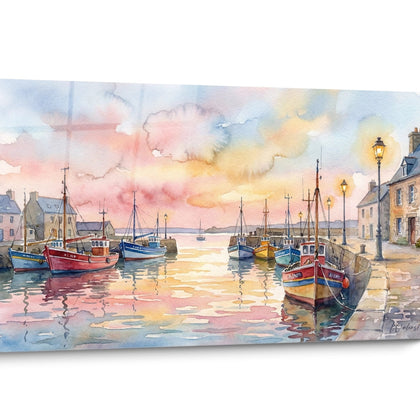
Bygone port activities, with their langoustine boats, sardine dundees and oyster sloops, occupy a privileged place in traditional Breton iconography. These large-scale paintings document the technical gestures of sailing, hauling vessels, mending nets or landing catches. To deepen this maritime theme, a Breton port wall art offers complementary perspectives on the regional port universe.
Traditional fish markets, with their human effervescence and complex social organization, provide rich narrative scenes. Fish sellers in traditional costume, fish merchants and buyers create a disappeared social choreography that these traditional Breton wall artworks perpetuate. The integration of these artworks is particularly suitable for seafood restaurants, historic nautical clubs or interiors of maritime history enthusiasts.
The importance of lighthouses in traditional Breton imagination
Breton lighthouses, veritable granite cathedrals standing against the elements, symbolize the centuries-old struggle against maritime perils. Traditional representations favor emblematic lighthouses such as Ar-Men, Créac'h or La Vieille, often accompanied by storm scenes or changing of the guard. These monumental compositions restore the daily heroism of lighthouse keepers and the exceptional engineering of these structures. Lovers of this specific theme will find in a Breton lighthouse wall art artworks dedicated to these maritime sentinels.
Sea rescue scenes, with National Maritime Rescue Society lifeboats maneuvering in crashing waves, constitute another powerful traditional subject. These representations document the courage of volunteer crews and the maritime solidarity characteristic of Breton coastal communities. Their presence in an interior evokes values of commitment, courage and collective mutual aid.
Climatic Atmospheres and Lights of Traditional Brittany
How do Breton skies structure traditional composition?
The traditional Breton wall art grants determining importance to atmospheric conditions specific to the Armorican peninsula. Turbulent skies, with their stratified cloud accumulations, sudden clearings and grazing lights, often constitute more than half of the compositional surface. This celestial predominance reflects Breton climatic reality where rapid weather variations create dramatic ambiances.
Representations of morning mists enveloping valley gorges, squalls crossing bays or sunsets aflame over the moors capture regional light variability. These atmospheric effects do not stem from artistic stylization but document meteorological phenomena characteristic of the Breton oceanic climate. The large dimensions of these artworks allow for restoring the immensity of coastal landscapes and the constant interaction between land, sea and sky.
Moors and peat bogs in traditional iconography
Heather moorland spaces, furze and broom occupy a significant place in the traditional Breton repertoire. These semi-desert expanses, dotted with granite chaos, standing stones and burial mounds, evoke the mysterious and Celtic dimension of Brittany. Traditional Breton wall artworks document these landscapes before their agricultural transformation or reforestation, testifying to ecosystems that are now rare.
The peat bogs of the Monts d'Arrée, with their dark waters, sphagnum moss and particular vegetation, constitute less frequent but highly evocative subjects. These humid environments, often associated with Arthurian legends and Breton fantastic narratives, add a narrative dimension to compositions. Their representation suits interiors seeking connection with regional mythology and folklore.
What chromatic palette defines traditional Breton authenticity?
Earthy tones dominate traditional compositions: ochres of plowed earth, browns of disappeared thatched roofs, grays of granite and slate. These sober colors contrast with punctual touches of indigo blue from male costumes, red from festive skirts or immaculate white from female headdresses. This chromatic restraint radically distinguishes traditional artworks from contemporary interpretations with saturated palettes.
For those who appreciate a more luminous chromatic approach while preserving regional essence, a Breton watercolor wall art offers an alternative to softer tones. Conversely, lovers of particular light treatment can explore a Breton impressionist wall art, which offers a complementary vision while remaining anchored in Breton identity.
What spaces best enhance large-scale traditional Breton wall art?
Main living rooms such as family living rooms or dining rooms constitute the privileged locations for these monumental artworks. Large wall surfaces, ideally above a Breton dresser or solid oak console, allow for optimal contemplation. Personal libraries, offices of professionals from Brittany, or reception rooms of Breton cultural associations also offer pertinent integration contexts.
How does traditional Breton wall art integrate into non-regionalist decoration?
The insertion of a traditional Breton artwork into a contemporary or eclectic interior creates a powerful narrative focal point. The approach consists of treating the artwork as a historical testimony rather than a coordinated decorative element. This juxtaposition generates productive aesthetic tension, where the documentary authenticity of the artwork dialogues with surrounding sobriety. Minimalist interiors, with their pared-down surfaces and neutral palettes, paradoxically make the narrative density and chromatic richness of these traditional compositions stand out.
Why choose traditional Breton wall art over historical photography?
Traditional pictorial representation offers an interpretive synthesis that no photograph can equal. The traditional artist selects, composes and accentuates characteristic elements to create an essence of Bretonness rather than a documentary instant. This synthetic approach generates superior evocative power, particularly in large dimensions where the richness of details and compositional depth fully deploy their narrative potential.


