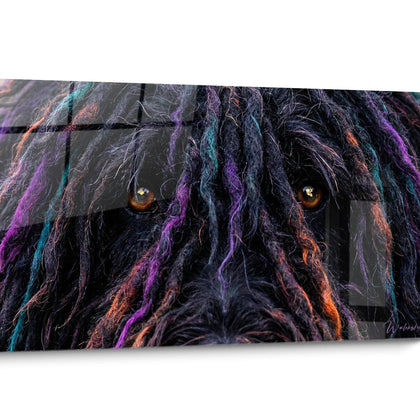
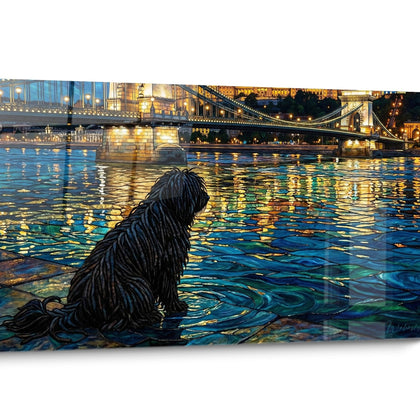
The Puli dog street art canvas transforms the iconic silhouette of this Hungarian breed with natural dreadlocks into an urban decorative manifesto. This graphic interpretation captures the rebellious essence of street art to celebrate one of the most visually distinctive dog breeds in the world. With its monumental formats, this mural creation stands as an architectural statement that dialogues with contemporary spaces seeking visual authenticity and bold character.
The Graphic Explosion of the Puli in the Street Art Universe
The Puli dog street art canvas reinvents canine representation by merging the unique texture of this breed with urban art visual codes. The characteristic dreadlocks of the Puli become explosive graphic elements, treated as paint flows or layered tags. This approach transforms each corded strand into a creative opportunity, creating a play of vertical lines that simultaneously evokes flowing graffiti and the organic structure of the coat.
Why does the Puli become an icon of canine street art?
The exceptional morphology of this Hungarian breed offers ideal terrain for urban techniques. Artists exploit the natural cordage to create controlled dripping effects, where each dreadlock appears to have been spray-painted. This visual correspondence between canine texture and graffiti aesthetics generates immediate recognition that transcends the boundaries between classical animal art and contemporary urban culture.
The explosive color palette of urban art applied to the Puli
The color treatment of the Puli dog street art canvas abandons natural tones to embrace the saturated hues emblematic of tagged walls. The compositions juxtapose neon pinks, electric cyans, and acid yellows that transform the animal into a vibrant chromatic sculpture. This intentional saturation creates striking contrasts with minimalist or industrial environments, allowing the work to function as a magnetic focal point in lofts with raw concrete walls or spaces with clean lines.
How to integrate this work into a contemporary interior?
The installation requires reflection on visual balance between the graphic intensity of the work and its environment. The available monumental formats allow for the creation of accent walls that capitalize on the natural verticality of the Puli's cordage. For enthusiasts seeking a softer approach, certain variants explore watercolor treatments that retain urban energy while softening chromatic impact, as can be discovered in the collections of Puli dog watercolor canvases that offer an alternative reading of this fascinating breed.
Discerning collectors position these creations in circulation areas where monumentality can be appreciated from a distance, while progressively revealing technical details upon approach. This dual distance-proximity reading fully values the texture work and layering characteristic of street art style.
The Architectural Impact of the Puli Dog Street Art Canvas
Beyond its decorative dimension, the Puli dog street art canvas functions as a full architectural element in contemporary residential and commercial spaces. Its presence modifies the volumetric perception of rooms, particularly in height configurations where the vertical lines of stylized dreadlocks amplify the impression of grandeur. This ability to visually restructure space explains its growing adoption by interior architects specialized in projects with strong visual identity.
What is the best spatial configuration to maximize impact?
The imposing formats of these creations require thoughtful spatial planning. In open loft-type spaces, the canvas becomes a visual separator that delineates functional zones without physical partitioning. The eye naturally follows the vertical lines of the stylized coat, creating a visual axis that organizes the space. This quasi-architectural function proves particularly effective in studios where differentiation of living-working zones requires non-invasive solutions.
Interaction with industrial and raw materials
Material dialogue constitutes a crucial aspect of successful integration. The Puli dog street art canvas reveals its full potential when contrasting with industrial surfaces: polished concrete, exposed brick, oxidized metals, or aged woodwork. This confrontation between the chromatic energy of the work and the textured neutrality of backgrounds generates productive visual tension that energizes spaces risking monotony.
Design professionals also exploit light reflection to amplify impact. Positioned facing metallic surfaces or strategically placed mirrors, the work multiplies its presence without literal duplication, creating fragmented reflection games that evoke urban walls photographed from different angles.
How does this work transform the atmosphere of a professional space?
In avant-garde commercial contexts—creative agencies, urban fashion showrooms, trendy coworking spaces—the Puli dog street art canvas instantly communicates values of unbridled creativity and assumed nonconformism. Its presence signals a cultural positioning that resonates with clientele valuing originality and aesthetic boldness. Restaurateurs specializing in fusion cuisines or unconventional gastronomic concepts adopt it as a strong identity element that visually prepares for the innovative culinary experience.
Retail spaces use it as a brand identity amplifier, particularly effective in corners dedicated to urban accessories, limited-edition sneakers, or premium streetwear clothing. The work functions as cultural validation of the urban authenticity claimed by these brands.
The Cultural Symbolism of the Puli Reinterpreted in Urban Key
The Puli dog street art canvas performs a fascinating cultural translation by extracting a breed traditionally associated with Hungarian pastoralism to project it into the codified universe of contemporary urban art. This unlikely encounter between ancestral canine heritage and graphic expression of modern metropolises creates a rich visual narrative that interrogates the boundaries between tradition and modernity, nature and urban culture.
The transformation of the flock guardian into a metropolitan icon
Historically developed for sheep protection in Hungarian plains, the Puli finds a second symbolic life as guardian of contemporary interior spaces. Street art artists exploit this duality by preserving the watchful posture characteristic of the breed while adorning it with urban culture visual attributes: chromatic splashes, stencil effects, fragmented typographic overlays. This cultural reappropriation simultaneously celebrates the breed's heritage and its ability to traverse epochs while remaining visually relevant.
How does street art reveal the underappreciated aesthetic qualities of the Puli?
Unlike photographic representations that faithfully document the Puli's appearance, street art interpretation extracts its geometric and rhythmic essence. The cordage becomes hypnotic repetitive patterns, treated as organic barcodes or graphic cascades. This partial abstraction allows the uninitiated to appreciate the structural complexity of the coat without requiring prior canine knowledge. The work thus functions on two reading levels: immediate recognition of urban energy for the general public, and informed celebration of an exceptional breed for canine enthusiasts.
Collectors seeking conversational works find in these canvases a rare balance between visual accessibility and referential depth. The work systematically triggers discussions about the identity of the breed represented, creating moments of exchange that enrich the domestic or professional experience of art.
The evolution of perception according to exhibition contexts
The contextual versatility of the Puli dog street art canvas constitutes one of its major assets for buyers considering decorative rotations. In a predominantly monochrome environment, the work explodes as chromatic fireworks. Transposed into an already colorful space, it functions differently, creating tone dialogues and unexpected resonances. This perceptual adaptability justifies the investment for discerning collectors who regularly rearrange their spaces without constantly wanting to renew their art acquisitions.
FAQ - Frequently Asked Questions about the Puli Dog Street Art Canvas
Why choose a Puli dog street art canvas over another dog breed?
The unique texture of the Puli's cordage offers unequaled graphic potential in the canine world. This morphological particularity lends itself exceptionally to the superposition and dripping techniques characteristic of street art, creating visual synergy impossible to reproduce with conventional-coated breeds. The work thus becomes instantly recognizable and memorable.
Does a Puli dog street art canvas suit classical or traditional interiors?
This creation excels precisely in bold stylistic contrasts. Integrated into a classical environment, it functions as a contemporary breaking point that energizes the whole without denaturing it. Interior designers exploit this creative tension to modernize heritage spaces while respecting their original architectural structure, creating stimulating temporal juxtapositions.
How to maintain the chromatic vibrancy of a Puli dog street art canvas over time?
Large formats generally benefit from UV protection treatments during manufacturing, preserving the intensity of saturated urban-style tones. Strategic positioning away from direct light sources prolongs color stability. Periodic gentle dusting with dry microfiber maintains graphic detail sharpness without altering the surface.


 Dog with Dreadlocks and Multicolored Highlights Wall Art - Urban Energy - Puli Edition233,90 €
 Colorful Dreadlock Dog with Amber Eyes Wall Art - Artistic Portrait - Puli Edition233,90 €
 Puli Painting with Vibrant Colors in an Expressionist Whirlwind - Perpetual Movement - Puli Edition233,90 €
 Puli Portrait Painting in Artistic Whirlwind - Intense Gaze - Puli Edition213,90 €