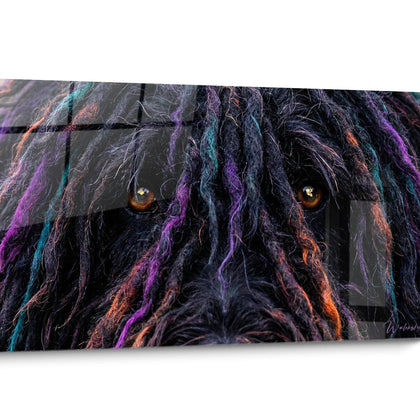
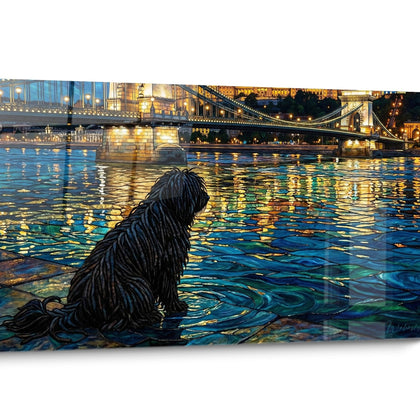
This Puli Watercolor dog painting captures the singular beauty of this Hungarian breed with its characteristic corded coat through a soft and fluid pictorial interpretation. The watercolor technique brings a poetic dimension to the Puli's unique coat, transforming its naturally formed strands into translucent hues and delicate chromatic overlays. Intended for contemporary canine art enthusiasts seeking a large-scale wall piece, this XXL format reveals every subtlety of the watercolor rendering and enhances the artistic expression of this exceptional dog. The work particularly appeals to collectors of artistic canine representations and Puli owners wishing to celebrate their companion through a refined and luminous pictorial vision.
Watercolor Transparency in Service of the Corded Coat
The Puli Watercolor dog painting brilliantly exploits the characteristic fluidity of this pictorial technique to convey the exceptional texture of the Puli's cords. The superimposed washes create visual depth that naturally evokes the three-dimensional structure of the coat, while areas of light preservation suggest changing reflections on the strands. This artistic approach differs radically from photographic renderings by capturing the very essence rather than mere appearance.
Which color palette enhances the Puli in watercolor?
Shades of bluish grays, rosy beiges and diluted ochres allow the richness of the coat to be suggested without weighing down the composition. Subtle gradients between dark and light areas generate organic modeling particularly suited to representing this breed with complex textures. Watercolor enables imperceptible transitions between tones, creating a chromatic harmony impossible to achieve with opaque techniques.
The impact of pigment fusion on the perception of movement
The distinctive characteristic of this painting lies in spontaneous fusions between wet pigments that evoke the natural swaying of the Puli's cords in motion. These diffusion effects bring kinetic dimension to the static work, suggesting the fluidity of this agile dog's movement. For collectors of watercolor animal art, this visual dynamics represents a major acquisition criterion, particularly in monumental formats where every nuance becomes perceptible.
Complementarity with golden representations
Enthusiasts seeking a coherent collection appreciate pairing this watercolor interpretation with brighter versions like the Golden Puli Painting which offers an aesthetic with metallic accents. This combination provides enriching stylistic diversity while maintaining thematic coherence around this emblematic breed.
Creating a Contemplative Atmosphere with Watercolor Tones
How does watercolor rendering influence a space's atmosphere?
A large-scale Puli Watercolor dog painting radically transforms a room's ambiance by infusing it with immediate serenity. The transparency characteristic of this technique generates airy luminosity that contrasts with the visual intensity of opaque works. In contemporary living spaces, this pictorial softness balances refined architectural lines without creating brutal visual disruption.
Puli owners often favor this watercolor representation for its emotional authenticity that captures their companion's gentle personality despite its imposing appearance. The technique suggests rather than imposes, creating a soothing presence perfectly suited to master bedrooms or relaxation spaces where contemplative atmosphere prevails.
Valorizing architectural spaces through chromatic lightness
The diluted and nuanced tones of watercolor rendering integrate harmoniously into environments with dominant neutral palettes. This large-format work functions as a delicate focal point that draws the eye without visually overloading the space. Interior architects frequently recommend this typology for lofts with generous volumes where pictorial fluidity dialogues with spatial amplitude.
Association with natural materials and soft textiles
The watercolor aesthetics of the Puli finds its best expression when surrounded by organic materials and soft textures. Raw linen, woven plant fibers or light woods amplify the tactile sensitivity suggested by the cord rendering. This material synergy creates sensory coherence where the wall work extends the textural qualities of the environment, particularly sought in Scandinavian or Japanese-inspired interiors favoring refined simplicity.
Technical Particularities of Watercolor Applied to the Puli
Why is watercolor ideally suited to the Puli?
The correspondence between watercolor technique and Puli representation rests on a fascinating formal analogy: translucent pigment overlays naturally evoke the stratification of cords. Each chromatic layer functions like an individual strand, creating organic visual depth impossible to reproduce with opaque mediums. This technical affinity explains why collectors of watercolor canine art specifically seek Pulis in this interpretation.
Artists exploit hydro-soluble properties to generate imperceptible transitions between dense and airy zones, mimicking variations in compactness observed in the natural coat. On a monumental format, these technical subtleties become fully legible, revealing the artistic mastery necessary to capture this exceptional breed.
Managing light reserves in the dark coat
Representing a black or dark gray Puli in watercolor constitutes a major technical challenge where unpainted areas play a crucial role. These strategic reserves suggest luminous reflections that traverse the brilliant cords, avoiding the monolithic effect of uniform dark mass. The balance between pigment saturation and preservation of the white support determines the work's success, particularly visible in XXL dimensions where each technical choice amplifies.
Durability and conservation of watercolor pigments
Buyers of high-value large Puli Watercolor dog paintings legitimately question pigment permanence. Contemporary works use museum-quality pigments offering exceptional photochemical resistance when preserved from direct sunlight exposure. This chromatic stability guarantees that the delicate hues of the watercolor coat retain their initial freshness for decades, a decisive criterion for investing in a monumental format.
Is a large-format Puli Watercolor dog painting suitable for humid environments?
Although watercolor technique is hydrophilic by nature, finalized works with contemporary protective fixatives resist normal residential hygrometric variations perfectly. It is nevertheless advisable to avoid placement in areas of excessive humidity such as bathrooms to preserve the support and pigment integrity long-term.
What observation distance optimizes appreciation of a large-format Puli Watercolor dog painting?
Monumental formats reveal their technical subtleties at a distance of approximately two to three meters, allowing simultaneous appreciation of watercolor details and overall composition. This distance naturally corresponds to reception space configurations where these works find their optimal placement.
How to identify an authentic Puli Watercolor dog painting from a digital reproduction?
Authenticity is verified through observation of natural pigment variations, irregular edges characteristic of washes and grainy texture of the watercolor support. High-quality digital reproductions present uniformity in gradients absent from original works where every chromatic fusion remains unique.


 Long-Haired Dog Swimming in Turquoise Water Canvas - Aquatic Immersion - Puli Edition232,90 €
 Dog Puli Jumping in Water Wall Art - Splash of Freedom - Puli Edition233,90 €
 Curly-Haired Dog by a Pool - Canine Relaxation - Puli Edition233,90 €