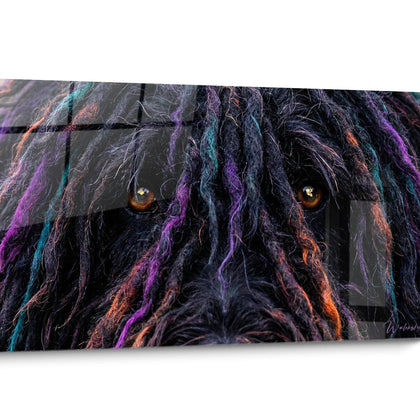
The black and white Puli dog wall art celebrates one of the most recognizable dog breeds through its extraordinary silhouette. This large-format wall piece captures the graphic essence of the Hungarian Puli in a refined aesthetic, where the bicolor contrast enhances the characteristic cords of this ancestral breed. Unlike colorful representations, the monochrome version emphasizes the architectural structure of its unique coat, creating a minimalist decorative piece that aligns with contemporary modern interior design trends. This binary chromatic approach transforms the animal into a visual sculpture, ideal for spaces with a refined style where each decorative element must assert its presence without color saturation.
The Graphic Impact of the Black and White Puli in Contemporary Interiors
The black and white Puli dog wall art establishes itself as a bold artistic statement in modern spaces. The removal of color reveals a sculptural dimension often masked in polychrome versions, where each strand of the coat becomes a line of graphic composition. This monochrome approach transforms the Puli into a conceptual art object, particularly suited to industrial lofts, Scandinavian apartments, and minimalist interiors where a restricted color palette constitutes a fundamental principle.
Why does black and white contrast reveal the Puli's unique structure?
The absence of chromatic nuances forces the eye to concentrate exclusively on the distinctive texture of natural dreadlocks that characterize this Hungarian breed. In a large-format black and white Puli wall art, each corded strand becomes an autonomous graphic entity, creating a play of shadows and light that evokes classical engraving techniques. This chromatic simplification highlights the organic geometry of the coat, transforming the animal into an abstract composition where sharp contrasts replace subtle gradations. Contemporary animal art collectors specifically seek this visual tension between realistic figuration and formal abstraction.
The alliance of monochrome Puli with refined architectures
In spaces dominated by raw concrete, stainless steel, and glossy white surfaces, the black and white Puli dog wall art functions as an organic focal point without breaking chromatic harmony. Its imposing format allows for visual wall structuring without introducing color disturbance. Interior architects favor this representation for the entrance halls of contemporary residences, where the distinctive Puli silhouette creates an immediately memorable visual signature. The textile dimension of the corded coat also establishes a material dialogue with textured wall coverings, acoustic panels, and other tactile surfaces present in modern interiors.
Complementarity with other artistic canine representations
For enthusiasts wishing to explore different artistic expressions of this fascinating breed, the Puli watercolor dog wall art offers an alternative where the fluidity of dissolved pigments contrasts with the graphic sharpness of black and white. This stylistic duality allows for the creation of evolving wall compositions, where the geometric rigor of the monochrome version dialogues with the spontaneity of watercolor flows. Discerning collectors thus constitute decorative ensembles that explore the multiple visual facets of the Hungarian Puli.
Maximum readability in circulation spaces
The monumental format of the black and white Puli dog wall art guarantees instant recognition even from a distance, an essential quality for corridors, staircases, and transition spaces where observation time remains limited. The binary contrast eliminates any visual ambiguity, allowing immediate identification of the breed and its unique morphological characteristics. This graphic clarity proves particularly valuable in professional environments – specialized veterinary clinics, premium grooming salons, cynological exhibition spaces – where the subject must be understood without cognitive effort.
The Corded Texture of the Puli Sublimated by Monochrome
How does black and white amplify the tactile perception of the coat?
The black and white Puli dog wall art exploits a fascinating visual phenomenon: the elimination of chromatic information intensifies the perception of textural information. Each cord strand typical of the Hungarian Puli's coat generates micro-contrasts of light that create an illusion of almost three-dimensional relief. On a large-format wall piece, this tactile amplification transforms the flat surface into a topographic landscape where the eye can literally traverse the valleys and ridges formed by natural dreadlocks. Visual neuroscience confirms that our brain compensates for the absence of color by increasing sensitivity to luminosity variations, making texture appear more prominent than it would be in a colorized version.
The architectural aesthetic of natural cords
In its monochrome representation, the Puli's coat reveals a quasi-architectural organization reminiscent of organic structures studied by contemporary bioarchitects. The descending cords create a rhythmic vertical pattern similar to the fluting of classical columns or the ribs of modern biomimetic structures. This structural dimension makes the black and white Puli dog wall art a privileged choice for interiors inspired by parametric design, where mathematized organic forms constitute the dominant aesthetic language. The repetitive lines of the coat also establish visual resonance with screens, perforated walls, and other architectural elements based on modular repetition.
The visual depth created by cast shadows
The black and white treatment allows transcending simple photographic representation to reach an almost cinematic dimension. The cast shadows between the cords create gray gradients that suggest vertiginous depth, as if one could plunge into the successive strata of the coat. On a large-format wall art, this effect generates a hypnotic fascination particularly effective in meditative spaces – private libraries, reading rooms, reflection cabinets – where the artwork must foster prolonged contemplation rather than rapid visual stimulation. Animal photographers recognize that monochrome is ideally suited to subjects with complex coats, as it avoids the chromatic confusion that would dilute the impact of texture.
Which wall arrangement optimizes the texture effect of the monochrome Puli?
The installation of a large-format black and white Puli dog wall art requires reflection on ambient light sources. Raking lateral lighting dramatically accentuates the micro-reliefs suggested by tonal variations, creating a sculptural effect that evolves according to the time of day and the natural light orientation. This dynamic characteristic transforms the artwork into a living element that progressively reveals itself, fully justifying its investment in high-end residential spaces where decorative sophistication relies on these installation subtleties. Architects recommend positioning on walls perpendicular to main windows to maximize this luminous modeling effect.
Compatibility with black and white photography collections
For collectors of monochrome photography, the black and white Puli dog wall art integrates naturally into ensembles comprising works by Ansel Adams, Sebastião Salgado, or other masters of the genre. Chromatic coherence allows constituting thematic gallery walls where aesthetic unity takes precedence over subject diversity. This curatorial approach transforms an interior into a personal exhibition space, particularly sought after in urban penthouses and architect residences where decoration reflects an affirmed artistic sensibility.
Graphic Modernity and Timelessness of the Puli in Bichrome
Why does black and white guarantee aesthetic permanence?
The black and white Puli dog wall art escapes the ephemeral cycles of chromatic trends that render so many decorative choices obsolete after a few seasons. Design history demonstrates that monochrome traverses decades without stylistic aging, from Art Deco interiors of the 1920s to contemporary minimalist spaces. This timelessness represents a rational decorative investment for owners considering their acquisition over the long term. Unlike color palettes that dialogue with fleeting fashions, bichromacy maintains its aesthetic relevance independently of collective taste evolution, guaranteeing that this imposing wall format will retain its visual impact for decades.
Maximum expressivity with minimal means
The chromatic restriction of the black and white Puli dog wall art perfectly illustrates the "less is more" principle dear to modern architecture. With only two extreme tonal values and their intermediate nuances, the artist captures the essential character of the Hungarian Puli: its vigilance, ancestral intelligence, imposing presence despite modest size. This economy of means paradoxically generates expressive richness superior to polychrome representations that can dilute the message in visual information profusion. Contemporary interior designers particularly appreciate this semantic concentration, where each visual element carries maximum meaning without decorative redundancy.
How does the monochrome Puli dialogue with raw materials?
In interiors privileging untreated materials – sealed concrete, natural stone, raw wood, oxidized metal – the black and white Puli dog wall art establishes material continuity rather than artificial contrast. Its unadorned appearance resonates with the material honesty of these authentic surfaces, creating a cohesive atmosphere where artifice and nature converge. Repurposed industrial lofts, with their exposed metal beams and exposed brick walls, find in this monochrome Puli representation a decorative complement that respects the architectural integrity of the place. The corded texture of the coat also echoes coarse weaves, Berber rugs, and other natural textile elements present in these environments.
Readability in visually dense environments
Paradoxically, the large-format black and white Puli dog wall art asserts itself powerfully even in interiors already rich in visual stimuli. Its chromatic simplicity creates visual rest amid environmental complexity, functioning as a graphic pause that allows the eye to reset. This quality makes it particularly suited to libraries with overloaded shelving, open-concept kitchens where utensils and containers accumulate, or creative offices with walls covered in visual references. Where a colored work would add to saturation, monochrome brings structure and breathing room.
Adaptability to renovations and decorative evolutions
Homeowners who periodically rearrange their spaces appreciate the flexibility of the black and white Puli dog wall art, compatible with radical changes to the surrounding color palette. Whether redecorating in warm terracotta tones, deep blues, or vegetative greens, the monochrome base retains its relevance and impact. This adaptability represents a substantial economic advantage, avoiding replacement of works that have become chromatically incompatible after renovation. For real estate investors who enhance properties for premium rental, this decorative versatility justifies acquisition of imposing wall formats that will traverse multiple tenant cycles with differing aesthetic sensibilities.
Frequently asked questions about the black and white Puli dog wall art
Does a black and white Puli dog wall art suit colorful interiors?
Absolutely, monochrome functions as a chromatic neutralizer that balances environments saturated in vibrant colors. Its structuring graphic presence allows visual anchoring of a space where multiple hues might otherwise create perceptual dispersion. The imposing format ensures it maintains focal point status despite chromatic competition.
Can the black and white Puli dog wall art integrate into rustic style?
The contrast between the graphic modernity of monochrome and the authenticity of rustic interiors generates a sophisticated aesthetic tension sought in renovated farms and contemporary chalets. This juxtaposition avoids thematic excess while respecting the place's DNA, the Puli being historically a Hungarian herding dog perfectly coherent with revisited rural environments.
What ambient luminosity best highlights a black and white Puli dog wall art?
Lighting with neutral color temperature (4000-4500K) preserves the balance of tonal values without introducing warm or cold dominance that would alter carefully calibrated contrasts. Sufficient luminous flow reveals subtle gray nuances in intermediate zones, preventing them from merging into an undifferentiated mass.


 Frosted Dreadlocks Dog Painting - Icy Portrait - Puli Edition233,90 €
 Dog with Black Dreadlocks Artistic Portrait - Intense Gaze - Puli Edition233,90 €
 Black Puli Dog Water Splash Dynamic Movement - Aquatic Motion - Puli Edition233,90 €
 White Long-Haired Dog in the Rain Canvas - Soothed Storm - Puli Edition233,90 €
 Black Puli Dog Canvas with Dreadlocks in Modern Kitchen - Artistic Movement - Puli Edition233,90 €
 Black Dog Canvas by Water with Illuminated Bridge - Nocturnal Reflections - Puli Edition233,90 €