


Japanese Zen Watercolor Wall Art
Our Zen Watercolor Painting Japanese collection celebrates the contemplative beauty of traditional Japanese art. Each piece captures the essence of minimalist Japanese painting with its delicate washes, cherry blossom motifs, bamboo and soothing landscapes. These creations evoke the serenity of Japanese gardens and the harmony of wabi-sabi. Perfect for creating a meditative and refined atmosphere, these zen paintings Asian-inspired transform your interior into a haven of peace.
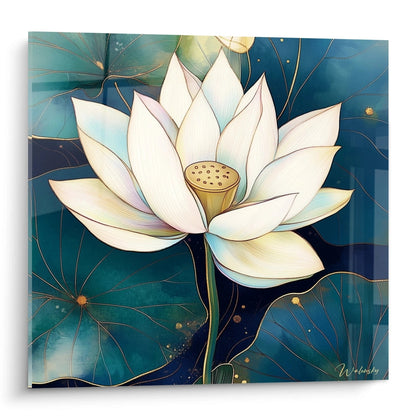
 Lotus Painting Pure Grace - lotus flower edition213,90 €
 Lotus Inner Peace Wall Art - lotus flower edition213,90 €
 Lotus Flower Eternal Grace Painting - Lotus Flower Edition233,90 €
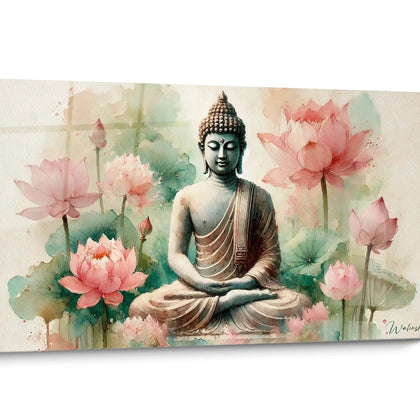
 Spiritual Harmony Artwork - Zen Buddha Edition233,90 €
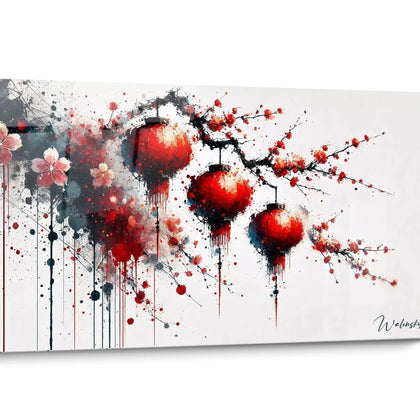
 Flowers and Lanterns Canvas - Zen Edition233,90 €
Explore further
In Japanese Zen Watercolor Wall Art
All about Japanese Zen Watercolor Wall Art
- Zen Watercolor Japanese Painting Presentation
- Japanese Watercolor Aesthetics
- Japanese Zen Atmosphere
- Buying Guide & Placement
A zen watercolor Japanese painting constitutes a majestic decorative artwork that fuses traditional Japanese aesthetics with the fluid techniques inherent to watercolor paintings. These large-scale wall creations capture the essence of Oriental philosophy through delicate compositions where each virtual brushstroke evokes the serenity of ancestral Asian landscapes. Japanese watercolor art distinguishes itself through subtle gradients, vaporous transparencies, and contemplative minimalism that instantly transforms any space into a soothing sanctuary. Perfectly suited to modern interiors seeking timeless sophistication, these monumental representations combine Japan's cultural heritage with commanding visual presence capable of harmoniously structuring contemporary architectural volumes.
The Art of Japanese Watercolor in Service of Zen Decoration
The zen watercolor Japanese painting draws its authenticity from the pictorial tradition of suiboku-ga, that centuries-old technique where Chinese ink dilutes into infinite nuances. Current monumental representations perpetuate this heritage through compositions where flowering cherry trees, misty mountains, graceful bamboo, and arched bridges unfold across large wall surfaces. This generous dimension amplifies the meditative effect sought, allowing the gaze to travel through different strata of translucent pigments.
Why choose watercolor wall decoration with Japanese inspiration?
Japanese watercolor is characterized by its approach to void and fullness, a fundamental principle of Zen aesthetics. Unlike saturated Western compositions, these creations cultivate negative space as an essential compositional element. Graduated washes perfectly imitate the morning mist enveloping Mount Fuji, while controlled splashes suggest the sea spray of the Pacific coast. This technical mastery creates atmospheric depth that is particularly striking when the artwork reaches imposing dimensions.
Emblematic motifs of zen Japanese watercolor paintings
Botanical representations occupy a prominent place in this artistic universe. The sakura with its ephemeral rosy petals symbolizes Buddhist impermanence, while the gnarled pine embodies resilience against the elements. Majestic cranes evolving in lacustrine landscapes bring vertical dynamism to horizontal compositions, creating visual balance conducive to contemplation. Exploring our zen watercolor painting collection reveals the stylistic diversity of these contemporary interpretations.
Subtle chromatics and Japanese natural palette
The chromatic range favors organic hues inspired by Japanese seasons: deep indigo of mountain rivers, autumnal ochre of maple foliage, jade green of spring rice fields. These soothing nuances facilitate integration into residential environments seeking a restful ambiance. The tonal variations created by layering transparent washes generate inner luminosity that evolves according to ambient lighting, conferring upon the artwork a living presence throughout the day.
Creating an Authentic Zen Atmosphere with Japanese Aesthetics
Integrating a zen watercolor Japanese painting into one's home transcends simple decorative acquisition to become an intentional act of contemplative arrangement. These monumental wall creations function as spiritual windows opening onto meditative landscapes, transforming domestic spaces into serene refuges. The psychological influence of Japanese watercolor compositions rests on their ability to slow mental pace through fluid organic forms and progressive chromatic transitions.
How does a Japanese watercolor visual influence interior atmosphere?
The wabi-sabi philosophy permeates every compositional element of these representations, celebrating beauty in natural imperfection and refined simplicity. The non-uniform watercolor drips, far from being flaws, embody acceptance of the natural cycle and authenticity. This aesthetic approach resonates particularly in contemporary minimalist interiors where each decorative element must justify its presence through emotional charge and substantial visual impact. A generous format amplifies this silent communication with the observer.
Privileged spaces to maximize contemplative effect
Environments dedicated to mental relaxation benefit exceptionally from these soothing compositions: master bedrooms seeking to promote restorative rest, home offices requiring serene concentration, spaces for yogic or meditative practice. The main living room also becomes ideal terrain for expression when a substantial wall welcomes a panoramic representation evoking a misty Japanese garden. Portrait format heights particularly suit narrow hallways where a watercolor cascade or bamboo forest creates illusory depth.
Association with contemporary zen design principles
Decorative harmony establishes itself through material and philosophical coherence. Natural textures like linen, woven bamboo, polished stone spontaneously dialogue with themes represented in Japanese watercolor. A zen watercolor Japanese painting of grand dimension visually anchors the space, becoming the focal point around which streamlined furniture and carefully selected accessories organize. The asymmetrical balance typically Japanese encourages off-center arrangements rather than systematic Western alignment, creating natural visual dynamism.
The influence of Japanese seasons on perceived ambiance
The tradition of shiki (seasonal awareness) reflects in thematic choice: spring cherry blossoms to revive vital energy, summer wisteria to visually refresh, autumn maples to accompany introspection, winter snow landscapes to cultivate inner calm. This conceptual rotation allows subtly adapting domestic atmosphere to the annual cycle without material modifications, the artwork revealing different emotional facets according to season.
Selecting and Enhancing Your Zen Watercolor Japanese Painting
Acquiring a zen watercolor Japanese painting of generous format requires strategic reflection to guarantee lasting decorative investment. The monumental dimension of these creations implies meticulous spatial planning where wall proportions, visual circulation, and decorative hierarchy interact harmoniously. Unlike modest formats, these imposing representations entirely restructure a room's volumetric perception, necessitating methodical approach during selection and positioning.
Which criteria to prioritize when buying a large-scale Japanese watercolor painting?
Thematic coherence constitutes the first decision factor: mountainous landscapes to bring majesty and spiritual elevation, aquatic scenes to fluidify ambient energy according to feng shui principles, floral compositions to instill delicacy and renewal. Compositional complexity gains readability with large formats, allowing appreciation of technical subtleties like multi-layered atmospheric gradients or meticulous botanical details that would be lost on reduced surface. Verify that visual resolution maintains clarity and depth even when observed at close range.
Strategic positioning for optimal visual impact
A monumental zen watercolor Japanese painting functions ideally as visual anchor on a clear wall section, preferably the first visible from the main room entrance. Positioning height differs from standardized recommendations: the lower third of the artwork should align approximately with seated eye level to encourage meditative contemplation. Open loft-type spaces magnificently exploit these panoramic formats that can extend multiple meters, creating narrative continuity between different functional zones.
Enhancement through immediate environment
The immediate peripheral zone should remain pared down to preserve contemplative impact. Avoid decorative overload that would fragment attention: prioritize low and discreet furniture, a few living plant elements (bonsai, orchid) echoing represented themes. Indirect lateral lighting reveals watercolor nuances without creating ungraceful reflections, while slight natural backlight amplifies the translucency characteristic of this pictorial technique. Adjacent walls will benefit from maintaining chromatic neutrality allowing the artwork to fully express its palette.
Does a zen watercolor Japanese painting suit minimalist modern interiors?
Absolutely, this aesthetic harmonizes perfectly with streamlined contemporary codes. Ancestral Japanese minimalism directly influenced current Western design. Watercolor compositions bring organic warmth and cultural depth to spaces risking otherwise clinical coldness, while respecting the visual discipline characteristic of minimalist style.
Which dimension to privilege for a zen Japanese watercolor painting in a spacious living room?
For a generous living room exceeding 320 square feet, opt for formats reaching minimally 47-59 inches in width to establish proportionate presence. Horizontal panoramic compositions effectively structure vast wall expanses, while monumental vertical formats bring welcome counterbalance to rooms with high ceilings.
How to maintain the visual intensity of a zen watercolor Japanese painting long-term?
Preserve these creations from prolonged direct sun exposure that could gradually alter delicate pigments. Gentle semi-annual dusting with antistatic microfiber suffices to maintain visual clarity. Hygrometric stability prevents potential deformations, particularly important for expansive formats more sensitive to environmental variations.
Further reading
Our articles on this topic
- Did Kanō Masanobu’s Zen Paintings Codify a Japanese Court Style?
- Do Tomioka Tessai’s Zen Paintings Mark the Transition to Modernity?
- How Did Ike no Taiga Fuse Zen and Literati Traditions in His Paintings?
- How Did Japanese Zen Masters Adapt Chinese Chan Painting?
- Do Miyamoto Musashi's Zen Paintings Reflect the Way of the Sword and Brush?


