I spent fifteen years studying ancient lacquers in the temples of Kyoto, then two decades advising European collectors and museums on Japanese art. And each time a client asks me where true modernity in Japanese art begins, I bring out the same scrolls: those of Tomioka Tessai. These fascinating works, painted between 1880 and 1924, capture a unique moment when Japan shifts between two worlds. But are they truly zen? And more importantly, do they embody this much-discussed transition to modernity?
Here's what Tomioka Tessai’s paintings bring to your understanding of Japanese art: a gateway to the Meiji era where tradition and innovation meet, a visual vocabulary that reinvents Chinese literati painting, and a poetic meditation that foreshadows 20th-century abstraction.
You may be looking to decorate your interior with authentic zen artworks, but you feel lost amidst historical references. You see ink landscapes, enigmatic calligraphy, and wonder: is it truly traditional? Or already modern?
Rest assured: understanding Tessai means understanding the complexity of this pivotal period. And you will discover that his unique approach perfectly illuminates what is sought today in contemporary zen art.
I'll show you how this artist, little known in the West, wove the threads between past and future, and why his works still resonate in our modern interiors.
The last of the literati in a changing Japan
Tomioka Tessai was born in 1836, when Japan was still closed to the world. He died in 1924, in a country completely transformed by the Meiji opening. This trajectory of nearly 90 years makes him an exceptional witness. Unlike young Meiji artists who rush towards Western techniques, Tessai remains faithful to the tradition of literati-painters (bunjin-ga), these scholars who practiced calligraphy, poetry and ink painting.
But be warned: fidelity does not mean immobility. Tessai absorbs classic Chinese influences – Song dynasty landscapes, literati school bamboos – while infusing them with a fierce, almost wild energy. His brushstrokes are more vigorous, his compositions bolder than those of his predecessors. He paints zen mountains that seem to vibrate with an inner force, hermits who disappear into expressionistic mists.
This tension between inherited technical mastery and new gestural freedom makes his zen paintings unsettling objects. They respect the codes while subtly subverting them. This is exactly what Meiji reformers were seeking: how to remain Japanese while becoming modern?
The scholar facing the machine
In the 1880s, Tokyo was covered in brick buildings, railways crossed the country, Western printing replaced woodblocks. Tessai, for his part, continued to grind his ink by hand, mounting his rollers according to ancestral techniques. But he painted subjects that revealed his acute awareness of change: mythological journeys evoking both Taoist legends and new possibilities of movement, landscapes that seem to oscillate between observed reality and inner vision.
His zen paintings from this period often show solitary figures in vast landscapes. These hermits can be read as a meditation on the place of the individual in an accelerating world. Traditional Zen seeks the dissolution of the self; Tessai seems rather to explore the creative solitude of the modern artist.
A zen aesthetic reinvented by the brush
When we talk about Zen art, we generally think of Ensō circles, Sesshū's minimalist landscapes, that economy of means which suggests infinity. Tessai knows this tradition perfectly – he studied Zen masters for decades. But his approach differs radically.
Where a classic Zen painter uses three brushstrokes to evoke a bamboo, Tessai uses thirty, creating a density, a thickness that more closely recalls the expressionist abstract artists of the 20th century. His zen compositions are not peaceful and empty; they are charged, dynamic, almost tumultuous. It is a form of energetic zen that anticipates the gestural research of modernity.
I have seen collectors remain stunned in front of a Tessai scroll, seeking the expected serenity of a Zen painting and discovering instead an almost disturbing vitality. This is precisely where his modernity lies: he refuses passive contemplation to propose an active meditation, engaged with the material of ink.
Calligraphy as emotional architecture
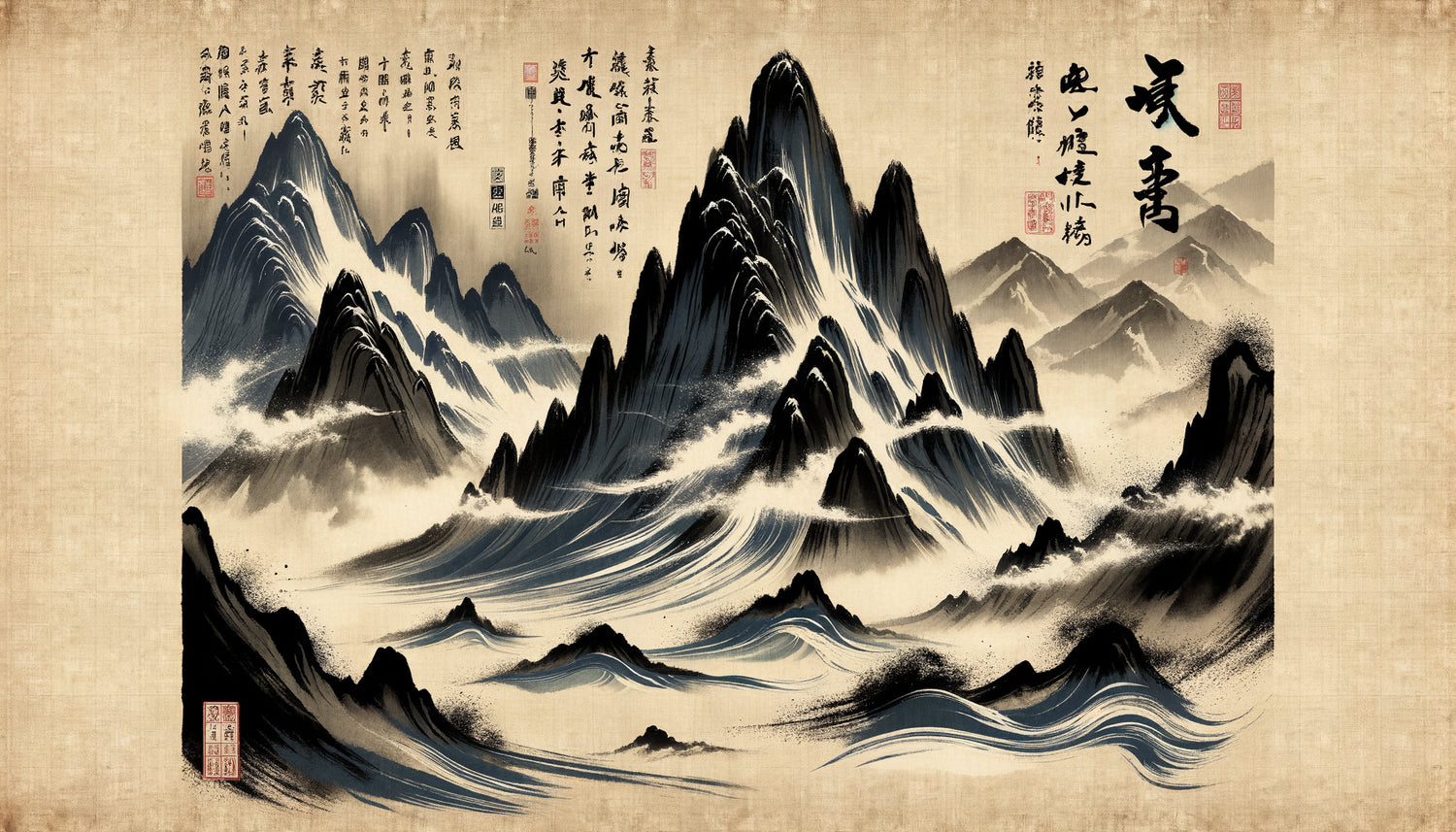
Tessai's paintings often integrate long calligraphic inscriptions – classical poems, personal comments, quotations from Taoist or Buddhist texts. This practice comes directly from the tradition of Chinese scholars. But look at how he arranges these texts: they are no longer wise vertical columns neatly ordered. They dance, fragment, dialogue with the pictorial elements in a radically new way.
This fusion between text and image, between literary meaning and visual experience, foreshadows modern research on concrete poetry and conceptual art. A zen painting by Tessai is not only to be looked at; it is to be read, deciphered, inhabited mentally. It is a multidimensional experience that announces contemporary installations.

Why Tessai Remains Little Known in the West
Here's the paradox: in Japan, Tomioka Tessai is considered one of the greatest painters of the Meiji era. His works fetch considerable prices, his exhibitions attract crowds. In the West, he remains largely ignored. Why?
The answer lies in what the West has sought in Japanese art. When European collectors discover Japan at the end of the 19th century, they are fascinated by ukiyo-e – the colorful prints of Hokusai and Hiroshige. Then, in the 1950s-60s, it was the era of enthusiasm for minimalist zen, stone gardens, the aesthetics of emptiness.
Tessai, on the other hand, does not fit any of these expectations. Too erudite, too laden with Chinese literary references, too visually dense to seduce the Western gaze accustomed to a certain idea of purified zen. His zen paintings require an effort of cultural understanding that few Western collectors were willing to provide.
Yet, today, as we rediscover the complexity of Asian traditions beyond orientalist clichés, Tessai appears in all his richness. He embodies this non-Western modernity that does not pass through the mimicry of European forms but through an internal radicalization of its own tradition.
How to Recognize an Authentic Tessai (and His Influence)
If you visit a gallery or museum and come across a work attributed to Tessai, here are the distinctive signs. First, this vigour of the line: even in his most contemplative landscapes, the brush never hesitates, it asserts itself. Then, this unique way of treating space: the elements do not float in traditional zen emptiness, they pile up, overlap, create depth by accumulation rather than suggestion.
Also observe the palette: Tessai uses black ink of course, but he is not afraid to add touches of color – intense blues, vermilion reds – with a freedom that foreshadows the Fauvists. His zen compositions escape conventional formats; some are stretched horizontally for several meters, creating immersive panoramas.
His influence can be seen today in many contemporary artists who work on abstract calligraphy or gestural ink. When you see a modern zen painting that combines energy and meditation, movement and contemplation, there is a good chance it spiritually descends from Tessai, even if the artist does not know it.
The Spirit of Tessai in Your Interior
Integrating the aesthetics of Tessai into a contemporary space is embracing a form of zen that isn't necessarily calming at first glance. It's choosing works that stimulate as much as they soothe, that create a strong presence rather than a meditative absence.
I often recommend placing these zen paintings energetic in creative or active reflection spaces – an office, a workshop, a library – rather than in a bedroom intended for pure rest. They beautifully complement interiors that blend tradition and modernity, natural wood and brushed metal, where each element has character.

The Transition to Modernity: A Question Still Open
So, do Tessai's zen paintings mark the transition to modernity? The answer is not binary. Tessai never sought to be modern in the Western sense. He did not join artistic reform movements that advocated for the adoption of European techniques. He remained stubbornly faithful to his brushes, his ink, his traditional formats.
Yet, by pushing the tradition of scholar-painters to its expressive limits, he created something radically new. His zen works contain in germ the seeds of abstract expressionism, gestural art, and the text-image fusion that characterizes 20th century art. He embodies this alternative modernity that does not break with the past but reinvents it from within.
Perhaps Tessai's most valuable lesson for us today is that modernity is not an obligatory rupture; it is an intensification. One can be deeply rooted in a tradition and yet create new forms, unprecedented emotions. This vision of cultural transition resonates particularly strongly at our time when we seek to reconcile heritage and innovation.
Ready to invite meditative energy into your space?
Discover our exclusive collection of Zen paintings that capture this creative tension between contemplation and vitality, tradition and personal expression.
Conclusion: The Living Legacy of a World Passer
Tomioka Tessai reminds us that major cultural shifts don't happen in a single block. They pass through individuals who, standing between two eras, reject binary choices. His zen paintings are neither purely traditional nor frankly modern – they are both at once, in a personal synthesis that precisely defines what authentic creativity is.
Today, when you choose a work for your interior, you also do this work of intermediary: you connect aesthetics, eras, sensibilities. You create your own transition. The spirit of Tessai invites you not to be afraid of this complexity, to embrace creative tensions rather than seeking simple answers.
Start by carefully observing a single zen painting, whether it is by Tessai or inspired by his approach. Let it speak to you about the permanent dialogue between heritage and invention. That's where your own modernity begins.
Frequently asked questions about Tomioka Tessai and modern zen art
Was Tomioka Tessai a zen monk or simply a painter of zen subjects?
Excellent question that reveals a common confusion. Tessai was not a zen monk, but a Confucian and Shinto scholar deeply imbued with Buddhist culture. He studied Zen texts and masters of Zen painting, but his approach was that of a versatile scholar rather than a monastic practitioner. It is precisely this position as a cultivated observer that allowed him to reinterpret the Zen aesthetic with a freedom that monks themselves might not have had. His zen paintings are therefore the result of an intellectual and artistic meditation on tradition rather than strict religious practice. This creative distance also explains why his works can seem less orthodox – and more modern – than those of Edo-period monk painters.
Can one find authentic reproductions of Tessai to decorate one's interior?
Tessai's original works are indeed rare and very expensive, mainly kept in Japanese museums and a few private collections. However, several institutions have produced high-quality reproductions of his most famous scrolls, generally available from museum shops specializing in Japanese art. If you are looking to integrate the spirit of Tessai into your decor rather than an exact reproduction, I recommend turning to contemporary artists who work in the same vein – expressive calligraphy, energetic ink landscapes, text-image fusion. These modern creations often capture the essence of Tessai's approach better than a faithful reproduction. A contemporary zen painting of quality, which dialogues with this tradition while speaking to our current sensibility, will probably be more vibrant in your space than a historical copy.
How to tell if a zen painting is truly traditional or already modern?
This question touches on the heart of the matter and, honestly, the boundary is often blurred – which is what makes zen art so fascinating. Here are a few guidelines: a traditional zen painting (before the Meiji era) generally favors economy of means, suggestion rather than affirmation, empty space as an active compositional element. Even vigorous brushstrokes remain controlled, almost ritualized. A modern painting, on the other hand, embraces a form of expressive subjectivity – the gesture becomes the artist's personal signature. With Tessai, you have this productive ambiguity: he perfectly masters the traditional grammar but uses it to express an intense personal vision. My advice for choosing a work: don't worry too much about this classification. Instead, ask yourself: does this piece create in me a space of active contemplation? Does it speak to me of something old and something alive? If so, it accomplishes exactly what the best zen paintings, whether from the 15th or 21st century, are supposed to do: open an inner dialogue.