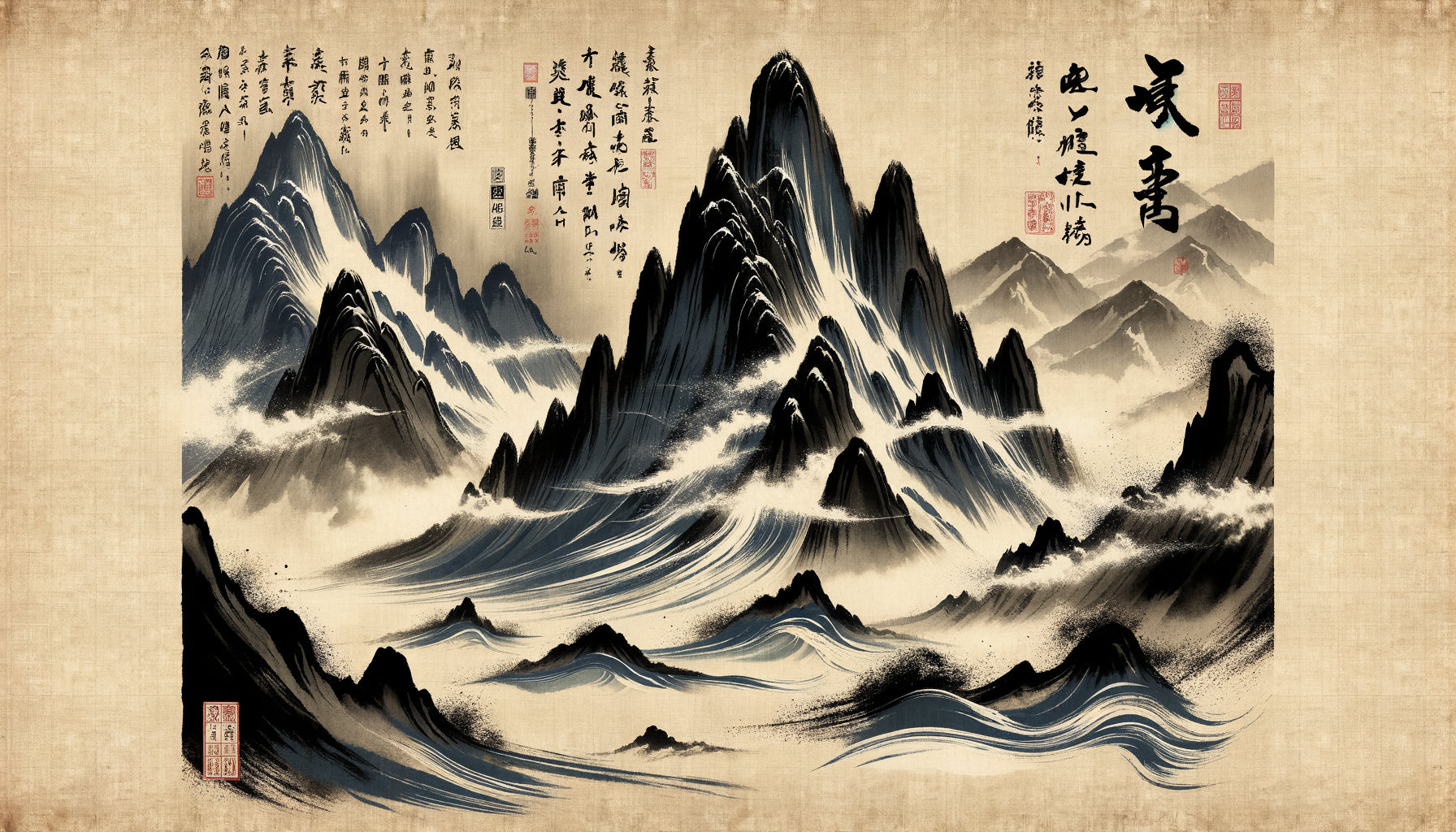
A few years ago, in a small gallery in Kyoto, I felt something indefinable. Facing a sumi-e depicting a simple pine branch emerging from the mist, I felt as if I were contemplating much more than an image. It was as if the painting whispered secrets that my mind could not fully grasp, a beauty that eluded me even as I thought I understood it. The Japanese have a word for this: yūgen.
Here's what the concept of yūgen brings to zen paintings: an emotional depth that transcends simple representation, an invitation to mystery that enriches your space with a contemplative dimension, and a subtle aesthetic that reveals its beauty over time rather than shouting it immediately.
In our world saturated with garish images and constant stimulation, we desperately seek spaces of visual silence. Yet, many minimalist works leave us wanting: too cold, too empty, lacking that depth which truly nourishes the soul. How to create a soothing interior without falling into blandness? How to hang a work that inspires meditation without boring the eye?
The answer lies in this fascinating notion of yūgen, this Japanese aesthetic principle that celebrates mysterious and veiled beauty. In authentic zen paintings, yūgen manifests through precise visual techniques that create exactly this elusive depth. I will show you how to recognize these works and why they so profoundly transform the atmosphere of a space.
The art of suggesting rather than showing
Yūgen in zen paintings always begins with what the work does not show. Unlike traditional Western painting which fills every centimeter of canvas, zen art embraces emptiness as a fundamental expressive element. It is not an emptiness born of laziness or lack of skill, but a deliberate space that allows your imagination to breathe.
In an authentic zen painting, you will often see a mountain whose summit disappears into the mist, a landscape where contours gradually dissolve, a silhouette barely sketched emerging from the white of the paper. This technique creates a mysterious depth because your mind naturally completes what is not shown. You become a co-creator of the work.
I have noticed that customers who hang these paintings in their living room or bedroom tell me the same thing: the image changes according to their mood. One day, they see solitude in that monk walking towards the misty mountains. The next day, they perceive freedom. This ambiguity is not a defect, it is the very essence of the concept of yūgen.
The pictorial techniques that embody yūgen
Zen masters use specific techniques to materialize this elusive depth. The tarashikomi, where wet ink blends on still-wet paper, creates misty effects that are impossible to control completely. The painter guides, but does not impose. The result carries an unpredictable, organic, living quality.
Subtle gradations of black ink, from ebony black to the palest gray, create a vaporous atmosphere where forms seem to float between existence and disappearance. This manifestation of yūgen in the technique itself recalls the ephemeral nature of all things, a central Buddhist principle.
Suspended time in the image
The yūgen manifests also through a unique relationship to time. Unlike dramatic scenes frozen in full action, Zen paintings capture moments of pure tranquility where nothing seems to be happening, and yet everything is subtly in motion.
A boat moored at dusk. Bamboo swaying in an invisible breeze. A temple half-hidden by autumn trees. These scenes possess a timeless quality that creates a mysterious depth: we could contemplate them a thousand years ago or in a thousand years, they would carry the same silent truth.
This suspended time explains why these Zen paintings never tire. Unlike images that deliver all their message at once, a work imbued with yūgen is revealed gradually. Each contemplation unveils a nuance you had not noticed, a spatial relationship that had escaped you.
The influence of the seasons and their melancholy
Zen masters often incorporate subtle seasonal references that enrich the concept of yūgen. A cherry tree whose flowers are beginning to fall evokes the ephemeral beauty of spring. Autumn mists enveloping the mountains speak of passage and transformation.
This awareness of impermanence is not sad, but deeply soothing. It reconnects us to our own transient nature and, paradoxically, this acceptance brings lasting serenity. That's why an authentic Zen painting does not simply decorate, it accompanies your inner life.

How yūgen transforms your living space
I have advised dozens of people on integrating zen paintings into their homes, and the transformation goes far beyond aesthetics. A living room that welcomes a work imbued with yūgen naturally becomes calmer. Conversations there take on a different quality, more poised and authentic.
In a bedroom, this mysterious depth promotes a more serene sleep. Rather than staring at a blank wall or an overly stimulating image, your gaze can get lost in these suggested spaces, these soothing mists, gently preparing your mind for rest.
Meditation or yoga spaces particularly benefit from this aesthetic. The yūgen in zen paintings creates a focal point that does not grab attention but welcomes it. It's like having a silent companion for your practice, a presence that supports without overwhelming.
Choosing an artwork that breathes yūgen
How to recognize a work that truly embodies this concept of yūgen? First, look for restraint. If everything is shown, explained, revealed, the mystery cannot exist. The best zen paintings practice economy of means: a few brushstrokes are enough to evoke an entire landscape.
Also observe the color palette. Yūgen expresses itself particularly well in subtle nuances: grays, beiges, deep blacks, sometimes enhanced with a touch of discreet color that acts as a visual haiku. This sobriety is never austere when it carries a contemplative intention.
Finally, test your feeling. Faced with an authentically imbued work of mysterious depth, you should experience simultaneously clarity and questioning. Something within you understands intuitively, while another part remains curious, attracted, eager to contemplate further.
Recurring motifs carrying yūgen
Certain subjects are particularly well suited to expressing yūgen in zen paintings. Mountains shrouded in mist perfectly embody this aesthetic: majestic but veiled, present but elusive. They evoke spiritual aspiration and the path to enlightenment, always visible but never fully attained.
Aquatic scenes also offer fertile ground for this mysterious depth. A pond with a few dead leaves floating on it, an empty boat moored at dusk, reeds reflecting in calm water. The water itself, with its fluid and reflective nature, becomes a metaphor for the contemplative mind.
Representations of monks or sages on journeys often carry a strong charge of yūgen. Figured from behind or in profile, advancing towards a misty horizon, they embody the spiritual quest as a path without a final destination. Their solitude is not isolation but inner fulfillment.
Emptiness as a major expressive element
In the most powerful zen paintings, emptiness often occupies more than half of the composition. This ma, this negative space, is not absence but subtle presence. It represents unrealized potential, the infinity of possibilities, the silence from which all forms emerge.
This masterful use of emptiness radically distinguishes Zen art from other pictorial traditions. Where some fill, Zen purifies. This purification reveals the essence, and it is precisely in this stripped-down essence that the concept of yūgen finds its purest expression.
Let mystery enter your daily life
Discover our exclusive collection of Zen paintings that cultivate this mysterious depth and transform your interior into a sanctuary of serenity.

Living daily with yūgen
Integrating a Zen painting carrying yūgen into your daily life is not simply hanging an image on the wall. It's inviting a particular quality of presence into your home. In the first days, you will mainly notice the visual soothing, this breath that the work brings to the space.
Then, gradually, you will discover that this mysterious depth acts more subtly. Your gaze naturally rests on it during moments of pause, between two tasks, upon waking up, before sleeping. Without conscious effort, these micro-moments of contemplation create mental breaths that reduce accumulated stress.
Some customers confide in me that their Zen painting has become a silent companion. In difficult moments, its serene presence reminds you that everything passes, that life always contains invisible dimensions rich in meaning. This psychological function of yūgen far exceeds simple decoration.
Over the months, you will also notice how the changing light transforms the work. In the morning, it reveals certain details. In the evening, other nuances emerge. This natural variability constantly enriches your experience, preventing the habituation that dulls our perception of familiar objects.
Imagine yourself in six months, returning home after a demanding day. Your gaze falls upon this misty landscape, this mountain partially veiled, this monk walking towards an uncertain horizon. Something within you settles instantly. It's not magic; it’s the power of yūgen: reconnecting us to the soothing mystery that inhabits all existence. Simply begin by choosing a piece that speaks to your intuition rather than your reason. Hang it in a space where your gaze can naturally rest. And let time do its work. The mysterious depth is never revealed all at once; it unfolds gradually, like a friend who shares their secrets slowly, over the course of a long, silent friendship.
Frequently Asked Questions About Yūgen and Zen Paintings
Is yūgen reserved for connoisseurs of Japanese art?
Absolutely not, and that’s precisely the beauty of the yūgen concept. You don't need any theoretical knowledge to feel this mysterious depth. It is an intuitive, almost visceral experience. When you face a true zen painting carrying yūgen, something within you reacts naturally, even if you cannot explain it intellectually. Trust that feeling rather than scholarly explanations. Yūgen speaks directly to your sensitivity, not your erudition. Children, who know nothing about Japanese aesthetics, are often fascinated by these misty and mysterious images. This is proof that this quality transcends culture and learning. Your only prerequisite is to accept that beauty can be subtle, veiled, suggested rather than shouted.
Can a zen painting with yūgen fit into a modern interior?
It’s often the most successful marriage! Contemporary aesthetics also value simplicity, clean lines, and uncluttered spaces. A zen painting carrying mysterious depth perfectly complements a minimalist modern interior without overwhelming it. Where some sparse spaces can seem cold or impersonal, adding a work imbued with yūgen brings that contemplative warmth which humanizes the space. In a loft with white walls and designer furniture, a large format representing misty mountains creates an extraordinarily elegant subtle contrast. The secret is to respect the same restrained color palette: grays, blacks, beiges, whites. Simply avoid multiplying conflicting decorative styles in the same room. Let yūgen breathe in its clean environment, and harmony will be natural.
How can I maintain this contemplative relationship with my painting on a daily basis?
The beauty of yūgen in zen paintings is that it doesn't require any particular effort to continue nourishing you. Unlike a formal meditative practice which requires discipline and dedicated time, your artwork simply acts through its presence. However, you can enrich this relationship by establishing small informal rituals. For example, take three deep breaths while contemplating your painting each morning before starting your day. Or allow yourself a few minutes in the evening to sit facing it without distraction, without your phone, simply letting your gaze wander through the mists and empty spaces. Some people also like to slightly modify the lighting according to the seasons or times of day, revealing different facets of the work. The essential thing is not to fall into blind habit which makes us cease to really see what surrounds us. From time to time, look at your zen painting as if it were the first time. The mysterious depth always reveals itself more to those who accept to remain curious.