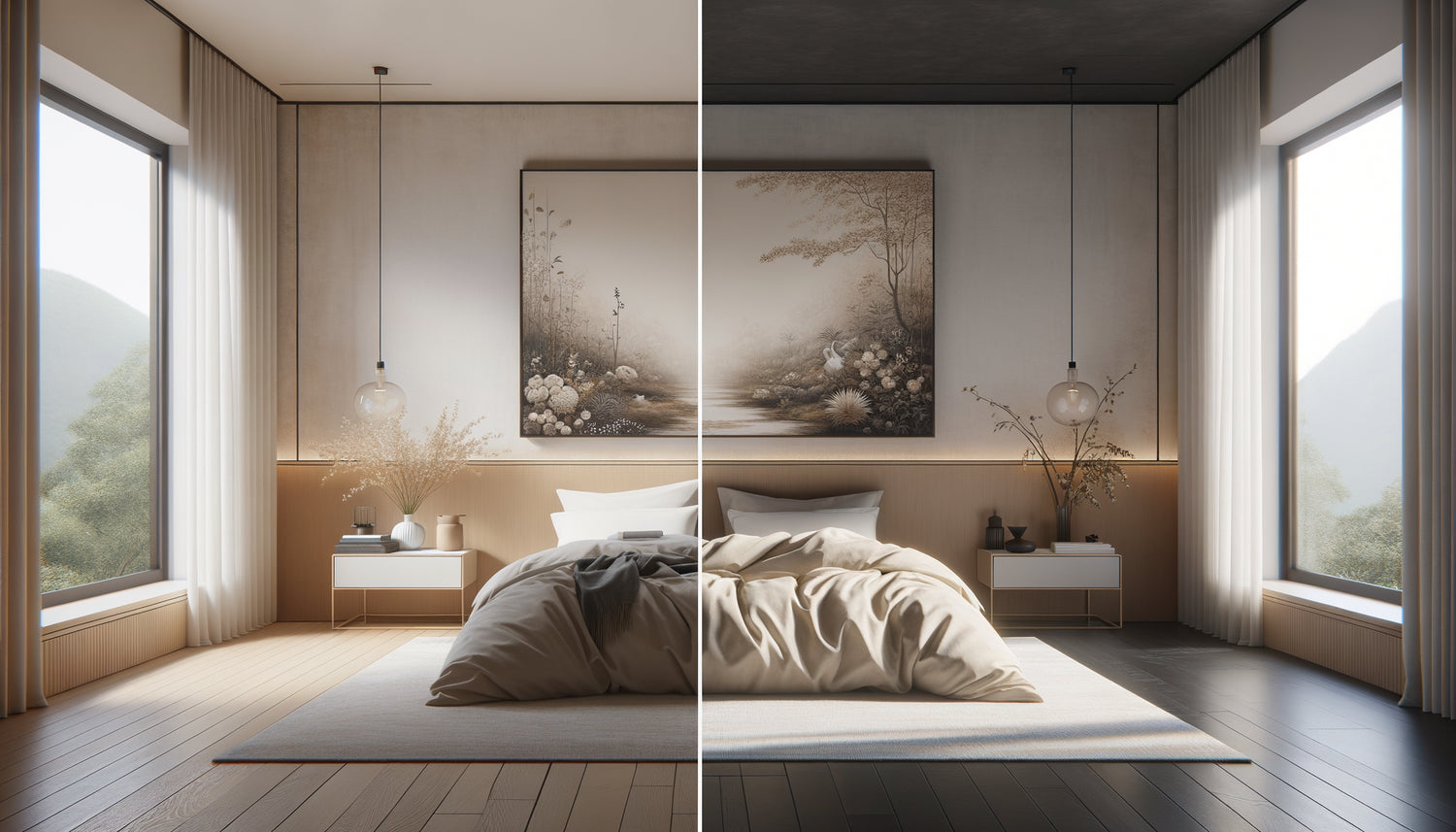
Three AM. You stare at the ceiling, your mind racing. Your gaze drifts to the artwork hanging facing the bed – the one that was supposed to soothe you but, strangely, only adds to the visual noise of your insomnia. How many clients have confided in me this dull frustration: having invested in a work for their bedroom without ever feeling that sense of refuge they so desired.
Here's what a bedroom-appropriate artwork truly brings: a visual anchor that slows down heart rate, an atmosphere that naturally prepares you for sleep, and that precious impression of coherence between your space and your need for rest. After accompanying more than 200 people in transforming their bedrooms into true sanctuaries, I realized one essential thing: the choice between a zen minimalist artwork and a detailed composition is never about trend, but personal alchemy.
In this article, I will guide you through the sensory and practical criteria that will allow you to choose the work that truly transforms your bedroom into a haven of peace.
The golden rule no one tells you about bedroom artworks
During my training in environmental psychology, I discovered a principle that revolutionized my practice: our brain processes visual information differently depending on our state of consciousness. In the evening, when your nervous system needs to slow down, an artwork too rich in details inadvertently keeps your visual cortex awake. It's like trying to fall asleep with an animated conversation in the background.
A zen minimalist artwork – composed of a few clean lines, a subtle gradient or a simple organic shape – acts as a decompression signal for your brain. It requires no effort of interpretation. Your gaze scans it without snagging, without seeking to understand or analyze. This visual fluidity is precisely what your nervous system needs to switch to rest mode.
Conversely, a detailed artwork – rich in textures, narrative elements or complex nuances – naturally stimulates your curiosity. Each time your eyes settle on it, they seek, explore, discover. This dynamic can be wonderful... in a living room or office. In a bedroom, it creates an imperceptible but real tension.
Minimalist: when less becomes infinitely more soothing
I remember Claire, a hyperactive senior executive, who had wallpapered her bedroom with detailed travel photographs. 'I thought these memories would soothe me,' she confided to me. We replaced those compositions with a single zen minimalist artwork depicting a black ensō circle on an off-white background. The change was spectacular: 'It’s as if the room finally breathes.'
The concrete benefits of minimalism in your bedroom
A minimalist wall art for bedroom offers an immediate reduction in cognitive load. Your brain has nothing to analyze, nothing to decipher. It can simply be. This visual simplicity creates a mental void – exactly what those who practice meditation seek.
The restricted palette of a zen artwork – often neutral tones, beiges, soft grays or whites – maintains a chromatic consistency that never disrupts the balance of the room. Unlike detailed compositions that can clash with your bedding or curtains, minimalism integrates universally.
I also observe that minimalist zen artworks age better in space. Their timelessness protects them from fashion effects. In five years, this abstract line or monochrome texture will still be relevant, where a detailed scene might tire you.
Who is the minimalist approach really for
If your daily life is overloaded – busy schedule, incessant notifications, multiple solicitations – your bedroom must become a radical counter-space. The minimalist artwork then becomes a silent manifesto: here, nothing is urgent, nothing claims your attention.
People sensitive to visual stimuli, those who say they are easily overstimulated, find in these purified works a true sensory relief. One of my hypersensitive clients confessed that replacing his former elaborate artwork with a simple composition of three zen stones had reduced his morning migraines.

Detailed : when visual richness nourishes the soul
However, I would be dishonest to present only minimalism as a solution. Some people literally switch off in an environment that is too pure. Marc, a cabinetmaker, had tried the minimalist experience on my advice. Result: "I feel like I'm sleeping in a waiting room. I need substance, depth."
When detail becomes meditation
A detailed wall art for bedroom can paradoxically create a zen effect if – and this is crucial – the details are organized according to a repetitive and harmonious logic. Think of the fractal patterns in nature: the branches of a tree, the waves of the ocean, the petals of a peony. These natural repetitions hypnotize the gaze gently without ever jolting it.
I installed a large zen wall art depicting a bamboo forest in the mist for an insomniac client. Very detailed, certainly, but with such regularity in the verticals, such softness in the gradients, that the work acted as a visual mantra. She told me that following the stems of bamboo with her eyes had become her sleep ritual.
The secret lies in the nature of the details. Detailed zen compositions work when the elements do not tell a narrative story (no characters, no action), but rather create a contemplative texture. A Japanese garden seen from above, pebbles aligned on a beach, ginkgo leaves arranged in a pattern – these are details that soothe rather than stimulate.
The profile that flourishes with visual richness
If you are a contemplative person, if you like to lose yourself in observation, a detailed wall art can become your decompression companion. Some of my clients tell me that they ‘travel’ within their artwork before sleeping, mentally exploring each nuance, each texture.
Creative personalities, who are visually nourished, may feel a form of sensory deprivation in the face of excessive minimalism. For them, a detailed zen wall art but harmoniously structured offers the best balance: enough substance to satisfy their aesthetic appetite, enough order not to disturb their sleep.
The five-look test: your personal compass
Rather than imposing an arbitrary rule on you, I suggest an exercise that I systematically use with my clients. Place yourself in your bed, in a resting position. Look at the potential artwork (or the space where you want to hang it) five times:
First look (10 seconds): What do you feel immediately? Attraction, indifference, slight tension?
Second look (30 seconds): Does your breathing naturally slow down or remain at the same pace?
Third look (1 minute): Does your gaze latch onto details that solicit your analysis, or does it glide smoothly?
Fourth look (2 minutes): Do you feel eye fatigue or, on the contrary, visual rest?
Fifth look (5 minutes): Do you naturally want to close your eyes, or do you remain mentally awake?
This sensory test instantly reveals whether a minimalist zen wall art or detailed one corresponds to your unique physiology. Your bodily reactions never lie.

The fatal mistakes that sabotage the Zen effect (whatever the style)
Beyond the minimalist versus detailed debate, certain mistakes systematically destroy the soothing effect of a wall art for bedroom.
The mistake of stimulating color: A bright red, an electric orange or a lemon yellow – even in a minimalist composition – keep your nervous system on alert. Effective Zen tables prefer cool tones (blues, soft greens) or neutrals (beiges, grays, off-whites).
The mistake of placement: Facing the bed, yes. But never at eye level when lying down. If the painting is perfectly in your direct line of vision, it becomes an intrusive presence. Place it slightly higher or offset, so that it remains in your peripheral field without imposing itself.
The mistake of overload: A Zen table, even minimalist, loses all its power if it is surrounded by ten other frames, overloaded shelves or mirrors. The negative space around the work is as important as the work itself. Let it breathe.
The mistake of aggressive light: A spotlight directed directly at your detailed table turns it into a source of visual stimulation. Prefer soft ambient lighting that reveals the work without projecting it.
Ready to transform your bedroom into a sanctuary of serenity?
Discover our exclusive collection of Zen tables that harmonize refined aesthetics and the science of rest, selected to create the soothing atmosphere your intimate space deserves.
Your bedroom tells who you really are
Close your eyes for a moment. Visualize your ideal bedroom – one where you fall asleep easily, where you wake up rested, where simply entering instantly lowers your stress level. What painting do you see on that wall? Clean lines that create a soothing void, or a textured richness that gently envelops you?
The truth is, there's no universal answer between a minimalist zen artwork and a detailed piece. Your optimal choice depends on your sensory sensitivity, your pace of life, your need for stimulation or visual silence. What deeply soothes one may leave the other indifferent.
Trust your visceral feeling. Test, observe your bodily reactions, adjust. Your bedroom isn't a decoration project – it's your daily refuge. The artwork you choose should be the one in front of which your breathing spontaneously slows down, the one that makes you sigh with relief as you cross the threshold.
Start this week: observe your current artwork with the five gazes. Then, look for the one that truly calls to you. Your sleep will thank you.
Frequently asked questions about zen artworks for bedrooms
Can a colorful artwork really disrupt my sleep?
Absolutely, and science confirms it. Our retina contains photosensitive ganglion cells that transmit information about light and colors directly to our biological clock. Warm and saturated colors – reds, bright oranges, intense yellows – keep our arousal system active, even at low brightness. That's why an effective zen artwork favors cool or neutral shades that don’t disrupt melatonin production. If you love a vibrant artwork, keep it for your living room where it will energize the space without compromising your rest. In the bedroom, opt for soothing palettes: deep blues, sage greens, pearl grays, beige sands. You'll probably find that you fall asleep more easily and that your nighttime awakenings decrease. The chromatic environment of your bedroom isn’t a cosmetic detail – it's a physiological parameter that directly influences the quality of your sleep.
What size artwork should I choose not to overwhelm my bedroom?
The rule I consistently apply: your wall art for bedroom should occupy approximately 60 to 75% of the width of the furniture on which it is visually anchored (usually the headboard). A picture that is too small creates a sense of incompleteness that subtly disrupts visual harmony, while one that is too large overflows and weighs down the space. For a 160 cm headboard, aim for a wall art piece 100 to 120 cm wide. But be careful: these proportions change dramatically depending on the style. A zen minimalist artwork can be more imposing because its simplicity prevents any feeling of clutter. Conversely, a detailed artwork often requires smaller dimensions so as not to visually saturate. Also consider ceiling height: in bedrooms with low ceilings (less than 2.40 m), prioritize horizontal formats that visually widen the space. In a bedroom with high ceilings, a vertical format can beautifully balance proportions. Before buying, cut out a piece of cardboard to the intended dimensions and hang it temporarily – you will immediately see if the scale works.
Can we combine several zen artworks in a bedroom or is it better to have just one?
Essential question that even divides professionals! My experience has taught me this: in a bedroom, less is almost always more. A single zen artwork carefully chosen creates a clear focal point that soothes the eye. Your eye immediately knows where to rest, your brain doesn't have to choose between multiple visual stimuli. However, a composition of two or three minimalist artworks can work wonderfully if – and only if – they form a coherent series (same palette, same style, same energy) and are arranged with rigorous geometry (perfect alignment, regular spacing). This visual unity transforms several works into a single expanded composition. On the other hand, mixing a detailed artwork with other works almost systematically creates a visual cacophony incompatible with rest. If you have multiple artworks that you like, practice seasonal rotation: change your work every three months. You thus renew the energy of your bedroom without overloading the space. And remember: in this space dedicated to rest, your goal is not to create an art gallery, but a cocoon that welcomes your fatigue gently.