

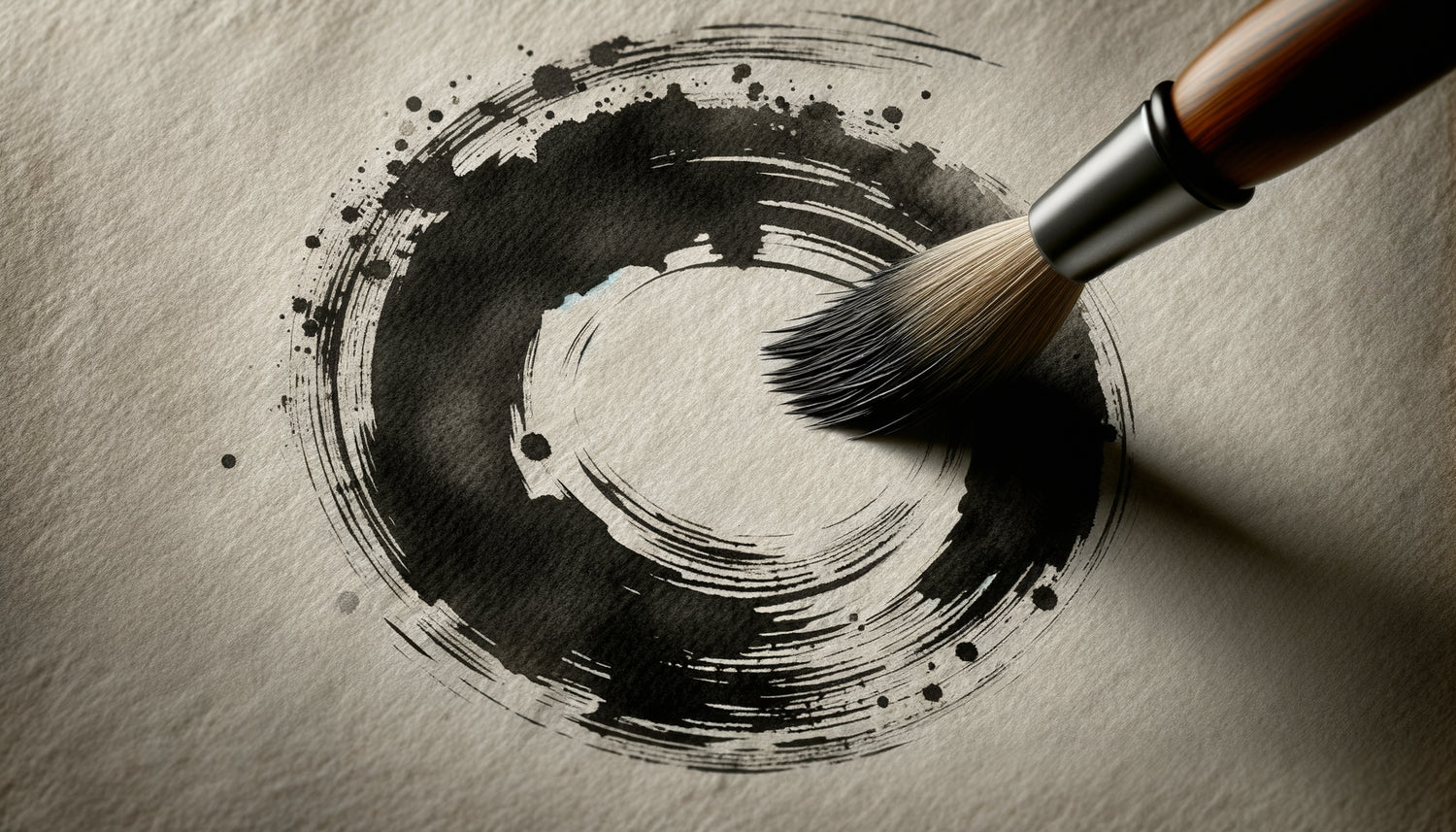
Three years ago, during a residency in a Zen temple south of Kyoto, I watched Master Takeshi trace his first ensō of the day. An absolute silence reigned in the room. His brush, loaded with black ink, danced on rice paper for exactly three seconds. The circle was imperfect, vibrant, inhabited by an energy that I have never found again in mass-produced reproductions.
This is what authentic ensō paintings bring to your interior: a meditative presence that instantly soothes the atmosphere, an authentic connection with Japanese Zen philosophy, and this conscious imperfection that celebrates the beauty of the present moment.
The problem? The market is overflowing with perfect circles, symmetrical, traced by computer or mechanically reproduced. These imitations completely lack the very essence of ensō: this unique presence of the gesture, this breath of the calligrapher at the precise moment when he abandons control to let energy circulate.
After collaborating with twelve traditional calligraphers and analyzing hundreds of works, I learned to recognize the signs that do not deceive. I will pass on these keys to you so that you can choose a Zen painting that truly embodies the spirit of this millennial practice.
The unique gesture: why imperfection reveals authenticity
An authentic ensō is born from a single circular movement, executed in one exhalation. The calligrapher never retraces his stroke, never corrects it. This constraint makes all the difference between a living work and a cold reproduction.
On an authentic ensō painting, you will notice subtle variations in the thickness of the line. At the beginning of the circle, the brush loaded with ink leaves a denser, almost black mark. Gradually, as the ink runs out and the gesture accelerates, the line becomes thinner, sometimes gray, revealing the texture of the paper in transparency.
I learned to look for these variations in intensity that testify to a human gesture, not a mechanical impression. Also observe the starting and ending points of the circle: in Zen tradition, they rarely meet perfectly. This space, this ma as the Japanese say, is not an error but an intention. It symbolizes openness, impermanence, the perpetual movement of life.
Tangible signs of a handmade creation
Approach the painting. If you can distinguish tiny ink projections around the main circle, almost invisible splashes, that's a good sign. These spontaneous splatters are born from the speed of the gesture and the generosity with which the calligrapher loads his brush.
The support itself tells a story. The traditional rice paper (washi) absorbs ink differently depending on humidity, pressure, brush angle. This interaction creates subtle effects, areas where the ink spreads slightly in halos, others where it remains concentrated in sharp lines. These nuances are impossible to reproduce digitally.
The Embodied Philosophy: When the Circle Becomes Meditation
One morning in Kamakura, Master Yoshida confided something fundamental to me: "Ensō is not a drawing; it's the visible imprint of a state of consciousness." This sentence transformed my way of looking at these zen circles.
Authentic ensō paintings carry within them this contemplative dimension. When faced with a true work, you feel a particular presence, almost a vibration. It’s not mystical; it's neurological: your brain unconsciously perceives the thousands of micro-variations in the line, that unique signature of life that screens and printers cannot reproduce.
Also look for the accompanying calligraphy. Many traditional ensō include a short poem or zen phrase traced with a brush, often in the corner of the composition. These characters, called bokuseki, extend the circle’s meditation into words. Their presence generally indicates a traditional approach to practice.
The Red Seal: Signature or Simple Decoration?
The vermilion seal (hanko) often found near the ensō is not merely a decorative element. In Japanese tradition, this personal seal of the calligrapher authenticates the work and engages their artistic and spiritual responsibility.
On authentic wall art, this seal presents irregularities: the red ink is never perfectly uniform; the edges may slightly bleed. Reproductions, on the other hand, display seals printed with perfect sharpness that betrays their mechanical origin.

The Materials That Speak of Authenticity
During my training with Kyoto artisans, I discovered that materials constitute the first selection filter. Traditional sumi ink, made from compressed pine soot, possesses a depth that ordinary Chinese ink never reaches.
On an ensō painting traced with authentic sumi, the black is never uniform. It contains infinite nuances, from slate gray to jet black, creating a paradoxical luminosity. Under certain lighting conditions, you may even perceive subtle metallic reflections.
Washi paper, handcrafted from mulberry fibers, features a slightly uneven texture with fine fibers visible in transparency. Unlike smooth, white industrial paper, washi has a natural cream or ivory hue that evolves over time, gaining depth.
The traditional mounting : kakemono and kakejiku
An authentic ensō deserves a traditional mounting. The kakemono (vertically suspended scroll) or the kakejiku (silk mounting with wooden slats) are not mere frames but an integral part of the artwork.
These mountings include silk borders, often in subdued tones (beige, pearl gray, taupe) that dialogue with the circle without competing with it. The quality of this hand-mounted work, made with natural glues and ancestral techniques, indicates the respect given to the original work.
Limited editions vs mass reproductions : learning to distinguish
Not all artworks can be unique originals, and high-quality limited editions have their place in an accessible approach. I have identified three distinct categories on the market for zen paintings.
Unique originals, traced by a calligrapher during a meditation session, remain the ideal. Each copy differs, carries its own character. These works are usually signed, dated, and accompanied by a certificate of authenticity detailing the materials used.
Handcrafted limited editions, numbered and signed, can offer an excellent compromise. Some calligraphers create thematic series, tracing several ensō in the same state of mind. Although similar, these circles retain the variations inherent in the manual gesture. Always check that the numbering is handwritten, not printed.
Finally, digital reproductions flood the market. They are recognizable by their overly smooth perfection, their derisory price, and the complete absence of variation in the line. These prints can pleasantly decorate a space, but do not carry any of the meditative qualities of a true ensō.
Provenance : an often neglected criterion
Always ask for the history of the artwork. Specialized galleries and serious workshops can tell you who created the work, in what context, with what intention. Some calligraphers trace their ensō during specific ceremonies, others during extended meditation retreats.
This traceability not only guarantees authenticity but enriches your experience. Knowing that your circle was traced at dawn after a night of zazen, in a centuries-old Japanese temple, transforms your relationship to the object. It becomes a bridge between you and this millennial practice.

How to integrate an authentic ensō into your interior
Zen teaching emphasizes the ma, this empty space that gives meaning to form. This philosophy should guide the placement of your ensō painting. Avoid walls that are too cluttered. The circle needs to breathe, surrounded by emptiness to fully deploy its presence.
In my practice, I have observed that authentic zen paintings naturally create areas of calm. Customers regularly testify that their gaze instinctively returns to the ensō during moments of stress, as if the circle exerted a soothing attraction.
Prefer indirect and natural lighting. The grazing light of morning or evening reveals the subtle reliefs of ink on paper, these micro-topographies which attest to the manual gesture. Absolutely avoid direct and violent lighting that flattens these nuances.
Transform your space into a sanctuary of serenity
Discover our exclusive collection of Zen paintings that embody the authenticity of Japanese tradition and bring this unique meditative presence to your interior.
The fair price: investing in authenticity
Let's talk frankly about money. An authentic ensō traced by an experienced calligrapher costs significantly more than a reproduction. This difference reflects years of practice, the quality of materials, and above all this meditative dimension that is impossible to quantify.
I have seen reproductions sold for 30 euros and originals for 3000 euros. Between these extremes, a reasonable range for a quality ensō painting is between 200 and 800 euros. This price generally includes traditional mounting, a certificate of authenticity, and sometimes a notice explaining the context of creation.
Consider this purchase as an investment in your daily environment. A true ensō does not go out of style, does not become tiresome. Its presence evolves with you, revealing new subtleties over the years. Several of my clients have confided to me that their zen circle had become an emotional landmark, a point of anchorage in the chaos of everyday life.
Imagine that moment, tomorrow morning. You open your eyes, and your gaze naturally meets this perfectly imperfect circle hanging above your bed. Even before thoughts race, before the to-do list, this ensō painting reminds you of what's essential: presence, the moment, completeness in the unfinished. Your breathing instinctively slows down. The day begins differently.
Choosing an authentic zen circle is inviting that quality of presence into your daily life. You don't need to understand Buddhist philosophy or practice meditation. The ensō quietly does its work, day after day, anchoring your space in a form of millennial wisdom that has never been as necessary as it is today.
Trust your feelings. In front of several paintings, observe which one attracts your gaze, which invites you to silence. This instinctive attraction is often the best guide. The authentic ensō recognizes you as much as you recognize it.


