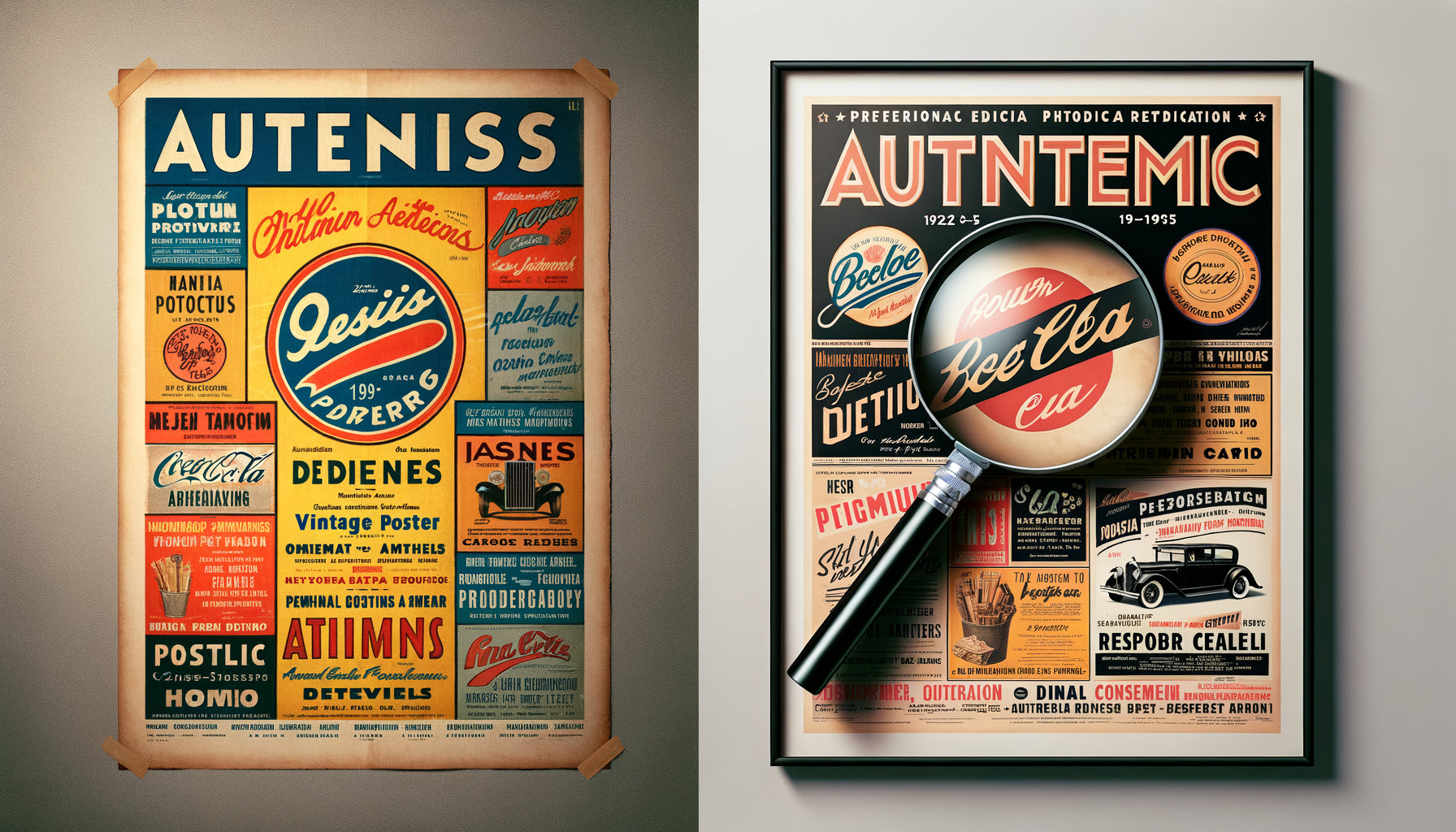
I experienced that precise moment three years ago: standing in front of my wall of vintage frames, unable to remember where I had found this Art Deco lithograph or how much I paid for it. Worse still, I couldn't find the certificate of authenticity for my 1950s advertising poster. It was at that instant that I understood the urgency of a professional inventory.
Here’s what a structured inventory of your vintage wall art collection brings: accurate valuation of your artistic heritage, complete traceability of each acquisition, and optimal protection in case of disaster or resale. Because yes, these treasures gleaned from flea markets, galleries, and antique shops deserve the same documentary care as a museum collection.
The frustration of the amateur collector is universal: we accumulate beautiful pieces without ever taking the time to document them properly. We forget details, we lose proof of purchase, we mix up information. And when it's time to estimate the collection for insurance, inheritance or simply out of curiosity, it’s total chaos.
Good news: creating a professional inventory requires neither a degree in art history nor complex software. Just method, regularity, and the best practices that I am about to share with you. In twenty minutes, you will have all the keys to transform your disorganized collection into a catalog worthy of a gallery owner.
The documentary foundation: photographing like an auctioneer
Every inventory of vintage wall art begins with impeccable visual documentation. I learned this lesson at my expense after taking blurry photos under yellowish lighting that made my pieces unsellable online.
Frontal photography is your first step. Take down each painting, place it against a neutral white or light gray wall, and photograph it straight on with indirect natural light. Avoid flash which creates reflections on glasses and alters colors. Take several shots at different exposures: you will choose the most faithful one later.
But the real professional secret lies in detail photos. Capture close-up the artist's signature, workshop stamps on the back, labels from old galleries, edition numbers, and even visible defects (tears, stains, discolorations). These details become crucial during an appraisal or resale.
Never forget the back of your vintage wall art. This is where the most valuable information often hides: exhibition seals, handwritten annotations, period framing labels. I discovered that a 1930s poster came from a Parisian exhibition in 1934 thanks to a simple label on the back, tripling its value.
The minimal equipment of the amateur photographer
You don't need to invest in professional equipment. A recent smartphone is more than enough to document your collection of vintage wall art. Simply activate HDR mode to capture all the color nuances, disable flash, and stabilize your device against a piece of furniture to avoid blur.
If you own valuable pieces, consider purchasing a tripod for 30 euros and a portable LED lamp with neutral white light. This modest investment will radically transform the quality of your photographic documentation.
The identification sheet: anatomy of a properly cataloged painting
Each painting in your collection deserves its own complete inventory record. I use a simple numbering system: VIN-001, VIN-002, and so on (VIN for Vintage). This unique number becomes the permanent identifier of the piece.
Here is the essential information to record for each vintage wall painting:
Artistic identification: Title of the work (if known), name of the artist or printer, creation date or estimated period, technique used (lithography, screen printing, offset, original painting), exact dimensions in centimeters (height x width), with or without frame.
Provenance and acquisition: Place and date of purchase (Clignancourt flea market, Lyon Art Nouveau gallery, online sale), name of the seller if relevant, exact purchase price, reference to the invoice or receipt, ownership history if known (particularly important for valuable pieces).
Condition and conservation: Overall condition (excellent, good, fair, restoration needed), specific defects (folds, tears, foxing, discoloration), documented previous restorations, type and condition of the frame (period or later).
This descriptive rigor transforms your amateur collection into a professional archive. The day you want to sell, insure or bequeath your vintage wall paintings, you will thank yourself for the hours invested in documentation.

Choosing your tool: from moleskine notebook to specialized application
The traditional method of a paper register still has its followers, myself included for my beginnings. A simple spiral-bound notebook with plastic pockets allows you to create one sheet per page, with printed photos glued and handwritten notes. It's tangible, reliable, and never crashes.
But I quickly moved to more flexible digital solutions. A simple Excel or Google Sheets spreadsheet offers a solid foundation: one row per artwork, columns for each piece of information, the ability to sort, filter and search instantly. Add a column for the link to a Dropbox folder containing the photos, and you get a functional system at no cost.
More demanding collectors turn to dedicated applications like Collectify, Sortly or Art Inventory. These tools allow you to scan barcodes affixed to the back of frames, automatically generate insurance reports, and share elegant portfolios with galleries or potential buyers.
My advice after five years of experimentation: start simple with a spreadsheet, then evolve to a specialized application only if your collection exceeds fifty pieces or if you plan to manage the commercial aspect of your vintage wall art.
Backup: the life insurance of your inventory
An inventory of vintage wall art is only valuable if it survives accidents. I apply the 3-2-1 rule: three copies of my data, on two different media, one offsite. Specifically, my inventory exists on my computer, an external hard drive, and in the cloud (Google Drive). High-resolution photos are also backed up to a separate service.
Update your backups whenever you add a piece to your collection. This two-minute discipline can save you years of documentary reconstruction.
Valuation: between expertise and market realism
Assigning a value to each vintage wall art remains the most delicate exercise in inventory. The initial purchase price is your minimum reference, but the market value evolves according to trends, rarity and condition.
For common pieces (reproduced advertising posters, decorative prints), check platforms like eBay, Etsy or Le Bon Coin by filtering sold listings (not asking prices, often fanciful). Note a low and high range for each similar artwork.
For original works or limited edition numbered prints, professional expertise becomes essential as soon as you suspect a value exceeding 500 euros. An auctioneer or graphic art expert typically charges between 50 and 150 euros per piece, an investment quickly recouped if the actual value exceeds your estimates.
I record three distinct values in my inventory: historical purchase price, conservative current estimate (for insurance), and optimistic market value (for resale under ideal conditions). This triple reference allows me to track the patrimonial evolution of my vintage wall art collection.

Certificates and proof of ownership: building a solid file
A professional inventory is always accompanied by physical evidence documentation for each important piece. I keep in individual plastic sleeves: original purchase invoices, certificates of authenticity issued by sellers, expert reports if ordered, press articles mentioning the work or artist, photos of the artwork in its original context.
For vintage wall art acquired without documentation (flea market purchases, family inheritance), create your own affidavit stating the circumstances of acquisition, approximate date, and any memorable contextual elements. This document, even informal, has a higher probative value than the total absence of written trace.
Systematically digitize these documents and link them to the corresponding inventory record. A disaster, a move or simply clutter should never separate an artwork from its supporting documentation.
Your collection deserves pieces to match your documentary rigor
Discover our exclusive collection of Vintage paintings that will enrich your inventory with authentic and traceable artworks.
Inventory maintenance: the discipline of the informed collector
Creating an inventory of vintage wall art represents half the work. Keeping it up to date constitutes the other half, often neglected. I have established a simple ritual: each new acquisition is photographed and inventoried within 48 hours. No delay, no exception.
Also schedule a complete annual review of your collection. Use this opportunity to check the conservation status of each piece, update value estimates according to market trends, and complete any missing information you may have identified in the meantime.
This review also allows you to detect pieces requiring preventive restoration before damage becomes irreversible. A living inventory protects better than a static catalog frozen in time.
Beyond the inventory: bringing your collection to life
A professional inventory of your vintage wall art opens up unsuspected doors. You can now share elegant portfolios with local galleries, offer some pieces on loan for themed exhibitions, or simply document the evolution of your passion on a blog or Instagram.
I discovered that this documentation exercise transforms the relationship to the collection itself. One becomes more selective in acquisitions, more attentive to details, more aware of the heritage value of what adorns our walls. Each painting ceases to be a simple decorative element to become a piece of meticulously preserved history.
Your inventory becomes the tangible narrative of your collector's journey: impulsive crushes, extraordinary discoveries, formative mistakes. It is this personal narration, far more than the market value, that will give meaning to your collection of vintage wall art.
Imagine yourself in ten years, browsing your inventory which has become a personal catalog of several dozen pieces. Each record tells a story, each photo revives a memory. You know precisely the value of your artistic heritage, you have all the necessary evidence for optimal insurance, and you can pass on this collection with documentation worthy of a professional.
Start today. Hang your first painting, photograph it properly, create its inventory record. Then the second. Then the third. In a few weekends, your disorganized collection will transform into a professional archive that enhances each piece while securing your passionate investment.