Engraving and Printmaking: The Art of the Impression at the Service of Graphic Precision
By Alexandre MARY
⏱️ Reading time: 8 minutes
You’ve fallen for this magnificent print you spotted in a gallery, but once you get home, uncertainty gnaws at you: is it really an authentic work of art or just a simple commercial reproduction?
You contemplate this image with such fine and precise details, those subtle nuances that seem to dance in the light, and you wonder how to distinguish a true handcrafted engraving from an industrial print. The anxiety grows: have you invested in a durable collector's item or a decorative object without value?
You may have already consulted online guides, asked friends for advice, but their answers remain vague and contradictory. Some talk about "limited edition", others about "ancestral technique", but no one explains to you concretely what makes the difference.
This confusion is perfectly normal: the world of engraving and printmaking uses precise technical vocabulary that few people really master. Even dealers sometimes mix up terms, creating even more blur around these millennial artistic techniques.
By the end of this article, you will perfectly know how to identify a true handcrafted print, understand its heritage value, and choose works that will enhance your interior while constituting an intelligent artistic investment.
Why does artisanal engraving fascinate experienced collectors so much?
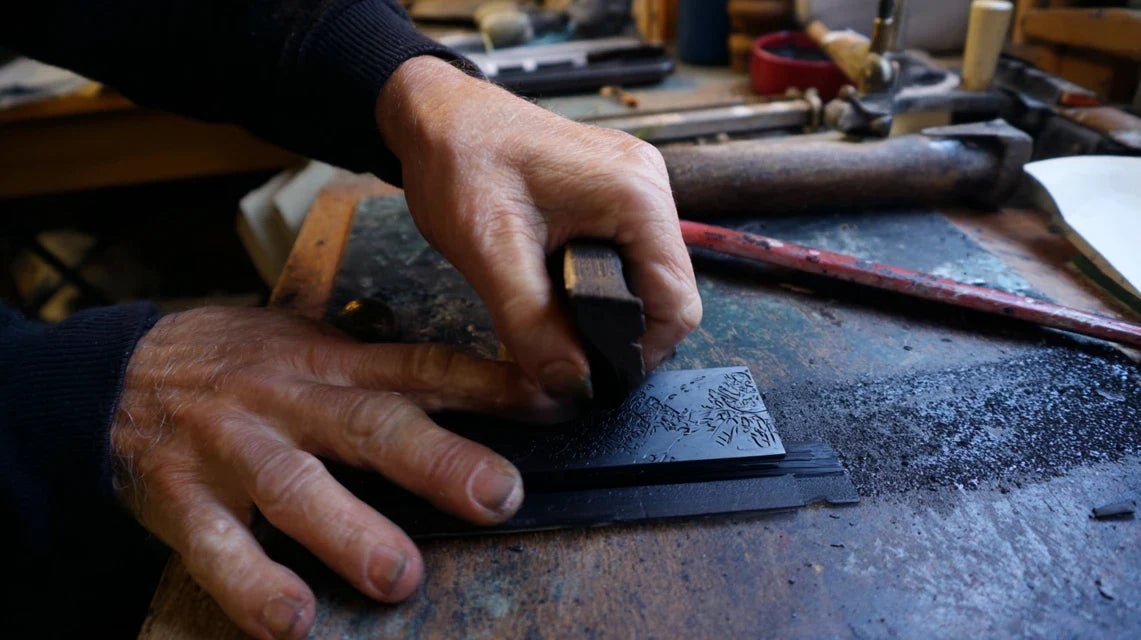
In a world saturated with digital images, owning an authentic print is like holding a fragment of art history. Each work carries within it the artist's unique imprint, their gestures, their technical choices, their emotions engraved in the material. Imagine: each copy of this print has been printed manually, one by one, by the hands of its creator.
🎨 Testimonial from a collector: "I discovered my first engraving in an antique shop in Paris. The artist had engraved each line with a burin, and when I ran my finger over the paper, I felt the reliefs of the ink. That texture, that depth... no modern reproduction can rival that tactile authenticity."
💬 Conversation with a print expert
"Prints are necessarily fragile and delicate... I won't dare hang them in my living room for fear of damaging them!"
Don’t be fooled! A quality print, made on rag paper and with stable inks, can last through the centuries without losing its splendor. Think of Dürer's engravings: five hundred years later, they still retain all their finesse. With a UV protective glass frame, your print will be perfectly protected while enhancing your decor.
"I’ve always been told that engraved works are less valuable than unique paintings..."
This vision belongs to the past! Today, collectors are primarily looking for technical excellence and authenticity. A Picasso etching or a Rembrandt engraving can be worth much more than any contemporary painting. Rarity and craftsmanship take precedence over support.
The golden rule of printmaking: each copy tells the same story with unique nuances. Unlike mechanical reproduction, each hand-pulled edition presents slight variations that make it an authentic piece. You can notice this authenticity in seconds only, as soon as you know what to look for.
What really lies behind this fascination with engraved art?
Perhaps you recognize yourself in these situations: you admire a print without understanding its technique, you hesitate between several works without objective criteria, or you fear making a bad choice due to lack of technical knowledge.
What you feel actually reveals your natural artistic sensitivity. Your attraction to these works is not random: it testifies to your taste for authenticity and refinement. The problem is not your lack of culture, but the absence of clear explanations about these fascinating techniques.
It's like appreciating a great wine without knowing the grape varieties: your palate recognizes the quality, but you lack the words to express it and fully understand it.
The perspective error on "reproducibility"
Many think that since an engraving can be pulled in several copies, it loses its artistic value. Exactly the opposite happens: this ability to reproduce was revolutionary and democratic, allowing artists to spread their art beyond aristocratic circles.
Imagine Gutenberg revolutionizing access to knowledge through printing: engravers did the same for visual art, creating a bridge between the artist and the public.
This democratization has never diminished artistic value: on the contrary, it has magnified it by allowing engraving techniques to refine and perfect over the centuries.
🔍 Immediate authenticity test: Carefully look at the contours of a line on your print. If you notice a slight "embossed" mark in the paper (like a delicate relief), you have a real handmade engraving. This imprint comes from the pressure of the press on the engraved plate.
The myth of "technical complexity"
It is often thought that it takes years of study to understand prints. In reality, a few basic knowledge are enough to distinguish the main techniques and fully appreciate a work.
It's like learning to recognize wood essences: once you know how to differentiate oak from pine, everything becomes clearer and your gaze naturally refines.
This understanding immediately transforms your relationship with art: you go from passive spectator to informed enthusiast capable of debating and choosing knowingly.
The Misconception About Art Investment
Many believe that only unique artworks constitute a good investment. However, some prints can be worth more than contemporary paintings, especially those created using mastered traditional techniques.
You can spot these gems by observing the artist's signature, the numbering of the edition, and above all, the visible quality of execution.
This recognition gives you access to a less saturated art market, where your budget can acquire high-quality artworks without the prohibitive prices of unique paintings.
5 signals that reveal a quality print:
The edges of the paper are irregular and not cleanly cut: they testify to a superior quality handmade paper, such as vergé or rag paper
The ink shows subtle variations in density: this characteristic reveals manual inking, impossible to reproduce mechanically
Fine lines show perfect sharpness without smudges: this indicates a deep and precise engraving, a sign of accomplished artisanal know-how
The Trigger Factor: The Tactile Encounter with the Artwork
What really makes the difference is the unique sensory experience offered by an authentic print. Like a domino effect, this first tactile sensation triggers a cascade of emotions and discoveries: you begin to perceive nuances, understand techniques, and develop your personal artistic taste.
The rule of three senses: A true print is recognized by sight (ink reliefs), touch (paper texture and imprint), and even smell (subtle scent of natural inks). Test this rule on your next visit to a gallery.
❌ Common Misconception
✅ Artistic Reality
💡 Simple Explanation
🎯 Benefit for You
Prints are fragile and difficult to preserve
They last through the centuries with minimal maintenance
Rag paper is more resistant than stretched canvas
Sustainable investment without constraints
Only unique artworks have value
Rarity comes from limited edition and technique
50 prints by a master are worth more than an anonymous painting
Access to quality art with a reasonable budget
You need to be an expert to understand prints
A few guidelines are enough to choose well
Like recognizing good wine: the eye learns quickly
Immediate confidence in your artistic choices
Modern reproductions rival the original
No machine imitates artisanal texture
The physical imprint of the press is unique
Guaranteed authenticity and certain appreciation
How to Recognize and Choose Your Prints Like a True Connoisseur
Now that you understand the fundamentals of this art, let's move on to practice. Choosing an authentic print follows a simple logic, like building a house: first we examine the foundations (the paper), then the structure (the engraving technique), and finally the finishing touches (the inking and signature). The result? You will quickly develop an expert eye capable of spotting artistic wonders.
🎯 Overview of your learning: Three progressive steps will lead you from curious novice to informed collector. First, you will learn to identify the main supports and techniques. Then, you will develop your aesthetic and technical assessment skills. Finally, you will master the art of uncovering gems and building a coherent collection.
Step 1: Mastering the fundamentals (the solid base)
Let's start at the beginning: recognizing authentic materials. It’s like learning to recognize spices in cooking: once you know how to identify the basic elements, you can appreciate all the nuances. This first step will immediately give you the satisfaction of understanding what you are looking at.
The noble supports to absolutely recognize
Vergé or rag paper: recognizable by its visible fibers in transparency and its slightly rough texture. It serves as a noble base that ages beautifully without yellowing. Avoid pure white industrial paper which reveals a modern print. Its quality is verified by looking at the paper in transparency: you must see a watermark or verge lines.
Traditional engraving ink: it has variable density and a characteristic matte depth, unlike the bright inks of modern printing. Its principle: it penetrates the fibers of the paper instead of staying on the surface. Good quality is recognized by the absence of metallic reflections under light.
The printing plate: this is this slight rectangular imprint around the image, created by the pressure of the plate on the paper. This invisible signature guarantees artisanal authenticity and adds extra elegance when framing.
Now let's move on to practical identification of techniques
How to examine a print in 3 simple steps
Surface examination under raking light: slightly tilt the artwork under a light source to reveal the reliefs of the ink. This technique immediately reveals whether the ink has been deposited by pressure (authentic) or by projection (modern reproduction). The engraved lines create characteristic small shadows.
⏱️ Time: 30 seconds | ✅ Successful when: you clearly distinguish the ink reliefs and the paper texture | ⚠️ Attention: never touch the artwork directly with your fingers, always use gloves or examine without contact
Signature and numbering verification: look for the pencil signature in the margins, usually in the lower right corner, accompanied by a numbering such as "15/50" in the lower left. These elements should be handwritten, never printed. An authentic signature has variations in pencil pressure.
⏱️ Time: 1 minute | ✅ Success when: you clearly identify a handwritten signature and consistent numbering | ⚠️ Attention: beware of printed signatures or stamped numbers, signs of commercial reproduction
Analysis of edges and margins: observe the borders of the paper which should have an irregular cut (handmade paper) or a clean rebate (soft ground etching). Generous margins indicate respect for printmaking traditions. This area immediately reveals the seriousness of the edition.
⏱️ Time: 45 seconds | ✅ Success when: you spot the characteristic rebate or handmade edges | ⚠️ Attention: edges cut with a guillotine often indicate a reproduction cut from a book or catalog
✨ Validation of your budding expertise: at this stage, you should be able to determine in minutes whether a print is authentic or not. You recognize noble materials, identify the main techniques, and spot elements of authenticity. If you are still hesitating, that's normal: the eye becomes refined with practice. Next step: develop your aesthetic sense!
OUR RECOMMENDED PRODUCTS
Step 2: Developing Your Artistic Eye (Refining Taste)
You now know how to distinguish the authentic from the fake. Time for aesthetic education! This step is the most rewarding as you will develop your personal taste while understanding artistic codes. The snowball effect begins: each work observed enriches your view of the following.
The Aesthetic Criteria That Make the Difference
Analysis of composition and line: observe the fineness and regularity of the lines, the richness of textures obtained by hatching, the balance between light and dark areas. A quality etching reveals a technical mastery at the service of an artistic vision. Every stroke has its reason to be and contributes to the overall harmony.
⏱️ Time: 2-3 minutes | ✅ Success when: you perceive the artistic and technical coherence of the whole | ⚠️ Attention: do not confuse technical complexity with artistic quality: sometimes simplicity reveals more mastery
Assessing the condition: check for stains, creases, or discolorations. Pay particular attention to the margins and areas of dense ink. Good preservation multiplies the heritage and aesthetic value. Slight browning of old paper remains acceptable if it is uniform.
⏱️ Time: 2 minutes | ✅ Success when: you precisely identify the condition and any possible restorations | ⚠️ Attention: overly visible restorations or amateur cleaning attempts significantly reduce value
Step 3: Building Your Personal Collection (Mastery)
You have now reached expert level! You master authentication and possess an educated eye. This final step transforms you into a true collector capable of uncovering gems and building a coherent collection that reflects your personality while constituting a valuable artistic heritage.
The Informed Collector's Strategy
Define your guiding line: choose a theme, an era, or a technique that particularly interests you. This specialization will allow you to acquire pointed expertise and create a homogeneous and enhancing collection. Whether it is etchings of landscapes or burin portraits, your specialty will become your collector's signature.
⏱️ Time: reflection over several weeks | ✅ Success when: you have defined 2-3 precise criteria for collecting | ⚠️ Attention: avoid flitting around: a scattered collection loses coherence and value
Master the art of negotiation and acquisition: develop your relationships with specialized galleries, learn to assess market prices, and don't hesitate to ask all your technical questions. A good gallery becomes a valuable partner in enriching your collection. Patience is your best ally: it is better to wait for the perfect piece than to rush into a disappointing purchase.
⏱️ Time: ongoing process | ✅ Success when: you negotiate serenely and know market prices | ⚠️ Attention: "good deals" that are too tempting often hide defects or authenticity problems
The collector's progression rule: you are ready for the next step when you can simply explain your artistic choices to a novice friend, when you instantly spot major defects in a work of art, and when you feel that particular little emotion facing an exceptional engraving. Passion guides, knowledge reassures.
Congratulations! You now possess all the keys to navigate the fascinating world of prints. You know how to distinguish authentic from fake, assess artistic quality, and even build a collection strategy. This expertise gives you a considerable advantage over impulsive buyers and opens the doors to a world of art rich in discoveries.
🎨 Expert tip: The most beautiful discoveries are often made at local auctions or in provincial antique shops, where quality prints sometimes go unnoticed. Your educated eye will allow you to spot these neglected treasures by less informed buyers.
💭 A question we often hear
"I see a print that I like, but it's not signed... Should I avoid it altogether?"
Not necessarily! This hesitation shows that you are well versed in the codes of graphic art. Some antique prints or specific techniques (such as woodcuts) do not bear a signature without lacking artistic interest. The absence of a signature can even reveal an authentic historical piece of great documentary value. The determining factor remains the quality of execution and the emotion the work evokes in you. Trust your feelings while applying your new technical knowledge.
🔍 Practical advice: Always ask the seller for the origin and history of the artwork. A clear and documented provenance largely compensates for the absence of a signature. You will thus obtain valuable information about the authenticity and value of your favorite piece.
The pitfalls to avoid at all costs to protect your investments
Your nascent enthusiasm for prints deserves to be protected from disappointment. These mistakes are tempting but avoidable: knowing the classic pitfalls will prevent you from making regrettable purchases and preserve the pleasure of collecting.
⚠️ Confusing "numbering" and "limited edition": Some modern publishers number reproductions to create a false scarcity. An authentic limited edition is recognized by the artist's handwritten signature and the technical consistency of all copies. Always check that the artist has participated in the printing, even for supervision.
⚠️ Letting yourself be seduced by a "too good" price: An authentic print has an incompressible production cost (craftsman's time, noble materials, manual printing). An abnormally low price often hides a disguised reproduction or an undisclosed condition problem. It is better to save for a real piece than to collect fakes.
⚠️ Neglecting framing and conservation: Even the most valuable print can degrade quickly with poor framing. Invest in UV-protective glass and an acid-free mat: this initial investment preserves your acquisition for decades to come. It is a beauty and value insurance.
⚠️ Buying impulsively without documentation: Artistic emotion should be accompanied by rationality. Always ask for a certificate of authenticity or documentation on the artwork. These papers facilitate resale and prove your seriousness as a collector. A photo of the work with its dimensions is already sufficient.
⚠️ Ignoring the importance of provenance: an art print without a clear history can hide unpleasant surprises (theft, forgery, concealed condition). Favor sellers who can tell you the story behind their pieces. This transparency reveals a serious business and reassures you about your acquisition.
🛡️ Your safety checklist before purchase: verified handwritten signature, printing technique consistent with the announced era, acceptable condition, price consistent with the market, seller able to explain the provenance. If in doubt about any of these points, take time to reflect or seek a second opinion.
Because you took the time to inform yourself, enjoy 10% discount on your first order:
ART10
⏰ Valid 72h after reading • Applicable to all our products
🤔 Frequently asked questions about prints and engravings
💰 What budget should you plan to start a quality print collection?
Allow between 150 and 500 euros for your first quality acquisitions. This range gives you access to genuine prints by contemporary artists or works from the past in good condition. Start with pieces in this range to educate your eye before investing further. Experience shows that a collection of 5-10 well-chosen pieces is better than 20 impulsive purchases.
⏰ How long does it take to develop an expert eye?
With regular practice (gallery visits, art fairs, museums), six months is enough to acquire a solid foundation. Your expertise then refines gradually with each work observed. The essential thing: don't be afraid to ask professionals questions and handle (carefully) the prints to develop your tactile sense.
🔍 How to verify the authenticity of a print before purchase?
First examine the printing technique (ink reliefs, paper quality), then check the handwritten signature and consistent numbering. Always ask for the provenance and don't hesitate to take a photo to verify later with an expert. Serious sellers always accept this verification process.
🖼️ Can prints be mixed with other works of art in the same room?
Absolutely! Prints harmonize perfectly with other artistic mediums. Their fineness and precision even create an interesting contrast with more gestural paintings. Simply ensure a color or thematic consistency to avoid visual cacophony. Similar frames unify the whole.
📈 Do prints constitute a good long-term investment?
Prints by recognized artists or with high technical skill tend to increase in value, especially as traditional techniques become scarce. However, buy first for aesthetic pleasure: financial appreciation remains a bonus, never a guarantee. The works that move you are often those that will also appeal to future collectors.
🌟 Your transformation into an accomplished connoisseur
In a few weeks, you'll be strolling through galleries with the confidence of the discerning collector. Your trained eye will instantly recognize the technical qualities of a print, your artistic culture will enrich your conversations, and your nascent collection will reflect your refined personality. Your guests will admire not only your works but also your passionate expertise.
This mastery extends far beyond prints: you have developed a global artistic eye, an aesthetic analytical ability, and confidence in your personal tastes that will serve you in all your future decorative choices. Your artistic sensitivity flourishes fully.
The hardest part was understanding the codes and techniques: now that these fundamentals are acquired, let yourself be guided by your emotions. Visit this gallery that intrigues you, ask your questions without complexes, and treat yourself to your first favorite print. Your collection awaits you!
🎨 Your first step as a collector: you now have all the keys to choose with discernment and passion. Trust your new expertise: it will guide you towards extraordinary artistic discoveries that will beautify your daily life for years to come.
📚 To deepen your passion for art
Explore other fascinating artistic techniques: oil painting, watercolor, sculptures... Each medium reveals its secrets and enriches your overall understanding of art.