⏱️ Reading time: 8 minutes
You're still staring at that blank wall for weeks, dreaming of a decor that truly reflects you, but everything you find in stores seems cold, impersonal or already seen everywhere.
You imagine the effect of a unique artwork that would immediately catch the eye of your guests, which would spark admiring conversations, but classic paintings leave you indifferent and reproductions give you the impression of decorating with "déjà-vu".
You've probably tried framed posters, printed canvases or even some traditional artworks, but nothing gives you that authentic feeling of warmth and originality that you are looking for in your interior.
It’s perfectly normal: traditional wall decor often lacks this tactile and artisanal dimension that creates a real emotion. Flat works, even beautiful ones, don't tell a tangible story.
By the end of this article, you will discover how embroidered artworks and textile art instantly transform the atmosphere of a room thanks to their unique textures, and you will know exactly how to integrate them into your decor to create an interior that truly reflects you.
Why does textile art revolutionize wall decoration today?
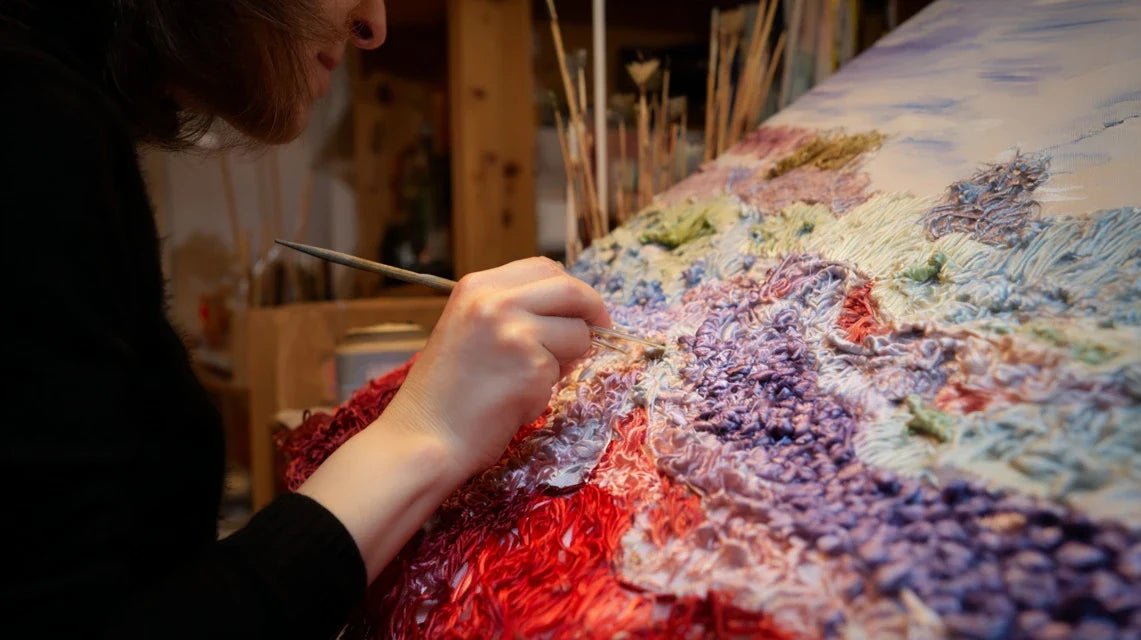
In a world saturated with digital images and standardized decorations, textile art responds to our visceral need for touch, texture and authenticity. Like a perfume that instantly awakens memories, a textile mural creates an immediate emotional connection that no print can reproduce.
Waiting any longer is missing out on this rising trend that transforms the most ordinary interiors into spaces with character. Do your guests really notice your current decor?
🏠 Decor testimonial: Sarah, interior architect, says: "When I hung my first contemporary embroidery in my living room, my clients immediately changed their behavior. They approached, asked questions, almost touched. It was the first time a wall decoration generated so much natural interaction."
💬 Conversation with a decor expert
"I'm afraid it will be too fragile for a living room, my children touch everything..."
On the contrary!
Modern textile fibers are often more resistant than poster paper. Think of your favorite clothes: they withstand washes, manipulations and keep their beauty for years. A well-made textile artwork has this same natural robustness.
"I've always been told that you should avoid textures on walls, that it looks old-fashioned..."
This rule dates back to an era when textile meant flowery wallpaper!
Contemporary textile art plays on clean lines, modern geometries, current colors. It's the difference between wearing a grandmother’s shawl and a designer cashmere sweater.
What Really Happens When Your Décor No Longer Inspires You
You start avoiding having people over, you stop taking photos of your interior, and you feel that sense of incompleteness every time you look at your walls. These signals reveal that your décor is no longer nourishing your daily well-being.
The problem isn't your taste or your budget:
it’s the lack of sensory dimension in your décor. Your brain needs varied stimuli - visual, tactile, emotional - to feel soothed in a space.
Imagine your living room as a playlist: if it only contains songs with the same rhythm, even beautiful ones, it quickly becomes monotonous.
Textile art brings that variation of visual "tempo" that your walls need.
The First Hidden Cause: Uniform Surfaces
Contrary to what one might think, a harmonious interior is not a uniform interior. Too-smooth surfaces create a sense of subliminal discomfort, like a conversation where everyone would speak in the same tone.
It's exactly like in cooking: a delicious dish mixes different textures - crunchy, melting, smooth. Your eye instinctively seeks the same variety in your environment.
Concrete result: you feel unexplained visual fatigue, your guests don’t find a natural place to rest their gaze, and the atmosphere remains cold despite your efforts.
Introducing a textile texture immediately changes this dynamic.
✋ Instant test: Look at your main room and count the different visible textures. Less than 4 distinct textures? Your eye lacks stimulation - simply place a textured fabric on a piece of furniture and watch how your gaze naturally clings to it.
The Second Cause: Lack of Personal Story
Mass-produced décor, even pretty, tells no personal story. Your subconscious detects this immediately: these objects could have been found anywhere.
Think about the difference between a chain hotel and a family-run bed and breakfast. Same comfort, but one leaves you indifferent while the other instantly creates a connection.
Artisanal textile art carries this recognizable human signature.
Direct consequence: you don’t feel that natural pride when someone compliments your décor, because subconsciously, you know it's not really "you". Textile art brings “handmade” back into your world.
The Third Cause: Poorly Exploited Light
Here’s what no one notices: flat surfaces reflect light uniformly, creating static lighting. Your room remains the same from morning to evening, missing all the magic of natural light variations.
Observe your current decor at different times: morning, afternoon, evening. Does it change in appearance?
Textile textures capture and diffuse light differently, creating subtle shadow plays that bring your decor to life.
Daily impact: your interior lacks this "visual breath" that naturally accompanies your biological rhythms. You are not enjoying the changing beauty of your own natural light.
🔍 4 signs that your decor lacks texture:
- The eye doesn't know where to settle: absence of a natural focal point, the eye "glides" over surfaces without stopping
- The atmosphere remains cold despite the colors: colors alone are not enough without the tactile dimension that warms them
- Your guests remain in the center of the room: nothing invites them to approach the walls, a sign of a lack of visual attraction
- You often change your decor: fleeting satisfaction revealing an unmet need for depth
The trigger element: the search for authenticity
What really makes the difference is the visible trace of human hand in the object. Like a domino effect, as soon as an authentic artisanal piece enters your decor, it instantly elevates the level of everything around it.
You will recognize it by these clues: the slight irregularities that prove manual work, the richness of materials that no machine can reproduce, this particular "soul" that emanates from every object born of human hands.
The golden rule of decor balance: A single authentic and textured piece can transform the atmosphere of an entire room. Check it by observing how your gaze is naturally drawn to the most "living" elements of your current decor.
| ❌ Misconception |
✅ Textile Reality |
💡 Why it works |
🎯 Visible Benefit |
| Wall textiles are a thing of the past |
Contemporary textile art revolutionizes decor |
New techniques, clean designs |
Guaranteed originality, "wow" effect |
| It's fragile and difficult to maintain |
More resistant than a classic canvas |
Ultra-robust modern fibers |
Superior durability to posters |
| It only goes with a bohemian style |
Adapts to all decor styles |
Infinite variety of styles and colors |
Harmony with your existing universe |
| It's necessarily very expensive |
More accessible than an original work of art |
Exceptional quality-uniqueness ratio |
Smart decor investment |
The gentle method for integrating textile art into your decor
Rest assured: incorporating a textile artwork doesn't require a major decor revolution. It’s like adding an instrument to an orchestra - it enriches the whole without disrupting the existing harmony.
You will create this visual depth in three progressive steps, which transforms an ordinary interior into a space with character, without ever risking bad taste.
🎯 Overview: First identify the ideal location (like choosing the right wall for a painting), then select the artwork that dialogues with your existing style, finally optimize the hanging to reveal all its beauty. Each step brings you closer to the satisfaction of contemplating an interior that resembles you.
Step 1: Identify the wall that will showcase your textile
Start with the location rather than the artwork, this ensures a harmonious result. Just like planting a tree, the right location determines 80% of the final success.
This step will immediately give you the satisfaction of "seeing" your future decor mentally before even choosing the artwork.
🔍 Criteria for the perfect location
-
Optimal natural lighting: Identify the wall that receives soft, changing light (avoid direct sunlight which can dull colors). A well-lit textile reveals its subtle nuances and creates those shadow plays that bring it to life. Unlike frames with glass which create reflections, textiles absorb and gently diffuse light.
Natural eye level: Locate where your eyes naturally settle when you enter the room (usually 1m50-1m60 from the floor). This is the principle of the "first glance": your textile should be in this visual comfort zone to create maximum impact without effort.
Sufficient viewing distance: Check that you can step back 2-3 meters to admire the whole thing (avoid narrow passages). This distance allows you to appreciate the details AND the overall composition, creating a feeling of an artwork that "breathes".
Now, let's move on to analyzing your existing space:
🎨 Evaluate harmony with your current decor
Analyze dominant colors: List the 3 main colors of your room (walls, furniture, textiles). This "existing palette" will guide your choice without creating a visual break. The ideal textile will pick up on 1-2 of these shades or bring in a complementary color that enhances them.
⏱️ Time: 5 minutes | ✅ Success when: You clearly visualize the dominant tones | ⚠️ Attention: Don't count accent colors (cushions, decorative objects) in the dominants
Measure available wall space: Precisely define the area (width/height) taking into account existing furniture. A simple rule: the artwork should occupy 2/3 to 3/4 of the available width to create a balanced visual impact without being overwhelming.
⏱️ Time: 3 minutes | ✅ Successful when: Dimensions noted to the nearest centimeter | ⚠️ Attention: Consider future furniture changes
Test light circulation: Observe this wall at 3 times: morning, noon, evening. Note variations in intensity and color. A textile reveals different facets depending on the light - that's its magic!
⏱️ Time: 1 day of observation | ✅ Successful when: You know the "golden hours" of this wall | ⚠️ Attention: A wall that is too dark will dull the colors
🎯 Choose according to your decor personality
Identify your "temperature" decor: Does your current interior tend towards warm tones (beiges, ochres, wood) or cold tones (grays, whites, metals)? Choose a textile that extends this temperature or deliberately brings a controlled contrast to energize the whole.
⏱️ Time: 2 minutes | ✅ Successful when: You clearly define warm/cold/neutral | ⚠️ Attention: Neutral tones accept all textile temperatures
Determine your desired contrast level: Prefer a soft harmony (textiles in the same tones as the walls) or a visual impact (contrasting colors)? Mentally test both options on your chosen wall.
⏱️ Time: 5 minutes of visualization | ✅ Success when: You visualize the desired effect | ⚠️ Attention: Strong contrast requires more decorating confidence
Step 3: Optimize hanging for a professional effect
Hanging reveals or ruins the beauty of a textile. It's the difference between wearing a beautiful garment that doesn't fit well and one that is perfectly tailored.
This final step will give you that pride in a job well done, and the satisfaction of contemplating a work perfectly showcased - one that definitively transforms the atmosphere of your room.
🔧 Hanging techniques specific to textiles
Choose the appropriate suspension system: Textiles require hanging that preserves their natural suppleness. Avoid rigid frames that break their charm! Opt for discreet bars, thin rods or tension systems that allow the textile to "breathe".
⏱️ Time: 15 minutes of installation | ✅ Success when: The textile falls naturally without forced creases | ⚠️ Attention: Some heavy textiles require reinforced fixings
Adjust the height for maximum impact: The "center of the work at eye level" (approximately 5'3") rule works perfectly for textiles. If your ceiling is high, don't hesitate to raise it slightly to create a sense of grandeur.
⏱️ Time: 5 minutes of adjustment | ✅ Success when: Naturally drawn gaze without effort | ⚠️ Attention: Too high = feeling of distance, too low = "placed" effect
The textile progression rule: Start with a masterpiece that you really like, observe how it transforms your space for a few weeks, then consider other additions. Patience guarantees harmony rather than accumulation.
You now master the fundamentals of decorative textile art. Here are the expert subtleties that will make you a true connoisseur, capable of creating atmospheres your guests won't forget.
🎨 Professional secret: Accent lighting completely transforms a textile. An LED spotlight with variable color temperature (3000K in the evening, 4000K during the day) reveals shades invisible in general lighting. It's the technique of art galleries to create this "magic" you feel when facing exhibited works.
🤔 Frequent question from our readers
"How can I be sure that my textile won't clash with my existing decor?"
This apprehension is perfectly natural, especially when investing in a unique piece! The key lies in the method of progressive validation.
Instead of imagining the final result, first test the color harmony by placing a textile sample (or even a garment of similar color) against your chosen wall. Observe the effect for a few days, at different times.
Your eye will immediately tell you if it "feels right" or if something is wrong. Trust your instinct: if the harmony pleases you from the first glance, it will please you durably.
💡 Validation tip: Ask a friend for their spontaneous initial reaction - often more objective than our own gaze. If their reaction is positive and immediate, you have your perfect match!
Pitfalls to avoid for a professional result
Even with the best intentions, some common mistakes can compromise the desired effect. Here are the most frequent pitfalls and above all how to elegantly circumvent them.
-
🚫 Choosing the artwork first then looking for where to put it: It's tempting to crack on a magnificent textile, but without a defined location, even the most beautiful piece can seem ill-integrated. Always start by defining the space, then choose the artwork that will inhabit it perfectly. It’s exactly like buying an outfit before an occasion: the result is rarely optimal.
🚫 Underestimating the importance of lighting: A textile poorly lit loses 70% of its visual impact and can even seem dull or sad. Always check the lighting of your location at different times. If necessary, add supplementary lighting - it's a small investment that fully reveals your artwork.
🚫 Wanting to perfectly match existing colors: Perfect harmony can create a "faded" effect where the artwork visually disappears. Dare a slightly different shade or a delicate contrast that makes the whole vibrate. Think of musical harmony: harmony is born from the subtle tension between notes.
🚫 Neglecting proportions in relation to furniture: A textile too small on a large wall seems lost, too large it overwhelms the space. The simple rule: the artwork should be 2/3 the width of the main piece of furniture below (sofa, console, bed). This proportion naturally creates visual balance.
🚫 Hanging too high for fear of accessibility: A textile placed too high gives an impression of cold distance. The center of the artwork at eye level (approximately 1m60) remains the reference, even with children. It's more resistant than you think, and above all more beautiful!
🛡️ Final validation checklist: Your textile is well positioned if: you naturally see it when entering the room, it harmoniously dialogues with at least one existing element (color, material, style), the lighting reveals it without creating annoying shadows, the proportions balance the whole without dominating or disappearing. Warning sign: if you have to "look" where to look, the location is not optimal.