


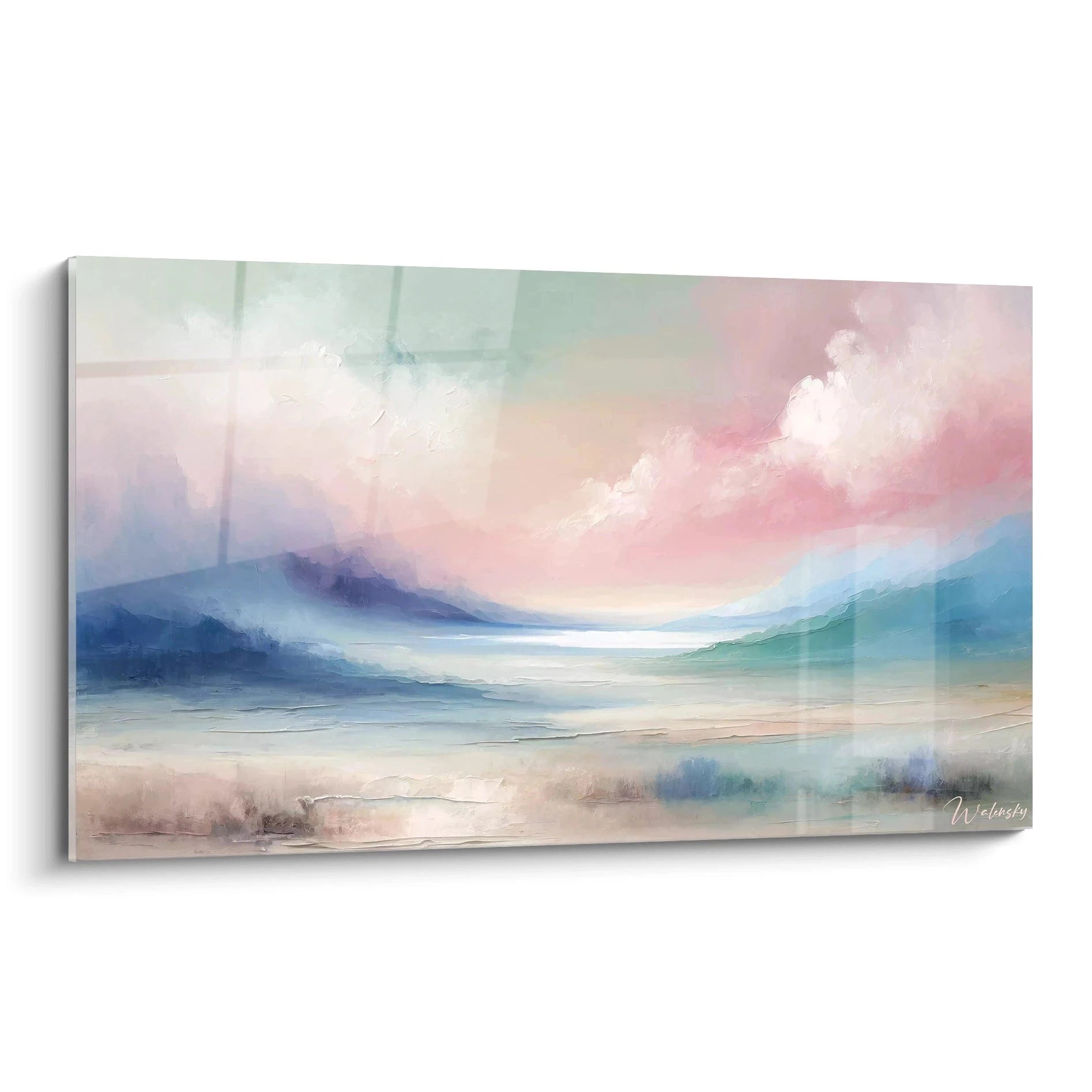

Wall art for second homes: practicality and visual impact
October 11, 2025 · 16 min read · by Walensky
You push the door of your vacation home after several weeks of absence, and that feeling hits you again: the bare and cold walls that welcome you, this impersonal atmosphere that reminds you that the place sorely lacks soul.
The dim lighting reveals spaces that seem frozen in anticipation, as if the house itself were blaming you for abandoning it. This desolate ambiance painfully contrasts with the excitement you felt upon arrival, and you realize that your relaxation retreat looks more like temporary housing than a true refuge.
You've already tried hanging some family photos or cheap reproductions, but the result disappoints you: either the whole thing looks sloppy, or you fear that humidity or temperature variations will damage your favorite works during your absences.
This frustration is perfectly normal because the decoration of a vacation home follows particular rules that few decor guides mention: it is necessary to create an immediate visual impact while taking into account the specific maintenance and conservation constraints of intermittent residences.
By the end of this article, you will know exactly how to choose and arrange durable wall art that will instantly transform the atmosphere of your vacation home, creating that feeling of "home" as soon as you cross the threshold.
Why do your empty walls sabotage your beautiful getaway?
The psychological impact of a warm interior is felt within the first 30 seconds after your arrival. If your walls remain bare, you miss this valuable opportunity to instantly create that bubble of serenity for which you invested in this residence. It's like preparing a gourmet meal and serving it on a cardboard plate: the overall experience is diminished.
📸 Customer testimonial: "When we inherited my grandparents' country house, the walls were covered with their memories. After the renovation work, we found ourselves with immaculate but totally impersonal walls. My children no longer wanted to spend the weekend there because they found the place 'sad'. It took us six months to understand that it was the absence of visual elements that created this cold atmosphere."
Conversation with a decor expert
The golden rule of second home decor : A well-chosen artwork acts as an instant emotional trigger that transforms a space from passage to a true personal refuge, and this effect is felt from the first minute of your arrival.

What’s really happening in your head when you walk in
Your brain unconsciously analyzes three key elements: light, volumes, and visual anchor points. Without these latter, you feel like you're “passing through” the space rather than settling into it. This is exactly what happens when you look at a beautiful but hazy landscape: your eye seeks an element to focus on in order to create meaning.
The problem isn’t your demanding nature, but the lack of personalized visual references that allow your brain to recognize this place as “your” territory.
Imagine your gaze like a visitor discovering your home: without paintings, it wanders aimlessly and leaves with a sense of incompleteness. With well-placed artworks, it finds visual resting points that make you want to linger.
The real reason for this feeling of “cold” decor
Contrary to what many think, it’s not the lack of furniture that creates this impersonal atmosphere, but the absence of visual storytelling. Your walls tell a story: either one of abandonment and emptiness, or one of your tastes and your vision of life.
It's like the difference between an extinguished shop window and a staged shop window: both potentially contain the same elements, but only the second creates desire and emotion.
This awareness will transform your approach to decorating: you no longer choose paintings to “fill” your walls, but to create the atmosphere in which you want to live your moments of relaxation.
🔍 Revealing test: Close your eyes for 10 seconds in your living room, then open them and note where your gaze first lands. If it wanders without stopping anywhere, your walls need visual attraction elements.
Most people think a second home should remain "understated" to be versatile. In reality, it's the place where you need to most express your personality because it’s your space of total freedom.
Think about your favorite restaurant: it's never the most neutral, but one that has a strong identity that makes you feel good instantly.
This revelation will free you from the fear of "doing too much" and allow you to create an atmosphere that truly resembles you.
The emotional wear factor we ignore
Every time you enter a visually empty space, your energy level drops unconsciously. Over a weekend, this effect accumulates and can literally ruin your relaxation.
You'll recognize it by these signs: you tend to stay in certain rooms for less time, you feel the need to go out more often, or you get the impression that your guests never completely relax.
It is your visual environment that directly influences your ability to mentally disconnect from your urban routine.
The 3 warning signs of an unsuitable decor:
- The "hotel hallway" effect: You feel like you're passing through rather than at home, even after several hours.
- Escape to the outside: You spend an abnormally long time on the terrace or in the garden compared to inside.
- The atmosphere fades: The excitement of arrival quickly disappears and gives way to a feeling of emptiness.
The real turning point happens when you understand that your wall art is not decoration, but emotion activators. Just as a perfume can instantly transport you to a memory, a well-chosen artwork can transform your state of mind in seconds. You'll know it by observing how your breathing changes and your shoulders naturally relax when you look at your walls.
The rule of the soothing gaze: If your eyes find a pleasant anchor point in each main room in less than 3 seconds, your brain automatically activates its "relaxation" mode and you feel that instant sense of well-being.
| ❌ Empty "practical" walls | ✅ Intelligently inhabited walls | 💡 Mechanism | 🎯 Perceived benefit |
|---|---|---|---|
| Cold space that requires effort to feel good | Enveloping atmosphere that naturally soothes | Works create reassuring visual landmarks | Immediate decompression upon arrival |
| Feeling of "improved camping" temporary | Impression of being in YOUR true cocoon | Visual personalization creates appropriation | Legitimate feeling of being at home |
| Constant need to "entertain yourself" to avoid boredom | Simple pleasure of contemplating and pausing | Works offer gentle, permanent stimulation | Natural ability to recharge on site |
| Guests who leave quickly or stay outside | Visitors who settle in spontaneously and relaxArt creates conversation and a welcoming atmosphereAuthentic conviviality and memorable shared moments

Our favourite
The Invisible Bonds Wall Art - Contemporary Abstract Painting Edition
233,90€
Discover this artworkThe 3 Circles Method to Transform Your Space
Rest assured, creating a warm atmosphere with appropriate artworks follows a simple and progressive logic. Just like preparing a garden, you start with the structural elements before adding the details that make the difference. By following this methodical approach, you will achieve a harmonious result that truly transforms your home experience, and that from the first weekend.
🎯 Overview of the transformation: We will proceed like an interior architect: first identify maximum impact areas, then choose artworks that resist the specific constraints of your residence, and finally create this visual harmony that makes the living space irresistible.
Step 1: Identify Your Priority Living Areas
Starting by mapping out your living spaces avoids scattering your efforts and guarantees maximum emotional impact from the first artworks installed. It's like planting the most imposing trees in a garden first: they immediately structure the whole thing and create the "wow" effect you are looking for.
Strategic Spaces to Prioritize
- The entrance or main living room: This is your visual “calling card” that sets the tone upon arrival. Choose a artwork of a beautiful size (minimum 60x80cm) with colors that immediately give you a feeling of well-being. Avoid scattered small formats that create an amateurish “patchwork” effect. The dining area or open kitchen: This convivial space deserves artworks that stimulate conversation and create a warm atmosphere. Favor supports resistant to humidity such as aluminum or plexiglass, which perfectly withstand the temperature variations of second homes. The master bedroom: Your sanctuary of relaxation requires soothing visuals that promote rest. Opt for soft tones and balanced compositions that do not overload mental space.
Once your areas are identified, let's move on to the practical selection
How to Evaluate Each Space
Analyze natural lighting: Observe your room at different times of the day to understand how the light evolves. Walls facing windows can support more intense colors, while less lit areas benefit from lighter tones that reflect available light.
⏱️ Time: 15 minutes per room | ✅ Successful when: You know which wall receives the most light and at what time | ⚠️ Attention: Don't forget evening artificial lighting, often overlooked but crucial for ambiance.
Measure available wall spaces: Take the exact dimensions of your free walls, taking into account existing furniture. A work should occupy about 60 to 75% of the space above a piece of furniture to create a harmonious visual balance.
⏱️ Time: 10 minutes per room | ✅ Successful when: You have noted the optimal dimensions for each location | ⚠️ Attention: Always leave 15-20cm between the artwork and a piece of furniture to avoid a "stuck" effect.
Define the desired atmosphere: Note three keywords that describe the atmosphere you want to create in each room. This clear intention will guide your choices and avoid impulsive purchases that do not harmonize with your overall vision.
⏱️ Time: 5 minutes per room | ✅ Successful when: Each space has its defined emotional "signature" | ⚠️ Attention: Avoid vague terms like "pretty"; prefer "energizing", "cocooning", "sophisticated".
✅ Validation of step 1: You must have a clear list of 3-4 priority locations with their dimensions and the desired atmosphere for each. If some choices seem unclear, take the time to revisit these spaces in real-life usage situations (during a meal, a moment of relaxation...) to refine your vision.
— Our selection


OUR RECOMMENDED PRODUCTS
Step 2: Choose artworks adapted to technical constraints
Now that your spaces are defined, we move on to the next level: selecting timeless artworks without sacrificing aesthetic impact. This step is more rewarding because you see concretely how the atmosphere of your dreams takes shape, and each judicious choice reinforces your confidence in the final result.
Recommended technical supports
- Printing on aluminum (Dibond): This ultra-modern support is perfectly resistant to humidity and temperature variations. Colors remain vibrant for decades and cleaning is done with a simple wipe. More expensive than canvas, but the investment is justified by exceptional durability. High definition acrylic glass: Offers a striking color depth with a unique depth effect that beautifully captures natural light. Perfect for humid rooms like open kitchens or adjoining bathrooms. Humidity-resistant canvases: For lovers of traditional texture, choose canvases with reinforced protective varnish and suitable framing. Opt for aluminum or resin frames rather than natural wood which can warp.
Visual Selection Criteria
Prioritize balanced compositions: Choose artworks with a clear focal point that naturally attracts the eye without tiring it. Compositions that are too busy or very contrasting can create an exhausting visual tension in a relaxation space.
⏱️ Time: 10 minutes per artwork | ✅ Success when: Your eye instantly finds a "rest" when looking at the image | ⚠️ Attention: Be wary of artworks that attract but tire after 30 seconds of contemplation.
Harmonize with your existing palette: Even if you like contrasts, make sure at least 20% of the colors in your artwork pick up tones present in the room. This consistency creates a sense of natural unity without monotony.
⏱️ Time: 5 minutes per artwork | ✅ Success when: The artwork seems "made for" the space rather than "placed on it" | ⚠️ Attention: An artwork can have different dominant colors as long as there are these subtle chromatic links.
Step 3: Create a Global Visual Harmony
The final step transforms your selection of individual artworks into a coherent visual journey that naturally guides your movements and creates this unique decorative signature. This is where your second home acquires that strong personality you dreamed of, and your guests immediately feel the difference.
Orchestrate Transitions Between Spaces
Create a chromatic thread: Establish a signature color that appears subtly in each main room, either in the artworks or in a complementary decorative detail. This repetition creates an unconscious unity that makes the whole particularly refined.
⏱️ Time: 20 minutes for the entire set | ✅ Success when: A visitor feels a global consistency without being able to explain why | ⚠️ Attention: Subtlety is the key word: too much repetition becomes tiring.
Balance visual intensities: Alternate "active" artworks (vivid colors, dynamic compositions) with more soothing visuals to create a natural rhythm in your visual journey. Like a playlist, the whole should have its highlights and its breaths.
⏱️ Time: 15 minutes of adjustment | ✅ Success when: Each room has its own personality while integrating into the whole | ⚠️ Attention: Avoid concentrating all intense artworks in the same area.
The rule of harmonious progression: You can proceed to hanging when each artwork individually provides you with a positive emotion and the whole tells a coherent story that resembles you, even if all the details are not yet perfect.
Congratulations! You now master the fundamentals of intelligent selection. Here are the expert subtleties that will make the difference between a satisfactory result and an arrangement that truly impresses your guests and provides you with the daily pleasure of contemplating your spaces.
🏆 Little-known pro tip: Photograph your installed artworks with your smartphone in different lighting conditions. This technique instantly reveals visual imbalances invisible to the naked eye and allows you to precisely adjust the impact of each artwork according to the time of day.
Frequent question from our readers
"Do I risk getting tired quickly if I choose artworks with bright colors or marked patterns?"
This is a very understandable concern, especially when investing in quality pieces. In reality, boredom rarely comes from the colors or patterns themselves, but rather from a lack of coherence or artworks chosen impulsively without reflection on the overall atmosphere. When an artwork harmonizes perfectly with your personality and your space, it becomes like a close friend: the more you see it, the more subtleties you discover that enrich your pleasure. Many customers even tell us that they appreciate their paintings more after several years.
💡 Personal validation test: Before any purchase, keep the image of the artwork on your phone for a week and look at it daily. If it continues to provide you with a positive emotion after this period, it is a sign of lasting affinity.
— You may also like


The expensive pitfalls to avoid absolutely
Even with a good method, some mistakes can compromise months of effort and make you lose confidence in your choices. These errors are so common that we see them in 8 out of 10 homeowners, but they are perfectly avoidable when you know them.
- 🚫 Choosing artworks first, then looking for where to put them: This seductive approach almost always leads to visual imbalances. You fall in love with a work without checking its compatibility with your spaces, and the final result lacks harmony. Always proceed in order: space first, then suitable artwork.
- ⚡ Underestimating the impact of artificial lighting: Many beautiful paintings become dull or distorted under the cold LED lighting in the evening. Systematically test your artworks under your usual lighting before definitive installation. Dedicated accent lighting can completely transform a work. 📏 Neglecting proportions with furniture: A painting that is too small above a large sofa creates a disappointing "postage stamp" effect, while an oversized work overwhelms the space. The 2/3 rule works in 90% of cases: your painting should be about 2/3 the width of the furniture it overlooks.
- 💰 Saving on print or support quality: A beautiful image on a low-end substrate quickly deteriorates in a second home. Colors fade, edges peel off, and you have to replace everything. It's better to have a quality work than three fragile reproductions.
- 🔄 Exactly copying an atmosphere seen elsewhere: Pinterest and Instagram are full of tempting inspirations, but reproducing a decor created for other constraints and other tastes rarely leads to a satisfying personalized result. Get inspired but always adapt it to your reality.
🛡️ Checkpoints before finalization: Verify that each work still provides you with a positive emotion after 48 hours of reflection, that the overall respects your budget without sacrificing quality, that installation is technically feasible without complex intervention, and that those close to you share your enthusiasm for the main choices.
— In the same vein


Your practical questions about second home paintings
Allow between 800 and 1500 euros for a coherent set of quality in 3-4 spaces. This range includes 4-5 works on durable substrates with professional framing or finish. To optimize, start with 2-3 strategic rooms (living room + bedroom): the impact will already be spectacular and you can gradually complete according to your favorites.
With ready-to-install works, allow 2-3 weeks between the order and complete installation. The longest part is often the production on technical substrate (7-10 days), then you will need one day for methodical hanging. The "transformation" effect is immediate with the first work installed!
No, standard hanging only requires basic tools (drill, level, tape measure) and a little patience for measurements. Modern fixing systems are designed to be accessible to individuals. For heavy works (+15kg) or stone walls, plan the intervention of a local artisan, but it is rarely necessary.
Find out about the average humidity level and temperature variations in your region. Aluminium and plexiglass supports easily handle 5-35°C and up to 80% humidity. For very humid areas (coast, mountain), avoid untreated canvases and opt for direct prints on waterproof supports.
Focus on timeless compositions (stylized landscapes, balanced abstracts, contrasted black and white) rather than very marked trends. Works that stand the test of decades all share this ability to provide authentic emotion regardless of fashion. If an image touches you deeply today, it will probably retain that impact.
Your new reality in a few weeks
Imagine yourself in a month, opening the door to your vacation home and immediately feeling that sense of well-being that overwhelms you. Your walls now tell your story, every glance finds an enjoyable anchor point, and this warm atmosphere welcomes you like a personalized cocoon. Your guests instantly notice the difference and spontaneously compliment you on this particular ambiance.
This transformation goes far beyond simple decoration: you have developed an aesthetic eye that will serve you in all your future projects, a confidence in your decorative choices that frees you from paralyzing doubts, and that deep satisfaction of living in spaces that truly resemble you. Your relationship with your vacation home has fundamentally changed.
The most difficult part was understanding the logic behind successful aesthetic choices. Now that you master this method, start by identifying your 2-3 priority spaces this week. Take measurements, define the desired atmosphere, and you will see that choices naturally impose themselves. Your future self will thank you for daring to create this inspiring environment.
🌟 Your first step towards transformation: You have all the tools to succeed in this visual metamorphosis that will revolutionize your moments of relaxation. Trust your instincts, follow the method, and prepare to rediscover the simple pleasure of contemplating your own spaces.
Also read: 📖 Read more articles about art according to your habitat

More selected pieces
Painting Inspired by The Starry Night by Vincent Van Gogh No. 1 – Tribute to Famous Artist
233,90€
Discover this artwork →Explore our collections


