


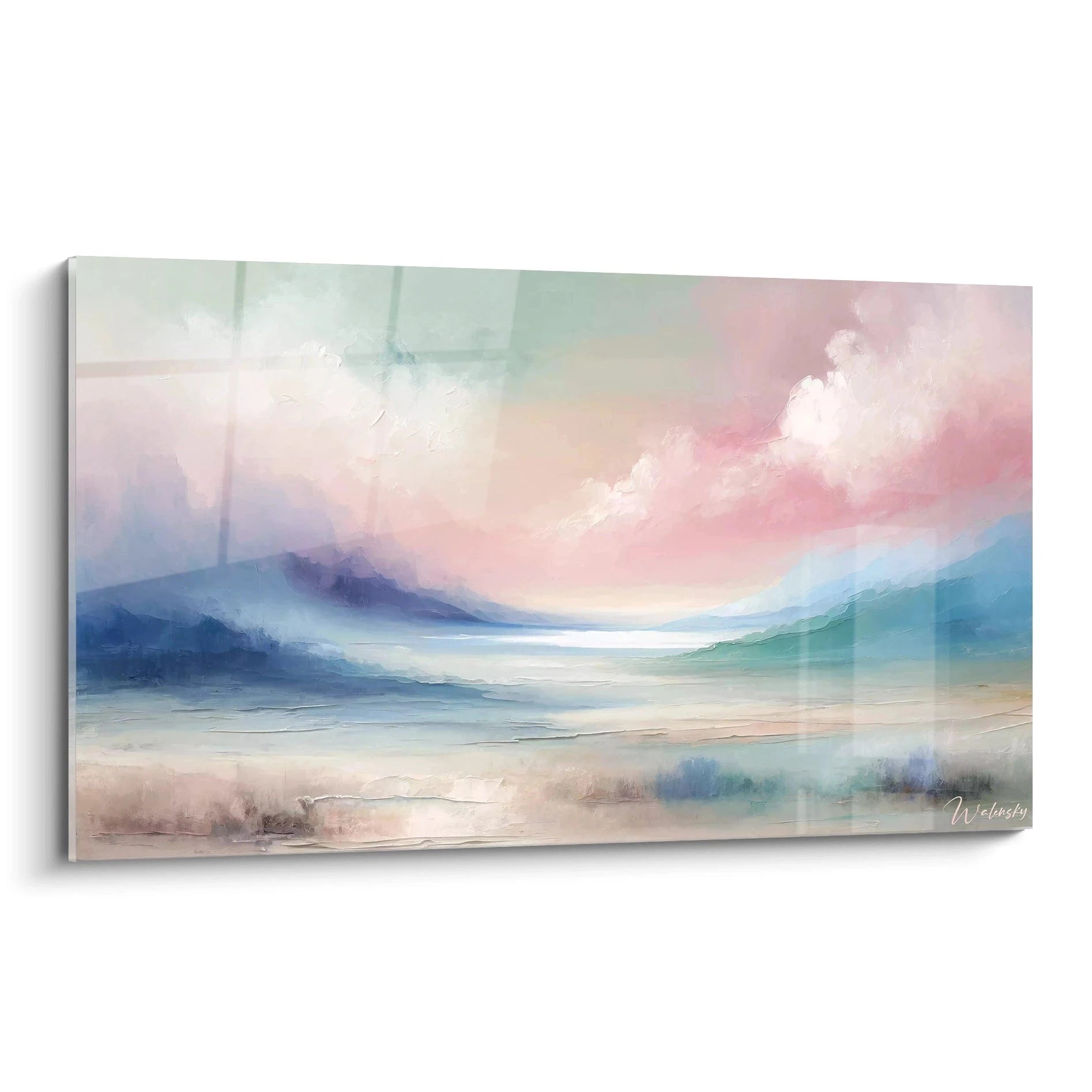

Decorating your vacation home (or second home) with suitable artwork
11 October 2025 · 21 min read · by Walensky
You've just spent your first night in your long-awaited vacation home , and yet... a feeling of emptiness washes over you. The white walls send back a cold, almost impersonal echo, which contrasts with the warm atmosphere you had imagined.
You look around: the furniture is there, the curtains too, but there’s that decorative soul missing that transforms a space into a true cozy nest. Each bare wall seems to remind you that your summer refuge still looks more like a rental apartment than your personal sanctuary.
You may have already tried hanging a few standard artworks you retrieved from your main residence, but the result disappointed you. Either they seemed too formal for the vacation spirit, or they quickly showed signs of deterioration due to humidity and temperature variations.
Rest assured, this disappointment is not due to a lack of taste on your part. The problem lies in the fact that decorating a second home follows specific rules that few owners know, especially in terms of material resistance and climate adaptation.
By the end of this article, you will know exactly how to choose and install artwork perfect for your vacation home, creating a unique atmosphere that will last for years while reflecting the relaxed spirit of your vacation.
Why your vacation home deserves specific wall decor?
Unlike your main residence, your vacation home undergoes unique constraints that can quickly turn your decorative investment into a disaster. The alternation between periods of occupancy and abandonment, humidity variations, prolonged exposure to the sun... so many challenges that your usual artworks are not ready to face. It's like planting indoor flowers in a seaside garden: without adaptation, failure is guaranteed.
🏖️ Customer testimonial: "After three summers, my framed artworks all showed signs of mold between the glass and the canvas. I had to throw everything away and start over by choosing supports suitable for the coastal climate. Now, my works withstand the seasons without any problems!"
Conversation with a decor expert
The golden rule of summer decor: A resistant artwork, well chosen instantly transforms the atmosphere of a room, creating that feeling of "home" from the first glance. You will feel this difference from your next arrival, as if your house welcomed you personally.

Understanding the specific challenges of your second home
Do you recognize these situations? Fading discoloration on your old frames after a particularly sunny summer, mysterious warps on your favorite canvases, or that feeling that your artwork seems "dull" in your vacation home when it shone brightly in your main living room.
What you are observing is not a matter of chance, but a direct consequence of an environment with particular constraints. Your second home is not faulty: it simply obeys different physical laws than traditional decoration ignores.
Imagine your summer house as a high-performance athlete: it needs equipment specifically designed for its performance, not standard gear.
Intense sun exposure: the silent enemy of your paintings
Contrary to popular belief, it's not the heat that destroys your wall paintings, but the UV rays that pass through your closed windows. Most owners think that by closing the shutters, they protect their works, but in reality, they create a greenhouse effect that accelerates degradation.
It's exactly like leaving a family photo on your car's dashboard: even in the shade, it will eventually fade and warp under the concentrated effect of temperature and humidity.
This continuous exposure explains why your colors lose intensity and why some materials crack. Fortunately, understanding this mechanism allows you to choose resistant supports that will transform this constraint into a decorative asset.
🔍 Quick test: Place a piece of colored paper on your most exposed windowsill for a week. Then compare it to a part that remained in the shade: you will concretely visualize the UV impact on your future paintings.
Fluctuating humidity: the trap of closed residences
Many imagine that closing their house hermetically protects it, but it is actually creating an environment where humidity stagnates and varies brutally. When you reopen it after several weeks, the dry air meets the accumulated humidity, creating a hygrometric shock.
Think of the effect produced when opening a bottle of wine kept in a cellar: contact with the outside air causes an immediate reaction on the contents.
This variation explains why your frames warp and why halos appear on your canvases. Anticipating this phenomenon allows you to select materials adapted that even improve over time.
Intermittent use: when absence is worse than presence
Here's a paradox that few notice: your vacation paintings suffer more during your absences than during your stays. Without air circulation or temperature regulation, they undergo extreme variations in a closed environment.
You can easily identify this phenomenon by observing whether your works seem different each time you return from vacation, or if you notice changes in texture or color after each period of closure.
This alternation creates a permanent material stress that explains why your decorations "age" prematurely in your second home.
The 3 warning signs to watch out for:
- Progressive discoloration: Your colors gradually fade, a sign of uncontrolled UV exposure
- Support deformation: Warps or cracks revealing hygrometric variations that are too important
- Appearance of halos: Circular traces indicating recurring condensation that has not been treated
The trigger factor: the cumulative effect of time
What really makes the difference is that all these factors accumulate season after season, creating an invisible but relentless domino effect. Like a drop of water that eventually pierces the stone, each opening-closing cycle weakens your artworks a little more until the breaking point. You can recognize this cumulative effect when several problems appear simultaneously on different paintings after a few years of use.
The decorative survival rule: The longer your second home remains closed, the more resistant your materials must be. Count in terms of opening-closing cycles rather than years of use to assess the necessary durability.
| ❌ Common belief | ✅ Reality | 💡 Explanation | 🎯 Practical benefit |
|---|---|---|---|
| Sealing tightly protects my paintings | Controlled ventilation preserves better | Stagnant air concentrates humidity | Timeless artworks |
| The same materials work everywhere | Each climate requires its own adaptation | Constraints vary depending on the environment | Durable and profitable investment |
| The more expensive it is, the better it is protected | Specificity is more important than price | Technical adaptation vs prestige | Real effectiveness guaranteed |
| I can use any painting | Only certain supports are resistant | Each material has its limits | Peace of mind assured |
— Also to discover


The 3-step method for durable and elegant wall art
Now that you understand the specific challenges of your vacation home, here's a step-by-step approach that will take you from diagnosis to perfect execution. Like an architect building on solid foundations, we will first secure the technical basics before focusing on aesthetics. At each step, you will gain confidence and expertise, until you master the art of summer wall decor.
🗺️ Overview of the method: Step 1 - Audit and material selection (solid foundations), Step 2 - Artistic selection and harmonization (building the style), Step 3 - Installation and protection (expert finishes). Each level brings you increasing satisfaction and immediately visible results.
Step 1: Technical audit and selection of suitable supports
Starting with this technical step avoids 90% of future problems. It's like checking the solidity of the ground before building a house: this initial precaution guarantees the success of the entire project. Once this base is mastered, you will feel the satisfaction of a professional who knows that their work will last over time.
Essential resistant supports
- Canvas on aluminum frame: Recognizable by their lightness and perfect rigidity, they advantageously replace traditional wood which works with humidity. Find them with specialized contemporary art suppliers. Check the quality by testing the resistance to pressure: a good aluminum canvas does not flex under moderate pressure. Avoid wood even treated because it remains sensitive to hygrometric variations.
- Prints on dibond (aluminum composite): This sandwich material offers the rigidity of aluminum with the insulation of the central polyethylene. Its principle: two sheets of aluminum frame a central insulating core, creating an indeformable support. Recognize the quality by the minimum thickness of 3mm and the finish of the perfectly straight edges. The impact on your decor: colors that remain vibrant for decades.
- High resistance UV acrylic: As clear as glass but unbreakable, it protects your works while enhancing them. Its anti-reflective peculiarity creates a striking depth effect. Check for the "anti-UV" mention engraved on one side: this is your guarantee of protection. The visible benefit: your colors retain their original intensity even in front of the most exposed windows.
Now, let's move on to concrete implementation
How to proceed without risk of error
Measure the exposure of each wall: Use a mobile UV measurement application (such as the free "UV Index") to quantify the actual exposure of each planned location. This step avoids approximations: one wall can receive 3 times more UV than another in the same room. Record measurements at different times of the day and note exposure peaks. Do not rely on your impressions: the human eye does not perceive UV.
⏱️ Time: 15 minutes per room | ✅ Successful when: You have a quantified record for each wall | ⚠️ Attention: Do not measure on a cloudy day - UV rays pass through clouds but not uniformly
Test the ambient humidity: Place a hygrometer in each room for a full week, noting day/night variations. The goal is to identify discrepancies: beyond a 20% variation, your standard materials will deform. This measurement indicates precisely which supports to choose according to the real constraints of each space. A digital hygrometer with memory costs less than 20€ and saves you hundreds of euros in avoided errors.
⏱️ Time: 5 minutes installation time, 1 week measurement | ✅ Success when: You know the hygrometric amplitude of each room | ⚠️ Attention: Measure windows both closed and open to get the extremes
Calculate the wall load capacity: Test the solidity of your walls by pushing a pin: if it goes in easily, prefer fixings distributed over several points. For plasterboard walls, limit yourself to 15kg per square meter without reinforcement. This preliminary check avoids falling artworks and costly repairs. Photograph your tests to memorize the solid areas.
⏱️ Time: 10 minutes per wall | ✅ Success when: You know the load capacity of each location | ⚠️ Attention: Do not confuse point resistance and weight distribution - a nail can hold 5kg, but not necessarily distributed over a large surface
🎯 Validation of step 1: You now have a "technical passport" for your house: UV exposure, humidity variations, and load-bearing capacity of each wall. If some measurements surprise you, that's normal - you are discovering the technical personality of your space. If you have any doubts about a measurement, repeat it at another time: the accuracy of this step determines the success of the entire project.
Step 2: Artistic selection and decorative harmonization
Now that your technical constraints are no longer a secret to you, you can focus on creative pleasure with complete serenity. This step is even more rewarding because you know that your aesthetic choices will be based on solid foundations. The snowball effect begins here: each artwork selected inspires and enhances the following, creating a natural decorative coherence.
Artistic selection criteria adapted
- Summer color palette: Favor tones that gain intensity with natural light - deep blues, emerald greens, warm ochres. These colors resist UV fading better and create a soothing atmosphere even in high heat. Check color stability by requesting the "lightfast" certification: this is your anti-fading guarantee. The pastel alternative ages poorly under intense solar exposure.
- Evocative themes without clichés: Opt for subjects that evoke relaxation without falling into seaside caricatures. Abstract landscapes, natural textures, soothing geometric compositions create a sophisticated atmosphere. Recognize a good composition by its ability to evoke: it should suggest rather than show explicitly. The decorative impact: a timeless elegance that transcends trends.
- Formats adapted to vacation spaces: Large formats (minimum 80x60cm) structure the space and compensate for the "dilution" effect of the often generous volumes of vacation homes. They create powerful focal points that unify the decoration. The quality criterion: a large format must remain legible and impactful even when viewed from afar, from the entrance of the room.
Failproof selection method
Create a physical mood board: Gather color samples, mood photos, and existing decorative elements on a large panel. This tangible visualization reveals harmonies invisible on screen and avoids proportion errors. Work in natural light to anticipate the real effect in your space. The goal: create a chromatic coherence that unifies your entire wall decoration.
⏱️ Time: 45 minutes | ✅ Success when: Your eye immediately identifies the overall harmony | ⚠️ Attention: Do not rely on colors on screen - they vary depending on your monitor settings
Test emotional impact: Display a test print of your selection for 48h in the intended space, then note your feelings at different times of the day. A successful artwork maintains its emotional impact even after several days of exposure. This step naturally filters out fleeting crushes from lasting choices. Photograph the result under different lighting to memorize the variations in ambiance.
⏱️ Time: 2 days of observation | ✅ Successful when: The artwork continues to move you after 48h | ⚠️ Attention: Distinguish fatigue (normal) and emotional rejection (eliminating)
Validate proportions in situ: Delimit on the floor with masking tape the exact dimensions of each painting intended, then step back to judge the visual balance. This step reveals invisible imbalances on paper and optimizes decorative impact. Adjust sizes if necessary: it is better for a painting to be slightly larger than a set that lacks presence. Take photos to memorize the effect of each tested configuration.
⏱️ Time: 20 minutes per configuration | ✅ Successful when: The visual balance satisfies you from all viewing angles | ⚠️ Attention: Test the effect from the entrance of the room, not just facing the wall
✨ Validation of step 2: Your selection now forms a coherent ensemble that dialogues with your space and your emotions. Each artwork has its reason for being and contributes to the overall atmosphere. If a piece leaves you indifferent after the tests, replace it: indifference is the enemy of successful decoration. You are ready for technical finalization.
Step 3: Professional installation and optimal protection
This final step transforms your technical expertise and aesthetic sense into a concrete and lasting achievement. You reach here the level of mastery that makes the difference between an enlightened amateur and a true connoisseur. The final result will exceed your initial expectations: not only your paintings will resist perfectly the constraints of your second home, but they will create that unique atmosphere of which you will be proud for years.
Professional installation hardware
- Distributed fixing system: Discreet rails with adjustable hooks that distribute the weight across the entire width of the wall. Identifiable by their thin metal profile and high load capacity (up to 30kg per meter). Find them with museum exhibition hardware suppliers. Quality criterion: corrosion resistance certified for humid environments. Avoid point fixings that concentrate stresses.
- LED lighting dedicated to artworks: Adjustable spotlights with color temperature (3000-4000K) and integrated UV filters. Their principle: reveal colors without altering them, even in continuous exposure. Recognize professional quality by the color rendering index greater than 90 (CRI>90). Decorative impact: your artworks keep their natural brightness even in the evening or on cloudy days.
- Invisible anti-UV protection: Transparent film applied to windows that filters 99% of harmful rays without altering brightness. Discreet installation and maximum effectiveness for a minimum of 10 years. Verify the "museum grade conservation" certification: this is the reference used by major museums. Concrete benefit: protection equivalent to closed shutters with the brightness of open shutters.
Optimized installation sequence
Install the mounting system: Use a laser level to mark the exact location of the rail, then fix it with fasteners suitable for your wall type (drywall, concrete, stone). This initial precision ensures perfect alignment of your artworks. Check for horizontal alignment at each fixing point: a 2mm deviation is immediately noticeable on a large format. Test the sturdiness by suspending an equivalent weight before final installation.
⏱️ Time: 30 minutes per rail | ✅ Success when: The rail supports the test weight without flexing | ⚠️ Attention: Mark the locations of electrical cables before drilling - severing a cable is expensive to repair
Adjust dedicated lighting: Position each spotlight at a 30° angle relative to the normal of the painting to avoid reflections, then adjust the intensity to reveal details without creating shadows. Successful lighting is that which seems natural: the artwork is noticed, not the light source. Test different color temperatures to find the one that best enhances your color palette. Photograph each setting to memorize the optimal configurations.
⏱️ Time: 15 minutes per spotlight | ✅ Success when: The artwork is evenly illuminated without shadows | ⚠️ Attention: Avoid direct lighting on shiny surfaces - this creates dazzling reflections
Optimize climate protection: Apply the UV film to the most exposed windows, starting with the corners to avoid air bubbles. This invisible protection multiplies the lifespan of your colors by 10. Supplement with strategic placement: never place a painting directly facing a window, but slightly offset to capture the light without direct exposure. Create gentle airflow with ceiling fans set to a minimum.
⏱️ Time: 20 minutes per window + 10 minutes per painting | ✅ Success when: No artwork receives direct sunlight at any time of day | ⚠️ Attention: Test for indirect light reflections - they can be as harmful as direct exposure
🏆 Final validation: Your installation now combines sophisticated aesthetics and optimal technical protection. Each painting is perfectly showcased and secured for years of visual enjoyment. Document your achievement with detailed photos: this will serve as a reference for reproducing the same level of quality in other spaces. Your guests will immediately notice the professional difference in your wall decoration.
Expert progression rule: Master each step perfectly before moving on to the next. Objective criteria: technical measurements validated for step 1, emotionally stable selection for step 2, technically flawless installation for step 3. Initial patience guarantees final excellence.
Congratulations! You now master the subtleties that only professional decorators know. This expertise gives you a decisive advantage: creating vacation interiors that impress with their sophistication and durability, while perfectly reflecting your personality.
🎨 Professional decorator's tip: Create a "technical file" of your house with photos, measurements, and specifications for each installation. This documentation will allow you to easily reproduce the same level of quality in other rooms and effectively advise your loved ones. It's your "secret recipe" for repeatable successes.
Frequent question from our readers
"I'm not sure I have the artistic eye to choose the right artworks... How can I be sure to make the right choices?"
Your concern is perfectly legitimate and even reassuring: it shows that you have high quality requirements! The truth is that the artistic eye develops with practice, and our structured method guides you precisely to avoid beginner mistakes. Start with works that personally move you rather than what should please according to trends: your personal sensitivity is your best guide. The technical expertise you have acquired already gives you a significant advantage over most art buyers.
🔍 Immediate practical tip: Test your instinct by visiting a gallery or art fair: mentally note the works that spontaneously mark you, then analyze their common points. You will discover your natural "artistic signature", much more reliable than all theoretical advice.
— In the same spirit


The 5 costly mistakes to absolutely avoid
After supporting hundreds of homeowners in their summer decoration projects, I have identified the recurring pitfalls that turn a decorative dream into a budgetary nightmare. These mistakes are so common that they seem inevitable, but knowing them allows you to easily avoid them.
- 🚫 Underestimating actual UV exposure: Many choose their materials based on apparent exposure rather than measured exposure. A wall "in the shade" can receive UV reflected by a pool or a light terrace. Consequence: rapid discoloration and premature replacement. Solution: always use a UV meter to quantify actual exposure. This mistake affects most beginners, but it is easily avoidable with the right tools.
- 💸 Saving on fixings: The temptation to reuse standard nails or screws to support quality works. Result: falling works of art and wall damage. Investing €30 in a professional fixing system protects hundreds of euros of artwork. It's the economy that costs the most in the end!
- 🌡️ Ignoring thermal variations: Installing works during temperate periods without anticipating summer extremes. Materials expand and contract, creating irreversible deformations. Install your works in high heat to anticipate maximum movements. This precaution avoids 90% of deformation problems.
- 🎨 Copying a decoration you like elsewhere: Reproducing an atmosphere seen in a magazine or at friends' houses exactly, without adapting to the specificities of your space. Every vacation home has its unique personality. Be inspired but always personalize according to your technical constraints and tastes. Perfect imitation often leads to disappointment.
- ⏰ Rushing final choices: Buying impulsively during a crush without testing the integration into the space. A magnificent work in a gallery can be unsuitable for your ambiance. Always use the recommended 48h test period. Initial patience avoids lasting regrets and additional expenses.
🛡️ Your pre-purchase safety checklist: Verify certified UV resistance, test chromatic harmony in situ, confirm the load-bearing capacity of the intended wall, and validate the emotional impact after 48 hours of exposure. Warning signs: abnormally low price (beware of quality), pushy seller (allow yourself time to think), lack of material warranty (prioritize certifications), and unverifiable technical promises (request proof).
— Other selected pieces


Our selection
Artwork The Invisible Links - Abstract Contemporary Painting Edition
233,90€
Discover this artwork →Frequently asked questions about summer wall decor
Allow between 800€ and 2000€ depending on the desired level of finish: 200-300€ per room for quality decoration with resistant artworks and professional fixing system. Optimize by starting with the main rooms (living room, master bedroom) then gradually expanding. Concrete example: a 25m² living room requires 2-3 medium/large format artworks, or 400-600€ all inclusive with installation.
A complete installation takes 2-3 days spread over several weeks: 1 day for technical audit and measurements, 1 week of reflection for artistic selection, then 1-2 days for the actual installation. Do not rush the steps: each maturation phase improves the final result. Initial patience earns you years of satisfaction.
90% of installations can be done by a skilled DIYer with the right tools. Hire a professional only for old stone walls, lighting electrical installations, or artworks of great value (>2000€). Our method guides you precisely to avoid common technical errors. Professional budget if necessary: 150-300€ depending on complexity.
Each environment has its specificities: by the sea (attention to salt and extreme humidity - prioritize anti-corrosion treated supports), in the mountains (significant temperature variations - use materials with compensated dilatation), in the countryside (intense UV rays and pollen - opt for easily cleanable surfaces). Adapt the measurements of our technical audit according to your specific context.
Minimal but essential maintenance: gentle cleaning 2 times per year with a slightly damp microfiber cloth, annual check of fixings (tighten if necessary), and visual check of UV protection condition. Maintenance budget: less than 50€/year for a complete installation. This regular preventative care avoids costly repairs and preserves the value of your artistic investments.
Your decorative transformation: from frustration to pride
In a few weeks, when you push the door of your vacation home, you will feel that magical sensation that a perfectly harmonious space provides. Your walls, once bare and cold, will now tell your personal story through carefully chosen artworks and perfectly preserved.
This transformation goes far beyond simple decoration: you have developed expertise that will serve you for all your future development projects. Your ability to analyze a space, anticipate its constraints, and adapt sustainable solutions to it gives you new confidence in all your decorating choices. This skill is transferable and will accompany you in each of your future creative projects.
The best thing about this achievement is that you built it step by step, methodically and patiently. Now, your first step will be to identify the wall that inspires you most, then apply our technical audit method. Start today: every day of delay deprives you of a day of visual pleasure in your summer sanctuary.
🌟 Your new expertise awaits you: You now have all the tools to create your summer wall decoration of your dreams, one that will last for years while inspiring you every day. Your vacation home can become the perfect reflection of your artistic personality this weekend.
Also to read: 📚 Discover the complete guide by room


