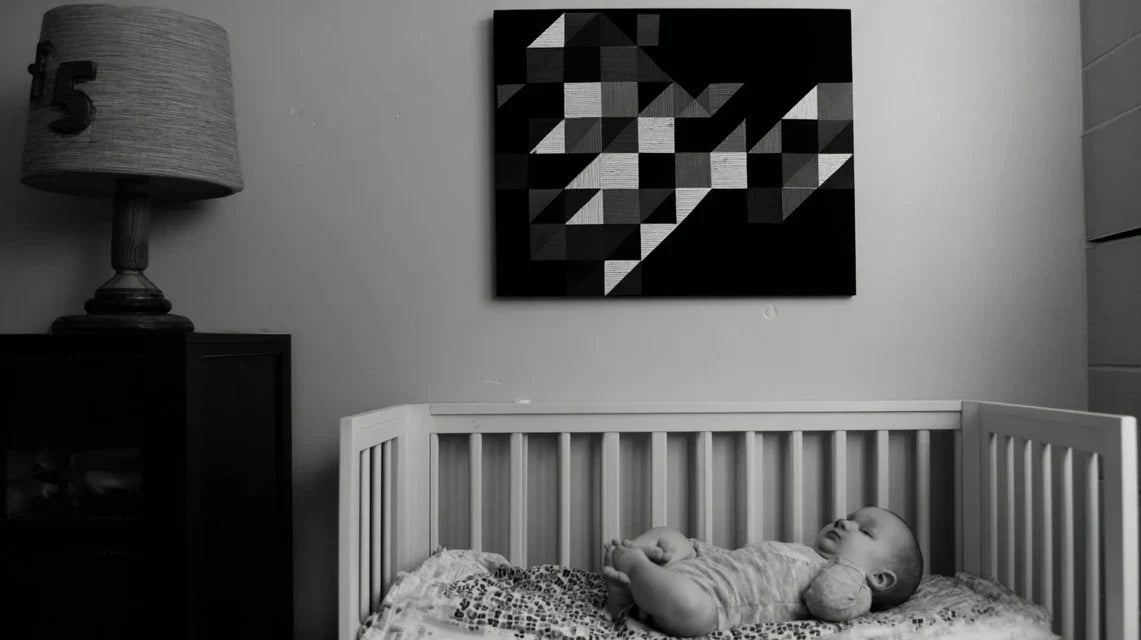
You just hung that lovely colorful artwork in your little one’s room, and a few days later, a corner starts to peel off.
Stress overwhelms you: what if the artwork falls on your child while they play? You already imagine the worst scenario, that frame sliding off the wall just as your little one walks underneath.
You followed the salesperson's advice, used the provided fixings, but something is wrong. Maybe this standard hanging system wasn't suitable for a child’s room after all.
Rest assured, it's not your fault! Most classic wall fixings do not take into account the specificities of a children's environment: vibrations, energetic games, sometimes humidity.
By the end of this article, you will know exactly which materials and fixings to choose to create a decorative space that is both beautiful and perfectly safe for your children.
Why is the safety of kids artworks so crucial today?
Each year, emergency services record thousands of domestic accidents related to decorations poorly secured. in a child’s room, it is even more critical because our little ones explore, jump, run...
Imagine your living room: you walk calmly, you don't touch the walls. Now imagine that same room with a 4-year-old playing ball! The vibrations and shocks are not at all the same.
📖 True story: Sarah, mother of 3-year-old twins, discovered one morning that the artwork above her daughter's bed had slid several centimeters during the night. The vibrations caused by the previous day’s games had gradually loosened the fixing.
💬 Conversation with a decor expert
The golden rule of kids' decor: A safe wall art piece must withstand a child playing normally in their room, without you having to constantly supervise. The result? A serene decoration that you can admire for years.
Understanding what really weakens your fixings
Do you recognize these situations? The picture ending up crooked after a restless nap, the black marks appearing on the wall where the frame rubs, or even that constant worry when your child plays near the decorated wall.
The real thing happening is that repeated micro-movements gradually wear out even the best fixings. It's not you who did something wrong, it’s the system that wasn't designed for this specific environment.
Imagine an entrance door: it seems solid, but after thousands of openings, even the most robust hinges end up having play. For your pictures, it's exactly the same principle.
Vibration: The invisible enemy of your decorations
Contrary to what one might think, it’s not the big shocks that cause paintings to fall, but constant micro-vibrations. Every jump on the bed, every race in the hallway creates small waves that spread through the walls.
It's like coffee cooling down: you don’t see the heat leaving, but after a while, your drink is cold. Fixings loosen gradually, imperceptibly.
Result? You live with this dull anxiety, this little voice that tells you "what if the picture falls?". Understanding this mechanism is already being able to counter it effectively.
🧪 Revealing test: Place your hand against the wall of the child’s room while they jump on their bed. You will feel these micro-vibrations that we are talking about. Now, imagine the cumulative effect over several weeks!
The mistake of unsuitable materials
Many think that a lightweight picture necessarily requires a light fixing. In reality, it’s the opposite that is true in a child's room: the lighter the object, the more easily it will move with vibrations.
It's like comparing a feather and a stone in the wind: the feather dances, the stone remains stable. Your kids’ pictures need an anchoring that compensates for their natural lightness.
This misunderstanding explains why you feel this constant stress: inconsciently, you know something is wrong, but you can't figure out what.
The trap of modern walls
Our homes today have thinner and more flexible partitions than before. These walls “breathe” more with temperature and humidity changes.
Your grandparents hung their pictures on thick stone walls: today, you need to adapt your technique to these more lively supports. It's normal that old methods don’t work perfectly anymore.
Recognizing this difference is key to understanding why you need a specific approach to create a long-lasting decorative environment in your child's room.
🔍 3 warning signs to watch out for:
- The artwork is regularly crooked: A sign that vibrations are moving the entire piece. It's like a weather vane indicating the wind direction.
- Marks appear on the wall: Repeated friction reveals abnormal movement. Imagine the wear of a path in a park: the more traffic, the more visible the trace.
- You often check its stability: Your instinct tells you that something is wrong. Trust this intuition: it reveals a real problem even if it's not yet visible.
The trigger factor: the domino effect
The key difference lies in the chain reaction: a slightly loosened fixing allows more movement, which accelerates the loosening, which further increases the movement... It's a vicious circle that quickly spirals out of control.
Identify this phenomenon at the first signs: an artwork slightly crooked, a slight play in the fixing. Acting at this moment avoids escalation and preserves the safety of your child.
The universal prevention rule: A perfectly fixed artwork never moves, not even by a millimeter. If you observe any movement, it's a signal to reinforce before the problem worsens.
| ❌ Misconception | ✅ Reality | 💡 Explanation | 🎯 Practical advantage |
|---|---|---|---|
| Light artwork = light fixing | Light artwork = reinforced anchoring | Light objects move more easily | Perfect stability even with energetic play |
| Children don't touch the walls | The whole room vibrates with their activities | Vibrations spread throughout the structure | Anticipation of real constraints |
| One screw is always enough | The anchoring must adapt to the support | Modern walls require specific techniques | Maximum safety adapted to your home |
| If it lasts a week, it's good | The real test takes place over several months | Wear is progressive and cumulative | Long-term peace of mind |
The step-by-step method for a secure hanging
Now that you understand the stakes, let's move on to practice! This method follows a simple logic: just like building a house, you start with solid foundations, then build step by step.
At each level, you will gain confidence and expertise. In the end, you'll look at your children's artworks with pride, knowing that they are both beautiful and perfectly secure.
⏱️
⏱️
⏱️ Time: 2 minutes | ✅ Successful when: You have listed the possible vibration sources | ⚠️ Warning: Don't forget indirect vibrations (door slamming, sibling playing in the next room)
✓ Validation of step 1: You know your wall type, have located at least one stud, and identified the main constraints. If any information is missing, take the time to verify it: this is the guarantee of a successful installation. You are now ready to choose the right materials!
OUR RECOMMENDED PRODUCTS
Step 2: Selecting Suitable Materials (the structure)
You are now moving to the next level: choosing the technical components that will guarantee safety. This step is more rewarding because you see concretely your project taking shape. The snowball effect begins: each good choice facilitates the following.
🔩 Arsenal of Secure Fixings
- Metal expansion anchors: These anchors deploy behind the partition like an umbrella that opens. They distribute the load over a large surface. Choose them with a minimum working load of 25kg even for a light picture. Avoid plastic anchors: they deform under repeated vibrations.
- Stainless steel wood screws: For anchoring in wooden studs. Stainless steel resists moisture sometimes present in bedrooms (breathing, plants...). Minimum length 50mm to pass through the plasterboard and bite firmly into the stud. A coarse thread grips better than a fine thread screw.
- Secure hook system: Prefer Z hooks or fixing rails that prevent horizontal slippage. They function like a lock: the picture cannot accidentally come loose even in the event of strong vibration.
📏 Size according to your artwork
Calculate the actual load: Weigh your framed artwork, then multiply by 3 to obtain the safety load. This margin compensates for dynamic effects (vibrations, accidental shocks). Like an elevator designed for 8 people but tested for 12.
⏱️ Time: 2 minutes | ✅ Successful when: Safety load calculated and noted | ⚠️ Warning: Don't forget the weight of the hanging system itself
Adapt to dimensions: For a picture more than 40cm wide, you must use at least 2 fixing points. The rule: never less than one point per 30cm of width. It's like the legs of a table: the wider it is, the more supports are needed.
⏱️ Time: 1 minute | ✅ Successful when: Number and spacing of fixings determined | ⚠️ Warning: Respect the maximum spacing of 40cm between fixings
✓ Step 2 validation: Your materials are sized for 3 times the weight of the artwork, suitable for your wall type, and the number of anchor points meets the dimensions. You now have all the elements for a professional hanging!
Step 3: Installation with professional technique (the finishing touch)
You are now reaching the level of technical mastery that makes the difference between a DIYer and a professional. This step transforms your theoretical understanding in concrete realization. The final result? A painting that you can admire for years without ever worrying.
🎨 Secure installation process
Precise and appropriate drilling: Use a drill with the exact diameter (neither too small = cracking, nor too large = excessive play). Drill perpendicular to the wall, at a moderate speed to avoid overheating. Like a surgeon: precision and gentleness are key to success.
⏱️ Time: 3 minutes per hole | ✅ Successful when: Clean holes without chips, perfect diameter | ⚠️ Attention: Immediately vacuum up the dust to prevent it from hindering the expansion of the anchor
Anchor installation with method: Insert the anchor flush with the wall (not inserted), then tighten the screw gradually. You should feel increasing resistance: this is the expansion taking place. Stop when the resistance becomes strong. Overtightening breaks the anchor, not tightening enough does not secure it.
⏱️ Time: 2 minutes per anchor | ✅ Successful when: Anchor firmly anchored, screw that resists traction | ⚠️ Attention: Test each fixing individually before hanging the painting
Hanging and final verification: Position the painting gently, check horizontality with the level, then test stability with light pressures. The painting must not move at all. It's like testing the solidity of a bridge before crossing it.
⏱️ Time: 5 minutes | ✅ Successful when: Painting perfectly horizontal and immobile | ⚠️ Attention: If any play persists, repeat the fixing step
✅ Successful installation: Your painting is perfectly horizontal, does not move a millimeter even under slight stress, and the fixings are invisible. You have created a decoration that is both beautiful and secure that will accompany your child's growth!
Expert level progression rule: Move on to the next step only when the previous one is perfectly mastered. A professional never rushes steps: this guarantees an impeccable and lasting result.
Congratulations! You now master the professional techniques for secure hanging. These subtleties give you a huge advantage over parents who still use unsuitable traditional methods for children's rooms.
🏆 Pro tip: Photograph your fixings before installing the artwork. If you move or change your decor, you’ll know exactly where to drill to reuse the same anchors. This technique saves time and avoids multiple holes.
🤔 Frequent parent question
"I'm afraid of making big holes in the wall for a simple picture... What if I got it wrong?"
This hesitation is perfectly normal! Many parents feel this apprehension. In reality, a well-made and well-placed hole can be easily repaired with a little filler if you ever change your mind. On the other hand, a picture that falls can leave otherwise more significant marks on the wall... and potentially injure your child.
To reassure yourself, start with a picture in a less visible corner: you’ll gain confidence seeing the perfect result.
💡 Advice for starting calmly: First practice on a piece of plasterboard or in a garage. You'll see exactly how the wall plug behaves and gain confidence before tackling the final wall.
The mistakes to absolutely avoid
Even with the best method, some errors can compromise your work. These errors are tempting because they seem to save time, but they create significant safety risks.
- ⚡ Neglecting the load test: "It looks solid" is not enough! It’s tempting to rely on a visual impression, but you risk a delayed fall. Consequence: potential accident with your child. Solution: always test with a weight greater than the artwork. This is a mistake even experienced DIYers make. 🔧 Using too small wall plugs: For economy or because that’s all you have on hand. Result: the anchor gradually loosens with vibrations. Consequence: delayed fall, often when you least expect it. Solution: invest in the right wall plugs from the start. "A penny saved is a penny earned," as grandma used to say!
- 📏 Ignoring minimum spacing: Wanting to center everything on a single point seems simpler. But a wide picture on a single fixing pivots and comes loose. Result: constant movement that wears out the fixing. Solution: respect the 2-point minimum rule for widths > 40cm.
- 🎯 Drilling "approximately" in the right place: Telling yourself “a few centimeters difference, it’s not serious”. Mistake! An approximate drilling creates asymmetrical stresses that fatigue fixings. Solution: systematically use a level and measuring tape. Precision takes 2 minutes, corrections take hours.
- 🧰 Mixing fixing systems: Using a metal wall plug on one side, a plastic wall plug on the other due to lack of equipment. Different behaviors create unequal tensions. Result: the system fails on the weakest side. Solution: total homogeneity of fixings.
🛡️ 3-Point Verification System: 1. Visual test: Is the artwork perfectly horizontal and stable? 2. Tactile test: No movement even under slight pressure? 3. Time test: Check after 48h then 1 week of normal use. Warning signs: Artwork tilted, noise during testing, feeling of "give" in the fixing.
🎁 Special Offer for Readers
Because you took the time to inform yourself, enjoy 10% discount on your first order:
⏰ Valid 72h after reading • Applicable to all our products
🙋 Frequently Asked Questions about Secure Hanging
Allow 8 to 15€ for hardware for a standard artwork: 2 quality wall plugs (3€), stainless steel screws (2€), secure hooks (5€), plus small accessories. It's the price of a decor magazine! To optimize, buy in bulk and reuse your tools. Concrete example: The Martin family equipped 3 children’s artworks for a total of 25€, or less than 9€ per artwork installed.
45 minutes to 1 hour for the first artwork (with learning), then 20-30 minutes for subsequent ones once the technique is mastered. The analysis phase takes 10 minutes, hardware purchase 15 minutes, installation 20 minutes. Important reminder: taking your time guarantees a lasting result. Better 1h well invested than 3 retries because you wanted to go too fast.
Absolutely! This method is designed for parents, not professionals. If you know how to use a screwdriver and follow precise instructions, you will succeed. The secret: proceed step by step without ever skipping a step. Many moms tell us they have gained confidence after their first successful artwork.
The method adapts to 95% of situations: plasterboard, concrete, brick, stone... Only exceptions: tiled walls (special technique required) and very thin partitions < 5cm (reinforcement required). For difficult walls, the analysis phase will guide you towards the necessary adaptations. If in doubt, a test on an inconspicuous area will reassure you.
Once mastered on lightweight artworks (< 2kg), the technique easily adapts to medium artworks (2-5kg) by simply increasing the number of fixings. For very heavy items (> 5kg), wait until you have successfully completed 3-4 classic installations: you will then have the experience to adapt the parameters. The natural evolution: light → medium → heavy → very heavy.
🌟 Your new decorative reality
In a few weeks, you will look at your child's room with immense pride. These perfectly hung pictures will testify to your attention to their well-being and safety. Your guests will notice this careful decoration, and you will be able to explain with confidence the techniques you now master.
Beyond decoration, you will have developed a technical expertise that will serve you for all your future projects: mirrors, shelves, photo frames... This newly acquired confidence will transform your relationship with DIY and interior design.
Never again that little worried voice asking "what if it falls?". Your first step? Choose the location of your first picture using this method, then gather the necessary equipment. Your child deserves an environment that is both beautiful and perfectly secure!
🎯 Your next action: You now have all the keys in hand to create a secure decorative space. Start today by analyzing the location of your first picture: it's the beginning of a decoration you will be proud of for years!