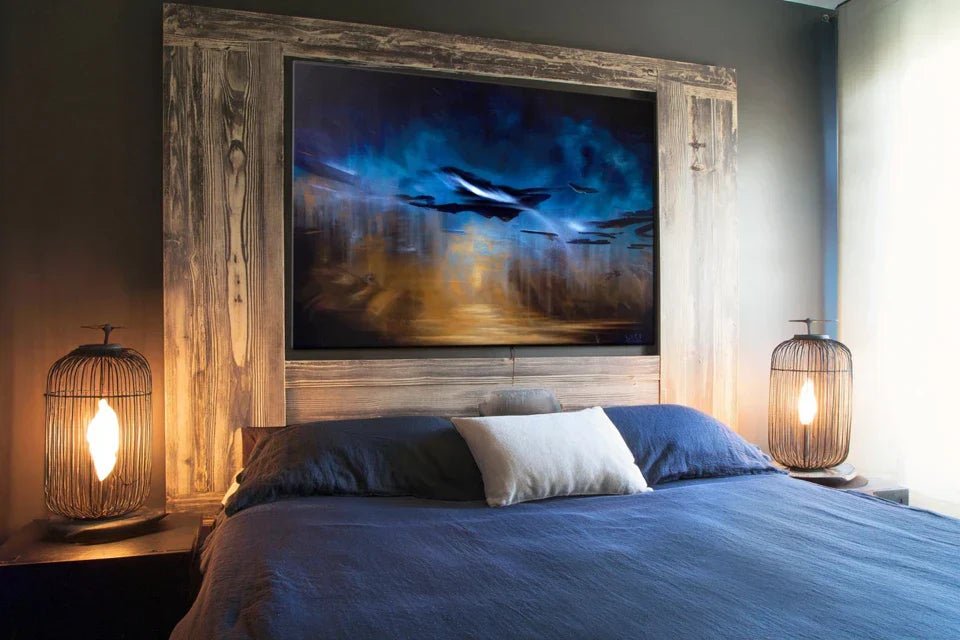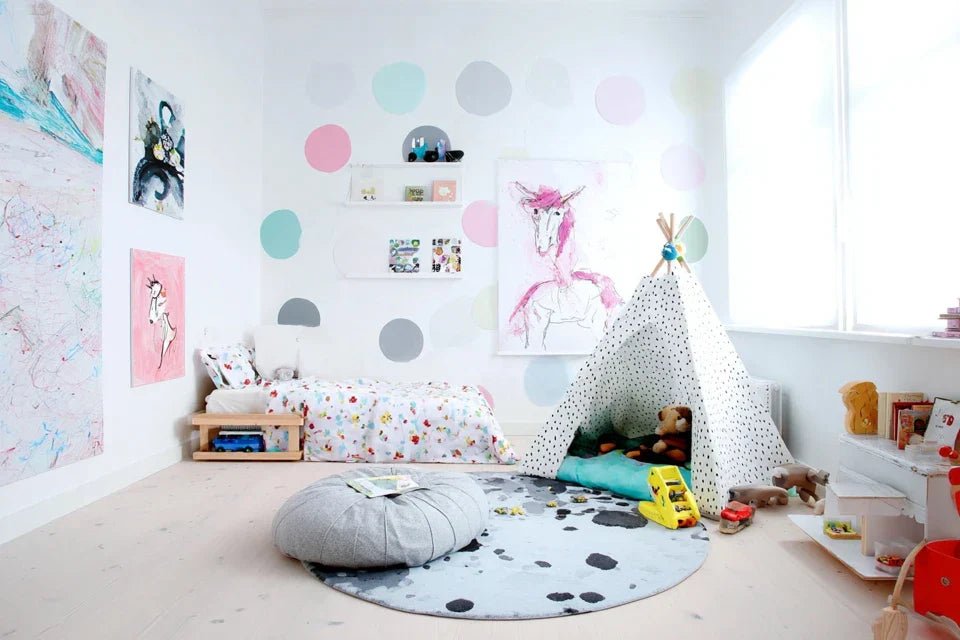
You're looking at the bare walls of your child’s room and already imagining beautiful colorful artworks that would spark their imagination. But as soon as that lovely image is formed, anxiety sets in: what if the artwork fell on their bed? What if the fixings failed? What if the colors were toxic?
You can already see yourself explaining to the emergency room how this decorative artwork that you so carefully chose ended up hurting your little one. The smell of fresh paint worries you, the sharp corners of the frame suddenly seem dangerous like blades, and even the hanging height becomes a puzzle.
You keep postponing this wall decoration, you buy stickers instead (which peel off after a week), or you opt for foam artworks (which look more like toys than art). Result: a room that lacks personality and a child deprived of the visual stimulation so important for their development.
Rest assured, this fear is perfectly legitimate and you are not alone. The problem isn't your parental caution, but the lack of reliable information on the safe decoration solutions that exist today.
By the end of this article, you will master all the techniques to create a real little personal museum in your child’s room, safely, and you will know exactly what types of artworks to choose to stimulate their awakening while sleeping soundly.
Why safe wall decoration has become so crucial today?
Our children now spend 12 to 14 hours a day in their room between sleep, games and homework. Unlike our generation who went out to play outside, they evolve in more confined spaces where every decorative element influences their mood, creativity and even their sleep. Waiting "until they are older" to decorate is depriving your child of 2 to 3 years of crucial artistic awakening for their cognitive development.
🏠 Parent testimonial: Sarah, mother of 4-year-old Léo, waited 2 years before daring to decorate. "One day, Léo said to me: 'Mom, why is my room sad?' I realized that by wanting to protect him, I had deprived him of beauty. Now his room looks like a miniature art gallery and he falls asleep inventing stories with his artworks.”
💬 Conversation with a decor expert
The golden rule of child-safe decor: A properly installed artwork with the right fixings becomes the most stable element in the bedroom. In 2 hours of careful installation, you create an artistic environment that will last throughout childhood.
Why have your previous attempts failed?
You may have already tried to hang something: a frame that came off after a week, a fixing that made a gaping hole in the wall, or worse, an artwork that slipped during the night. You told yourself "it's too complicated" or "this isn't for us".
In reality, what failed wasn't your ability, but your approach. Most parents use the same fixings as for an adult living room, ignoring that a child’s bedroom requires specific techniques: more safety, suitable materials, and a totally different approach to hanging.
It's like trying to ride a bike with motorcycle techniques: the basics are close, but the safety rules are completely different.
The first hidden cause: You choose your fixings like an adult
Most parents assume that a standard wall fixing will suffice. Mistake! In a child’s bedroom, you need to think "anti-disaster": what happens if the child pulls, pushes, or even clings to the frame?
It's the difference between building a bridge for pedestrians and a bridge for trucks: even if no one plans to drive a truck across it, the structure must be able to withstand it.
This miscalculation turns your beautiful decorative intention into a source of constant anxiety. You spend your time checking "that it still holds" instead of enjoying the result.
🔍 Quick test: Look at your current fixings: if you wouldn't be comfortable with an adult leaning on them with all their weight, they are not suitable for a child’s bedroom. A child can exert a surprising force of 15-20kg on a frame while playing.
"Child" materials aren't what you think
Many parents think that "child-friendly" necessarily means colored plastic, foam, or "shatterproof" materials. In reality, true artworks secured for children use the same noble materials as adult art, but with specific finishes and treatments.
It's like the difference between plastic toys and Montessori wooden toys: safety doesn’t come from cheap material, but from intelligent design.
By choosing low-end "special child" products, you get a decor that looks like a daycare center rather than a real personalized bedroom.
You neglect the “tactile curiosity” effect
Here's what almost no one tells you: a child needs to touch in order to understand. Prohibiting contact with the artwork creates frustration and obsession. The secret is to choose artworks designed to withstand occasional touching.
You can recognize this problem if your child keeps asking "can I touch?" or if you constantly repeat "don't touch that". These signals indicate that the decor isn’t suitable for their age.
This constant tension transforms beauty into a forbidden object, exactly the opposite of what an educational decoration should bring.
🎯 3 signs that your approach is not suitable:
- You check the sturdiness several times a week: This means you don't trust your fixings - normal, they are not designed for this intensive use
- Your child constantly asks to touch: The artwork sparks their curiosity but you have created frustration - a sign that more tactile works of art are needed
- You hesitate to invite other children into the room: Your stress reveals that the installation is not secure enough for several energetic children
The trigger factor: The hanging height determines everything
Here's what really makes the difference: the hanging height in a child’s bedroom does not follow the same rules as in a living room. Too high, the child doesn't feel ownership of the artwork. Too low, it is dangerous. But there is an optimal safety and interaction zone that you can calculate according to your child's age.
The rule of 3 safety zones: Tactile zone (80-100cm), visual zone (100-130cm), decorative zone (130cm+). Each zone requires different hanging techniques and specific types of artworks.
| ❌ Adult living room approach | ✅ Child’s bedroom approach child’s room | 💡 Why it changes everything | 🎯 Concrete benefit |
|---|---|---|---|
| Standard wall fixing "it should hold" | Anti-pull system tested 25kg | The child can exert unpredictable forces | You sleep soundly even if the whole class comes to play | Aesthetic adult height (160cm) | Height adapted to a child's size (90-120cm) | The child must be able to admire without straining their neck | Your child really develops their artistic taste | Fragile decorative materials | Finishes resistant to small hands | Touching is part of learning | You can say "you can look closely" instead of forbidding | Frames with pointed right angles | Frames with rounded or protected corners | Children explore space differently | Zero risk of injury even in the event of a fall or intense play |
The 3-step method for a 100% secure wall decoration
Now that you understand why classic approaches fail, here's how to create a personalized art gallery in your child’s bedroom. This method follows a logical progression: first safety (foundations), then aesthetics (structure), finally artistic awakening (finishing touches). At each step, you build on solid ground and you can already enjoy the partial result.
🎯 Method Overview: Step 1 - Secure the structure (like house foundations), Step 2 - Harmonize aesthetics (like architecture), Step 3 - Personalize awakening (like final decoration). Each step gives you a satisfying and secure result.
Step 1: Create Your Security Infrastructure
This first step will give you complete peace of mind. Once completed, you can let your child play in their room without constantly watching their movements near the walls. It's the foundation that transforms parental stress into parental pride.
🔧 Essential Safety Items
- Reinforced Anti-Pulling Fixings: These are special wall plugs with expansion screws that deploy behind the partition. They look like small boat anchors that open once in the wall. Look for the "25kg load" indication minimum. Avoid classic plastic wall plugs which give way under lateral traction. The investment of €3 per fixing avoids €300 of wall repairs. Child Safety Anti-Lift System: These are special hooks that prevent the artwork from sliding upwards if a child pulls on it. The mechanism works like a safety ratchet: easy to install for the adult, impossible to dislodge for the child. Recognize quality by weight: a good system weighs at least 50g per hook. Transparent Self-Adhesive Corner Protectors: These small silicone corners stick onto all frame corners. Transparent, they are invisible from 50cm but transform a potentially sharp corner into a soft surface. Opt for medical grade (hypoallergenic) silicone that doesn't yellow and resists cleaning.
Now let’s move on to the practical side with the first installation:
🎯 Step-by-Step Installation of Your First Fixing Point
Locate Wall Studs: Use a stud detector or tap the wall - a hollow sound indicates the space between studs, a dull sound indicates the supporting structure. Mark lightly with pencil. This step determines the final solidity of your entire installation, do not neglect it.
⏱️ Time: 10 minutes per wall | ✅ Success when: You clearly hear the difference in sound and feel the resistance to drilling | ⚠️ Attention: In recent apartments, some walls are hollow for 10cm - drill until you feel the concrete resistance
Drill to the Right Depth: Measure the length of your wall plug, add 5mm, and limit the drilling depth with a piece of tape on the drill bit. A hole that is too deep weakens the fixing, too shallow and it won't hold. The dust that comes out should be fine and regular.
⏱️ Time: 2 minutes per hole | ✅ Success when: The wall plug goes in with slight force by hand | ⚠️ Attention: If the wall plug falls straight into the hole, it is too large - use a larger size wall plug
Test resistance before hanging: Once the fixing is in place, pull on it with a force equivalent to the weight of a full shopping bag (approximately 8-10kg). It should not move by even a millimeter. This simple test avoids unpleasant surprises and validates the quality of your installation.
⏱️ Time: 1 minute per fixing | ✅ Successful when: No movement even when pulling hard | ⚠️ Attention: If you hear a cracking sound or see the wall deform, start again with a more suitable wall plug
✅ Step 1 validation: Your fixings support your weight on them, no sharp elements are accessible to children, and you can pull on each hanging point without it moving. If in doubt, redo this fixing - your peace of mind depends on it.