

Composez votre galerie d'art

Des tableaux qui racontent votre histoire
Code d'initiation
ART10
10% offerts sur votre premiĂšre acquisition
Découvrir la collection

Create a Healing Atmosphere in a Bedroom or Intimate Space

Créer une ambiance de guérison dans une chambre ou un espace intime
⏱ Reading time: 12 minutes

You come home after a long day, you push open the door to your bedroom, and... nothing soothes you. The cold walls, the harsh light, that feeling of emptiness that reflects your own distress back at you. Your intimate space, which should be your refuge, instead amplifies your feelings of loneliness and emotional exhaustion.

Every evening, you secretly hope that this room will comfort you, that it will wrap you in softness. But instead, you feel that dull sadness rising, the impression that even at home, you can't recharge. The furniture seems to look at you with indifference, and you wonder why your own home isn’t helping you feel better.

You may have tried changing a few elements: a new duvet cover, a scented candle, some colorful cushions. But despite your efforts, this feeling of emotional emptiness persists. Your bedroom remains a place of transit rather than a true cocoon of healing, and you fall asleep each night with that weight on your heart.

It's not your fault. Most decor advice focuses on aesthetics but completely ignores the psychological and energetic impact of colors, shapes, and works of art on our inner healing process. Your brain needs specific visual cues to trigger emotional repair mechanisms.

By the end of this article, you will know exactly how to transform your bedroom into a true sanctuary of healing, where every element - from colors to works of art - will actively work towards your personal reconstruction and daily peace.

Why does your living space influence your emotional healing so much?

Your brain processes over 11 million visual pieces of information per second, and 90% of this data directly influences your emotional state without you being aware of it. If you’re still waiting to create a therapeutic environment, you are depriving your nervous system of the soothing stimuli it needs to heal. It's like trying to heal an injury while remaining in an environment that irritates it constantly.

🏠 Customer testimonial: Sarah, 34 years old, was going through a burnout period. Her bedroom with white walls and neon lighting reminded her of her stressful office. By incorporating tableaux with warm and soothing tones, she noticed that her sleep improved within the first week, and her nocturnal anxiety attacks gradually decreased.

💬 Conversation with a decor expert

"I don't see how simple decoration could help me feel better psychologically. They’re just objects, aren’t they?"
Debunking! Your primitive brain doesn't differentiate between a real threat and a visually aggressive environment. Imagine your nervous system as a delicate musical instrument: each color, each shape is a note that can create a soothing or dissonant melody in your mind.
"I’ve always been told that you need white everywhere for it to be calming and clean."
This rule dates back to an era when the impact of colors on the nervous system was ignored. Today, research shows that pure white can create a feeling of emotional emptiness, especially in people who are rebuilding. Warm and nuanced tones promote greater secretion of oxytocin, the hormone of well-being.

The 3-minute comfort rule: A therapeutically designed space should provide you with a feeling of calm within the first 3 minutes of entering. This is the time it takes for your brain to analyze the environment and trigger or not the production of calming neurotransmitters. You should feel your shoulders relax naturally.

Do you recognize these signs of a space that’s hindering your healing?

Do you wake up with a feeling of emotional heaviness even after a good night's sleep? Do you subconsciously avoid spending time in your bedroom, preferring the living room or even going out? Do you feel this inner restlessness that intensifies when you’re in your intimate space? These reactions aren't in your head: they reveal that your environment is working against your healing process.

What’s really happening is that your autonomic nervous system remains in “alert” mode instead of switching to “recovery” mode. Your bedroom should signal to your brain that it can finally let its guard down, but instead, it maintains a baseline level of stress. This isn't a character flaw on your part: it’s a normal biological reaction to an unsuitable environment.

Imagine your nervous system as a wild animal: it needs reassuring signals to accept lowering its vigilance. Without these appropriate visual and sensory cues, it remains tense, ready to flee or fight, even in your own home.

Artificial lighting: the silent saboteur of your serenity

Here’s something few people realize: fluorescent or cool white LED lighting mimics midday light and keeps your brain in a state of hypervigilance. For thousands of years, this quality of light signaled to our ancestors that they needed to be active and attentive to dangers. Your hypothalamus still reacts according to this ancestral program.

It’s like asking someone to relax under the spotlights of a television set. Even if consciously you want to calm down, your primitive brain interprets these light signals as: "Potential danger, stay alert!"

This misunderstanding between your conscious needs and your unconscious reactions creates this constant inner tension that you feel. Your approach will change when you understand that healing begins by reconciling your environment with your deep biological needs.

🔍 Quick test: Turn off all artificial lighting and turn on a simple bedside lamp with a warm bulb (2700K). Observe whether your shoulders relax naturally within 2 minutes. This difference in feeling will prove the immediate impact of light on your inner state.

Cool colors: when your brain confuses bedroom and laboratory

Many believe that neutral and cool colors create a "zen" environment. In reality, your brain unconsciously associates blue-gray tones with medical and institutional environments. This triggers a low-level stress response, as if you were sleeping in a hospital waiting room.

Think about the difference between the atmosphere of a warm spa with its ochre and golden tones, and that of a white and blue medical laboratory. Your nervous system reacts differently to these two environments, even if you are not consciously aware of it.

This sensory confusion explains why you may feel emotionally detached in your own bedroom, as if you were in transit rather than at home. Your brain is looking for "safety" and "home" signals, but does not find them in this cold palette.

Lack of natural elements: the disconnection that exhausts

Here's what almost no one notices: a completely artificial space deprives your brain of its evolutionary landmarks. For millennia, we have evolved in constant contact with organic shapes, natural textures, and colors from nature. Short story: a 45-year-old woman transformed her recovery from depression by simply adding reproductions of natural landscapes to her bedroom.

You can identify this disconnection in your own space by observing whether you feel unexplained fatigue even after rest, if your gaze finds no point where to settle with pleasure, or if you tend to constantly look at your phone to compensate for the lack of natural stimulation.

This sensory deprivation creates a state of chronic adaptive stress: your body spends energy compensating for the absence of the soothing signals it unconsciously expects. That's why you may feel exhausted even in your own bedroom.

The 4 warning signs of an anti-therapeutic space:

  • Unconscious escape: You always find excuses to avoid your bedroom, preferring to fall asleep elsewhere. It's your instinct that keeps you away from an environment it perceives as hostile to recovery.
  • Eye agitation: Your eyes find no element on which to settle with pleasure, they "bounce" constantly. This reveals the absence of soothing visual anchors.
  • Persistent muscle tension: Your shoulders remain tense even when lying down, a sign that your nervous system isn't switching to "safe" mode. Your body remains in defensive alert.
  • Looping thoughts: Your mind races as soon as you find yourself alone in this space, because it receives no reassuring signals to calm down. The absence of soothing stimuli amplifies anxious mental activity.

The trigger factor: when space becomes an actor in your healing

What really makes the difference is the emotional coherence of your environment. Imagine your bedroom as a silent therapist: every element must "speak" to your unconscious mind in the same benevolent language. You can identify this coherence when your breathing naturally calms down upon entering, when your thoughts slow down effortlessly, and when you feel that subtle sensation of being "welcomed" by your own space.

The rule of emotional welcome: A therapeutic space must "welcome" you emotionally before you even consciously analyze it. Test this: close your eyes before entering, then open them and observe your first emotion. It should be positive or neutral, never contracting.

❌ Space that hinders healing ✅ Space that promotes healing 💡 Mechanism of action 🎯 Benefit felt
Cold and uniform light that keeps you on alert Warm and adjustable lighting that gradually soothes Activates melatonin production and reduces cortisol Natural sleep onset and restorative sleep
Neutral colors that create an emotional void Warm and nuanced tones that envelop Stimulates the secretion of oxytocin and serotonin Immediate feeling of safety and well-being
Impersonal decoration that keeps you at a distance Artwork chosen to reflect your aspirations Strengthens positive identity and self-esteem Feeling of belonging and personal pride
Straight lines and angles that create tension Organic shapes that invite relaxation Mimics reassuring natural environments Spontaneous muscle and mental relaxation

The gentle method to transform your bedroom into a healing sanctuary

Rassurez-vous : crĂ©er un espace thĂ©rapeutique ne demande ni grand budget ni bouleversement total. C'est comme accorder un instrument de musique : quelques ajustements prĂ©cis suffisent Ă  transformer une cacophonie en mĂ©lodie harmonieuse. Nous allons procĂ©der en trois Ă©tapes progressives, chacune apportant un niveau de bien-ĂȘtre supplĂ©mentaire, jusqu’à ce que votre chambre devienne ce refuge Ă©motionnel que vous mĂ©ritez.

đŸŒ± Your transformation overview: Step 1 - Soothe (create a secure foundation with light and colors), Step 2 - Nourish (integrate elements that nourish your soul), Step 3 - Radiate (personalize to reflect your rebirth). Each level will bring you more serenity and strengthen your natural healing process.

Step 1: Creating soothing foundations - The art of reassuring your nervous system

We begin with this step because your brain needs to feel safe before it can heal. It's like preparing the soil before planting: without these soothing foundations, all your decorative efforts will remain superficial. Once this base is established, you will feel that delicious sensation of "finally coming home" every evening.

What you need to get started

  • Warm temperature lighting (2700K-3000K): Look for LED bulbs labeled "warm white" or "soft light." They emit that golden light that mimics sunset and naturally signals your brain to relax. Avoid "neutral white" bulbs sold cheaper as they keep your system alert. Investing in good lighting immediately transforms the atmosphere.
  • Color palette with earthy or muted tones: Think of the shades you find in nature at sunset: ochre, terracotta, blush pink, rose beige. These colors contain wavelengths that naturally activate your parasympathetic nervous system. The criterion for recognizing the right shade: it should remind you of a moment of calm in nature. One or two soft textile elements: A blanket made from natural material (cotton, linen, wool) or a fluffy cushion. Soft texture sends signals of comfort to your tactile brain. Choose materials that make you want to stroke them instinctively - it's this gesture that triggers the release of soothing endorphins.

Let's move on to the practical application of these principles

How to proceed without making mistakes

Replace your main lighting: Unscrew your current bulb and install a 2700K warm LED. If you have multiple light points, start with the one near your bed because that's where your brain needs to receive the "rest" signal most clearly. This simple modification instantly changes the atmosphere as your retina transmits different signals to your hypothalamus.

⏱ Time: 5 minutes | ✅ Successful when: The light is orange/golden rather than white/blue | ⚠ Attention: Don't change all the lights at once, your brain needs to gradually get used to the change.

Introduce a dominant warm color: Choose ONE wall or ONE large element (curtain, blanket, artwork) in a warm hue. The idea is to create a reassuring "visual anchor" for your gaze. This color should represent between 20 and 30% of what you see from your bed, enough to influence your mood without overwhelming.

⏱ Time: 1 to 3 hours depending on the solution chosen | ✅ Success when: Your gaze naturally rests on this colored element and you feel a micro-relaxation | ⚠ Attention: Avoid overly vibrant colors that stimulate rather than soothe - test first with a removable item.

Add a tactile softness element: Place a soft blanket or fluffy cushions within reach from your bed. The goal is for your brain to know that it can instantly access tactile comfort if needed. This immediate availability of comfort reassures your nervous system even when you are not using these items.

⏱ Time: 10 minutes | ✅ Success when: You feel like touching these elements as you pass by | ⚠ Attention: Choose natural materials rather than synthetic ones - your skin subconsciously detects the difference.

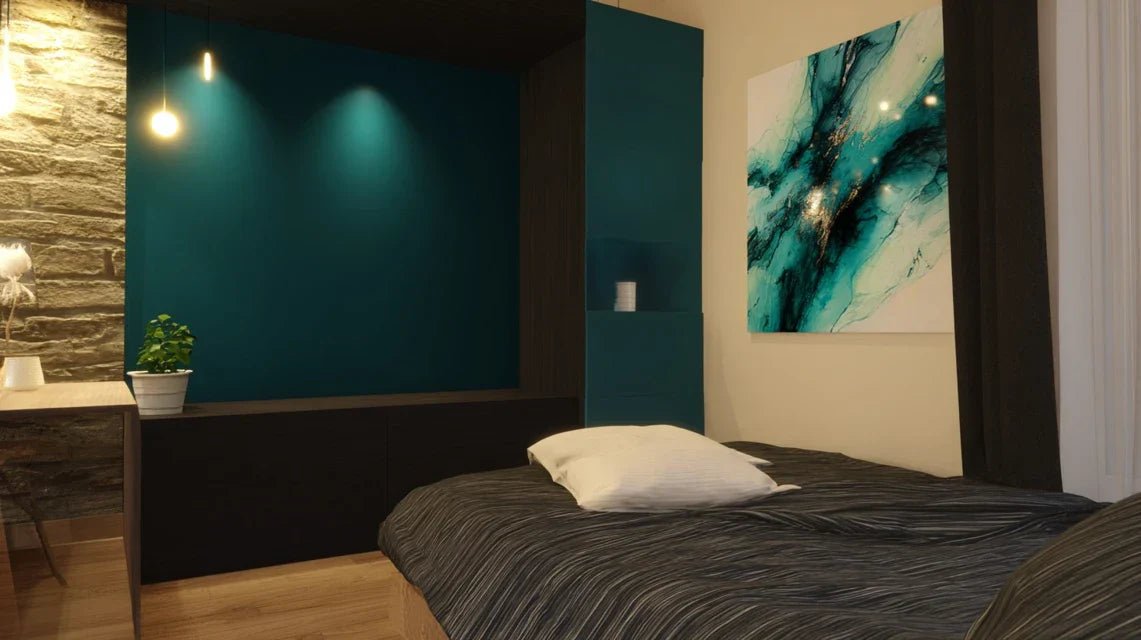
✹ Step 1 validation test: Sit on your bed, close your eyes for 30 seconds, then open them. You should feel a sense of "cocoon" rather than exposure. Your breathing should naturally slow down. If this is not the case, adjust the light intensity or the proportion of warm color. Successfully completing this step will make you want to spend more time in your bedroom.

OUR RECOMMENDED PRODUCTS

Step 2: Nourish your soul with inspiring elements

Now that your nervous system can relax, we are moving to the next level: nourishing your emotional and spiritual dimension. This step is more personal because it involves integrating elements that speak to your soul and support your healing aspirations. You will notice that your space begins to "talk" to you and reflects who you are becoming, not just who you were.

Nourishing elements for your rebirth

  • Inspiring artworks or reproductions: Choose images that evoke beauty, nature, serenity or your future aspirations. Art acts as a "visual vitamin" that nourishes your imagination and keeps your healing goals present in your subconscious. Prioritize works that make you smile inwardly rather than those that are just "pretty".
  • Vegetal elements or nature-inspired items: An easy-to-care-for plant, a dried branch in a vase, or reproductions of natural landscapes. These elements reconnect your brain to natural cycles and reduce cortisol levels. The quality criterion: these elements must evoke life and growth, never stagnation.
  • Objects charged with positive meaning: A book that marked you, a photo of a happy moment, an object brought back from a trip. These "emotional anchors" remind your subconscious of your inner resources and moments of happiness. They should trigger a smile or a feeling of gratitude when you look at them.

Installing your emotional ecosystem

Choose and place your main artwork: Select an image or reproduction that represents your desired state (peace, joy, freedom). Place it facing your bed so that it is the first thing you see when you wake up. This image will subtly program your mind every morning towards the emotional state you want to cultivate.

⏱ Time: 30 minutes to choose, 15 minutes to install | ✅ Success when: The image makes you feel the desired emotion in less than 3 seconds | ⚠ Attention: Avoid abstract images that are too complex and tire the eye instead of soothing it.

Create a point of natural life: Install a vegetal or natural element within your field of vision from the bed. Even a simple branch in a vase is enough - the important thing is that your brain perceives the presence of living things. This connection to nature activates your parasympathetic nervous system and improves sleep quality.

⏱ Time: 20 minutes | ✅ Success when: Your gaze naturally seeks out this natural element to rest | ⚠ Attention: If you choose a plant, opt for a very resistant species - failure to maintain it would create additional stress.

Arrange your positive emotional anchors: Place 2-3 meaningful objects in strategic locations where your gaze naturally crosses them. Avoid accumulation - each object must have space to "breathe" and retain its emotional impact. These objects act as subliminal reminders of your resources and your ability to be happy.

⏱ Time: 45 minutes | ✅ Success when: Each object triggers a micro-smile when you notice it | ⚠ Attention: Remove any objects that evoke painful memories - even if they have sentimental value.

🌿 Validation of your nourishing ecosystem: Lie down and let your gaze wander freely around the room. You should feel a sense of "inner richness" - as if the space reminded you of who you really are and what you are striving for. If you feel heaviness or visual confusion, simplify by removing an element.

Step 3: Personalize to radiate - Your signature of rebirth

You are now reaching the level of emotional mastery of your space. This final step involves refining the details that will make your bedroom a unique place, perfectly attuned to your personality and healing journey. You are developing here your decorative "sixth sense": this ability to intuitively feel what makes you feel good and what pulls you down.

The touches of personal mastery

  • Fragrances or room diffusers: Scents that instantly trigger your favorite state of relaxation. The olfactory sense is directly connected to your limbic system and can transform the atmosphere in seconds. Choose scents that evoke happy moments or places where you feel good - lavender for soothing, citrus fruits for joy, pine for strength.
  • Mood modulators: Light dimmers, candles, or ambient lamps that allow you to adapt the lighting to your emotional state. Your need for light varies depending on your mood and the moment - having this flexibility gives you control over your therapeutic environment. The important thing is to be able to create different "atmospheres" according to your needs. Unique personalization elements: Details that reflect your personal evolution - perhaps colors that match your new vision of yourself, or shapes that represent your growth. These elements act as visual affirmations of your transformation and reinforce your new identity.

Refining your personal sanctuary

Create your signature scent: Test different room fragrances until you find the one that instantly triggers your sense of well-being. Use it ritually - for example, diffuse it 10 minutes before going to bed to create an association between this smell and your relaxation moment. Your brain will learn to relax as soon as it perceives this fragrance.

⏱ Time: 2-3 weeks of testing to find the right scent | ✅ Successful when: This scent makes you smile and relaxes you in less than 30 seconds | ⚠ Attention: Avoid overly strong fragrances that can cause headaches - subtlety is more effective.

Install your mood control: Set up a system that allows you to modulate the lighting according to your mood - dimmer, multiple lamps, or candles. The goal is to have at least 3 levels of lighting: "energizing" for the morning, "comfortable" for the evening, and "cocooning" for falling asleep. This ability to adapt transforms your bedroom into a true therapeutic tool.

⏱ Time: 1-2 hours of installation | ✅ Successful when: You can adjust the atmosphere with a few gestures | ⚠ Attention: Test each lighting level at different times to check its effect on your mood.

Add your signature touch: Integrate an element that specifically represents your healing journey - a particular color, a symbolic shape, or a creative object you have made. This element should remind you of your strength and evolution. It acts as a "talisman" visually reinforcing your confidence in your ability to transform.

⏱ Time: Variable depending on the creation | ✅ Success when: This element gives you pride and strength every time you see it | ⚠ Attention: This element should evolve with you - don't hesitate to modify it if your journey changes.

👑 Final mastery test: Invite a trusted person into your space. They should immediately feel your "energy" and give you positive comments about the atmosphere. More importantly: you should feel proud to show them this space that resembles you. This pride indicates that your room authentically reflects who you are becoming.

The rule of continuous evolution: A therapeutic space must evolve with your healing. When an element no longer has the same positive effect on you, it is a sign that you have grown and it is time to adjust it. Trust your feelings rather than fixed rules - your intuition is your best decorative guide.

You now master the secret codes of the therapeutic atmosphere. You know how to create an environment that actively works for your well-being, but here are some expert-level tips that few people know.

🎹 Expert technique - The 20 second rule: A truly therapeutic space should make you feel an emotional state change in less than 20 seconds of immersion. If this is not the case, one of your elements is still "resisting". Test by temporarily removing each element one by one until you identify the disruptor. This technique allows you to achieve perfect harmony.

💭 Frequent question from our readers

"I'm afraid it will be too 'therapeutic' just, and that people will find it weird when they come to my house..."

This concern is very understandable - you want to heal without feeling like you are living in a doctor's office! The beauty of this approach is that it creates a space that simply seems "very welcoming" and "harmonious" to visitors. They will feel the well-being without identifying why. In fact, you will notice that your guests relax more easily at your home and often compliment you on the atmosphere, without realizing that it is therapeutically designed. The art of a good healing space is precisely that it acts discreetly.

💡 Reassuring test: Start by applying these principles in a very subtle way, then observe the reactions of your loved ones. You will notice that they simply feel "good" at your home, without asking questions. This social validation will reassure you about the universality of these well-being principles.

Pitfalls to Avoid to Protect Your Sanctuary

Now that you know the way, let's protect your emotional investment! Some mistakes can unintentionally turn your therapeutic space into an additional source of stress. These traps are particularly insidious because they seem "logical" at first glance.

  • ⚡ Trying to change everything at once: It's tempting to completely transform your bedroom in a weekend when you discover these principles. But your brain needs time to integrate each change and create new positive associations. Too drastic a change can create a feeling of strangeness rather than comfort. Proceed in 1-2 week steps to allow your nervous system to adapt harmoniously.
  • 🎹 Copying a "therapeutic" style seen elsewhere: Each person has different well-being triggers depending on their personal history. What soothes your neighbor may leave you indifferent, or even irritate you. The mistake is to follow universal "recipes" rather than listening to your own emotional reactions. Your body always tells you what feels good - learn to listen to it instead of following trends. 💾 Thinking a large budget is needed: The therapeutic effectiveness of a space does not depend on its cost but on its emotional coherence. A simple change of lighting can transform the atmosphere more effectively than poorly chosen expensive furniture. This belief leads to unnecessary purchases and creates financial stress that cancels out the desired benefits. Focus on free or low-cost items first. 🔄 Constantly modifying due to dissatisfaction: When you start to feel the benefits, you can become "addicted" to changes and constantly modify your space. This constant instability prevents your brain from creating stable associations between the environment and relaxation. Respect a stabilization period of 3-4 weeks between each major modification. 🎯 Prioritizing aesthetics over feeling: A space can be visually perfect according to magazines but not provide you with well-being if the colors or shapes do not resonate with your personality. The mistake is to choose with your eyes rather than with your emotions. A decorative element has therapeutic value only if it triggers a positive emotion in you, not in others.

đŸ›Ąïž Your ongoing verification system: Each week, take 2 minutes for an "emotional scan" of your space: does your breathing calm down when entering? Does your gaze easily find pleasant anchor points? Do you feel that micro-joy of being "at home"? If any of these sensations fade, it's a signal that an element needs adjustment. Warning signs: unconscious avoidance of the room, persistent muscle tension, or negative thoughts that intensify in this space.

🎁 Special offer for readers

Because you took the time to inform yourself, enjoy 10% discount on your first order :

ART10

⏰ Valid 72h after reading ‱ Applicable on all our products

Your practical questions about therapeutic design

💰 How much does it really cost to create an effective healing space?

Between €50 and €200 to achieve significant results, depending on your choices. The most impactful element - changing the lighting - costs less than €15. A framed art reproduction: €30-€80. The trick to optimize: start with the lighting and an inspiring artwork, you will already feel 70% of the benefits. Concrete example: Emma transformed her room with €85 (2 warm bulbs, a landscape painting, a plant, a soft blanket) and noticed an improvement in her sleep from the first week.

⏰ How long before I feel the effects on my well-being?

The first effects usually appear within 24-48h with the change of lighting, and deepen over 2-3 weeks. Your nervous system gradually adapts to new soothing stimuli. To accelerate: spend deliberately 10-15 minutes per day in your transformed space without distraction (phone, book), just to let your brain create new positive associations. Full integration usually takes place within 3-4 weeks.

🏠 Does it also work in a small space or a shared bedroom?

Absolutely! In a small space, the impact is often even more powerful because your brain has no "visual distractions". Focus on your personal area: your side of the bed, your bedside table, the lighting you control. Even 2mÂČ well arranged create a “bubble of well-being” sufficient. For a shared bedroom: negotiate common lighting (softer), add your personal elements to your space, use a screen or curtain to visually delimit your serenity zone.

🎹 How do I choose the right artworks if I don't know anything about art?

Trust your emotions rather than "artistic rules". Simple test: look at the artwork for 30 seconds - if it makes you smile inwardly, you relax your shoulders, or evokes a pleasant memory, it is the right one. Avoid overly complex images that tire the eye, or those that evoke intense movement (storms, falls...). Prefer: soothing landscapes, scenes of nature, harmonious abstracts, or reproductions of classic works that "speak" to you. The important thing is not artistic value but emotional impact on you.

đŸŒ± My bedroom has no window/natural light, can it still work?

It can even be easier because you have complete control over the lighting! Compensation: invest in 2-3 warm light sources at different intensities, add elements that evoke nature (reproductions of landscapes, quality artificial plants, natural textures). Advanced tip: use an aurora simulator that gradually reproduces the light of sunrise to regulate your circadian rhythm. Many of our customers ultimately prefer their windowless space because it becomes a true "cocon" controlled environment.

Your new life begins every evening in your sanctuary

In a few weeks, you will return home with that delicious anticipation of finding your personal refuge. Your bedroom will welcome you like a benevolent friend, your shoulders will automatically relax as you cross the threshold, and this feeling of truly being "at home" will nourish your confidence day after day. Your loved ones will notice that you seem more serene, more centered, without understanding that this transformation comes from your environment which is quietly working for your well-being.

This mastery of your space goes far beyond simple decoration: you develop a therapeutic sensitivity that will serve you everywhere. You will instinctively know how to create comfort and harmony wherever you are, adapt your environment to your emotional needs, and even help your loved ones feel better in their own space. This skill becomes a valuable resource for navigating the ups and downs of life.

The most beautiful thing about this transformation is that it confirms your creative power over your own happiness. You have taken control of your environment instead of passively accepting it, and this strengthens your confidence in your ability to change what doesn't suit you in your life. Start tonight by changing that light bulb - this simple gesture launches your visual renaissance.

✹ Your moment of transformation begins now: You already have everything you need to create this change - all that's missing is your decision to start. In 30 days, you will remember this moment as the turning point where you decided to make your home your best healing ally. Your future thanks you already.

🌿 Read more articles on art therapy

Read more

L’art mural comme soutien Ă©motionnel aprĂšs une pĂ©riode difficile
Tableaux abstraits & interprĂ©tation personnelle : ouvrir l’imaginaire