

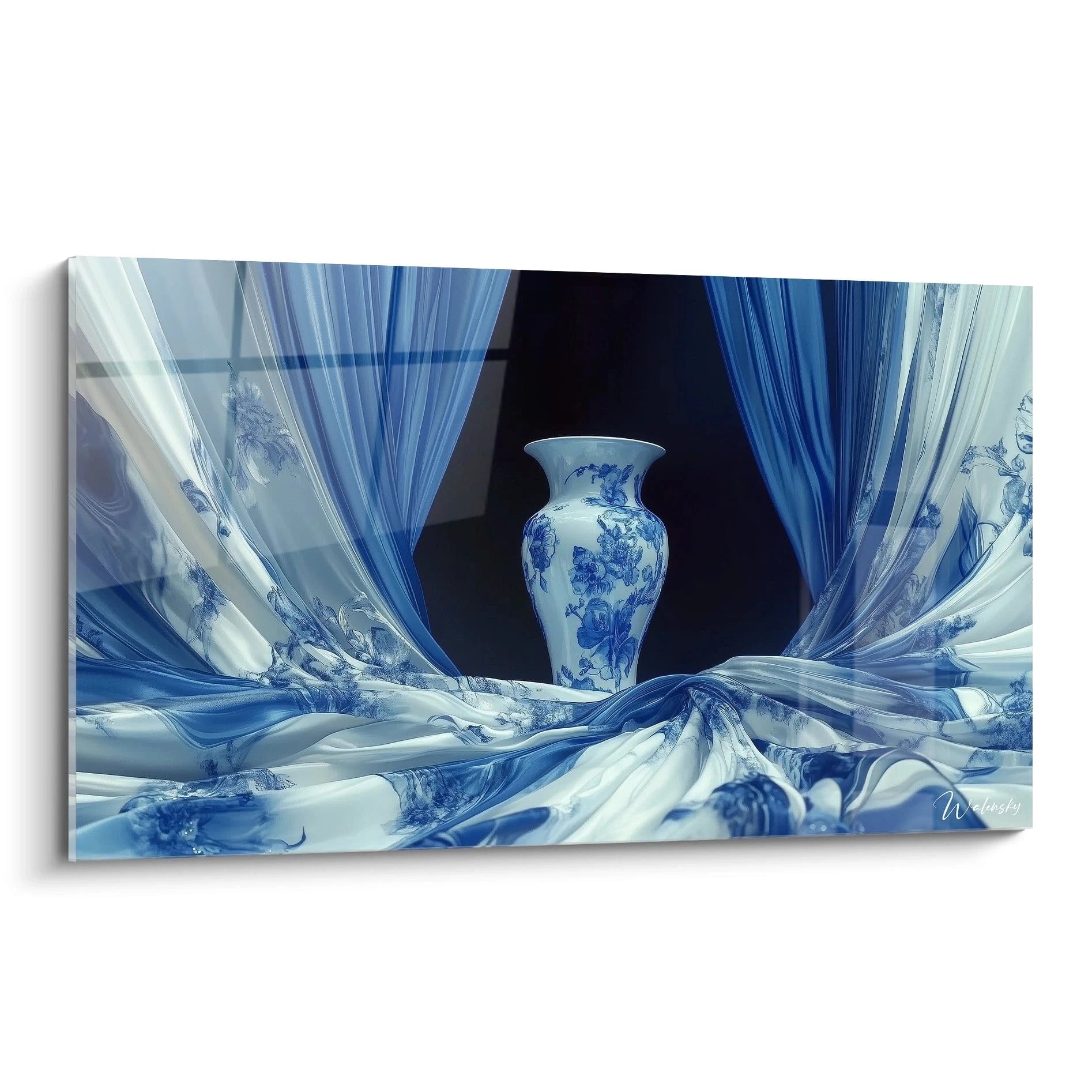






The Right Artwork Format for a High-End Wine Cellar
October 11, 2025 · 18 min read · by Walensky
You’ve just furnished your prestigious wine cellar with considerable investment, but something feels off. The space seems cold, impersonal, almost clinical despite your finest bottles carefully arranged.
No matter how perfect the lighting you installed or the most refined racks you chose, your cellar desperately lacks character and soul. The bare walls give a sense of incompleteness that frustrates you with each visit.
Perhaps you’ve tried hanging a standard painting, but the result was disappointing: too small, it got lost in the space; too large, it dominated your precious bottles. You're also worried about the humidity affecting the artwork's preservation.
That’s perfectly normal! Most wine enthusiasts make this mistake by applying classic decorating rules to a space with such particular constraints. A wine cellar requires a specific artistic approach that takes into account humidity, subdued lighting and harmony with your collections.
By the end of this article, you will know exactly how to choose the perfect dimensions, style and support to transform your cellar into an artistic showcase worthy of your finest vintages, while preserving your works in the long term.
Why choosing the right artwork can transform the soul of your wine cellar?
Wall art in a wine cellar is not just about aesthetics - it's what distinguishes a simple reserve from a true sensory experience. Imagine your guests descending into your cellar and discovering not only your exceptional vintages, but also a refined atmosphere that reveals your personality as a collector. Each moment of waiting becomes an instant of contemplation, and your cellar acquires that emotional dimension that makes the difference between owning wine and living a passion.
🍷 Collector's testimonial: "When I hung my first canvas in my cellar, my friends immediately noticed the difference. One of them said to me: 'Now we really understand who you are'. This patinated metal painting depicting ancient vineyards dialogues perfectly with my aging bordeaux, creating a silent conversation between art and viticulture.”
Conversation with a décor expert
The golden rule of art in the cellar: A well-chosen painting should create a harmonious dialogue with your collections without ever competing with them. Like a sommelier who reveals the aromas of a great vintage, the work of art reveals the personality of your cellar and you will see the difference from the first visit - the effect is immediate and lasting.

Decoding: what lies behind your decor hesitations
You find yourself in these situations? You go around in circles in your cellar imagining different locations, you hesitate between several styles without managing to decide, or you constantly postpone your purchase for fear of making the wrong choice. These hesitations actually reveal excellent intuition: you feel that there is a perfect solution, but the usual decoration codes do not apply here.
What's really happening is that your cellar requires a hybrid approach between interior design and museum conservation. It’s not a fault of yours to not naturally master these specific codes - it's normal, because few people have this cross-expertise.
It's like trying to cook a gourmet dish with family cooking techniques: the ingredients are excellent, but the method must be adapted to the level of requirement.
First cause: The obsession with "standard" dimensions
Contrary to popular belief, a wine cellar does not follow the proportions of a living room. Most people apply the rule of “one third of the width of the wall”, which works perfectly in a living room but creates an imbalance in the vertical and structured universe of a cellar.
Imagine dressing a prima ballerina with the proportions of a theater costume: the rules change depending on the context and specific constraints of the space.
This error in proportions makes you lose the desired emotional impact and creates that frustrating feeling that “something is not right” since you can’t precisely identify the problem.
🧪 Immediate test: Take a photo of your cellar and draw different painting formats on it with your finger. You will immediately see that the “living room” proportions seem strange in this space with such particular lines.
Many think they should choose a “one-size-fits-all” style to avoid making a mistake, but wine cellars mercilessly reveal the blandness. In this authentic and historic environment, only works with real personality find their place.
It's like wearing generic perfume at a gourmet dinner: it goes unnoticed when the occasion calls for character and authenticity.
Result: you end up with a decorated but soulless space, that doesn’t reflect your personality and doesn't create that feeling of pride you seek when hosting.
Third pitfall: Underestimating the technical environment
Few people realize that humidity, temperature variations, and specific lighting in a cellar create invisible but decisive constraints. A collector recently told us that he had seen his beautiful lithograph warp in six months due to an unsuitable support.
To identify this factor in your situation, observe whether you feel a difference in atmosphere entering your cellar (smells, coolness, feeling of humidity on the skin).
These variations directly impact the durability of your artistic investment and can turn a pleasure purchase into a source of frustration and repeated expenses.
🎯 The 3 signals that don't lie:
- You rarely photograph your cellar: Subconsciously, you know it lacks that "little something" that would make it photogenic and worth sharing
- Your guests admire your bottles but leave quickly: The space doesn't invite them to linger and savor the moment, a sign of a lack of warm ambiance
- You keep postponing your purchase: This procrastination reveals that you sense the complexity of the choice without having the keys to decide well
The trigger element: Thematic coherence
What really makes the difference is the harmony between the artwork and the wine-making universe. Like a perfect food and wine pairing, this coherence creates a multiplier effect where the whole becomes more beautiful than the sum of its parts. You will recognize it by that immediate feeling of "rightness" when you enter the space, and your guests will spontaneously notice it by commenting on the particular atmosphere of your cellar.
The principle of the perfect setting: Your painting should reveal the beauty of your collection rather than drawing attention to itself. This alchemy works when the artwork dialogues with the spirit of the place. You verify this by observing whether your gaze naturally navigates between art and bottles in a fluid movement.
| ❌ Classic living room approach | ✅ Specialized cellar approach | 💡 Why it works | 🎯 Visible result |
|---|---|---|---|
| Choose according to the wall size | Choose according to the architecture of the racks | Respect existing guidelines | Immediate visual harmony |
| Favor neutral colors | Dare earth and metal tones | Connection with the wine-making universe | Character and authenticity reinforced |
| Traditional wood frame | Technical supports resistant | Adaptation to environmental constraints | Durability and peace of mind |
| General decorative art | Wine-themed or noble abstract theme | Narrative coherence of the space | Emotion and pride of the owner

The 3-Circle Method for a Worry-Free Choice
Rassurez-vous, choisir le tableau parfait n'est pas plus complexe que sélectionner un bon millésime. La méthode suit une logique progressive : d'abord on analyse l'espace et ses contraintes (comme on examine un terroir), ensuite on définit le style et les dimensions (comme on choisit le cépage), enfin on optimise l'installation (comme on parfait la vinification). À la fin, vous aurez cette satisfaction profonde du connaisseur qui a fait le choix juste.
🎯 Vision d'ensemble de votre transformation : Les trois étapes vous mènent de l'analyse technique à l'émotion esthétique. Étape 1 = bases solides et choix éclairés, Étape 2 = personnalisation et harmonie visuelle, Étape 3 = installation pérenne et effet "wow". Chaque étape construit sur la précédente pour un résultat professionnel.
Étape 1 : Décryptage de votre espace (l'analyse technique)
Cette étape est cruciale car elle évite 90% des erreurs courantes. Comme un architecte qui étudie les fondations avant de dessiner, nous allons révéler les contraintes cachées et les opportunités de votre cave. Une fois cette analyse terminée, vous aurez cette clarté rassurante de savoir exactement ce qui est possible et souhaitable dans votre espace.
Vos outils d'analyse pro
- Mètre ruban et niveau à bulle : Pas seulement pour mesurer la largeur du mur, mais pour identifier les lignes de force créées par vos casiers et comprendre la géométrie réelle de l'espace. Vérifiez que le mur est parfaitement droit car un tableau révèle impitoyablement les défauts. Évitez les applications smartphone qui manquent de précision pour les mesures définitives.
- Luxmètre ou appareil photo en mode manuel : Cet outil révèle les zones d'ombre et de lumière qui détermineront l'emplacement optimal. Le principe : un tableau doit être éclairé uniformément sans créer de reflets. L'œil s'habitue à la pénombre et ne perçoit pas ces nuances cruciales pour le rendu final.
- Hygromètre électronique : Indispensable pour mesurer le taux d'humidité réel et choisir le support adapté. Recherchez un modèle qui affiche les variations sur 24h, car les écarts révèlent le niveau de stabilité de votre environnement. Cette donnée détermine directement la longévité de votre investissement artistique.
Maintenant, passons à la pratique avec un protocole simple mais précis
Protocole de mesure intelligente
Cartographier les zones de force visuelle : Placez-vous à l'entrée de votre cave et identifiez où votre œil se dirige naturellement. Ces "points d'ancrage" correspondent généralement aux angles entre les casiers ou aux espaces de circulation. C'est ici que votre tableau aura le maximum d'impact sans perturber la fonctionnalité.
⏱️ Temps : 15 minutes | ✅ Réussi quand : Vous avez identifié 2-3 emplacements où l'œuvre sera vue naturellement | ⚠️ Attention : Ne choisissez pas uniquement le mur le plus grand - choisissez le mur le plus "regardé"
Measure the optimal eye level: In cellars, you often look down (bottle labels) and then horizontally. Measure 1.50m from the floor - this is generally the ideal height to center your artwork. This position creates a natural visual pause that invites contemplation.
⏱️ Time: 10 minutes | ✅ Successful when: You have marked the central point with light pencil | ⚠️ Attention: In vaulted cellars, adapt this height to the geometry of the ceiling
Test environmental conditions: Leave your hygrometer in place for 48h to capture real variations. Note the differences between day/night and any humidity peaks. This data will guide you towards suitable materials: metal/plexiglass for variable environments, treated canvas for very stable cellars.
⏱️ Time: 5 minutes of installation + 48h of observation | ✅ Successful when: You know the amplitude of variations | ⚠️ Attention: A single instantaneous measurement does not reveal real constraints
✅ Validation of step 1: Your analysis is complete when you can precisely describe the optimal location, the maximum possible dimensions and the technical constraints to be respected. If in doubt about interpreting measurements, it is better to be conservative on dimensions than too ambitious. You are now ready for artistic selection!
— Our selection


OUR RECOMMENDED PRODUCTS
Step 2: Artistic selection and harmonization (the aesthetic choice)
You are now moving to the next level: transforming your technical data into informed aesthetic decisions. This step is more rewarding as you see your project take shape visually. The snowball effect begins here: each coherent choice facilitates the following and you gain confidence.
Recommended style palette
- Oxidized metal and industrial patinas: These finishes evoke the authenticity of old wine cellars and are perfectly resistant to humidity. Look for rust, aged bronze or brushed steel shades that naturally dialogue with the terracotta tones of the lockers. The advantage: they age well and gain character over time. Abstracts in vinous tones: Think of bordeaux, garnet, pale gold hues that evoke without imitating the colors of wine. The principle: create a subtle color resonance that enriches the atmosphere without dominating it. These shades bring warmth and sophistication to the mineral environment of the cellar. Black and white vineyard photographs: The absence of color avoids visual competition while introducing the poetry of the terroir. Opt for large acrylic formats that are resistant to humidity and create a striking sense of depth. A professional finish transforms your cellar into a private art gallery.
Elimination method
Define your "aesthetic signature": Look at your bottles and identify what attracts you most: classic elegant labels, modern streamlined estates, or exceptional vintages with luxurious design? This preference reveals your natural artistic sensitivity and guides the style of artwork that truly suits you.
⏱️ Time: 20 minutes | ✅ Success when: You can define your style in a maximum of 3 words | ⚠️ Attention: Don't choose according to trends but according to your deep tastes
Test proportions by simulation: Cut out rectangles of newspaper with the intended dimensions and temporarily attach them to the wall. Step back and observe the overall effect. This method immediately reveals whether the proportions are harmonious with your specific architecture.
⏱️ Time: 30 minutes | ✅ Success when: One size seems obvious to you | ⚠️ Attention: Test at least 3 different formats for comparison
Step 3: Technical installation and finishing (the realization)
You are now reaching the level of mastery: to realize your vision with a professional finish. The difference between amateur and connoisseur lies in these technical details that transform a simple hanging into a museum-quality installation. The final result you will obtain is this cellar that you will be proud to show off, where every element seems to have always been in its place.
Professional installation equipment
- High-strength chemical fixings: Essential in cellars often with stone or old concrete walls. These anchors expand chemically to create an indestructible grip. Calculate a minimum of 3 fixing points for formats over 60cm. The investment protects your artwork and your peace of mind.
- Anti-vibration hanging system: Cellars sometimes experience micro-vibrations (circulation, equipment). These systems compensate and keep the painting perfectly stable. Look for models with integrated dampers used in museums.
- Rear anti-humidity protection: A polycarbonate plate or protective film between the artwork and the wall prevents capillary moisture from rising. This invisible barrier significantly extends the lifespan of your artistic investment.
Durable installation protocol
Precision drilling with template: Create a cardboard template to the exact dimensions of your artwork to mark the fixing points with millimeter precision. This method eliminates measurement errors and guarantees perfectly horizontal hanging from the first try.
⏱️ Time: 45 minutes | ✅ Success when: The artwork is perfectly level without adjustment | ⚠️ Caution: Check the nature of the wall before drilling (metal detector)
Expert progression rule: You can consider each step completed when the result seems "evident" and natural to you. If something still bothers you, it means the step deserves to be refined. The perfect balance is immediately felt - trust your instinct while respecting technical criteria.
Congratulations! You now master the subtleties that only true connoisseurs apply. These expert finishes give you this distinct advantage: your guests will notice the sophistication of your cellar without being able to precisely identify what makes it so successful.
🎯 Expert collector tip: Install indirect accent lighting (2700K LED) that subtly reveals your artwork without dazzling it. Placed at a 30° angle from above, it creates the cozy gallery atmosphere that transforms every visit into a memorable experience. The effect is spectacular in the evening when light caresses both your bottles and your work.
Frequent question from our readers
"I'm afraid my guests will find it pretentious to have art in my cellar..."
This concern actually reveals your good taste and sensitivity! Well-chosen art expresses passion, not pretension. Your true friends will recognize your attention to detail and your love of beauty, just as they appreciate the quality of your wines. A painting in a cellar says "I care enough about this place to make it a unique place" - it's a compliment to your guests, not a demonstration of ego.
🎨 Social validation test: Choose a work that makes you smile or soothes you when you look at it. This positive emotion will naturally shine through in the way you talk about it, and your guests will feel your authenticity rather than a desire to impress.
— You may also like


The 5 mistakes that can ruin your project (and how to avoid them)
I prefer to alert you about these classic pitfalls that have already frustrated many enthusiasts. These mistakes are human and predictable - knowing them gives you a decisive advantage to succeed from the first try.
- 🚫 Choosing first the artwork, then finding where to put it: It's tempting to fall in love with a piece on a website, but your cellar has specific constraints. Result: the perfect painting online becomes unsuitable for your home. The reverse method (analyze then choose) avoids this costly frustration. This "love at first sight then adaptation" approach wastes time and money for 70% of buyers.
- 📏 Underestimating the impact of dimensions on atmosphere: A painting that is too small gets lost and creates a sense of incompleteness, too large it overwhelms the space and dominates your bottles. The perfect balance makes the work seem as if it has always been there. Allow 15-20% larger than your first intuition - cellars visually absorb size.
- 💰 Neglecting support quality to save money: An unsuitable support turns your artistic investment into a permanent source of anxiety. The first signs of degradation appear after 6-8 months and then accelerate. Consider the support as insurance for your purchase - it's long-term savings.
- 🔧 Rushing installation due to lack of patience: After the excitement of choosing, installation seems secondary. Yet, an approximate hanging spoils the final effect and can create risks of falling. Allow as much care for installation as for selection - this is what distinguishes an amateur result from a professional rendering.
- 💡 Forgetting lighting in planning: The most beautiful painting becomes invisible without suitable lighting. In a cellar, light reveals or kills the work of art. Plan the lighting at the same time as the location to create that warm atmosphere that invites you to linger and contemplate.
🛡️ Verification system before validation: Take a photo of your simulation with your smartphone and show it to a trusted friend. Their fresh perspective reveals the details you no longer see. Check that the work dialogues with your bottles without competing with them, that the proportions seem natural, and that the whole makes you want to spend time in your cellar. Warning sign: if you still hesitate after simulation, it means the choice is not ripe.
— In the same vein


Practical questions about the artistic arrangement of your cellar
Allow 2-3 weeks between order and final installation, including 48h for your space analysis and 1 week for delivery. <strong>Optimal budget: €300-€800 for a quality piece</strong> that will last through the years. To optimize: order in bulk if you plan to decorate several spaces, and choose standard sizes to reduce lead times. Concrete example: our client Antoine transformed his 15m² cellar with a 180cm metal triptych for €650 - the effect is striking and durable.
Your cellar in 3 weeks: from storage space to personal sanctuary
Imagine yourself in a few weeks, descending into your transformed cellar. <strong>From the moment you enter, the atmosphere takes hold</strong>: this perfectly integrated artwork reveals the beauty of your collections and creates that unique atmosphere you were looking for. Your guests won't be able to resist commenting on the elegance of the whole, and you will feel the deep pride of a collector who masters all the details of his passion. <strong>Each visit becomes a moment of contemplation</strong> where art and wine dialogue in harmony.
Beyond aesthetics, you will have developed this expertise in high-end design that applies to all your spaces. This confidence in your decorative choices is reflected in the way you welcome and share your passion. You are joining this discreet community of connoisseurs who know how to create memorable experiences.
You now understand that technicality was the only obstacle between you and your vision. Start by measuring your space this weekend and photographing possible locations. This first concrete action will naturally trigger the rest, and you will be surprised at how quickly your project takes shape.
🎯 Your cellar awaits you: You now have all the keys to transform your space into an exceptional showcase. Your technical expertise and artistic sensitivity combine to create something unique and personal. The best compliment will be that moment when your guests ask you for advice for their own cellar!
Also read: 📚 Read more articles on art by room
</div
More selected pieces
In the Shadow of Giants Painting - Mountain Landscape Edition
233,90€
Discover this artwork →Explore our collections


