The Art of Contrast: Exploring the Unexpected of a Cubist Painting in a Contemporary Minimalist Dining Room
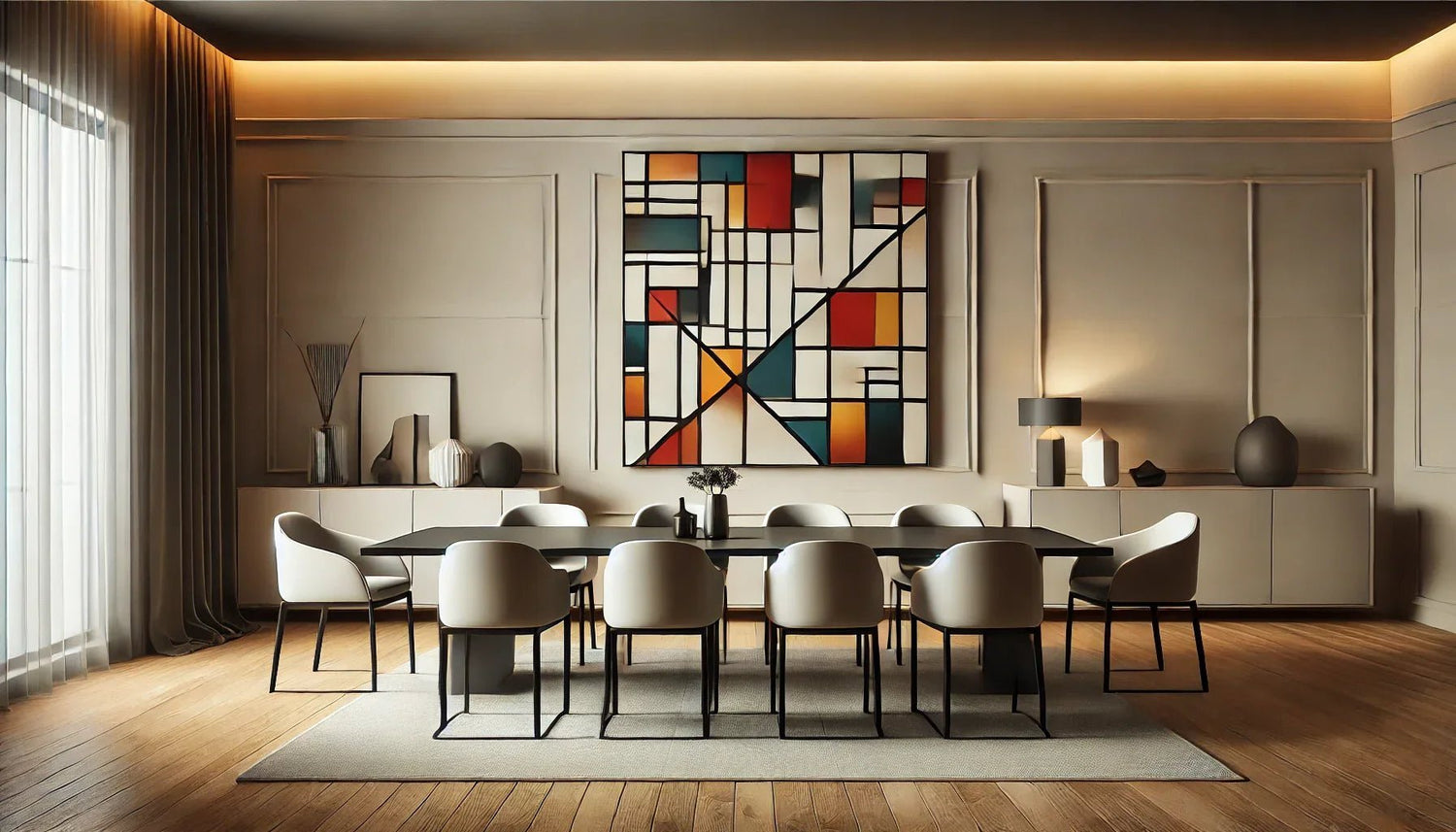
The combination of a cubist painting and a contemporary minimalist dining room may seem, at first glance, bold or even paradoxical. But it is precisely this striking contrast that offers a unique opportunity to create a living space rich in personality, sophistication, and character. Far from being a simple decorative element, a cubist painting becomes, in this context, a true statement of intent, a testament to an affirmed taste for art and originality. Imagine: the clean lines and flat surfaces of contemporary furniture, the subdued and neutral color palette, enhanced by the explosive burst of geometric shapes, multiple perspectives, and bold colors typical of Cubism. The result? A room that breathes creativity, elegance, and a strong personality.
A contemporary minimalist dining room is defined by its simplicity, clean lines, optimized functionality, and often neutral color palette. Minimalism, by essence, favors simplicity and the essential, creating a serene and soothing space. The introduction of a Cubist painting, with its vibrant geometric shapes, multiple perspectives, and bold colors, gently breaks this apparent harmony, injecting a dose of creative energy, a breath of life, and an unexpected touch of originality. It's no longer just a room to live in; it’s a space that tells a story, expresses a personal vision, and a unique artistic sensibility. The room becomes a place of dialogue between calm and stimulation, between simplicity and complexity, a harmonious fusion of opposites.
Why Choose a Cubist Painting for a Minimalist Dining Room?
Cubism, a revolutionary art movement from the early 20th century, has continued to inspire and fascinate. Its pioneers, Picasso and Braque, revolutionized the representation of the world, questioning traditional perspectives and exploring new dimensions of reality. Its influence can still be seen today in design and interior decoration. Integrating a Cubist painting into your contemporary minimalist dining room, is choosing:
- A captivating aesthetic dialogue: The contrast between minimalist simplicity and the geometric complexity of Cubism creates a fascinating visual dialogue. The purity of the room highlights the richness and depth of the painting, and vice versa. The artwork becomes the focal point, attracting the eye and stimulating the imagination. An invitation to contemplation: The multiple perspectives and games of shapes in Cubism invite contemplation, reflection, and discovery. Each glance at the painting reveals new details, new interpretations. It is a living, dynamic work that reveals itself with each observation. A unique masterpiece: An authentic cubist painting, or a quality reproduction, becomes a unique centerpiece, a focal point that attracts the eye and structures the space. It asserts its presence without overwhelming the room, thanks to the sobriety of the minimalist style surrounding it. A strong personal expression: Integrating a Cubist painting demonstrates a confirmed taste for art, boldness and originality. It expresses a strong personality and a particular artistic sensitivity, a desire to break away from tradition.
- Timeless added value: Cubism, a major artistic movement, retains timeless value. A Cubist painting is an investment that does not go out of style and can even increase in value over time. It is an artistic heritage and a unique piece that transcends trends.
Different Styles of Cubist Paintings for Your Dining Room
Cubism, although unified by fundamental principles, presents a great diversity of styles and expressions. Some works are dominated by warm, vibrant colors, while others feature cooler, monochromatic tones. Some emphasize the fragmentation of shapes, while others prefer a more synthetic approach. When choosing a Cubist painting for your dining room, consider the overall atmosphere you want to create. A colorful painting will bring a dynamic and energizing touch, while a more subdued and monochromatic work will create a calmer and more contemplative ambiance. The important thing is to find harmony between the painting and the entire decoration.
Integrating the Cubist Painting Harmoniously into Your Contemporary Dining Room
For perfect integration, a few key elements should be considered:
- Color harmony: Choose a Cubist painting whose colors dialogue with the color palette of your dining room. Neutral tones, pastels or complementary colors can create a subtle and elegant harmony. Avoid overly garish colors that could break the minimalist balance. The goal is to achieve a harmonious transition between the different elements of the room.
- Dimensions and format: The size of the painting should be proportional to the size of your dining room. A painting that is too small will get lost, while a painting that is too large will dominate the space unpleasantly. Also consider the format: a square, rectangular or panoramic painting will bring a different dynamic to the room. You need to find a visual balance that highlights the painting without making it intrusive.
- Strategic location: Choose a dominant wall, an empty wall or a wall located in front of a privileged viewpoint. Avoid placing the painting too close to other decorative elements so that it can breathe and assert itself fully. The chosen location will also determine how light interacts with the work.
- Appropriate lighting: Well-thought-out lighting is crucial to highlight the textures, play of light and details of the painting. Direct or indirect lighting, depending on the style of the painting and the room, can amplify its visual effect. Lighting can also modulate the ambiance and atmosphere of the room.
- Overall balance: Even if the cubist painting is a strong element, the overall balance of the dining room must be preserved. The entire decoration, from furniture to material choices, should contribute to creating an overall harmony, where the cubist painting finds its natural place. It's not just a juxtaposition, but a true harmonious integration.
Beyond Decoration: A Sensory Experience
Integrating a cubist painting into your contemporary minimalist dining room is not only a matter of decoration, it’s an invitation to a complete sensory experience. Geometric shapes, color games and multiple perspectives stimulate visual perception, creating a dynamic and captivating atmosphere. Reflection on the artwork itself can enrich the dining room experience, transforming it into a place of contemplation and discovery. Each meal then becomes an opportunity for dialogue with art, aesthetic appreciation and personal reflection. The painting becomes a true catalyst for experiences.
Conclusion: Dare to be Original and Enhance Your Space
In conclusion, integrating a cubism painting into a contemporary minimalist dining room is a bold and refined choice. This marriage of seemingly opposing styles allows you to create a unique space, rich in contrasts and personality. By taking into account the integration tips mentioned above, you will be able to enhance your space and affirm your taste for art and originality. Don't hesitate to dare this alliance full of promises to transform your dining room into an exceptional place, where artistic beauty meets the elegant simplicity of minimalism. The result will be a room that is both modern, sophisticated, and imbued with a unique personality, reflecting your taste for art and your sense of aesthetics. Dare the unexpected and let your creativity run wild!