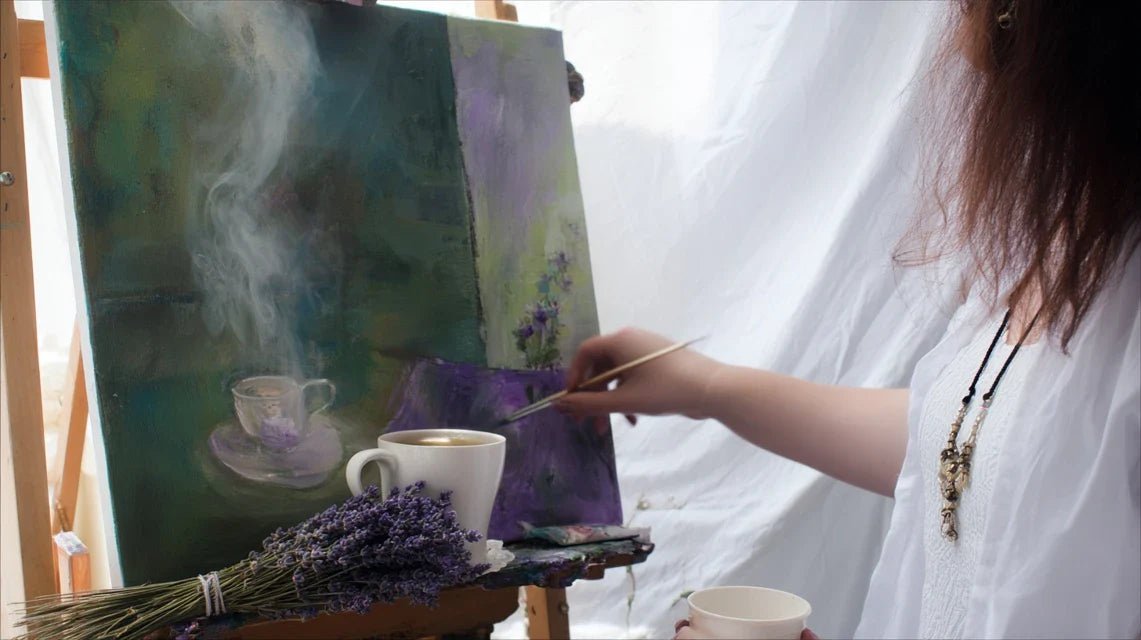
A painting inspired by a scent: tea, lavender, forest…
By Alexandre MARY
⏱️ Reading time : 8 minutes
You enter your living room, and something feels off. The space is impeccable, the furniture perfectly arranged, but this sense of incompleteness persists. As if your decor breathed halfway, deprived of that particular soul that makes a house a home.
No matter how many decorative objects you add, change the cushions, or adjust the lighting... Nothing works. Your interior remains frozen in a cold neutrality,
deprived of that emotional warmth that would make you smile with every glance.
You've tried the classic advice: harmonize colors, respect proportions, follow trends. But deep down,
you are looking for something deeper. A decor that tells your story, that awakens your senses beyond just sight.
It’s perfectly normal to feel this frustration. Traditional decoration only addresses the eye,
forgetting that our most intense memories are woven with smells and sensations. Your brain is craving complete sensory stimulation.
By the end of this article, you will discover how to create an olfactory artwork that transforms your space into a sensory sanctuary, where every glance awakens authentic emotions and precious memories.
Why does your decor leave you wanting more?
Your feeling of incompleteness is not an aesthetic whim. It's your limbic brain craving its dose of authentic emotions.
Imagine your living room as a musical score: you have the visual notes, but the olfactory melody that gives meaning to the whole is missing.
If you wait any longer, you will miss out on this sensory revolution that is already transforming the most inspiring interiors.
🎨 Customer testimonial: "I've long searched for what was missing from my office. Then I installed a painting inspired by the smell of freshly ground coffee. Now, every morning, this simple glance plunges me into that Parisian cafe atmosphere that I love. It’s as if my space has finally found its personality.”
💬 Conversation with a decor expert
"But a painting that evokes a smell, isn't that a bit strange? Will people understand?”
Think again! It’s exactly like when you look at a photo of your vacation and instantly feel the smell of the sea. Our brains naturally establish these sensory connections. An olfactory artwork is simply giving artistic form to this neurological magic.
“I've always been told that you have to stick with the classics so as not to get tired…”
That rule was from an era when decoration was frozen. Today, we are looking for spaces that evolve with our moods and memories. An olfactory artwork ages with you, becomes charged with personal history. It’s the opposite of boredom.
The golden rule of sensory decoration: A space that stimulates only one sense can create only a superficial emotion.
Like a perfume revealing its top, heart and base notes, your decor must unfold its sensory facets to touch your soul.
Count 3 weeks for your brain to fully integrate this new olfactory dimension.
Understanding what's really happening in your brain
You may feel that frustration when returning home after an intense day,
the impression that your decor doesn’t “carry” you emotionally,
or even this inexplicable desire to constantly change your decorative objects without ever being satisfied.
What's happening is that your limbic system - the emotional center of your brain - isn't receiving the stimuli it expects.
The problem isn’t your taste or budget. It’s that conventional decor ignores 80% of your sensory potential.
It's like trying to savor a dish with your eyes bandaged and your nose plugged.
You perceive the texture, but the experience remains incomplete, frustrating.
The first hidden cause: olfactory amnesia of our time
Contrary to what many think, our era has not enriched our sensory palette.
It has impoverished it. Our modern, aseptic and air-conditioned interiors cut us off from our natural olfactory references.
Imagine a chef gradually losing their sense of smell. They would continue to prepare beautiful dishes,
but something essential would be missing from their creations. That's exactly what happens to our decor.
This disconnection explains why you so often change your mind about your decorative purchases,
why some spaces instantly soothe you while others leave you indifferent.
Your approach will radically change when you integrate the olfactory dimension from the design stage.
🧠 Instant test: Close your eyes and think of your favorite vacation spot. Note that the smell comes before the image in your memory. Your brain naturally prioritizes olfaction to create emotion.
The second cause: the illusion of “neutral” decor
Most decor advice advocates neutrality as a guarantee of sophistication.
In reality, a neutral space is a space that communicates with none of your deep senses.
It's like wearing an
Observe your spontaneous reaction when entering a bakery or an antique bookstore.
You don't judge the smell, you inhabit it. It’s this same naturalness that you need to find in your home.
This fear keeps you in a "acceptable" but soulless decor,
which tells nothing of your personal story nor nourishes your daily well-being.
🎯 3 signs that your decoration lacks olfactory dimension:
You often change the layout without a precise reason: Your brain subconsciously seeks missing sensory stimulation, like rearranging an incomplete puzzle.
You feel more relaxed elsewhere than at home: This is a sign that your space does not nourish your limbic system, unlike certain places that awaken your senses.
Your guests find your interior "pretty" but nothing more: This polite reaction translates the absence of authentic emotion that a purely visual space cannot evoke.
The trigger element: olfactory memory as a guiding thread
The real secret lies in your personal olfactory library.
Each significant scent in your life is a powerful emotional lever, like a key that instantly opens secret chambers of your memory.
Identify your 3 most emotionally charged scents: this is your basic palette to create a painting that truly resembles you.
Fundamental rule: A successful olfactory painting evokes a scent without reproducing it.
It translates into shapes and colors the emotion that this scent gives you.
Test immediately: look at your current decoration and ask yourself what smell it spontaneously evokes.
❌ Classic decor
✅ Olfactory approach
💡 Mechanism
🎯 Felt benefit
I choose according to trends
I start from my olfactory memories
Direct connection to the limbic system
Authentic and lasting emotion
I harmonize colors with each other
I associate colors and olfactory sensations
Natural synesthesia of the brain
Global sensory coherence
I furnish to fill the space
I create to reveal an atmosphere
Evocation rather than accumulation
Calm and fulfillment
I seek general approval
I cultivate my sensory signature
Deep and assumed personalization
Confidence and well-being at home
The method to create your first olfactory painting
Rest assured, this approach is not complicated. Think of creating an olfactory painting as preparing a meal:
you start with simple ingredients (your memories), you transform them with technique (colors and shapes),
and you get a unique dish that nourishes your soul. In 3 progressive steps, you will discover deep creative satisfaction.
🗺️ Your Creation's Overview: Step 1 - Identify your signature scent (self-discovery satisfaction). Step 2 - Translate into visual language (pleasure of seeing an idea come to life). Step 3 - Materialize your vision (pride in accomplishment). Like a perfumer revealing their notes, you will reveal your sensory universe.
Step 1: Revealing Your Personal Olfactory Palette
It all begins with this sensory introspection, the true foundation of your project.
Like an architect studying the land before building, you must map out your olfactory universe.
This step will already provide you with immense satisfaction: that of reconnecting with your authentic emotions.
🛠️ Your Sensory Exploration Tools
A notebook dedicated to olfactory memories: A5 format with blank pages, no lines that would limit your creativity. It will capture your spontaneous associations of ideas. Avoid notebooks that are too small, which restrict expression. Find it at a stationery store or bookstore. Choose one with a cover that already inspires you.
Reference scent samples: Essential oils, spices, dried flowers - anything that awakens your memories. They act as emotional memory triggers. Prioritize organic quality to avoid synthetic notes that interfere with the exercise. The impact on your creativity will be immediate.
A temporary visual support: Large sheets of paper or cork boards for pinning your inspirations. This gives a physical dimension to your reflection, making the process more concrete and stimulating.
Let's move on to the exploration itself now
🔍 Revealing Your Signature Scents
Create your olfactory inventory: Settle comfortably and list 10 scents that immediately transport you. Let the memories come without filtering them, because your first intuition reveals your strongest emotional connections. Note the emotion associated with each scent (security, joy, nostalgia...). This mapping reveals your sensory DNA.
⏱️ Time: 30 minutes | ✅ Successful when: You have identified 3 scents that make you smile spontaneously | ⚠️ Attention: Don't look for "original" scents, prioritize those that truly touch you
Test your visual associations: For each scent selected, close your eyes and let the images, colors, textures come to mind. Your brain naturally makes these synesthetic bridges. Note everything: a dominant color, a recurring shape, a feeling of material. These spontaneous associations are your natural visual vocabulary.
⏱️ Time: 20 minutes | ✅ Successful when: Each scent clearly evokes 2-3 visual elements | ⚠️ Attention: Trust your first impression, don't rationalize
Prioritize based on your lifestyle: Among your favorite scents, identify the one that best matches the desired ambiance in your room. An energizing scent for an office, a soothing scent for a bedroom, a welcoming scent for a living room. This consistency between function and sensation guarantees the harmony of your space.
⏱️ Time: 15 minutes | ✅ Success when: A scent stands out naturally as evidence | ⚠️ Attention: Resist the temptation to mix everything, strength comes from consistency
✨ Validation of your choice: Your signature scent is found when its simple evocation makes you feel the desired emotion for your space. Test by closing your eyes: does the scent instantly transport you? If so, you have your guiding thread. If in doubt, let it rest for 24 hours and retest.
OUR RECOMMENDED PRODUCTS
Step 2: Translate your vision into artistic language
Now that you have your signature scent, you enter the most creative phase.
This is where your vision takes shape, where the abstract becomes concrete.
This step releases your natural creativity and will surprise you with its fluidity once the process is underway.
🎨 Your creative toolbox
Extended color palette: Gouache, acrylic or even wall paint samples. They translate the emotional intensity of your scent. Choose colors that "vibrate" with your feeling rather than neutral shades. Available in hardware and craft stores. The richness of color determines the final emotional impact.
Variety of textured supports: Grainy papers, canvases, mixed media to create reliefs. They add the tactile dimension that reinforces olfactory evocation. Explore different materials because each scent has a visual "skin". This sensory diversity amplifies evocative power.
Diversified creation tools: Brushes, knives, sponges, even your fingers. Each tool creates a different imprint that can better express your feeling. Alternate between precision and spontaneity according to what your emotion dictates.
🎯 Transform emotion into creation
Create your emotional color chart: Test different color combinations on small formats until you find the ones that faithfully reproduce your olfactory sensation. Trust your instinct: the right combination gives you the same emotion as the original scent. Keep all your attempts, they enrich your palette.
⏱️ Time: 45 minutes | ✅ Success when: A colorful harmony instantly evokes your scent | ⚠️ Attention: Do not copy real colors, translate the emotion
Experiment with evocative forms: Let your hand draw freely while thinking about your scent. Organic, geometric, abstract shapes - anything goes. Your natural gesture reveals the formal language of your emotion. Vary the rhythms: fast for energy, slow for contemplation.
⏱️ Time: 30 minutes | ✅ Success when: Some forms seem "right" to you spontaneously | ⚠️ Attention: Avoid literal representation, seek the essence
Compose your final mockup: Assemble colors and shapes on a reduced format to test the overall effect. This step reveals the general balance and allows for adjustments. Check that the work works from a distance (impact) and up close (details). The global harmony must serve the olfactory evocation.
⏱️ Time: 40 minutes | ✅ Success when: The mockup evokes your scent even without thinking about it | ⚠️ Attention: Resist overload, strength comes from synthesis
🎨 Artistic Validation: Your mockup is ready when it works independently of your explanation. Show it to a friend without context: do they feel a particular atmosphere? The goal isn't for them to guess the scent, but to perceive a consistent emotion. If so, your visual translation is successful.
Step 3: Materialize your definitive work
You are now on the threshold of materialization. This step transforms your vision into a durable work of art that will inhabit your daily life.
This is the most rewarding moment: to see this unique piece come to life under your hands, bearing your olfactory signature.
You will discover a particular pride, that of creating something that existed nowhere else.
🛠️ Professional finishing materials
Quality definitive support: Canvas stretched on frame or rigid panel, dimensions adapted to your space. It guarantees the durability and presence of your work. Invest in a noble support because it determines longevity and visual impact. Avoid supports that are too thin which tarnish the effect. Available in art stores or by order.
Durable artistic mediums: Artist-quality acrylic paints, resistant to light. They preserve the intense color over time. Choose recognized brands for their durability. Savings on quality pay off with premature degradation. The initial investment guarantees years of visual pleasure.
Finishing tools: Protective varnish, hanging system adapted to the weight. They ensure the conservation and safe installation. A beautiful painting poorly protected or hung loses all its impact. This professional finish enhances your creation.
🎯 Creation of your final work
Prepare your creative space: Set up in a bright and airy location, with enough space to step back and judge the effect. Creating an olfactory painting requires this critical distance to verify the emotional impact. Prepare your tools and materials within reach to maintain creative flow.
⏱️ Time: 20 minutes | ✅ Success when: Your space inspires creativity and serenity | ⚠️ Attention: Avoid distractions, this moment requires concentration
Create your painting in stages: Start with the large colored areas then gradually refine the details. This approach respects perceptual logic: overall impact first, nuances later. Regularly check the olfactory evocation by stepping back. Adjust until you find the emotion of your signature scent.
⏱️ Time: 2-3 hours | ✅ Success when: The painting evokes your scent even in progress | ⚠️ Attention: Respect drying times between layers
Finalize and protect your creation: Apply the protective varnish according to the manufacturer's instructions. This crucial step ensures the longevity of your work. Install the appropriate hanging system for the weight and wall support. Careful installation highlights your work and ensures safety.
⏱️ Time: 1 hour | ✅ Success when: Your painting is ready to be hung safely | ⚠️ Attention: Respect complete drying time before hanging
🏆 Final validation: Your olfactory painting is successful when it works at three levels: immediate visual impact, spontaneous olfactory evocation, consistency with your space. Test it installed in its final environment. If it positively transforms the atmosphere of your room, you have succeeded in creating a unique sensory creation.
🎯 Creative progression rule: Move forward when each step gives you satisfaction and curiosity for the next.
The objective criteria are: clarity of evocation (you feel the scent), quality of execution (technique mastered), environmental impact (positive transformation of space).
Cultivate patience in execution and boldness in expression.
Congratulations! You now master the fundamentals of olfactory creation.
Here are some expert subtleties that will make a difference and give you that creative confidence immediately recognized by connoisseurs.
🎨 Master's secret: Integrate a "surprise" color in small quantity - a touch of unexpected color that awakens attention without destabilizing the harmony. This technique, used by perfumers for their top notes, creates that little shiver that makes your painting unforgettable. Test on a maximum of 2-3% of the total surface.
💭 Frequent question from our creators
"I'm afraid my painting will be too personal and that no one else will understand..."
This concern is very natural and reveals your artistic sensitivity. But you are mistaken: the most personal art is often the most universal.
Your authentic emotion, translated with sincerity, touches others even if they don't guess the source of the scent. A successful olfactory painting creates an atmosphere that each person feels in their own way.
Keep your creative secret: it will give your work that mysterious depth that guests will feel without being able to explain it.
💡 Validation test: Observe the spontaneous reactions of your visitors to your painting. If they stop for a moment, look more closely, or positively comment on the atmosphere, your creation works perfectly. Emotion passes, even without explanation.
⚠️ Avoid these pitfalls that ruin the olfactory effect
Some mistakes can compromise all your work. I share with you these common pitfalls to avoid the frustrations that I have observed in many beginner creators.
🚫 Trying to reproduce the smell literally: Many try to paint lavender with purple or a forest with green. This is natural but counterproductive. The goal is to translate the emotion, not the appearance. Your brain will establish the olfactory connection through emotion, not through realistic color. Trust your spontaneous colored feeling.
🚫 Overloading out of fear of emptiness: The anxiety of "not enough" leads to multiplying the elements. Result: visual confusion and loss of olfactory impact. Like a perfume that is too complex, an overloaded painting no longer says anything. Prefer three strong elements to ten weak elements. Strength comes from synthesis, not accumulation.
🚫 Ignoring the destination lighting: Creating under different lighting than your wall completely falsifies the colors. Your painting may appear dull or garish once installed. Regularly test your work under the definitive lighting. This verification avoids disappointments and guarantees the desired impact.
🚫 Choosing a "trendy" scent rather than a personal one: Some select a scent because it seems sophisticated or fashionable. But if it doesn't genuinely move you, it is impossible to translate it with sincerity. Your creation will lack soul and you will quickly get tired of it. Always prioritize personal emotion over the supposed effect.
🚫 Neglecting size in relation to space: A small painting on a large wall or vice versa creates an imbalance that neutralizes the olfactory impact. Your work must have sufficient "presence" to transform the atmosphere. Respect the proportion: 1/3 of the width of the wall for optimal impact. This rule guarantees visual accuracy.
🔍 Error-checking system: Check these 4 points before finalizing: 1) Does your painting spontaneously evoke your scent? 2) Do the colors work under the definitive lighting? 3) Does the whole remain harmonious when viewed from afar? 4) Does it provide you with the same emotion as the source scent? Warning signs: emotional indifference, constant need for retouching, complicated justifications of your choices.
Because you took the time to inform yourself, enjoy 10% discount on your first order:
ART10
⏰ Valid 72h after reading • Applicable to all our products
🙋 Your most frequently asked questions about olfactory paintings
🕐 How long does it take to create your first olfactory painting?
Allow a full day for a motivated beginner: 2h of olfactory exploration, 3h of visual translation, 4h of creation. But spread over several days to allow your ideas to mature between stages. Creation improves with reflection time. Optimize by preparing all your materials in advance. A weekend is more than enough for your first accomplished work.
💰 What budget should you plan to get started?
Between €50 and €120 depending on the quality chosen. Prioritize investment in the support (€30) and basic colors (€40). Save on fancy tools but never on durability. This budget covers 3-4 creations with the same materials. Consider this investment against the price of an equivalent unique work in a gallery: your return on investment is immediate.
🎨 Do you need to know how to draw to succeed?
Absolutely not! Technique is less important than emotion. Some of my most talented creators had never held a paintbrush. Your olfactory sensitivity is your true asset. Spontaneity often produces more touching results than perfect technique. Start with simple shapes and bold colors. Your personal style will emerge naturally.
🏠 How to choose the ideal location?
Prioritize a wall that you see frequently but without competing visual clutter. The ideal: facing your favorite relaxation position (sofa, desk, bed). Avoid passageways where people don't stop. Check natural and artificial lighting at different times. Test with a cardboard of the same size before final installation. Location determines 50% of your creation's success.
🔄 Can the technique be adapted to other senses?
Excellent expert question! Yes, synesthesia applies to all senses. You can create "sound" artworks (translating a piece of music), "tactile" (evoking a texture), or even "gustatory" (inspired by a flavor). The principle remains the same: identify the source emotion, translate it into visual language, materialize consistently. This approach opens up an infinite creative universe adapted to your dominant sensitivity.
🌟 Your transformation into a sensory creator
In a few weeks, you will look at your olfactory painting and smile.
Not only because it transforms your space, but because it reveals a creative facet of yourself that you never imagined.
Your guests will notice this particular atmosphere without being able to explain it. They will compliment you on this "so personal ambiance" that makes your interior unique.
Your confidence in your artistic taste will naturally grow.
This experience goes far beyond simple decoration. You will have developed your sensory intelligence,
this ability to perceive subtle connections between emotions and environment.
This sensitivity will enrich your daily life well beyond your interior.
You will notice atmospheric details that you were missing, appreciate places you visit differently.
Understanding was indeed the most delicate step. Now that you master the principles,
just start: choose tonight your first signature scent.
Close your eyes, breathe deeply, and let the sweetest memory come to mind.
This scent will be the starting point of your first sensory creation.
🎯 Your first step towards olfactory art: You already carry within you all the sensitivity necessary.
Your personal olfactory library is unique in the world.
In a few days, you will contemplate your first work with that particular pride: that of having created something that existed nowhere else.
🔍 Deepen your creative practice
Discover other techniques of decorative synesthesia, explore the links between colors and emotions,
or learn to create multi-sensory atmospheres. Our blog is full of inspirations to develop your unique creative universe.