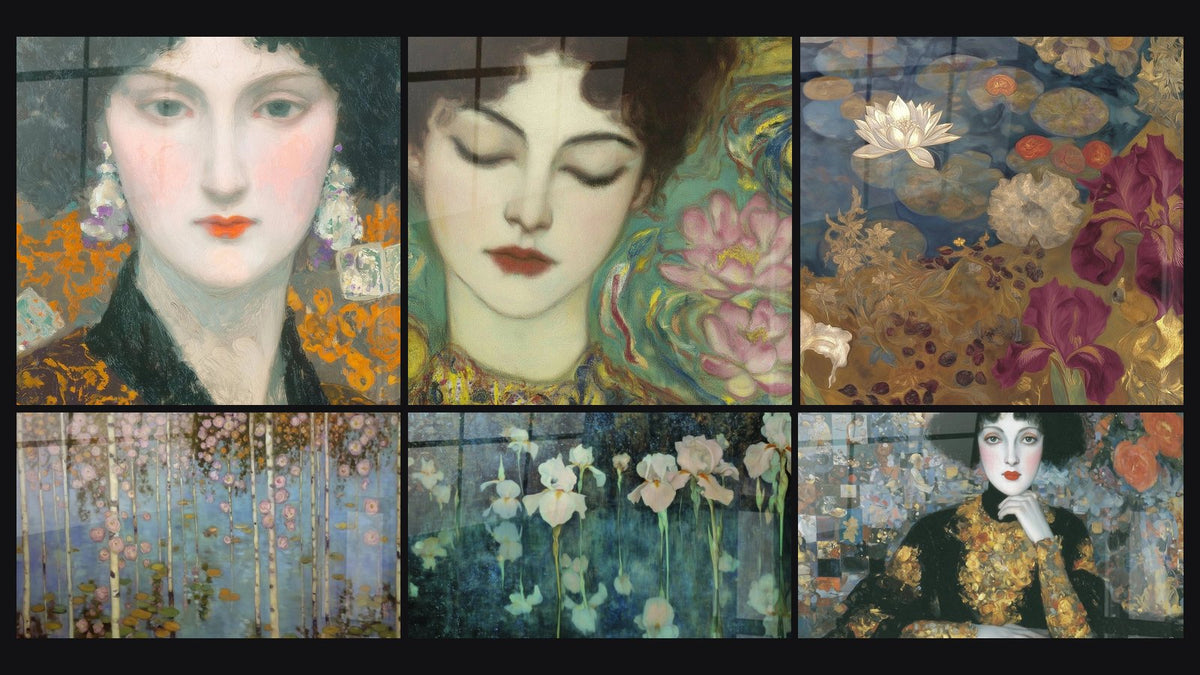
Coded Message Artworks: Decipher Symbolic Wall Art
October 11, 2025 · 17 min read · by Walensky
This feeling of looking without really seeing gnaws at you. You observe the shapes, the colors, the meticulous details, but the hidden message remains inaccessible. You wonder if this work really holds secrets or if it's just your imagination running wild.
You’ve probably already tried to intuitively decipher the visual elements, searched for generic explanations on the internet, or even asked friends their interpretation. But these superficial approaches have led you nowhere, leaving this thirst for understanding unfulfilled.
This is perfectly normal! The problem isn't your analytical ability, but the lack of a structured method to decode symbolic art. Works with coded messages obey precise rules, visual codes that artists have mastered for centuries.
By the end of this article, you will possess the keys to deciphering the hidden symbols in your wall art and transform every glance into a true initiatory journey into the artist's secret universe.
Why does symbolic art fascinate so much these days?
In our hyper-connected world where everything seems transparent, art with coded messages responds to a deep need for mystery and personal discovery. It's like possessing a treasure of which you are the only holder of the map: each deciphered symbol becomes an intimate victory, a privileged connection with the work.
Waiting is risking letting these visual treasures lose their evocative power. Imagine a collector accumulating rare books without ever reading them: undecoded symbolic art remains a simple decoration, deprived of its spiritual and emotional dimension.
🎨 Testimony from an enlightened enthusiast: "I lived with a reproduction of Dürer's 'Melancholia' for three years without understanding why it obsessed me. The day I discovered that the polyhedron represented the imperfection of human knowledge and the scattered tools symbolized the abandonment of earthly activities, the work literally came to life. Every morning, my gaze met that of this thoughtful figure with a new complicity."
Conversation with a decor expert
The golden rule of symbolic decoding: Each visual element is a word in a coherent language. Once you know the basic vocabulary, you can read the work like an open book and discover unsuspected dimensions in just a few minutes of attentive observation.

Finally understand what's behind your frustration
Do you recognize yourself in these situations? You stare at a work hoping it will "speak" to you spontaneously, you search for generic explanations that don't match your specific piece, or you feel uneasy about certain symbols without understanding why. These reactions reveal that your artistic instinct is working perfectly, but it just lacks the appropriate reading grid.
What actually happens is that your brain picks up on symbolic signals without being able to process them consciously. It's like hearing a conversation in a foreign language: you perceive the emotion, the intention, but the precise meaning escapes you. The problem isn't your sensitivity, but the lack of a decoder.
Imagine trying to understand a musical score without knowing the notes: you feel the melody, but you can't reproduce or analyze it. Symbolic art works exactly this way: once you know the "solfège" of symbols, everything becomes clear.
The real reason for your blockage: you are looking for modern in old
Here's the paradox: we approach symbolic art with our contemporary mindset, whereas these works were created according to totally different cultural and spiritual codes. It’s like trying to understand a text message in hieroglyphs!
Think of a GPS that would try to guide you with a map from the Middle Ages: even if the roads still exist, the reference system has changed. Medieval or Renaissance symbols obey a spiritual, alchemical or mythological logic that has nothing to do with our current references.
This revelation changes everything in your approach: instead of projecting your personal associations, you will learn to think like the artist of the time. This is what transforms a frustrating observation into a fascinating discovery.
🔍 Immediate verification test: Look at a symbolic work and note your first emotional reaction. Now, ignore your modern interpretation and ask yourself: "What did this symbol represent to a 16th century man?" You have just taken the first step towards authentic decoding.
The illusion of complexity: why everything seems incomprehensibleWe have been conditioned to believe that symbolic art is reserved for scholars, when in reality, these works were intended to be understood by their contemporaries, including the less literate. Symbols served as a "picture book" to convey universal messages.
It's like looking at a Japanese road sign: if you don't know the codes, it seems impenetrable, but each symbol has a precise and logical meaning. Symbolic art follows the same rules: once you master the code, reading becomes fluid.
This false complexity deprives you of deeper aesthetic pleasures and prevents you from experiencing the emotional richness that the artist wanted to share. It's like watching a movie without sound: you see the images, but you miss the story.
The trap of free interpretation: when your creativity lets you down
Paradoxically, our era values free interpretation so much that we forget that some symbols had codified meanings. It's like wanting to reinvent the alphabet: creative, but not very effective for communication!
You can see this in your own home: faced with a symbolic work, you instinctively look for what it inspires you personally, rather than what it was supposed to convey. This reflex, although natural, distances you from the true message of the artist.
This approach leads to a subtle frustration: you feel that there is something to discover, but your personal interpretations do not provide the satisfaction of true understanding. It's like trying to solve a puzzle by inventing your own rules.
The 3 signals that reveal a successful symbolic reading:
- The immediate "click" effect: When you understand a symbol, the entire work suddenly makes sense, like the pieces of a puzzle fitting together perfectly.
- Authentic emotional resonance: You feel the emotion that the artist wanted to convey, not the one you project onto the artwork through personal association.
- The multiplication of discoveries: Once the first symbol is decoded, you begin to spot others in the same work, creating a domino effect of understanding.
The trigger element: the contextual reading grid
What really makes the difference is your ability to place yourself in the historical and cultural context of the work. It's like changing glasses: suddenly, everything becomes clear. This contextual reading grid acts as a comprehension multiplier that transforms your gaze.
You can identify this in your own experience: the works that touch you most are often those whose history, era, and intentions of the artist you know. It's not a coincidence, it’s the universal key to symbolic decoding.
The rule of context first: Before attempting to interpret a symbol, ask yourself in what historical, religious or cultural context the artist was working. This information will give you 80% of the understanding in seconds.
| Modern intuitive approach | Authentic symbolic decoding | Why this changes everything | Concrete result |
|---|---|---|---|
| "This skull makes me think of death" | "This skull represents earthly vanity" | Coded meaning vs personal impression | Understanding the artist's spiritual message |
| "These scales evoke justice" | "These scales symbolize divine judgment" | Specific cultural reference vs general association | Access to the metaphysical level of the work |
| "These fruits are decorative" | "These fruits represent temptations" | Symbolic function vs aesthetic perception | Revelation of the hidden moral narrative |
| "This light creates an atmosphere" | "This light represents divine revelation" | Pictorial technique vs spiritual symbol | Sacred dimension of the visual experience |

The progressive method to become a decoder of symbolic art
Rassurez-vous : Decoding symbolic art is more accessible than learning to drive. Like driving, it takes mastering some basic rules, then practicing regularly to develop your automatisms. In three logical steps - observation, contextualization, interpretation - you will go from the status of passive spectator to that of an initiated reader.
🗺️ Overview of your progress: First, you will learn to observe methodically (the details speak), then to place the work in its time (the context reveals), finally to interpret the symbols according to their authentic meaning (the message is revealed). Each step reinforces the next and brings you closer to that unique satisfaction that is true understanding.
Step 1: Master the art of systematic observation
Starting with observation is like learning the alphabet before reading: fundamental but rewarding. This step will allow you to identify significant elements that your eye usually neglects, creating those famous "clicks" where you will exclaim "I never noticed that!"
Your enhanced observation tools
- Adjustable directional lighting: Prioritize an articulated arm lamp that reveals reliefs and textures. Side lighting brings out details invisible in front light, just as restorers examine works of art. Avoid indirect lighting which "flattens" volumes and masks subtleties.
- High-quality optical magnifying glass: Choose a x3 to x5 magnification with an anti-reflective treated lens. You will discover intentional micro-details: facial expressions, miniature objects, hidden inscriptions. The effect on your understanding is spectacular.
- A dedicated observation notebook: Document your discoveries with simple sketches and notes. This practice activates your visual memory and creates a "personal dictionary" of symbols that can be reused for other works.
Your foolproof observation protocol
Scanning by geometric zones: Mentally divide the work into nine areas (like tic-tac-toe) and examine each methodically. This technique prevents your eye from focusing only on the central subject and reveals peripheral details often carrying meaning.
⏱️ Time: 10 minutes | ✅ Successful when: You have noted 3 new elements per zone | ⚠️ Attention: Do not rush into interpretation - remain in a pure "inventory" mode.
Listing of "anachronistic" objects: List all objects that seem out of place, disproportionate or unexpected in the context. These elements are often the most symbolic because they deliberately break natural plausibility to attract attention.
⏱️ Time: 5 minutes | ✅ Successful when: You have identified 2-3 "strange" elements | ⚠️ Attention: A detail may seem bizarre due to lack of familiarity with the period, not necessarily by symbolic intention.
Analysis of gazes and gestures: Mentally trace the lines of sight of the characters and note their gestures. Artists used these elements to guide your attention towards important symbols or create "visual dialogues" between the elements.
⏱️ Time: 8 minutes | ✅ Successful when: You can draw the work's "visual path" | ⚠️ Attention: Distinguish "narrative" gazes (towards another character) from "symbolic" gazes (towards a significant object).
✅ Validation of your observation: You master this step when you can describe the work to someone who doesn't know it by mentioning details they wouldn't have noticed at first glance. If you get stuck, that's normal - start again with different lighting, the details will appear gradually.
— Our selection


OUR RECOMMENDED PRODUCTS
Step 2: Place the work in its cultural universe
You are now moving to the next level: contextualization. This is where your understanding multiplies because you stop looking with today's eyes and adopt the perspective of the time. This step is particularly rewarding as it reveals the deep logic of the work.
Your contextualization resources
- Historical atlas of art: Invest in a recent book that places each artistic movement in its political, religious and social context. Understanding the events contemporary to the artist illuminates his symbolic choices spectacularly.
- Specialized symbol dictionary: Choose a reference that distinguishes meanings by era and culture (the same symbol can have opposite meanings depending on the context). This precision avoids misinterpretations.
- Documented artist biographies: Knowing the life, influences, and patrons of the artist reveals their hidden intentions. Personal or social constraints often explain coded messages.
Your effective contextualization method
Research on the creation period: Identify historical events, dominant beliefs, and contemporary social codes of the work. This contextual information transforms your reading by revealing the implicit references that the artist shared with their audience.
⏱️ Time: 15 minutes | ✅ Successful when: You can explain why a particular symbol was relevant at that time | ⚠️ Attention: Be wary of modern interpretations imposed on ancient works.
Research the patron and destination: Discover who commissioned the work and where it was intended to be exhibited. A religious, private, or public work does not use the same symbolic codes and is not aimed at the same audience.
⏱️ Time: 10 minutes | ✅ Successful when: You understand the artist's constraints and freedoms | ⚠️ Attention: The patron sometimes influences the message more than the artist's personal convictions.
Step 3: Decode symbols according to their authentic meaning
You are now reaching the level of true mastery: authentic symbolic interpretation. The difference between an amateur and a connoisseur lies in this ability to read symbols according to their meaning at the time, not according to our contemporary associations. You will finally access this secret dialogue between the artist and you.
Your advanced interpretation keys
- Iconographic repertoire by theme: Build a library of symbols classified by domain (religious, mythological, alchemical, philosophical). This organization allows you to quickly find the authentic meaning of a symbol according to its context of use.
- Cross-referenced symbolic correspondences: Learn to recognize how symbols reinforce each other in the same work. This "network" reading reveals levels of meaning that isolated analysis cannot discover.
- Custom decoding grid: Create your own rating system to prioritize the importance of symbols in a work. This method avoids getting lost in secondary details and maintains the consistency of your interpretation.
Your professional decoding technique
Identifying primary symbols: First, identify the most obvious symbolic elements (crosses, scales, skulls, open books...) and verify their authentic meaning within the context of the work. These "main" symbols set the overall tone of the message.
⏱️ Time: 12 minutes | ✅ Success when: You have identified the central theme of the work | ⚠️ Attention: The same symbol can have opposite meanings depending on the religious or secular context.
Decoding secondary symbols: Analyze the less obvious elements that clarify, nuance, or enrich the main message. These details often reveal the artist's intellectual sophistication and the richness of their statement.
⏱️ Time: 20 minutes | ✅ Success when: You perceive the subtleties of the artistic discourse | ⚠️ Attention: Avoid over-interpreting: not all details are necessarily symbolic.
Synthesizing the global message: Reconstruct the complete message by articulating all symbolic elements according to their hierarchy of importance. This step reveals the intellectual coherence of the work and your mastery of decoding.
⏱️ Time: 10 minutes | ✅ Success when: You can summarize the message in a clear sentence | ⚠️ Attention: Your interpretation must be consistent with the historical and cultural context of the time.
The rule of mastered progression: You can move on to the next step when you spontaneously understand 70% of the symbols in a work of equivalent difficulty. Cultivate patience: symbolic mastery develops through accumulation of experiences, not by haste.
Congratulations! You now have the fundamentals of symbolic decoding. This mastery gives you a considerable advantage: you can appreciate art at a level that most museum visitors never reach. Here are some expert subtleties that will transform your gaze into true expertise.
🎯 Expert tip: Systematically search for the artist's "symbolic signatures" - these recurring elements that betray their personal obsessions beyond commission constraints. Van Eyck often hides revealing mirrors, Bosch multiplies hybrid creatures, Arcimboldo plays with vegetal trompe-l'œil. This signature allows you to mentally authenticate a work and anticipate its hidden messages.
Frequent question from enlightened amateur
"How can I be sure that I am not over-interpreting the symbols? Sometimes I feel like I see messages everywhere..."
Your caution is excellent! This concern proves that you are developing a refined critical sense. The trap of over-interpretation does indeed await enthusiastic beginners. The golden rule: an authentic symbol must be consistent with the era, culture, and other elements of the work. If your interpretation seems forced or anachronistic, it's probably a modern projection. Trust your instinct: true symbols create retrospective evidence, not a laborious intellectual construction.
✅ Validation technique: Verify your interpretation by searching for contemporary works using the same symbol in a similar way. This convergence confirms the authenticity of your reading and enriches your symbolic culture.
— You may also like


Avoid these mistakes that sabotage your understanding
Be careful, some common errors can compromise your progress and make you lose confidence in your analytical abilities. I will alert you to these classic traps to avoid unnecessary frustrations and accelerate your learning.
- 🚫 Projecting your personal references: It is tempting to interpret a symbol according to your current culture, but it is the most common mistake. A snake in a medieval work represents evil, not modern medicine! Always check the meaning of the time before analyzing. This error is so common that it has a name: "interpretive anachronism".
- 🚫 Searching for messages in every detail: Not all elements of a work are symbolic. Sometimes, a landscape is just decorative, a drapery serves only to balance the composition. Focus on the elements that "disrupt" the natural logic of representation.
- 🚫 Ignoring the context of commission: A work intended for a church does not use the same codes as a private or royal commission. The commissioner profoundly influences the message, sometimes more than the artist's personal convictions. Always inquire about the circumstances of creation.
- 🚫 Mixing symbolic cultures: Eastern, Western, Christian, or pagan symbols do not have the same meanings. A lotus in Asian art and in Western medieval art does not tell the same story. Respect the cultural boundaries of your interpretations.
- 🚫 Neglecting the historical evolution of symbols: The meaning of a symbol can change over the centuries. The Renaissance meaning is not necessarily the same as that of the Middle Ages. Precisely date your reading grid to avoid chronological misinterpretations.
🔒 Anti-error verification system: Before validating an interpretation, check that it corresponds to the period of the work, that it harmonizes with the other symbols present, that it respects the context of commission, and that it does not contradict established historical knowledge. If you have any doubts, consult several specialized sources.
— In the same vein


Frequently asked questions
Allow 3 to 6 months of regular practice to acquire a satisfactory ease, at a rate of 2-3 works analyzed per week. No prior training is necessary: the method is based on observation and documentation, not technical knowledge. Start with simple works (portraits, still lifes) before tackling complex compositions with multiple characters.
No! A medium-quality reproduction is sufficient for 90% of your learning. Prioritize high resolution on screen or art books with large illustrations. Reserve the investment in premium reproductions for your favorite works, once you master the basics. The essential thing is the accuracy of the details, not the quality of the materials.
A true symbol creates a "visual tension": it attracts the eye by its position, disproportionate size, unexpected character or repetition. Purely decorative elements integrate harmoniously without creating questioning. Trust your instinct: if a detail intrigues you, it is probably intentional. With experience, this distinction becomes automatic.
Absolutely! Religious art uses codified iconographic codes (saints recognizable by their attributes, standardized biblical scenes) while secular art allows more creative freedom and personal messages. Start with religious art because the symbols are better documented and stable there, then move on to secular art which requires more contextual intuition.
Prioritize specialized iconographic dictionaries by period (Réau for Christian art, Charbonneau-Lassay for symbols), monographs of artists by recognized historians, and exhibition catalogs from prestigious museums. Avoid "general public" books that oversimplify. Online resources from museums (Louvre, Met, National Gallery) offer free detailed analyses of excellent quality.
Your new life as an enlightened art enthusiast
In a few months, you'll be strolling through museums with a completely transformed gaze. Where other visitors see "pretty paintings," you’ll discover complex narratives, philosophical messages, and exciting intellectual challenges. Your living room itself will become a place of active contemplation where each artwork will tell you its secret story.
This mastery of symbolic decoding goes far beyond simple artistic culture: it develops your visual analysis ability, your attention to detail, your contemplative patience and your intellectual curiosity. These skills will enrich all aspects of your life, from everyday aesthetic appreciation to professional visual communication.
The best part? You've just crossed the most difficult step: understanding the mechanism. Now, it’s simply a matter of practicing regularly with the works around you. Start today by looking differently at that painting that has been questioning you for so long. You will be surprised by what it reveals to you!
✨ Your next challenge: Choose a work in your environment and apply the three-step method. In 30 minutes, you’ll discover aspects you never suspected. This first success will give you confidence to explore more complex works and develop your unique expertise.
Also read: 🔍 Read more articles on artistic symbolism
</div
More selected pieces
Aquatic Garden Solitary Blooms Painting - Symbolist Edition
233,90€
Discover this artwork →Explore our collections