The first time I laid eyes on a Jonone piece in a warehouse in the 13th arrondissement of Paris, I felt that particular electricity. The owner of the premises, a young entrepreneur, had invested €2,800 in this canvas before the artist exploded. Today, that same work is worth more than €15,000. This scene repeats every week in my gallery: collectors who knew how to spot emerging talent at the right time, turning their intuition into a shrewd investment.
Here's what an emerging artist’s street art brings to your interior: a unique piece that tells the story of an urban scene in full effervescence, a potential investment whose value can significantly increase, and that singular pride of supporting a creator before international recognition.
But faced with galleries, online platforms, and prices ranging from €300 to €8,000 for an emerging artist, how do you know if you are investing wisely? How do you distinguish authentic talent from fleeting trends? This uncertainty holds back many enthusiasts who dream of decorating their space with an original work without making a mistake.
Good news: the street art market has become more structured in recent years. The codes are now clear, price ranges established, and with the right references, you can acquire a remarkable piece that will enhance your interior for years to come. I'm going to share with you the keys I use daily to assess the necessary budget and make the right choices.
Realistic ranges for an authentic emerging artist
Let’s talk about concrete figures. An street art original artwork by an emerging artist generally ranges between €800 and €4,500 according to several determining criteria. This range corresponds to creators who have already exhibited in recognized galleries, possess a defined visual identity, and are beginning to develop a community of collectors.
For a canvas of 80x60 cm, count around €1,200 to €2,000. Medium formats of 100x80 cm range more between €1,800 and €3,200. Beyond 120x100 cm, you enter the category of master pieces that can reach €4,500 to €6,000 for a particularly promising emerging artist.
I accompanied a novice collector who was hesitating between a numbered serigraph at €450 and an original canvas at €1,600. He chose the canvas. Three years later, the artist was selected for the Lyon Biennale, and his piece was valued at €4,200. The serigraph, on the other hand, was still worth €500. The original makes all the difference.
Variations according to the technique used
The technique used significantly influences the price of a wall art. A work in spray and acrylic requires hours of work and technical mastery that justify a higher price, generally between €2,000 and €4,000 for a medium format. Mixed creations incorporating collages, stencils and paint are in a similar range.
Pieces made only with posca marker or aerosol spray on stretched canvas are more accessible, with a budget between €800 and €1,800. However, be careful: a low price does not necessarily mean a good deal. I have seen too many collectors disappointed by works costing €300 whose quality deteriorated in a few months.
How to recognize an emerging artist who is worth the investment
A true emerging street art artist can be distinguished by several objective signals. First, check their exhibition history. Have they been selected for recognized galleries, even modest ones? Do they participate in festivals such as the Kolorz Festival or the Quai des Arts? These professional validations guarantee a certain level.
Next, examine their signature style. An artist who deserves your investment has an immediately recognizable visual identity. You should be able to identify their works without seeing their signature. This consistency is evidence of a mature artistic approach, not just a passing experiment.
The digital presence also counts. A serious emerging artist maintains an active community, documents their creative process and dialogues with their collectors. But beware of false signals: 50,000 purchased followers are worth nothing compared to 2,000 engaged followers who regularly comment and share.
The documents that protect your purchase
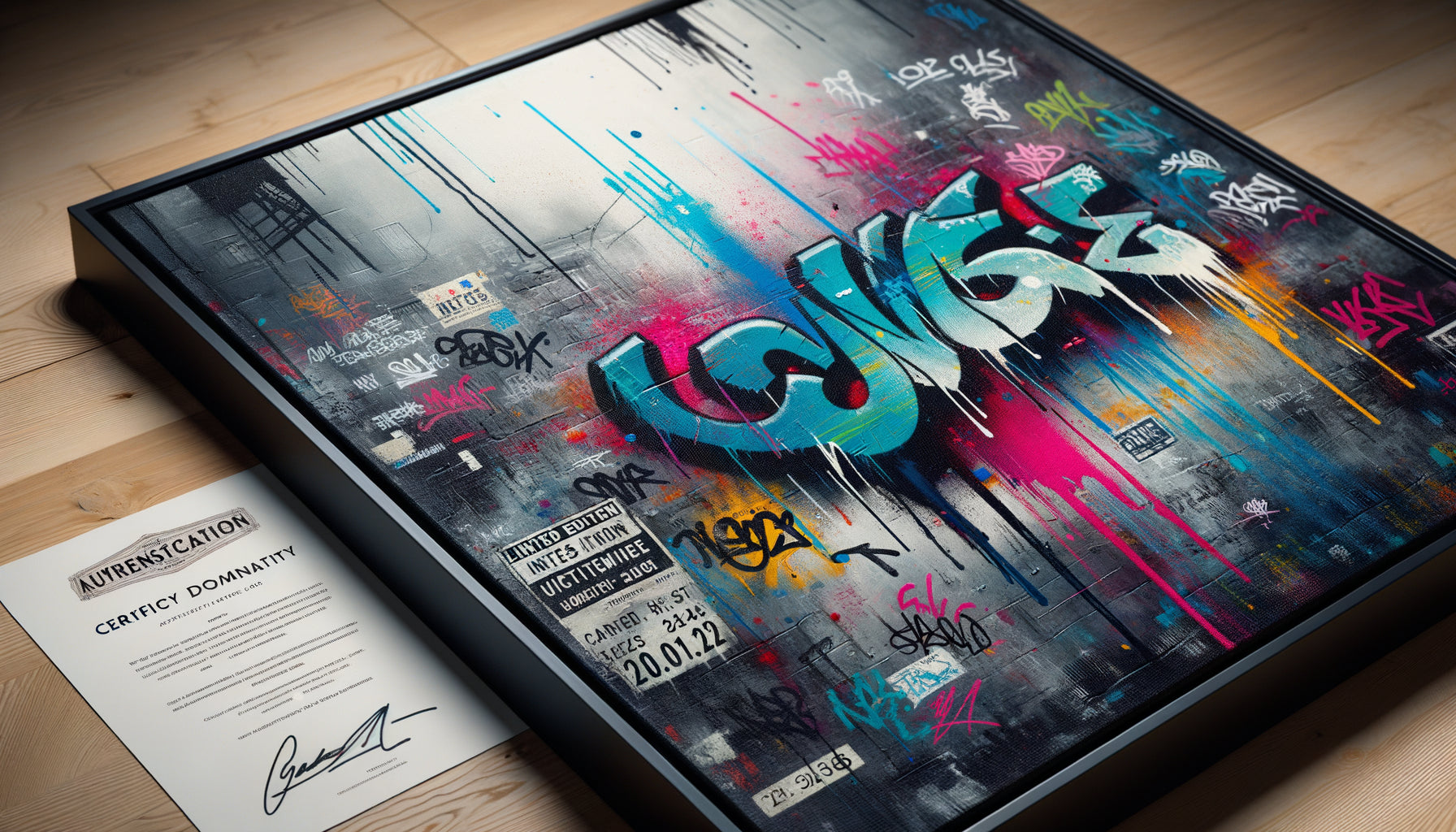
Never pay for a wall art without its certificate of authenticity. This document, signed by the artist, proves the originality of the piece and greatly facilitates a future resale. It should mention the exact dimensions, year of creation, technique used and ideally a photograph of the work.
Also request a detailed invoice mentioning the artist, the title of the work and its description. This justification secures your investment and will be essential for any subsequent estimate or insurance declaration.

Budget to consider beyond the purchase price
Acquiring the street art painting is only the beginning of your investment. To durably protect your artwork, budget between €150 and €400 for framing depending on the format. A frame with anti-UV glass protects the pigments from discoloration, crucial for spray paints particularly sensitive to light.
If you buy from a physical gallery, anticipate shipping costs: between €80 and €200 depending on the distance and dimensions. Fragile works require professional packaging and sometimes additional transport insurance.
For savvy collectors who consider their acquisition as an investment, artwork insurance costs approximately 0.5% to 1% annually. For a painting worth €2,000, count between €10 and €20 per year, a negligible expense compared to the protection offered.
Where to buy to optimize your budget
Physical galleries generally apply a margin of 40% to 60% on emerging artists. A painting sold for €2,000 in a gallery could be offered at €1,200 directly by the artist. But this difference finances the art dealer's expertise, his ability to authenticate the work and the visibility he offers the creator.
Specialized online platforms such as Artsper or KAZoART offer intermediate prices with solid guarantees: systematic certificate of authenticity, right of withdrawal, and sometimes payment in installments. For a first purchase, this option secures your investment.
Buying directly from the artist's studio offers the best rates, but requires more research. Follow open studio days, artist residencies and events like Belleville Art Show in Paris. You meet the creator, understand his approach and sometimes negotiate a preferential price.
Strategic periods for buying
The street art market experiences predictable cycles. The end of exhibitions are conducive to negotiations: artists often prefer to sell at a slightly reduced price rather than repatriate their works. Likewise, in January-February, a quiet period for contemporary art, galleries are more flexible on prices.
Emerging art fairs like Art Up in Lyon or Outsiders Art Fair concentrate dozens of artists in one place. This natural competition allows you to compare styles and sometimes benefit from special offers reserved for event attendees.
Ready to transform your space with a unique artwork?
Discover our exclusive collection of Street art paintings that capture the raw energy of the contemporary urban scene.

Assessing the potential for appreciation of your investment
A street art painting by an emerging artist is not just decorative: it's potentially an asset that appreciates in value. Creators who break through see their older works increase 300% to 800% in value over 5 to 10 years. But how do you spot these gems?
Prioritize artists who develop a coherent narrative universe. Collectors are looking for stories, not styles that follow trends. A creator who explores the same themes for several years, deepening their technique, has a more stable profile than an artist who radically changes style every year.
Institutional recognition is a major accelerator. When an emerging artist is acquired by a FRAC (Fonds Régional d'Art Contemporain) or selected for a biennial, their rating immediately increases by 30% to 50%. Monitor the press releases of these institutions to anticipate these movements.
Finally, observe the secondary market. If works by the artist begin to appear at auction with active bidding, it is a strong signal of growing interest. Platforms like Artprice allow you to track these market indicators for free.
Composing your first purchase without breaking the bank
You don't have to invest €3,000 immediately. Start with a medium format of 60x80 cm around €1,200 to €1,500. This dimension easily integrates into a living room or bedroom and constitutes a first collector experience without excessive financial risk.
Some galleries offer interest-free installment payments over 3 to 6 months. This makes it easier to access more ambitious artworks. For a painting costing €2,400, you would pay €400 per month for six months, making the investment more manageable.
A proven strategy is to purchase several smaller pieces by the same artist rather than one large piece. Three 50x40 cm works at €600 each create a spectacular wall composition for a total of €1,800, while also diversifying your collection and supporting the creator more broadly.
The street art market rewards curiosity and authenticity. The painting you choose will not only decorate your wall: it will tell your story, that of an encounter with an emerging talent, a bet on contemporary creation. In ten years, you will show this piece to your guests while telling them how you discovered this artist before everyone else.
Start by visiting exhibitions, follow some artists whose universe resonates with you, and let yourself be guided by the particular excitement that comes from a work of art that really speaks to you. The best investment is first and foremost one that moves you every day when you look at it.
Frequently Asked Questions
What is the price difference between a street art work and a studio painting by the same artist?
This is a common misunderstanding that deserves clarification. A street artwork (murals, urban collages) generally does not have direct market value because it belongs to public space and naturally degrades. Some daring collectors have attempted to cut entire walls, but this practice raises complex legal issues and costs between €15,000 and €50,000 in extraction and restoration. Conversely, a studio painting by the same street artist is created specifically for private collection, on canvas or prepared wood, with durable materials. For an emerging artist, this painting costs between €800 and €4,000 depending on the format, and represents a more accessible and secure investment. The artist transposes their urban language into a lasting format, often refining their technique. This is the version I systematically recommend to start a street art collection.
Can we negotiate the price of a street art painting in a gallery?
Absolutely, and it’s even more common than we think. Galleries specializing in street art generally have a negotiation margin of 10% to 15% on emerging artists. The secret lies in your approach: never start by asking for a discount, but show your knowledge of the artist, your sincere interest in their process and mention that you are considering other future acquisitions. A gallerist prefers to build a lasting relationship with a regular collector rather than maximize a single sale. If you buy several artworks simultaneously, negotiation becomes even easier, with discounts potentially reaching 20% on the entire lot. On the other hand, during a very busy opening exhibition, margins are reduced because demand is high. Timing matters: return a few days before the end of the exhibition, when commercial pressure intensifies. Finally, immediate payment always facilitates price discussions.
How to know if the asking price really corresponds to the value of the painting?
Excellent question that protects many novice collectors from costly mistakes. Start by checking the price per square meter: for a serious emerging artist, it is between €2,000 and €8,000 per m². A 0.6 m² painting (approximately 31x29 inches) should therefore cost between €1,200 and €4,800. If the price is radically outside this range, ask for explanations. Then, consult previous sales of the artist on platforms like Artsy or directly via their website. A consistent creator applies a stable pricing grid. Also compare with artists of similar level: same number of exhibitions, same recognition, comparable techniques. If an artist with two group exhibitions asks for the same price as a creator with ten solo exhibitions, it’s a warning sign. Finally, trust your gut feeling: if the price seems disconnected from the perceived quality, take the time to get a second opinion, ideally from an experienced collector or independent expert. Your intuition, combined with these objective checks, forms the best shield against errors in judgment.