


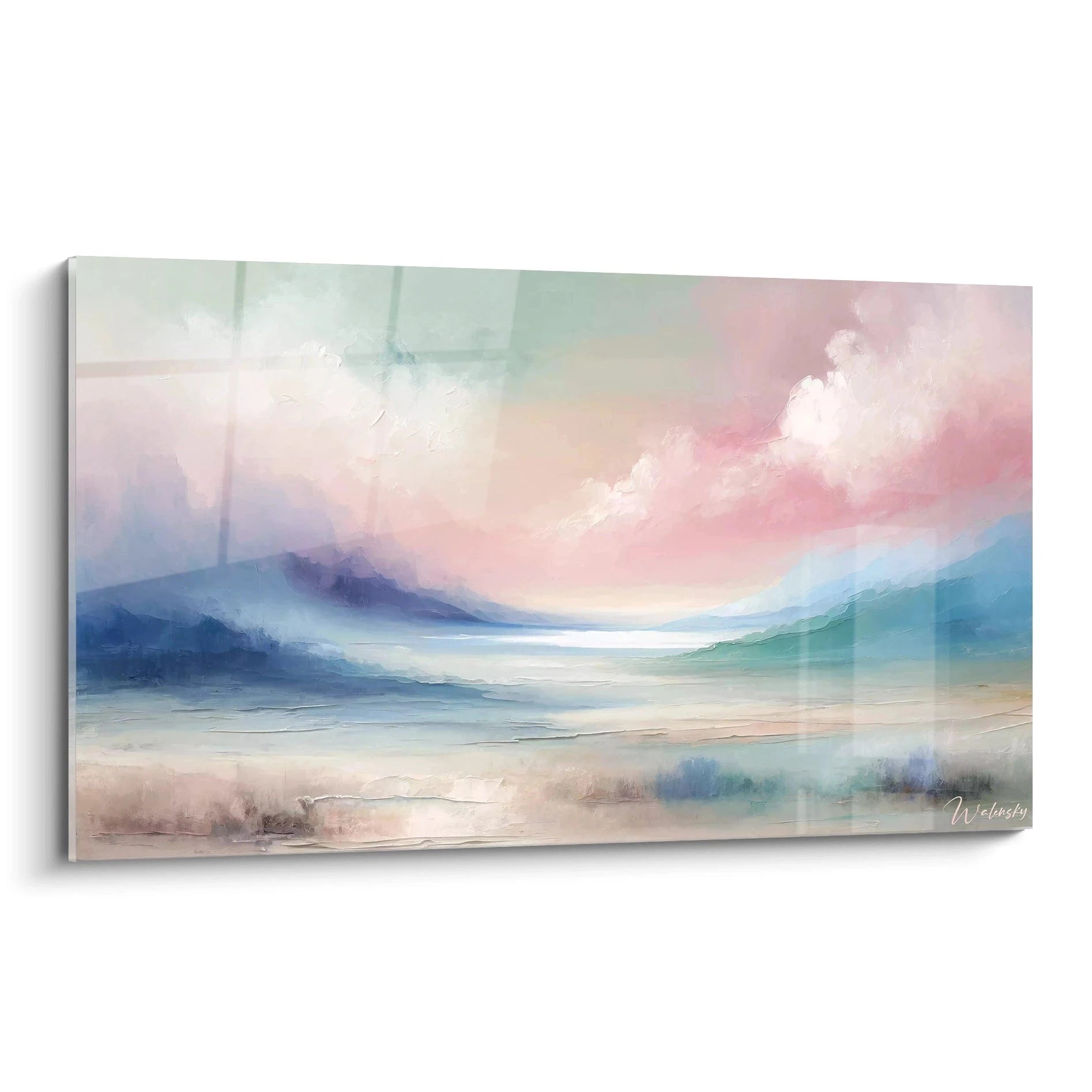

Why Do Wave Artworks Evoke Economic Cycles and Adaptability?
December 29, 2025 · 11 min read · by Walensky
In the meeting room of a London fintech startup I was working with last year, the founder confided something unsettling to me: 'Every time I look at this Hokusai wave during our crisis meetings, I understand better what we are going through.' It wasn't a coincidence. For fifteen years, I have been analyzing the psychological impact of art in professional environments, and I have observed this phenomenon in dozens of meeting rooms: wave paintings become powerful visual metaphors for economic turbulence.
Here’s what wave paintings bring concretely: they materialize the cyclical nature of markets, remind us of the importance of adaptability to change, and transform economic anxiety into a dynamic acceptance of perpetual movement.
Many leaders feel this frustration: how to maintain a stable vision when everything is constantly changing? How to inspire their teams in the face of unpredictable economic cycles? Strategic decision-making spaces desperately lack visual references that normalize uncertainty without falling into pessimism.
Rest assured: marine art is not just a soothing decoration. It's a cognitive resilience tool that helps decision-makers contextualize their challenges within millennia-old natural patterns. In this article, I reveal why wave paintings resonate so deeply with our modern understanding of economic cycles and how they cultivate the adaptability that has become essential.
The wave as an archetype of the cycle: what the ocean teaches us about markets
During a presentation at a Geneva family office, I was struck by the presence of a series of wave photographs framing the investment room. The manager explained to me: 'Our wealthy clients understand volatility better when they see these images.' This intuition is based on a profound truth.
Wave paintings visually capture what economists call business cycles: a progressive rise, an energetic peak, an inevitable descent, and then a lull before the next formation. This sequence is identical to the phases of expansion, peak, recession, and trough that economies experience. When Turner paints his maritime storms or contemporary photographers freeze the precise moment of the breaking wave, they are documenting the same dynamics as speculative bubbles and market corrections.
What fascinates about wave paintings is their ability to show that movement is never anarchic. Each wave follows precise physical laws: gravity, wind, deep currents. Similarly, economic cycles obey structural forces: technological innovation, monetary policies, the collective psychology of investors. This predictability in unpredictability is exactly what decision-makers exposed to these works intuitively seek.
I've noticed that professional environments incorporating wave paintings develop a different culture when facing crises. Rather than perceiving each difficulty as an exceptional event, teams begin to contextualize them as natural phases. This cognitive reframing significantly reduces decision-making anxiety. The ocean becomes a silent mentor whispering: 'This too shall pass, but something else will come.'
Between crest and trough: the art of navigating economic uncertainty
In my consulting practice, I often use wave paintings as starting points for strategic discussions. Their visual structure offers a common language for talking about timing and positioning. When a management team debates a major investment, pointing to the formation phase of a wave on the wall helps embody the question: 'Are we riding the right movement or launching into a wave that will collapse?'
This metaphor is not trivial. Wave paintings reveal that position counts as much as prediction. An experienced surfer knows it's better to miss a wave than to commit at the wrong time. Similarly, adaptive businesses understand that some economic cycles should be observed rather than ridden. Marine art cultivates this wisdom of strategic timing.
What I particularly appreciate about contemporary abstract wave artworks is their ability to show multiple simultaneous temporalities. The same canvas can capture the foam of the immediate present, the underlying swell movement, and suggest the long tide of the background. This is exactly the strategic vision required in economics: managing daily operations, anticipating semi-annual trends, and maintaining a ten-year vision.
Neuroscience confirms what I observe empirically: contemplating wave paintings activates brain areas related to anticipation and pattern evaluation. Faced with repetitive but never identical visual structures, our brains train to detect regularities in change. This is precisely the cognitive skill organizations need to develop their economic adaptability.


The power of the break: embracing creative destruction
A moment remains etched in my professional memory. During a difficult restructuring within a manufacturing company, the CEO lingered for a long time in front of a large painting of a breaking wave in the hall. He later confided to me that this image had helped him accept the necessity of dismantling certain divisions. 'The wave cannot remain suspended at its peak; it must break to release its energy.'
Wave paintings are particularly powerful in spaces of transformation, capturing the moment of the surge. They visualize what economist Joseph Schumpeter called 'creative destruction': this need for old structures to collapse so that new ones can emerge. In the crash of the foam, there is both the end of a form and the release of an energy that will nourish the next cycle.
This cathartic dimension of breaking wave paintings explains why they are often found in changing environments: mergers-acquisitions, strategic pivots, digital transformations. They legitimize the end of certainties. Unlike images of absolute calm which may seem disconnected from current economic reality, turbulent waves acknowledge the violence of change while suggesting that it is natural and necessary.
I often encourage my clients to choose wave paintings showing different energy states depending on the spaces. Strategic reflection areas benefit from works capturing the progressive formation of the swell — this phase where everything is still possible. Negotiation rooms gain by welcoming energetic surges that recall the intensity required. Rest areas deserve calms, those moments between two waves where the ocean breathes.
— Our selection

Embodied adaptability: what fluidity teaches us about resilience
The most fascinating characteristic of wave paintings is not their movement, but their fluidity. Water never resists; it bypasses, it embraces, it adapts to every obstacle. This visual wisdom has become a principle of organizational survival in the age of permanent disruption.
In a Parisian communication agency that I accompanied, an immense black and white photograph of a wave dominates the collaborative space. Their creative director explained to me that this image unconsciously influences their approach to client briefs: 'We no longer try to impose a rigid vision. We seek how our creativity can embrace constraints like water embraces rock.' Wave paintings thus become silent models of adaptive resilience.
This lesson in fluidity is particularly valuable in contexts of rapid economic change. Organizations that survive cycles are not the strongest or smartest, but the most adaptable — just like water that always finds its way. The daily presence of wave paintings in the professional environment visually anchors this strategic philosophy.
I’ve also observed that wave paintings help normalize failure as a learning phase. Each wave crashing on the shore hasn't 'failed' — it has simply completed its cycle. This psychological reframing is liberating for innovation cultures where rapid experimentation requires accepting many 'collapses' before finding the right amplitude.

— You may also like


The long view: marine horizons and strategic vision
What fascinates me about wave paintings of distant horizons is their ability to create temporal depth. When Claude Monet paints the English Channel or Hiroshi Sugimoto photographs his timeless Seascapes, they don't capture a moment but a permanence. The ocean will always be there, with its cycles, long after our human upheavals.
This perspective is a valuable antidote to the short-termism that paralyzes so many economic decisions. Horizon wave paintings remind us that beyond quarterly volatility, there are underlying trends — demographic, climatic, technological — that truly shape the future. They invite you to lift your eyes from daily life to contemplate long movements.
In a London hedge fund, I was struck by a room entirely dedicated to macroeconomic analysis, adorned only with ocean wave paintings under different lights and latitudes. The managing principal explained to me that these images help his team maintain an 'oceanic view': understanding that the same fundamental forces agitate all markets, regardless of their local appearance. This universality of cycles is soothing and clarifying.
Wave paintings also teach humility in the face of forecasts. Every marine meteorologist knows that predicting precisely the height of a wave a week out remains hazardous despite supercomputers. Likewise, the best economists acknowledge the irreducible uncertainty of their projections. This acceptance of partial unpredictability, far from being defeatist, frees up energy to focus on what is controllable: the quality of its crew, the solidity of its vessel, the clarity of its course.

Composing with perpetual motion: from resistance to dance
The deepest transformation I observe in organizations that consciously integrate wave paintings into their strategic spaces is the shift from a posture of resistance to a posture of dancing with economic cycles. Rather than dreaming of an impossible stable plateau, they learn to generate value within movement itself.
This wisdom is beautifully captured in wave paintings that show sailboats or surfers. The human being does not fight the ocean—they compose with it, they negotiate with its forces, they find their pleasure and performance in the dynamic interaction. This is exactly the posture of resilient companies: they do not suffer from economic cycles, they use them as grounds for opportunity.
In my practice, I often use wave paintings to facilitate difficult conversations about resource allocation. When a company goes through an economic trough, the image of the calm ocean before the next series reminds that this is precisely the time to prepare, reposition, invest in training. When the wave peak is reached, the work visually recalls that infinite expansion is illusory and consolidation is necessary.
The colors themselves of wave paintings subtly influence the perception of cycles. Deep blues evoke the stability of underlying trends, turquoise greens suggest the renewable energy of emerging innovations, stormy grays normalize difficult periods without dramatizing, golden sunsets foam remind that each cycle contains its own beauty.
Transform your strategic vision with the power of natural cycles
Discover our exclusive collection of wall art for Meeting Rooms that embodies the adaptability and economic resilience your organization needs.

Anchoring serenity in permanent change
After fifteen years spent observing the psychological impact of art in a professional environment, I remain fascinated by the particular power of wave paintings. In an economic world characterized by increasing volatility and accelerated disruptions, they offer much more than soothing decoration.
They materialize an essential economic philosophy: cycles are not anomalies to be feared but natural patterns to understand and navigate. Adaptability is not a skill among others—it is the very condition of perpetuity. And serenity in the face of change is not recklessness, but the wisdom of recognizing what can be controlled from what must be accepted.
Tomorrow, during your next strategic meeting, take a moment to contemplate the ocean—on your wall or in your mind. Observe how each wave is born, grows, culminates and fades to nourish the next. Ask yourself: 'In which phase of the cycle are we? Are we resisting natural movement or dancing with it?' This simple question, inspired by the millennial wisdom of waves, could transform your approach to the economic challenges that await you.
Wave art won't tell you when to invest or when to consolidate. But it will cultivate within you and your teams a quality that has become vital: comfort with uncertainty, the ability to see in each cycle not a threat but an invitation to evolve.
Frequently Asked Questions
Are wave artworks suitable for serious professional environments?
Absolutely, and that's even one of their main strengths. Unlike traditional corporate art, which is often bland and impersonal, wave artworks bring a profound symbolic dimension without falling into superficial decoration. I have worked with law firms, investment banks, and boards of directors who have all noted that these works elevate strategic conversations rather than distract from them. The maritime visual vocabulary—with its notions of navigation, anticipation, timing—resonates naturally with business language. Moreover, the aesthetics of contemporary wave artworks, particularly in black and white or minimalist palettes, integrates perfectly into the visual codes of high-end professional environments. The key is to choose works whose artistic quality and format match the ambition of your space.
How to choose the right wave artwork for a specific meeting room?
The choice depends on the function of the space and the energy you want to cultivate. For strategic thinking rooms and long-term planning, I recommend wave artworks showing wide horizons and progressive formations—they evoke anticipation and vision. For negotiation or crisis management rooms, works capturing the dynamic moment of a breaking wave bring energy and the reminder of constructive urgency. Boardrooms benefit from aerial perspectives or infinite horizons that evoke the required height of view. Also consider natural light: wave artworks with changing tones depending on lighting create an evolving experience that subtly reinforces the message of permanent transformation. Finally, format counts: a monumental work creates a stronger memorable impact, while a series of small artworks allows to show different phases of the same cycle.
Does this symbolism of waves and cycles really work or is it just poetic?
It’s a legitimate question, and I answer it with my empirical observations from over two hundred professional environments. The impact of wave paintings works on several simultaneous levels. First, there is the direct effect on mood and stress: neuroaesthetics research shows that images of water measurably reduce cortisol and improve concentration. Then, there is the shared language effect: I have documented dozens of cases where teams spontaneously began to use maritime vocabulary to discuss strategy ('we are in the trough', 'this wave is coming', 'entry timing'). This metaphorical vocabulary facilitates difficult conversations by depersonalizing them. Finally, there is the cognitive priming effect: the daily presence of wave paintings unconsciously activates mental patterns of cyclicity and adaptation. This obviously does not replace rigorous financial analysis, but it creates a psychological framework that promotes more resilient decisions. Art doesn’t do the work for you, but it subtly shapes the mindset with which you approach it.


