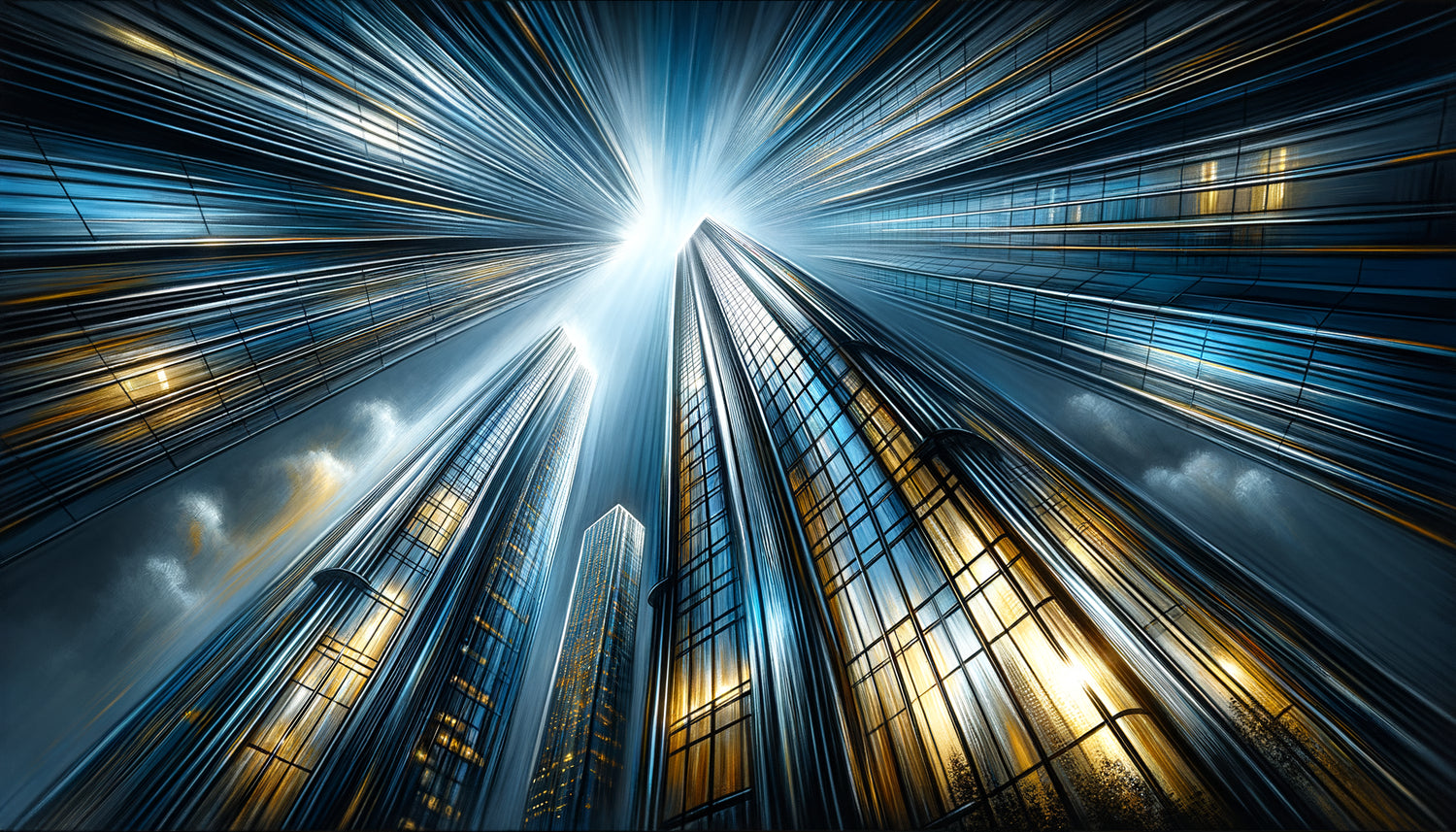
The first time I photographed the Chicago skyline from Lake Michigan, I understood something essential: these towers of glass and steel were not only telling the story of a city, but also that of human ambition itself. Fifteen years later, after documenting metropolises from New York to Dubai, I see that skyscraper paintings fascinate both business leaders and dreamers alike. But is this attraction simply aesthetic, or does it reveal something deeper about our relationship with power and success?
Here's what skyscraper paintings bring to your space: they visually embody ambition and vertical conquest, create a dialogue between architectural tradition and entrepreneurial modernity, and transform your professional environment into a manifesto of determination. Many believe that these works simply glorify the cold and impersonal corporate world. This overlooks their poetic dimension: each skyscraper is a inhabited sculpture, each skyline a composition orchestrated by visionaries. I will show you how these paintings transcend simple decor to become catalysts for energy and projection.
Vertical architecture as a metaphor for ascent
Skyscrapers are never neutral. When Frank Lloyd Wright designed his Mile High Tower or Mies van der Rohe drew the Seagram Building, they weren't just thinking in terms of square meters. They were sculpting symbols. A skyscraper painting captures this symbolic dimension: verticality as an expression of ambition, the transparency of glass as a metaphor for strategic clarity, steel as an incarnation of resilience.
In my reports, I have noticed that the most memorable corporate architectures share one quality: they defy gravity with elegance. The Burj Khalifa doesn't just seek to be tall; it aspires to redefine what it means to rise. When you hang a skyscraper painting in your office, you are not simply installing an image – you are visually anchoring this philosophy of surpassing.
The geometry of success
What distinguishes effective skyscraper paintings is their mastery of geometric composition. Stacked rectangular shapes create a visual rhythm that evokes progressive construction, floor by floor. This is exactly how a business is built: solid foundations, coherent structure, summit visible from afar. This geometry is never accidental in corporate architecture – it visually translates values of organization, method and controlled growth.
Between celebration and questioning: the double reading
Let's be honest: skyline paintings possess a fascinating ambiguity. They undeniably celebrate architectural boldness and economic power. But photographers and contemporary artists who capture these structures often introduce a critical distance. I’ve learned to recognize those nuances: a skyscraper photographed in fog evokes the isolation of power, a tower reflecting the sky questions the boundary between natural and artificial, a skyline at dusk suggests fragility behind apparent invincibility.
The best skyline paintings are not corporate propaganda – they are meditations on human ambition in all its complexity. They simultaneously acknowledge the beauty of technical achievement and the melancholy of our temporary empires. This tension is their strength. In a boardroom, they don’t simply say “be ambitious,” they murmur “be ambitious, but aware.”
Context changes everything
The same skyline painting will take radically different meanings depending on its environment. In a tech startup’s office, it proclaims the aspiration to become the next giant. In a law firm’s waiting room, it asserts institutional solidity. In an artist's loft, it becomes an ironic commentary on the establishment. This semantic plasticity explains why corporate architecture in photography transcends decades – it welcomes our changing projections.

Light as a revealer of intention
After years of photographing skyscrapers, I understood that light determines the message. A skyline painting bathed in golden morning light evokes beginnings, entrepreneurial energy, promise. The same towers under a dramatic stormy sky speak of resilience in the face of adversity. Artificial lights twinkling in the urban night suggest ceaseless activity, an economy that never sleeps.
Corporate architectures are designed to play with light: reflective facades that multiply the sky, transparent atriums that bring daylight into the heart of the building. A painting capturing these plays of light brings a poetic dimension that tempers what ambition can be harsh. It reminds us that even the most imposing structures depend on something intangible – the quality of light, the angle of view, the moment chosen.
When architecture becomes visual identity
Businesses have understood this for a long time: their headquarters is not just a place of work, it's their signature in the urban landscape. The Chrysler Building embodies the Art Deco era and industrial optimism, Apple Park represents creative fluidity and ecological innovation. Choosing a skyscraper painting for your professional space is essentially symbolically adopting this approach of embedding yourself in the landscape.
I’ve observed this phenomenon in dozens of offices: corporate architecture paintings function as contemporary totems. They tell visitors and teams: “We share the values of those who build these modern cathedrals.” It's a form of legitimation by visual association. But be careful – this approach is only authentic if it resonates with your actual culture. A skyscraper painting in a company promoting slow business would create cognitive dissonance.
The visual codes of ambition
Effective skyscraper paintings use precise visual codes: a dizzying low-angle shot to amplify the impression of power, black and white for timelessness, saturated colors for contemporary energy. The choice between a solitary tower and a dense skyline is not insignificant: the former evokes solitary leadership, the second a collaborative ecosystem. These details transform a simple decoration into a subtle but constant communication tool.

Beyond the corporate world: the human dimension
Here's what critics of skyscraper paintings often forget: these towers are never empty. Behind every lit window, people work, dream and struggle. The best artists capturing corporate architecture never forget this human scale. They include a tiny silhouette on the sidewalk, a reflection of passersby in the facade, lights suggesting life.
A powerful skyscraper painting celebrates both collective ambition and architectural audacity. It recalls that these structures exist only because thousands of people – architects, engineers, workers, users – believed in a common vision. It is this collaborative dimension that transforms individual ambition into tangible achievement. In your professional space, this reading considerably enriches the message: ambition is not a fantasy of isolation at the top, but an orchestration of converging energies.
Creating a dialogue between tradition and modernity
What particularly fascinates me is how some skyline paintings juxtapose old and new. A Gothic church at the foot of a glass tower, an Art Deco building in front of a contemporary skyscraper. These compositions create a temporal dialogue: modern corporate architecture does not arise from nothing; it is part of a continuity of architectural ambitions. The builders of medieval cathedrals and the developers of 21st-century towers share the same desire for vertical transcendence.
Integrating these works into your professional decor positions you in this lineage. You become heir to a tradition of bold construction while asserting your connection to the present. This double temporality brings depth that is sorely lacking in standardized corporate spaces. It suggests that your company understands where it comes from as well as where it is going.
Transform your space into a manifesto of thoughtful ambition
Discover our exclusive collection of Wall art for Meeting Room that celebrates architecture and human aspiration with sophistication.
Conclusion: ambition as an aesthetic principle
Do skyline paintings celebrate corporate architecture and ambition? Yes, undeniably. But the most powerful ones do much more: they question, nuance, and humanize this celebration. They transform raw ambition into an aesthetic principle, vertical conquest into meditation on our place in urban space. In your office or meeting room, they don't shout "be ruthless," they whisper "dare to build something that will outlive you."
Start by identifying what ambition means to you: rapid ascent or patient construction? Solitary leadership or collective success? Isolated tower or collaborative skyline? Then choose the skyline painting that embodies this philosophy visually. You won't just be decorating a wall – you'll anchor your intention in daily visual matter. And it is precisely this way that corporate architecture becomes a source of inspiration rather than simple decor.
FAQ: Skyline paintings and symbolism
Is a skyline painting suitable for all professional environments?
Not necessarily, and it’s important to acknowledge that. Skyscraper artworks particularly resonate in financial, legal, technological, real estate, or consulting sectors – areas where vertical ambition and structured growth are part of the cultural DNA. Conversely, in a social enterprise, a cooperative, or a therapy practice prioritizing human connection, these works can create dissonance. Corporate architecture works when it authentically reflects your actual values, not when it projects an aspirational image disconnected from your culture. Ask yourself this simple question: if your company were a building, would it resemble a skyscraper or another architectural form? The honest answer will guide you.
How to avoid these artworks appearing cold or impersonal?
The key lies in three elements: light, human presence, and association. Favor works capturing skyscrapers in warm light – morning golden, orange twilight – rather than under a uniform gray sky. Look for compositions including hints of human life: illuminated windows, silhouettes, reflections of passersby. Finally, never isolate these artworks: associate them with organic elements such as generous plants, natural wood furniture, or textured textiles. This juxtaposition creates a balance between ambition and humanity. I’ve seen offices where a magnificent New York skyline artwork dialogues with a vintage library and patinated leather armchairs – the result evokes success rooted in substance rather than superficial glitter.
Don’t these artworks glorify a form of capitalism that some reject?
This is a legitimate question deserving a nuanced answer. Skyscapers are indeed symbols of corporate capitalism, but they also represent technical ingenuity, large-scale human cooperation, and the ability to realize ambitious collective visions. It all depends on the angle from which you view them. A skyscraper artwork can celebrate financial power or honor the thousands of workers who made this construction possible. It can glorify urban dominance or admire the creative boldness of architects. Your intention and context determine the reading. If you’re uncomfortable with the corporate dimension, opt for works emphasizing architectural achievement, geometric beauty, or human dimension rather than economic power symbolism.