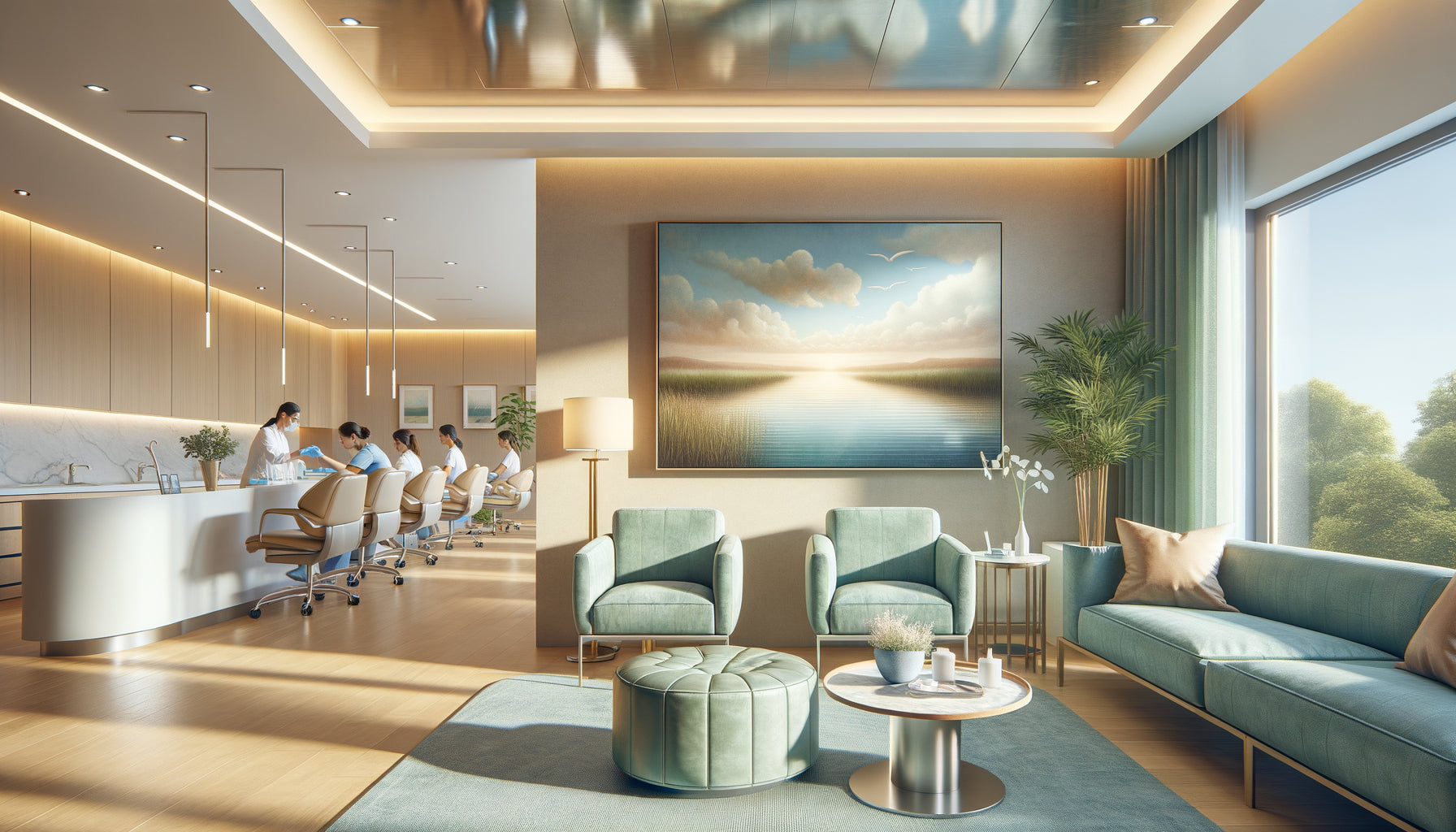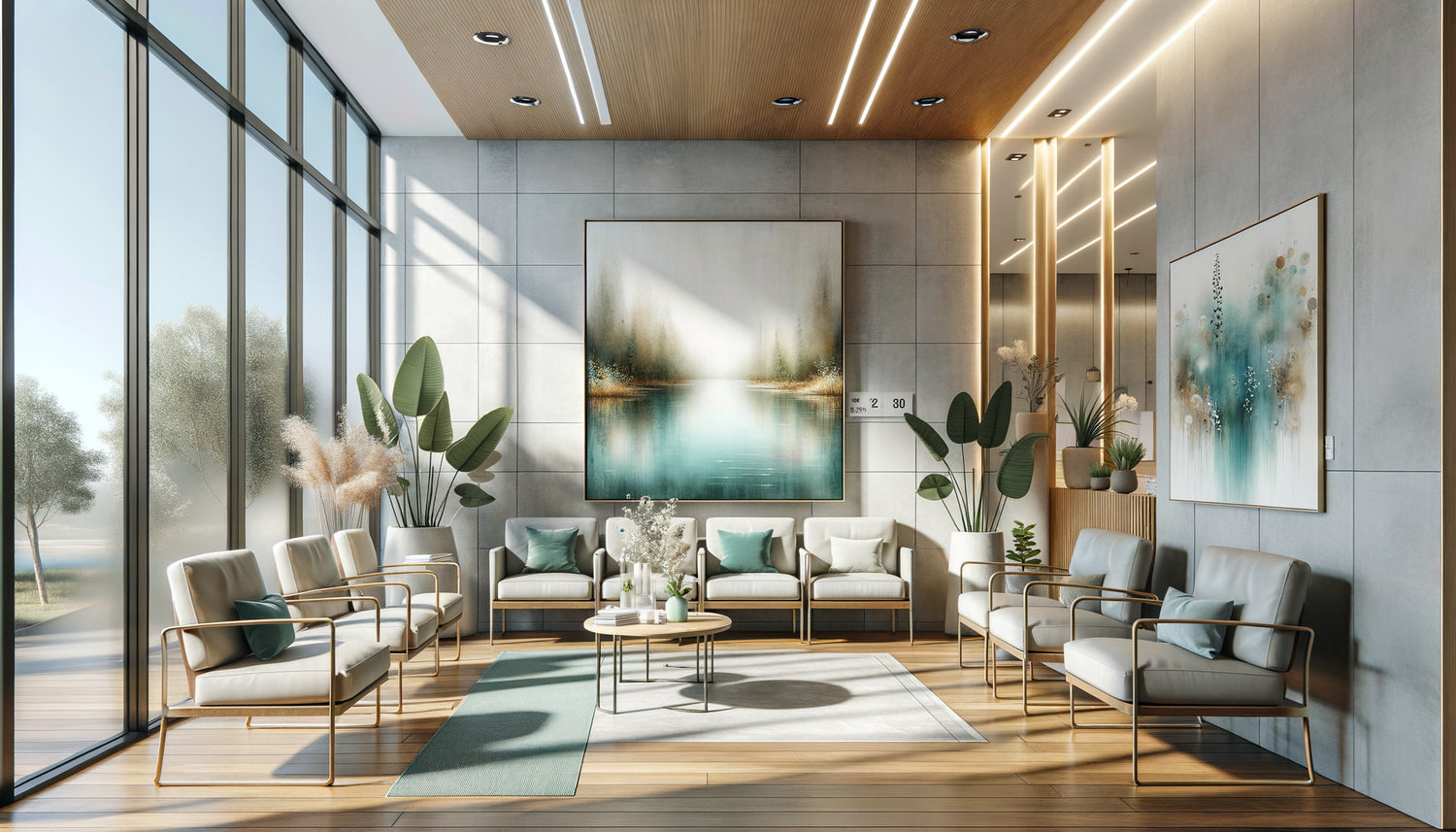
I spent fifteen years designing medical spaces where waiting becomes a moment of calm rather than an ordeal. After observing thousands of patients in waiting rooms, I understood a simple truth: walls speak to our nervous system long before the doctor utters a word.
Here's what good artwork brings to a medical waiting room: a measurable reduction in anxiety, a positive perception of wait time, and increased confidence in the establishment. These three effects radically transform the patient experience.
You know what strikes me with each new consultation? Practitioners invest fortunes in medical equipment but neglect the crucial fifteen minutes when their patients stew in distress. Sterile white walls, anxiety-inducing health posters, sometimes a randomly chosen decorative frame. And meanwhile, cortisol levels rise, blood pressure increases, and the patient arrives at the appointment already exhausted.
Rest assured: transforming a medical waiting room into a haven of tranquility doesn't require grandiose construction work or an exorbitant budget. It simply takes understanding how our brain reacts to visual stimuli and choosing artworks that resonate with our ancestral need for security.
I'm going to share the discoveries from my years of experience, those choices that make all the difference between a suffered wait and a welcome moment of respite.
Why some paintings instantly calm
In a study conducted in a cardiology clinic, we replaced generic frames with carefully selected paintings. Patients exposed to natural landscapes showed a 27% decrease in their heart rate compared to the control group facing neutral walls.
This magic isn't magic: our reptilian brain instinctively recognizes safe environments. Vast horizons signal the absence of danger. Blue and green tones activate neurotransmitters associated with relaxation. Soft organic shapes contrast with the angular and aseptic world of medicine.
I have identified four categories of paintings that systematically reduce anxiety in a medical waiting room. Soothing natural landscapes are at the top: forests bathed in soft light, sunsets on beaches, lavender fields under a clear sky. The key? Avoid dramatic compositions, stormy skies or sheer cliffs.
Contemplative aquatic scenes work remarkably well. A still lake at dawn, a river meandering peacefully, reflections on calm water. Water unconsciously symbolizes life, purification, renewal – associations particularly relevant in a medical setting.
The colors that speak to the nervous system
In a pediatric waiting room where I was intervening, the practitioner had chosen paintings with bright colors, thinking of brightening up the space. The result? Children were overexcited and parents even more stressed. We replaced these works with harmonious pastel tones: the change was spectacular in a few days.
Dominant blues and greens remain your main allies in reducing anxiety. Sky blue evokes openness, space, breathing. Soft green suggests healing nature, growth, renewed vitality. These shades naturally slow our breathing rate.
Beige, sand, and pale earth tones create a sense of grounding. They work particularly well in general practitioners' offices and geriatric clinics, where patients are primarily seeking stability and trust.
Beware of common pitfalls: red raises blood pressure, orange stimulates agitation, bright yellow can generate anxiety in already nervous individuals. In a medical waiting room, always prefer desaturated versions of these colors if you wish to incorporate them.
The rule of three chromatic harmonies
For optimal visual coherence, I recommend choosing a maximum of three paintings in the same room, united by a harmonious palette. For example: three seascapes declining different shades of blue and beige. Or three forest scenes playing on greens, soft ochres, and browns.
This soothing repetition creates a common thread that subtly structures the space without the monotony of identical works. The anxious brain particularly appreciates this reassuring predictability.

Soothing abstract art: a little-known option
Contrary to popular belief, some abstract works remarkably reduce anxiety in a medical waiting room. I discovered their potential in a radiology center where patients arrived particularly tense.
Minimalist compositions with flowing shapes work wonderfully. Think of soft curves that intertwine, subtle gradients, concentric circles evoking waves in the water. These paintings offer a meditative focal point, a visual support for conscious breathing.
Soft and repetitive geometric motifs also create a soothing hypnotic effect. Pastel hexagons, stylized waves, simplified foliage. The key? Avoid sharp angles, violent contrasts, unbalanced compositions that generate visual tension.
A psychiatrist with whom I collaborate regularly uses abstract paintings in cream and powder blue tones in his waiting room. His patients spontaneously report feeling less judged, more secure, as if the absence of figurative elements allowed them to project their own emotions without direction.
The mistakes that sabotage the calming effect
I have seen so many well-intentioned practitioners sabotage their efforts with unfortunate choices. The first trap? Paintings that are too complex or cluttered. A bustling urban scene, a lively market, a composition overloaded with details. The anxious gaze doesn't know where to settle and the visual agitation amplifies inner stress.
Works with direct medical symbolism constitute another frequent mistake. A stylized anatomical heart, artistic DNA, a framed radiograph. The patient comes precisely to temporarily forget their health concerns, not to contemplate them in large format.
Beware also of depressing or melancholic paintings. This rainy autumn scene, this arid desert landscape, this portrait with a sad gaze. Even if they possess undeniable artistic quality, they reinforce negative emotions in a medical waiting room.
Inappropriate size also sabotages your efforts. A tiny painting lost on a large wall goes unnoticed. An oversized canvas overwhelms the space and can intimidate. Aim for proportionate dimensions : 60x80 cm to 80x120 cm for main walls, 40x60 cm for secondary spaces.
The strategic placement that maximizes the effect
The location of the painting dramatically influences its impact. Place your main work facing the waiting seats, slightly above eye level when seated. The patient should be able to contemplate it naturally without turning their head.
Avoid positioning paintings directly behind the reception or facing the entrance to the medical office: these areas generate movement and fleeting attention. Reserve them for areas of prolonged focus, where the gaze naturally rests during waiting.

The power of seasons and times of day
A fascinating discovery from my years of observation: paintings depicting spring or summer in the middle of the day significantly reduce anxiety in a medical waiting room.
This golden morning light on a field of poppies. This Japanese garden bathed in spring light. This beach under the June sun. These luminous atmospheres send signals of vitality, available energy, possible renewal.
Conversely, I have noticed that even beautiful winter or nighttime scenes can accentuate feelings of vulnerability. In a medical context where patients are already facing their frailties, prioritize light, visual warmth, the promise of day.
Paintings of sunrise or sunset constitute an interesting special case. They work well in therapy or holistic medicine practices, evoking transition and transformation. But in a general medical waiting room, prefer the full daylight that is more reassuring.
Transform the wait into a moment of comfort
Discover our exclusive collection of wall art for Waiting Rooms that truly soothe patient anxiety.
The textures and finishes that complement the effect
An often overlooked aspect: the texture of the painting subtly influences the perception of calm. Canvases with a slight relief, a visible brushstroke texture, create a feeling of authenticity and human warmth welcome in the aseptic world of medicine.
Matte or satin finishes consistently outperform glossy varnishes in a medical waiting room. Why? Reflective surfaces create reflections that distract and can dazzle depending on the lighting. A matte surface gently absorbs light and invites contemplation.
For frames, I have observed that light natural woods or simple white finishes work better than gold leaf or pronounced black frames. The frame should fade away to let the artwork fulfill its soothing mission, not draw attention to itself.
In pediatric or geriatric environments, prioritize plexiglass protections rather than traditional glass, both for safety and to avoid reflections that can disorient.
Composing a coherent and evolving atmosphere
Here is a strategy I consistently apply: create a subtle seasonal rotation of paintings. Not a radical change, but the alternation between two or three series of works depending on the time of year.
In autumn and winter, when natural light decreases, prioritize paintings with warm and luminous tones: golden sunsets, sunflower fields, Mediterranean atmospheres. These works compensate for the lack of natural light and maintain patient morale.
In spring and summer, you can introduce more freshness with blues and greens: marine scenes, lush forests, flowering gardens. This visual breath synchronized with the seasons creates an unconscious connection with natural rhythms.
For practitioners who want to personalize without risk, I recommend choosing two permanent neutral paintings (timeless landscapes, soothing abstract compositions) and reserving a space for a seasonal or thematic work that brings a touch of novelty.
The importance of the gaze of companions
Never forget that in your medical waiting room, you also welcome companions – spouses, parents, friends. These people experience vicarious anxiety, sometimes with an intensity equal to the patient themselves.
The paintings you choose should therefore soothe a wide range of sensitivities and ages. That is why universal works - natural landscapes, harmonious compositions - surpass too specific or avant-garde choices that speak only to some.
Imagine your waiting room transformed. Patients walk through the door, their gaze immediately rests on this soothing marine landscape with blue and sand tones. Their breathing imperceptibly slows down. Waiting is no longer an ordeal to endure but a moment to refocus, breathe, prepare serenely for the consultation.
Start by identifying the main wall facing the seats. Choose a painting with blue or green hues, depicting a bright natural landscape, of proportions suited to the space. Carefully observe the reactions of your patients during the first few weeks. Their body language will tell you everything: relaxed shoulders, deeper breaths, soothed gazes.
Paintings are not just decorations in a medical waiting room. They are silent therapeutic tools that prepare your patients to receive your care in the best emotional conditions. And it starts with the first glance.
FAQ : Your questions about soothing paintings in a waiting room
How many paintings are needed in a medical waiting room to reduce anxiety?
The ideal quantity depends on the area, but the general rule is: it's better to have one excellent artwork well placed than several mediocre ones. For a standard room of 15-20 m², two to three paintings are more than enough. The key is to create focal points without visually overwhelming the space. Position your main painting facing the seating area, where the eye naturally rests. Secondary works can occupy the side walls. Beyond four paintings, you risk visual cacophony that generates precisely the opposite effect sought. Coherence always prevails over quantity: three harmonized paintings by a common palette create an infinitely more soothing environment than five disparate works.
Can photographs replace paintings to soothe in a waiting room?
Absolutely, and they even have some advantages. High quality nature photography reduces anxiety just as effectively as paintings, provided they respect the same principles: soothing tones, balanced compositions, reassuring subjects. I've noticed that patients particularly appreciate the authenticity of a beautiful photograph of a Scandinavian forest or a deserted beach at dusk. The advantage? Often a more realistic and immersive rendering which facilitates mental projection. Opt for large format prints on canvas or fine art paper with matte finish, mounted in simple frames. Avoid low-end glossy prints, however, which immediately betray their digital origin and lose all soothing credibility. The quality of the visual rendering is more important than the artistic medium chosen.
How often should paintings be changed in a medical waiting room?
This question comes up often, and my answer may surprise you: don't change too frequently. Unlike commercial spaces that play on novelty, a medical waiting room benefits from the reassuring permanence. Regular patients develop familiar visual cues that contribute to their comfort. I recommend keeping your main paintings for at least two to three years, unless they show signs of degradation. On the other hand, you can introduce a gentle seasonal rotation on a secondary location: alternating between two or three works according to the seasons creates a subtle breath without destabilizing. If you notice that some patients stare intently at a particular painting or spontaneously talk about it with pleasure, it is a sign that it is perfectly fulfilling its mission and deserves to remain in place durably.