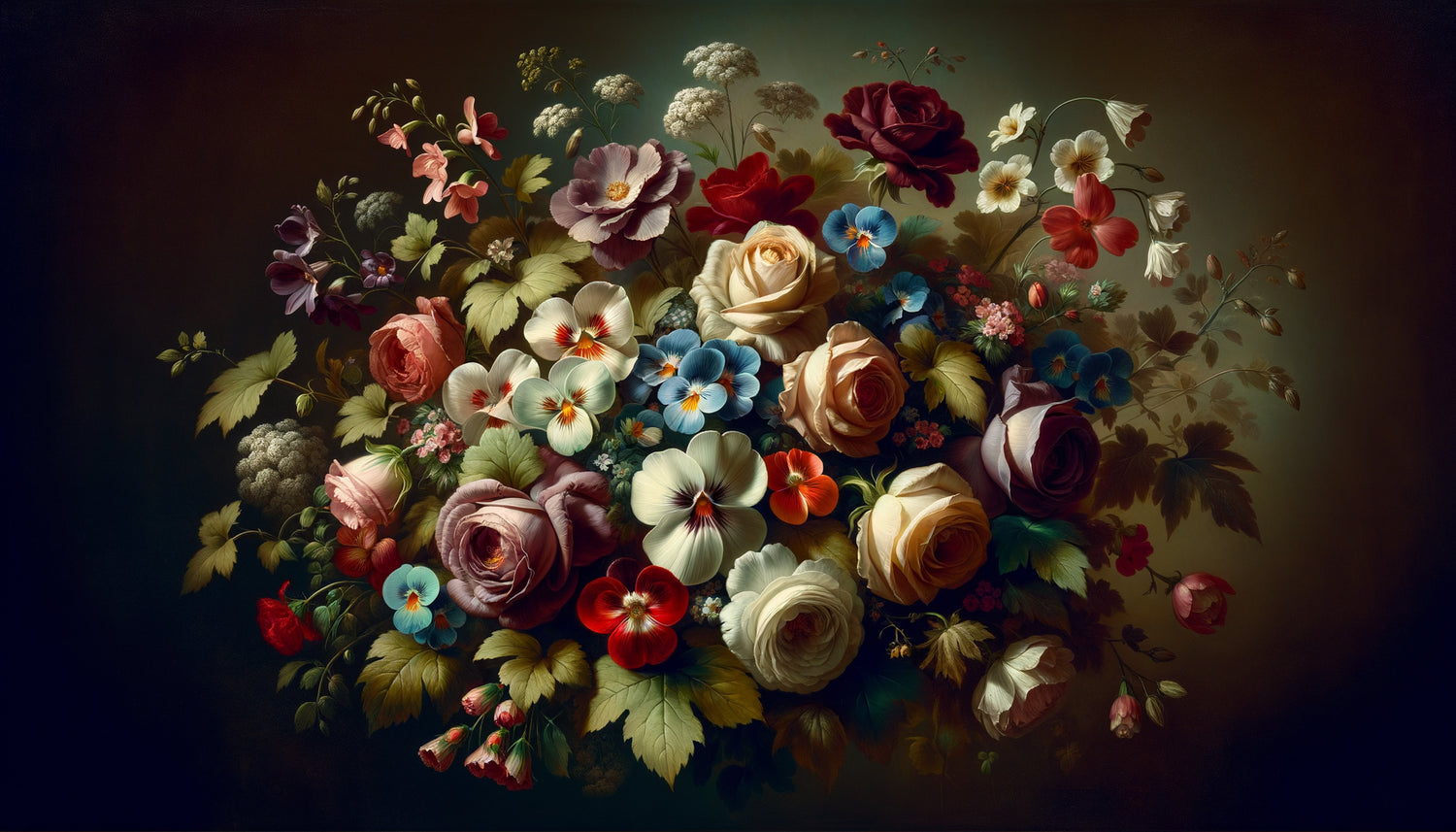
In the living room of a Victorian home I was restoring last year, I discovered a floral painting hidden behind a family portrait. The owner, moved, revealed to me that it was a declaration of love that her great-grandfather had commissioned for his beloved in 1887. Each flower in the bouquet carried a precise message, a vegetal love letter that only initiates could decipher. This moment transformed my perception of floral paintings: they were not mere decorations, but true sentimental cryptograms.
Here's what mixed floral bouquets bring to your interior: an invisible romantic dimension to profane eyes, a silent conversation with the history of courtly love, and a narrative sophistication that transforms your decoration into a gallery of coded messages. These floral compositions tell stories that words could not express at certain times.
Today, we hang floral paintings for their aesthetics, often ignoring that they convey an elaborate language of love for centuries. This lack of awareness deprives us of a fascinating layer of reading, as if we were admiring a text in a foreign language without understanding its poetry.
Yet, rediscovering this language of flowers requires no training in botany or art history. It just takes knowing a few keys to read so that your mixed bouquet painting reveals its romantic secrets, transforming your gaze on this decorative piece.
I invite you to explore together why these floral compositions are much more than pretty still lifes, and how they continue to whisper words of love through the centuries.
The language of flowers: when love could not be spoken
In the 19th century, social conventions forbade the direct expression of romantic feelings. Young people had to communicate their emotions by indirect means, and the language of flowers, or floriography, became their secret alphabet. Each variety of flower carried a precise meaning, creating a vocabulary of extraordinary richness.
Mixed floral bouquet paintings then served as silent messengers. A suitor could offer or commission a floral canvas whose composition revealed his intentions: ardent passion, respectful love, timid hope or desire for marriage. The woman who received this painting could decode it in the intimacy of her boudoir, without propriety being violated.
This practice developed particularly in Victorian England and Romantic France, where floral dictionaries circulated in salons. The red rose declared passionate love, white jasmine evoked amiability and attachment, while the iris carried a message of hope. A mixed bouquet allowed entire sentences to be composed, like a sentimental rebus.
The secret grammar of floral compositions
In mixed flower bouquets, the position of each flower was never arbitrary. The painters who mastered this coded language arranged their compositions according to a precise grammar. A flower placed in the center of the bouquet carried the main message, while those on the periphery nuanced or completed the statement.
The orientation of the stems also mattered: a flower leaning to the right intensified its positive message, while tilted to the left, it took on a more melancholic or questioning connotation. Closed buds evoked innocence and promise, blooming flowers celebrated romantic fulfillment, and petals beginning to fall suggested nostalgia.
Dutch Golden Age painters excelled in this art of coded floral messages. Their vanitas paintings, these sumptuous compositions that mixed roses, tulips, peonies and lilies, told complex love stories where desire, virtue and temporality mingled. A mixed flower painting could thus express: My love for you is eternal despite the passage of time, simply by combining a blooming red rose and a white tulip bud.

Floral combinations that spoke of love
Certain combinations of flowers in bouquets constituted particularly eloquent declarations of love. The combination of roses and forget-me-nots meant I love you, don't forget me. The mixture of red camellias and white gardenias expressed passionate flame tempered by the purity of intentions.
The peonies, with their generous opulence, evoked romantic shame and timidity in the face of powerful feelings. Combined with marguerites symbolizing innocence, they created a touching message of sincere but modest love. The tulips declared perfect love, and their color modulated the intensity: red for devouring passion, pink for tender affection, yellow for hopeless love.
In more sophisticated compositions, painters integrated lesser-known flowers whose symbolism enriched the message. Honeysuckle spoke of unbreakable bonds of love, anemone evoked abandoned love, while carnations carried varied nuances depending on their hue: pink for maternal love, red for deep admiration, white for pure and faithful love.
These details that transform a bouquet into a declaration
Beyond the flowers themselves, tableaux de bouquets mixtes (mixed bouquet paintings) contained revealing elements for those who knew how to read them. The presence of insects was never accidental: a butterfly symbolized the transformation of the soul by love, a bee evoked ardor and industriousness in love, while a dragonfly suggested the lightness of nascent feelings.
The vase itself carried a message. A porcelain container spoke of refinement and sentimental delicacy, while a simple rustic jug evoked simple and authentic love. A transparent vase revealed the stems, a metaphor for the transparency of intentions, while an opaque container suggested the mystery and secrets of the heart.
The backgrounds of the paintings also enriched the romantic narrative. A dark background dramatized feelings, creating an atmosphere of forbidden or passionate love. A light and bright background celebrated happy and accepted love. Some painters slipped landscapes into the background: a garden evoked Eden of shared love, while a window open onto a stormy sky suggested sentimental torments.

How to decode the message of an antique floral painting
Faced with an tableau de bouquet de fleurs mixtes (mixed flower bouquet painting) from the past, a few reflexes allow you to decipher its romantic message. Start by identifying the main varieties of flowers and research their symbolism in the language of flowers of the 19th century. Note their relative position and state of bloom.
Then observe the general composition: a tight bouquet evokes intimacy and concentration of feelings, while an airy arrangement suggests freedom in love. Flowers that touch or intertwine speak of union and complementarity. Those that seem to turn away evoke sentimental complications.
Examine the secondary elements: dew drops (freshness of feelings), visible thorns (painful love), ribbons (sentimental ties), water pearls (tears of joy or sadness). In the most sophisticated floral paintings, even the shadows create symbolic shapes that painters slipped in like secret signatures of their romantic message.
Integrate this romantic dimension into your decoration
Choosing a mixed flower bouquet painting for your interior takes on a new dimension when you know its narrative potential. For a bedroom, prioritize compositions combining red roses and white flowers, which create a dialogue between passion and purity. In a living room, an opulent bouquet mixing peonies, hydrangeas and lilies evokes the generosity of feelings and the abundance of domestic happiness.
A floral painting in an office or creative space can carry a bolder message: black tulips (rare elegance), poppies (overflowing imagination), or corn poppies (dreams and aspirations). The entrance to your home will beautifully welcome a composition of flowers signifying welcome and hospitality: sunflowers, daisies and forget-me-nots create a warm atmosphere.
For more intimate spaces like a dressing room or library, look for bouquet paintings with soft tones and personal messages: violets (modesty and fidelity), lily of the valley (return of happiness), lilacs (nascent emotions). These choices transform your decoration into a silent conversation with those who share your life and understand these subtle codes.
Transform your walls into silent love poems
Discover our exclusive collection of Valentine's Day paintings which perpetuates the romantic tradition of the language of flowers and transforms every glance into a declaration.
The floral language in the contemporary era
Today, mixed flower bouquet paintings are regaining their narrative dimension in our interiors. Young couples are rediscovering this tradition to offer works carrying personal messages, thus creating gifts infinitely more profound than simple decorations.
Contemporary artists who work on floral compositions consciously reinvest this symbolic heritage. Some create puzzle-like artworks where the initiated viewer can piece together a complete love phrase by reading the succession of flowers. Others divert traditional codes to create modern messages: acceptance, respect for differences, love that transcends norms.
This renaissance of the language of flowers in decorative art responds to our contemporary need for depth and authenticity. In a world of instant images and ephemeral communications, a floral painting carrying a coded message becomes an anchor, a shared secret, a conversation that crosses time. It transforms your wall into a confidant and your decoration into a sentimental library.
Conclusion: when your walls whisper words of love
Mixed flower bouquet paintings are much more than colorful accents in your decor. They perpetuate a centuries-old tradition where love, constrained by social conventions, found its voice in the delicate arrangement of petals and stems. Each floral composition potentially carries a love message, a coded declaration that you can now decipher.
Imagine yourself standing in front of your new floral painting, identifying the roses that speak of passion, the irises that whisper hope, the peonies that confess the timidity of deep feelings. Your gaze will never be the same. You will have acquired the ability to read these visual poems that former lovers wrote in petals and colors.
Start by observing differently the floral paintings you come across, in galleries, at friends' homes, in museums. Look for red roses, count white flowers, spot promising buds. Little by little, you will develop your own sensitivity to this secret language, and perhaps you will choose your next painting not only for its colors, but for the love message it carries, silent and eternal, on your wall.
FAQ : The Language of Love in Floral Paintings
Can you really decode all antique bouquet paintings?
Not systematically, as not all painters mastered the language of flowers or used it intentionally. However, works commissioned for sentimental occasions (engagements, weddings, declarations) generally carried deliberate coded messages. Flemish and Dutch paintings from the 17th century, as well as Victorian works from the 19th century, are most likely to contain these love messages. To identify whether your painting carries a code, look for symbolic consistency: if several flowers known for their romantic significance appear together in a harmonious composition, there is a good chance that a message was intentionally composed. Floriography dictionaries of the corresponding era will help you decipher it accurately.
How to choose a floral painting with a personal message for a loved one?
Start by defining the feeling you want to express: passionate love, tender affection, respectful admiration, lasting commitment. Then consult a flower language guide to identify the corresponding varieties. For example, to express eternal and faithful love, look for compositions combining red roses (passion), forget-me-nots (memory), and white carnations (fidelity). For a more discreet declaration, prioritize violets (modesty), lily of the valley (happiness rediscovered) and daisies (innocence). If you are purchasing an existing painting, check for the presence of meaningful flowers for your message. If you order a custom artwork, communicate your intention to the artist by indicating the symbolic flowers you wish to be integrated. This approach transforms your gift into a true visual love letter that only you and the loved one can fully understand.
Was the language of flowers the same in all countries?
No, and that is where the fascinating complexity of floriography lies. While some symbolism is almost universal (the red rose for passionate love), many meanings varied according to cultures and eras. In Victorian England, the language of flowers differed slightly from that practiced in romantic France or in the Ottoman Empire where this tradition was also very developed. For example, tulips had a capital importance in Turkish amorous symbolism, while the French favored roses and violets. Even within a single country, several floral dictionaries circulated with sometimes divergent interpretations. This is why, to precisely decode an old painting, it is useful to know its geographical origin and period of creation, then to consult the corresponding floral references. This diversity further enriches the mysterious and personal dimension of these coded messages.