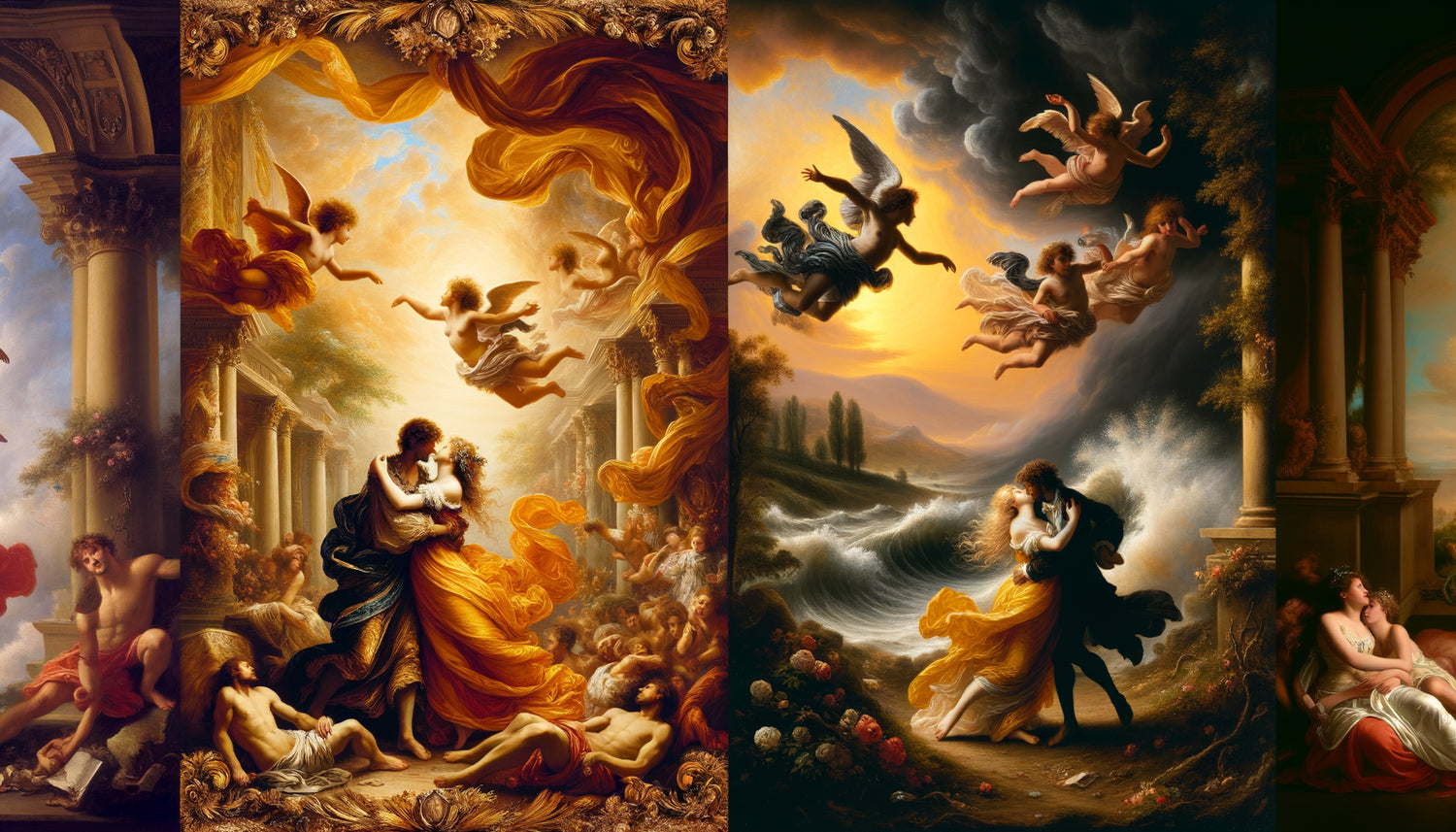
Faced with this canvas where two lovers embrace in a theatrical setting, you feel the intensity, the flesh that pulsates, the drama that consumes. Then, before another love scene, it is melancholy that seizes you, an almost painful languor, gazes lost in infinity. These two visions of passionate love seem so different... One belongs to the flamboyant Baroque of the 17th century, the other to the tormented Romanticism of the 19th. But how can we distinguish these two pictorial universes that celebrate love with such fervor?
Here's what understanding these differences brings you: the ability to instantly decode the emotion conveyed by a work, the assurance of choosing the painting that will resonate with the intimate atmosphere you want to create in your interior, and this knowledge that transforms every look at a canvas into an enriching experience.
You are attracted to passionate representations of love, but faced with the profusion of artistic styles, you feel lost. How do you know if this embrace scene belongs to Baroque exuberance or Romantic intensity? You fear missing essential nuances, choosing a work that will not really correspond to what you are looking for.
Rest assured: distinguishing a Baroque love painting from a romantic scene requires no academic training. It is enough to understand some visual and emotional codes, and above all to know how to feel the intention that animates each movement. I will guide you through these passionate universes, revealing what makes the heart of each era beat.
In this article, you will discover the keys to instantly identify these two visions of passionate love, understand what deeply separates them, and above all choose the one that will speak to your sensitivity.
Baroque: when love is given in spectacle
In Baroque paintings of the 17th century, passionate love is a carnal and theatrical celebration. Imagine opulent bodies, pearly flesh that captures the light, sumptuous fabrics that slide to reveal sensuality. Rubens, the undisputed master of this vision, paints love as a overflowing, almost cosmic vital force.
Baroque scenes of passionate love are immediately recognizable by their torrential dynamism. Compositions turn, spiral, create an upward movement that carries everything before it. Lovers do not simply stand: they embrace with an energy that defies gravity, supported by chubby putti, surrounded by mythological references that magnify their union.
The Baroque palette explodes with warm and rich colors: deep reds, luminous golds, intense blues. The contrast between light and shadow, the famous chiaroscuro, sculpts bodies with a palpable sensuality. Every square centimeter of the canvas breathes opulence, abundance, overflowing life.
Baroque passion: a divine and mythological affair
In the baroque universe, passionate love consistently draws from mythological or biblical narratives. Venus and Mars, Samson and Delilah, Psyche and Cupid... These references are not mere ornaments: they elevate human love to the rank of universal force, connecting it to the divine, the cosmic.
Baroque love paintings fear neither exuberance nor excess. On the contrary, they cultivate this jubilant extravagance that makes each embrace a grand event. The setting fully participates in this theatricality: majestic columns, sumptuous draperies, lush gardens where nature itself seems complicit with passion.
Romanticism of the 19th century: when love becomes sublime suffering
A radical change with the romantic paintings of the 19th century. Here, passionate love is tinged with melancholy, torment, an almost painful beauty. Romantic artists like Delacroix, Hayez or Géricault transform passion into an existential experience, where pleasure and suffering are inseparable.
Romantic love scenes prioritize introspection and emotional intensity rather than spectacular demonstration. Gazes become essential: they express languor, unfulfilled desire, the nostalgia for the impossible. The famous The Kiss by Hayez perfectly illustrates this approach: the embrace is certainly passionate, but the shadow enveloping the lovers already suggests imminent separation.
The romantic palette becomes more contrasted, sometimes darker. Colors can be vibrant – these vibrant reds, these deep greens – but they serve a different atmosphere: dramatic rather than festive, tragic rather than triumphant. The games of light no longer sculpt only the bodies; they create an atmosphere of mystery, sometimes of unease.
Romantic nature: witness and mirror of passions
Unlike baroque which favors sumptuous interiors, romanticism often places its lovers in wild and tormented landscapes. Steep cliffs, stormy skies, mysterious forests, Gothic ruins... Nature is no longer a complacent setting but a character in its own right that reflects inner turmoil.
Mythological references persist, but they turn to darker, more tragic narratives. Romeo and Juliet, Tristan and Isolde, Paolo and Francesca... Romanticism celebrates impossible love, love that defies conventions and pays the price. This transgressive, sometimes morbid dimension is totally absent from joyful baroque.

Visual codes to avoid mistakes
How to instantly distinguish between these two approaches to passionate love? A few infallible visual clues will guide you.
The baroque composition is centrifugal, explosive; it fills all available space. Bodies intertwine in complex, almost acrobatic poses. Look for dynamic diagonals, ascending spirals, the impression that characters could overflow from the frame due to their intense energy.
The romantic composition often favors the isolation of the couple in space, creating a bubble of intimacy. The poses are certainly passionate, but more static, as if suspended in an eternal moment. The background can be vast and dramatic, reinforcing the feeling of loneliness of lovers facing the world.
The treatment of bodies: triumphant flesh vs tormented souls
In baroque paintings, bodies are glorified in their materiality. The flesh is full, luminous, almost tactile. Rubens paints Venus figures with a frankly assumed sensuality.
Romanticism, even when showing nude bodies, favors the expression of inner torments. Anatomies can be more idealized, almost ethereal. Faces capture more attention than the bodies themselves. Romantic passionate love is first and foremost a matter of souls communicating, sometimes in pain.
Which style to choose to enhance your interior?
This distinction is not just intellectual; it has concrete implications for your decoration. A baroque love painting will bring a vital, optimistic, almost festive energy to your space. It is perfect for classic interiors, decors rich in textures and colors, rooms where you want to create a warm and generous atmosphere.
A 19th-century romantic painting will install a more introspective, poetic atmosphere, charged with complex emotions. Ideal for a bedroom where you seek deep intimacy, for an office where emotional intensity nourishes creativity, or for a living room where you enjoy conversations that explore the depths of the human soul.
Size also counts. Baroque scenes, with their exuberance, support – even demand – generous formats that allow them to deploy all their theatricality. Romantic compositions can be just as powerful in more intimate formats, their emotional intensity not needing physical extravagance.
Match your painting with your furniture
A baroque wall art of passionate love wonderfully dialogues with furniture with curved lines, precious materials, velvety fabrics. Think of tufted armchairs, gilded frames, crystal chandeliers. The ensemble creates an opulent harmony that extends the spirit of the work.
For a romantic painting, prefer cleaner atmospheres that let the artwork breathe. Dark woods, neutral tones on the wall, a few touches of intense colors echoing the palette of the painting. The idea is to create a setting that magnifies the emotional intensity without competing with it.
Ready to let passion transform your interior?
Discover our exclusive collection of wall art for Valentine's Day that captures all the intensity of love, from flamboyant baroque to sublime romanticism.

Let your heart decide
Beyond all these technical and historical distinctions, the choice between a baroque love painting and a romantic scene ultimately depends on your own vision of passion. Are you drawn to the joyful celebration, the exuberant energy, the assumed sensuality of the baroque? Or does your soul resonate more with the tormented intensity, the melancholic beauty, the emotional depth of romanticism?
These two visions of passionate love do not really oppose each other: they simply reveal the multiple facets of a universal human experience. Baroque reminds us that love is joy, vitality, carnal communion with life. Romanticism teaches us that this same passion can lift us to vertiginous heights, at the risk of falling and pain.
By understanding these nuances, you are not simply choosing a wall decoration: you are inviting a certain philosophy of love into your daily life, a constant reminder of what makes your heart beat. And perhaps that is the most beautiful gift a painting can offer: not only to beautify your wall, but to enrich your inner life.
FAQ: Your questions about baroque and romantic love paintings
How to tell if a love painting is baroque or romantic without knowing the artist?
Focus on three simple visual clues. First, the overall atmosphere: baroque paintings exude a joyful, almost festive energy, while romantic scenes carry a melancholy even in passion. Next, observe the treatment of bodies: opulent and luminous flesh for the baroque, more idealized figures and tormented expressions for romanticism. Finally, look at the decor: sumptuous interiors and joyous mythological references for the baroque, wild landscapes and dramatic atmospheres for romanticism. With these three keys, you will identify the style in seconds, even without knowing art history.
What passionate love painting style is best suited for a bedroom?
It depends entirely on the atmosphere you want to create in your intimacy. A baroque painting will bring joyful sensuality, a celebration of physical passion that can infuse vitality into your space. It is particularly suitable if you like rich and warm decor. A romantic painting will create a more introspective, poetic atmosphere, ideal for cultivating deep emotional intimacy. It harmonizes better with clean decors where the work can truly breathe. Don't hesitate to trust your intuition: the right painting is one that moves you every time you look at it, one that corresponds to your own vision of love.
Can baroque and romantic paintings be mixed in the same interior?
Absolutely, and it can even create a fascinating dialogue between two complementary visions of passion! The essential thing is to ensure visual and emotional balance. Avoid placing them side by side on the same wall, as their very different energies could mutually inhibit each other. Prefer to install them in distinct areas of your interior: the baroque in communal living areas such as the living room, where its exuberance will be celebrated, and the romantic in more intimate spaces such as the bedroom or office. This distribution respects the nature of each movement while enriching your decoration with multiple emotional facets. Your interior will then tell a more complex and nuanced story of passionate love.