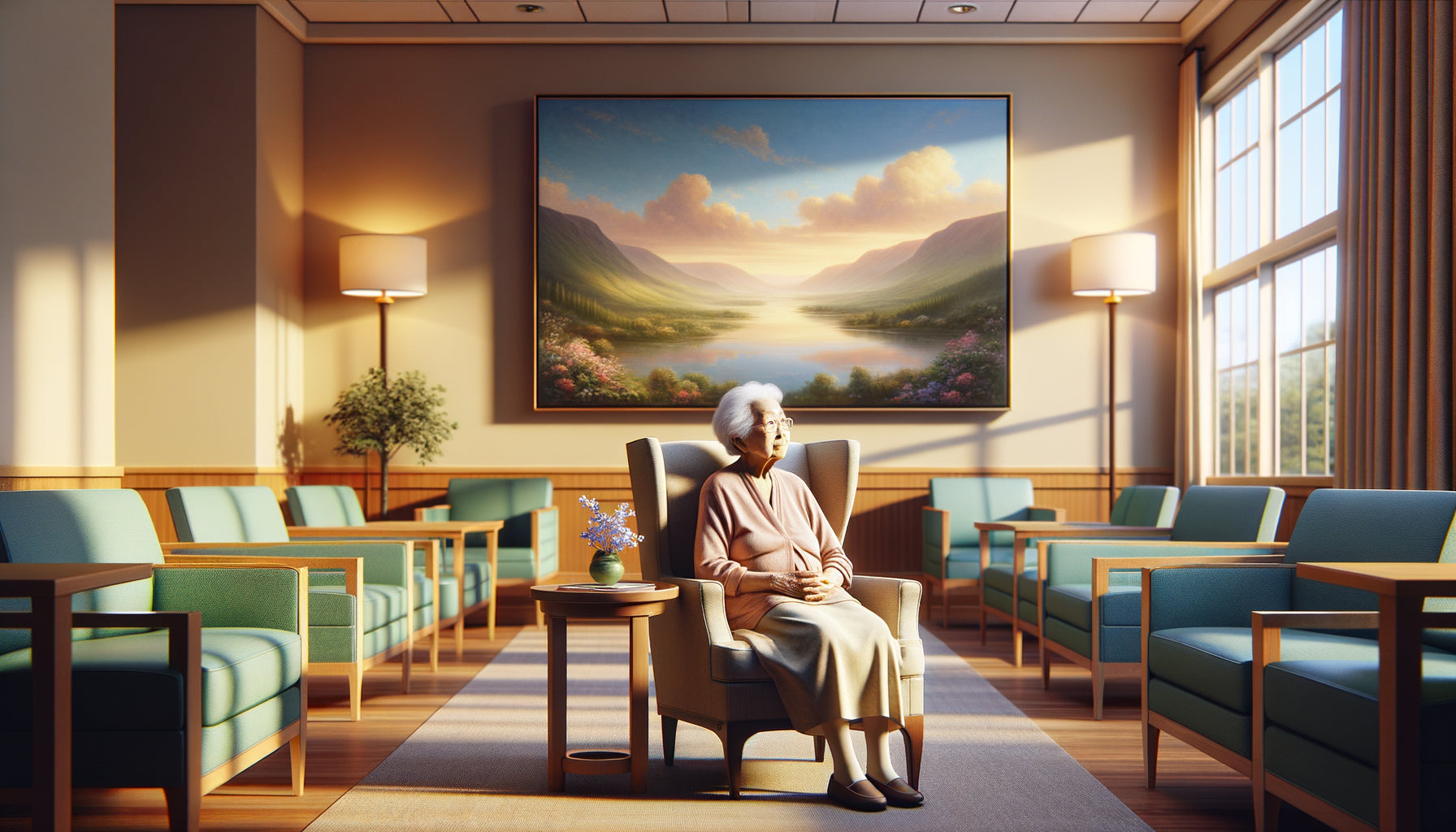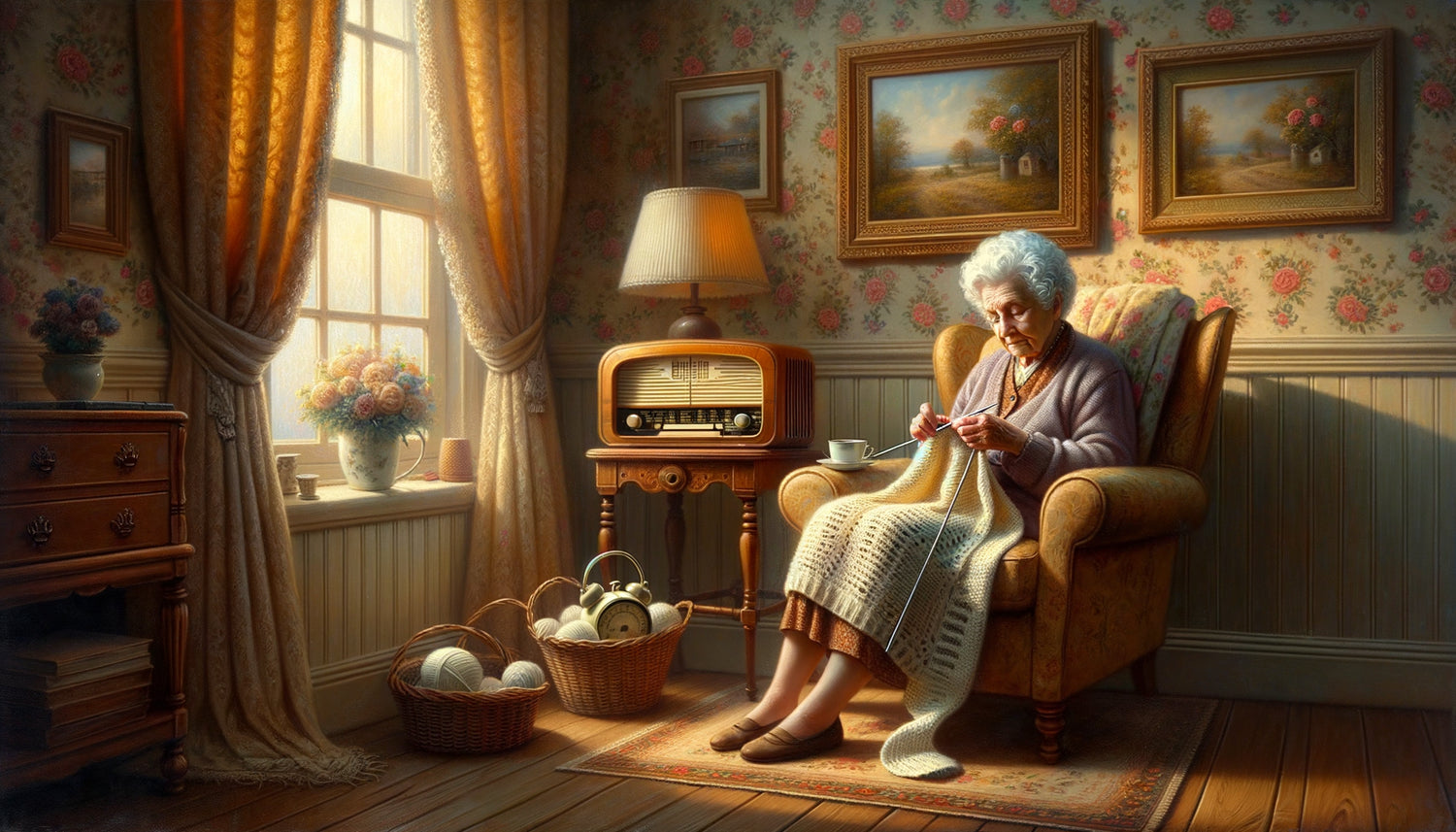
In the living room of the residence where I installed a new collection this week, an 82-year-old woman stopped for a long time in front of a painting depicting a simple smoking teapot placed near a window. Tears welled up in her eyes. “That's exactly the one I had in my kitchen,” she whispered to me. This moment crystallizes fifteen years of observations as a space planning advisor for care facilities: paintings of mundane everyday scenes possess an extraordinary comforting power with seniors.
Here is what these representations of daily life concretely bring: they create emotional bridges with the past, generate a feeling of continuity in a constantly changing world, and offer soothing visual anchors in sometimes destabilizing environments.
Many families and care facility managers wonder why their elders seem less receptive to abstract or spectacular contemporary works. Why does a painting of a bread basket or a sleeping cat capture more attention than a modern composition that is supposedly more “decorative”? This misunderstanding can create frustration when choosing artworks for the living spaces of seniors.
Rest assured: this preference for mundane everyday scenes is neither a lack of taste nor an aesthetic regression. On the contrary, it is a deep psychological response to specific needs that emerge with age. Understanding these mechanisms allows you to radically transform the atmosphere of a place of life.
In this article, I reveal the emotional and cognitive levers that explain why paintings of mundane everyday scenes have such a reassuring effect on seniors, and how to choose the right representations to create a truly soothing environment.
Memory embodied: when the banal becomes precious
Mundane everyday scenes act as autobiographical memory triggers. A painting depicting a bouquet of lavender in a vase, vegetables on a kitchen table, or an armchair near a lamp is never simply decorative for a senior. These images reactivate deeply buried sensory memories: the smell of morning coffee, the texture of a embroidered tablecloth, the slanting light of late afternoon.
I have observed residents with mild cognitive impairments regaining surprising lucidity in front of a painting showing a market scene. The mundane details – crates of fruit, old scales, merchants' aprons – unlock entire stories. “My father owned a grocery store,” “I went to Les Halles every Saturday,” “These apples were called reinettes.”
This immediate recognition creates a reassuring sense of cognitive control. Faced with abstract or conceptual works, many seniors experience frustration: they seek meaning, a story, a connection. Paintings of mundane everyday scenes offer this narrative evidence that soothes the mind rather than soliciting it into the unknown.
The mirrored effect of experience
Ordinary daily scenes act as temporal mirrors. They reflect back to seniors a validating image of their own history. A painting showing a woman making jam is not just a pretty rural scene: it's the validation of a skill, the recognition of an era when these gestures were everyday, essential, passed down from generation to generation.
This visual validation is particularly crucial in a modern world that can give seniors the feeling that their references, their habits, their lifestyle are outdated. Paintings of ordinary daily scenes silently say: "What you have experienced had value. These simple moments were beautiful."
Cognitive readability: landmarks in complexity
With age, the brain naturally seeks to save cognitive energy. Ordinary daily scenes present a narrative clarity that does not require interpretive effort. A senior can instantly identify the elements of a painting showing an interior with a teapot, cups, and an open book. This immediate readability provides a precious mental respite.
In my interventions in nursing homes, I have found that paintings with simple and recognizable compositions generate less anxiety than works with multiple interpretations. Faced with an abstract canvas, some residents express their discomfort: "I don't understand what it is," "It means nothing." This incomprehension can rekindle insecurities related to cognitive decline.
Conversely, paintings of ordinary daily scenes offer total accessibility. No artistic training, specific cultural references or abstraction skills are required. A basket of vegetables is a basket of vegetables – this obviousness is deeply reassuring.
The comfort of familiar proportions
Ordinary daily scenes generally respect a human scale and recognizable proportions. A table seen at eye level, a window with its panes, a garden with its path. These familiar compositions create neither vertigo nor spatial disorientation, unlike some modernist perspectives or deconstructed compositions that can generate visual confusion in older people.

When the mundane becomes an emotional anchor
Tableaux of mundane everyday scenes create what I call "islands of permanence" in a changing environment. For a senior in assisted living, facing a new place, unfamiliar faces, and a reinvented routine, these images of familiar daily life become essential emotional anchors.
A breakfast scene – a steaming cup, buttered toast, a folded newspaper – is not spectacular. But it refers to a comforting ritual, a reassuring continuity. "Life goes on," the painting seems to say. "These simple gestures you know still exist."
I accompanied a family looking for artwork for their father's recently installed assisted living room. We chose three paintings of mundane everyday scenes: a carpenter’s workshop, a dog sleeping near a fireplace, and a bicycle leaning against a wall. The son confided to me two months later that his father commented on them daily, recounting his own memories from these images. The paintings had become memory companions.
Soothing nostalgia versus melancholy
There is a crucial nuance: mundane everyday scenes must evoke gentle nostalgia, not heavy melancholy. A painting showing an old-fashioned kitchen with its copper utensils generates a feeling of warmth. But a scene too evocative of loss (an abandoned house, an empty table) can instead accentuate the feeling of grief.
The best representations for seniors are those that show life in its quiet continuity: used objects, inhabited spaces, moments suspended but not frozen in the past. This subtle distinction makes all the difference between comfort and sadness.
Scenes that spark conversation
A often underestimated benefit of paintings of mundane everyday scenes: their ability to generate conversations. Faced with an abstract work, exchanges remain superficial or embarrassed. Faced with a scene of cherry picking or ironing, personal stories abound.
In the common areas of assisted living facilities that I design, paintings of mundane everyday scenes become social catalysts. “I also had a coffee grinder like that,” one resident says. “My grandfather raised chickens exactly as in this painting,” another replies. These micro-exchanges break isolation and create connections around shared references.
For caregivers and families, these works also become mediation tools. Rather than directly asking “How are you?”, they can start with “Does this painting remind you of something?”. This indirect entry often frees speech more authentically.

Choosing the right scenes: essential criteria
Not all everyday scene paintings are created equal for a senior audience. After hundreds of installations, I have identified key criteria to maximize the reassuring effect.
Brightness: prioritize scenes bathed in natural and soft light. Too dark or twilight atmospheres can generate an oppressive atmosphere. A sunny kitchen, a garden in the morning, a room lit by a window create a feeling of soothing openness.
Clean composition: too many elements create visually tiring clutter. The best everyday scenes have a few clearly identifiable objects, in an airy composition. A basket of fruit and a pitcher on a table work better than a cluttered still life.
Soft colors: pastel tones, natural shades (beiges, soft greens, sky blues) are more soothing than violent contrasts. Paintings of everyday scenes with harmonious palettes reduce excessive visual stimulation.
Evocative era: for seniors born in the 1930s-1950s, scenes representing the 1940s-1970s resonate particularly well. Rotary phones, enamel coffee makers, vintage bicycles, these authentic details create a powerful generational connection.
Universally reassuring themes
Some everyday scenes transcend generations and social backgrounds: the table set for the meal, the reading corner near the window, the vegetable garden, the resting pet, traditional kitchen objects, sewing or DIY scenes. These representations activate common memories in most life journeys.
On the other hand, some scenes that are too specific (rare professional activities, very particular hobbies) can create distance if residents do not recognize themselves in them.
Offer the visual comfort your elders deserve
Discover our exclusive collection of wall art for senior residences that transform living spaces into havens of sweetness and memory.
Installation: Where and How to Position These Wall Art Pieces
The placement of wall art depicting mundane everyday scenes directly influences their reassuring power. In bedrooms, prioritize the wall facing the bed: it's the first and last image of the day. Choose a particularly gentle scene, such as a tranquil countryside landscape or a warm interior.
In common areas, position the wall art depicting mundane everyday scenes at eye level when seated. Many seniors spend their time sitting; a piece that is too high becomes invisible and loses its ability to provide comfort.
Corridors benefit from series of wall art depicting mundane everyday scenes telling a progression: the seasons, moments of a day, stages of an activity (from the garden to the table, for example). This visual narration transforms a simple movement into a contemplative stroll.
Avoid overloading walls. Three to four well-chosen pieces in a space are better than a dozen creating visual saturation. The eye must be able to rest, not be constantly engaged.
When Mundane Scenes Become Extraordinary
Paradoxically, what we qualify as « mundane » in everyday scenes becomes extraordinary through its power of emotional connection. I have seen entire families reconcile around a painting depicting a simple scene of apple picking, each sharing their own memories, creating a bridge between generations.
Wall art depicting mundane everyday scenes are not « inferior » art or a default choice. They are visual therapeutic tools that respond to deep psychological needs: need for continuity, recognition, connection with one's personal history, cognitive rest.
In a world that values innovation, disruption, and spectacle, these images of everyday life remind us that beauty often lies in the gentle repetition of simple gestures. For our elders who have experienced so many upheavals – wars, technological revolutions, social changes –, these mundane scenes are refuges of stability.
By choosing wall art depicting mundane everyday scenes for seniors' living spaces, you are not simply decorating walls. You are creating memory companions, story triggers, islands of gentleness in the sometimes tumultuous flow of old age. You offer visual validation that their life, with its simple gestures and ordinary moments, was beautiful and deserves to be celebrated.
The next time you stop in front of a painting depicting a steaming teapot or a cat sleeping in the sun, observe it through the eyes of a senior. You might see, as I do, much more than a mundane image: a door open onto a world of precious memories, a gesture of visual tenderness, a hand reaching out to the past that soothes the present.
FAQ
Do everyday scene paintings also suit seniors with dementia?
Absolutely, and they are even particularly beneficial. Mundane everyday scenes stimulate long-term memory, which is often better preserved than recent memory in people with cognitive impairments. A painting showing a familiar scene can trigger buried memories and offer soothing moments of lucidity. Opt for very simple compositions, with few elements, in soft colors. Avoid overly busy scenes that could generate confusion. Representations of everyday objects from the 1940s-1960s work particularly well as they refer to adulthood, often the best anchored in memory. These paintings become valuable mediation tools for caregivers and families, offering entry points into the inner world of the person.
Should reproductions or original works be preferred?
For the reassuring effect sought, the question is less about originality than about the quality of the representation and its ability to evoke authentic memories. A beautiful reproduction of a well-chosen everyday scene will have more impact than an abstract original work. The essential thing is the clarity of the image, the quality of the colors (no garish or faded tones), and the readability of the scene. Canvas reproductions offer a pleasant texture that recalls traditional painting. Invest in a good, understated frame that enhances the image without overloading it. For residences, prioritize medium formats (40x60 cm to 60x80 cm) which are visible without being overwhelming. The decisive criterion remains: does this scene speak to those who will look at it daily? Does it evoke positive and familiar memories?
How to avoid these paintings appearing too « old-fashioned » for the staff and visitors?
This is a legitimate concern, but it's based on a misunderstanding: well-chosen mundane everyday scenes are not tacky, they are timeless. The key lies in the aesthetic quality of the work. Favor paintings with clean compositions, in a realistic style but not academic or kitsch. Avoid scenes that are too « postcard » or sentimental (kittens with ribbons, overly idealized English cottages). Instead, look for authentic representations, with a real luminous presence, which capture the poetry of everyday life without falling into sentimentality. Scandinavian interior scenes, Dutch-inspired still lifes, or French rural scenes in an Impressionistic style offer this timeless elegance. A simple contemporary framing (natural wood, thin white or black frame) immediately modernizes the whole thing. Remember that these paintings primarily serve the residents – their emotional comfort takes precedence over visitor aesthetic considerations.