Last week, while installing a collection in a senior residence in Versailles, I observed a resident stop abruptly in front of a scene depicting a Provençal market. Her eyes misted over. “That's exactly the market from my childhood in Aix,” she murmured. This emotion is not an isolated case: nostalgic paintings transform collective living spaces into intimate refuges of memories.
Here’s what nostalgic paintings bring to senior residences: they stimulate positive emotional memory, create conversational bridges between residents, and personalize spaces that are sometimes perceived as too neutral. These works are not mere decorations; they become silent companions that tell the story of an era, a youth, a familiar world.
Many families hesitate: isn't this reinforcing a form of withdrawal into the past? How to choose artworks that touch without saddening? What is the limit between comforting nostalgia and paralyzing melancholy? These questions are legitimate, especially when you want to offer a stimulating and joyful living environment.
Rest assured: research in environmental psychology demonstrates that healthy nostalgia improves the well-being of older people. Nostalgic paintings, when chosen carefully, become catalysts for sharing, triggers for stories, and bridges between generations during family visits.
In this article, you will discover why senior residences favor these works, how they positively influence the daily lives of residents, and above all, how to select nostalgic paintings that transform a place of residence into a true home.
Positive nostalgia: a fundamental psychological need
Contrary to popular belief, nostalgia is not synonymous with sadness. Studies in social gerontology show that positive memories of the past strengthen self-esteem, reduce anxiety and create a sense of identity continuity. In senior residences, where landmarks change, this connection to one's personal history becomes crucial.
Nostalgic paintings act as comforting temporal anchors. A scene of a riverside guinguette, a countryside landscape with hay bales, a street in Paris from the 1950s: these images do not freeze in the past; they celebrate a richness of life. I have observed that in individual rooms, a painting depicting a familiar era instantly creates a sense of belonging.
In common areas, nostalgic paintings work differently. They become spontaneous conversation topics. “Did you know the trams? ” “This grocery store looks like the one in my neighborhood!” These exchanges break isolation and create bonds between residents who discover shared backgrounds.
What nostalgic themes resonate most with residents?
After equipping more than thirty residences, certain constants emerge. Scenes of everyday life from the past are a resounding success: bustling markets, neighborhood cafes, children playing in the street, flower sellers. These nostalgic paintings capture a lost sociability that resonates deeply.
Idealized rural landscapes also occupy a privileged place. Even for people who have always lived in cities, these representations of the countryside – traditional farms, paths lined with poppies, villages with their church – evoke childhood vacations, grandparents in the country, a France before mass urbanization.
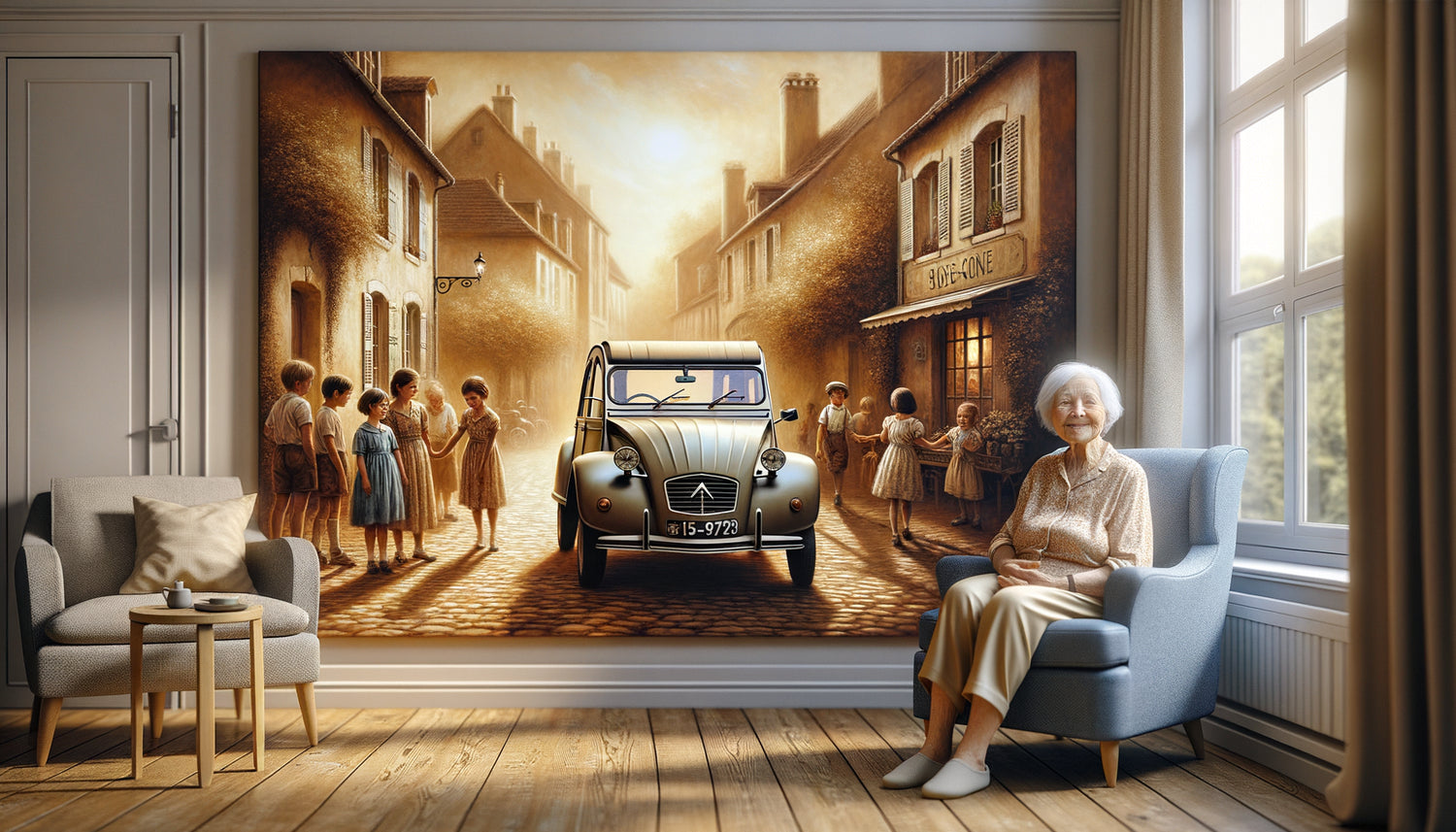
Vintage means of transport constitute a third popular category. Bicycles in front of a bakery, old Citroën cars, steam locomotives: these elements trigger very specific memories. One resident told me for twenty minutes about his first train journey thanks to a painting depicting a station from the 1940s.
The importance of seasons and forgotten trades
Nostalgic paintings representing the four seasons in their traditional version create a reassuring cycle: autumn harvests, snowy Christmas markets, cherry blossoms in spring, summer harvests. This seasonal rhythm recalls an era when people lived in tune with nature.
Disappearing trades – knife sharpener, dairymaid, bicycle postman, washerwomen – are particularly fascinating. These nostalgic paintings honor a world of manual and close-knit work that many residents have known. They validate their experience, recognize the value of their time.

The art of choosing without falling into melancholy
Not all nostalgic paintings are equal. The boundary between comforting nostalgia and heavy sadness lies in a few crucial details. Favor lively scenes, with characters interacting. Avoid compositions that are too dark or subjects evoking loss, loneliness, abandonment.
Colors play a decisive role. Nostalgic paintings with warm tones – ochres, golden beiges, soft greens, pastel blues – create a welcoming atmosphere. Palettes that are too gray or marked sepia can accentuate an impression of a bygone world rather than a living memory.
Artistic quality is immensely important. A nostalgic painting should not be kitsch or caricatural. Senior residents have a rich visual culture and recognize the difference between a work that respects their intelligence and a low-end reproduction. Opt for high-definition prints or, even better, reproductions of masterpieces.
Adapt themes to life experiences
A residence in the Mediterranean region will favor nostalgic paintings evoking the South: Provençal markets, pétanque games, lavender fields. In Brittany, maritime scenes, fishing ports, traditional headdresses will resonate more strongly. This geographical consistency reinforces territorial anchoring.
For residences hosting former city dwellers, retro urban scenes – café terraces, storefronts from bygone eras, square with a bandstand – work wonderfully. The important thing is that residents can project themselves: “I lived this, I knew this.”
Where to place nostalgic paintings to maximize their impact?
In individual bedrooms, a nostalgic painting above the bed or facing the relaxation chair creates a soothing focal point. It is often the last image seen before falling asleep and the first upon waking. Choose a particularly personal scene, in dialogue with the resident if possible.
Corridors, often neglected, become galleries of collective memory thanks to nostalgic paintings. A chronological or thematic series transforms daily movement into a sensory stroll. I have seen residents deliberately slow down to savor each work.
In dining rooms and common lounges, large-format nostalgic paintings act as windows in time. Positioned at eye level when seated, they accompany meals and moments of relaxation. Avoid food-related subjects (too literal), prefer scenes of conviviality.
Specific therapeutic spaces
In specialized units for people with cognitive disorders, nostalgic paintings take on a therapeutic dimension. Simple images, with few elements but very identifiable – a cat in front of a fireplace, a bouquet of roses, a red bicycle – stimulate memory without overwhelming.
Activity rooms benefit from nostalgic paintings related to pastimes: dancing, reading, gardening, board games. These works unconsciously prepare for the activities offered and value skills acquired throughout life.

Testimonials: When Nostalgic Paintings Transform Everyday Life
Marguerite, age 87, confided in me that the painting depicting an old haberdashery in the hallway brings her back to her career as a seamstress. “Every time I walk past it, I see my hands sewing again. I feel useful again.” This sense of identity continuity is precious when so much changes.
In a residence in Loire-Atlantique, a nostalgic painting showing children leaving elementary school has created an unexpected ritual: every afternoon, several residents gather in front of it to share memories of their school days. Staff have installed a small bench. The artwork has become a place of life.
Jacques, whose mother lives in an EHPAD (Establishment for Dependent Elderly People), testifies: “Before, our visits often went around in circles. Since she hung this painting of a flower market in her room, she tells me anecdotes from her youth that I had never heard before. It's as if the painting releases buried memories.”
Give more than decoration, create a bridge to precious memories
Discover our exclusive collection of paintings for senior residences that transform living spaces into refuges of memory and sharing.
Beyond Decoration: The Therapeutic Power of Images
Healthcare teams note that nostalgic paintings facilitate their relational work. Rather than directly addressing a resident's mood, they can start with the image: “Does this scene remind you of something?” The painting becomes a mediator, allowing emotions to be expressed that are otherwise difficult to verbalize.
In art therapy, these works serve as structured reminiscence supports. The therapist uses a nostalgic painting as a starting point for a session, encouraging residents to share their associated memories. This technique improves group cohesion and values each person's history.
For families, nostalgic paintings offer intergenerational dialogue keys. Grandchildren discover the world of their elders through these images. “What was it like, Grandma, when there were no supermarkets?” Transmission happens naturally, through visual curiosity.
Measurable benefits on well-being
Several studies in geriatric environments show that personalized wall art with nostalgic themes reduces adaptation anxiety when entering a residence. Resident satisfaction rates increase significantly in establishments that integrate these memorial dimensions into their decor.
Nostalgic paintings also help to reduce wandering behavior in disoriented individuals. Familiar images create reassuring visual landmarks, structuring the space more intuitively than simple signage.
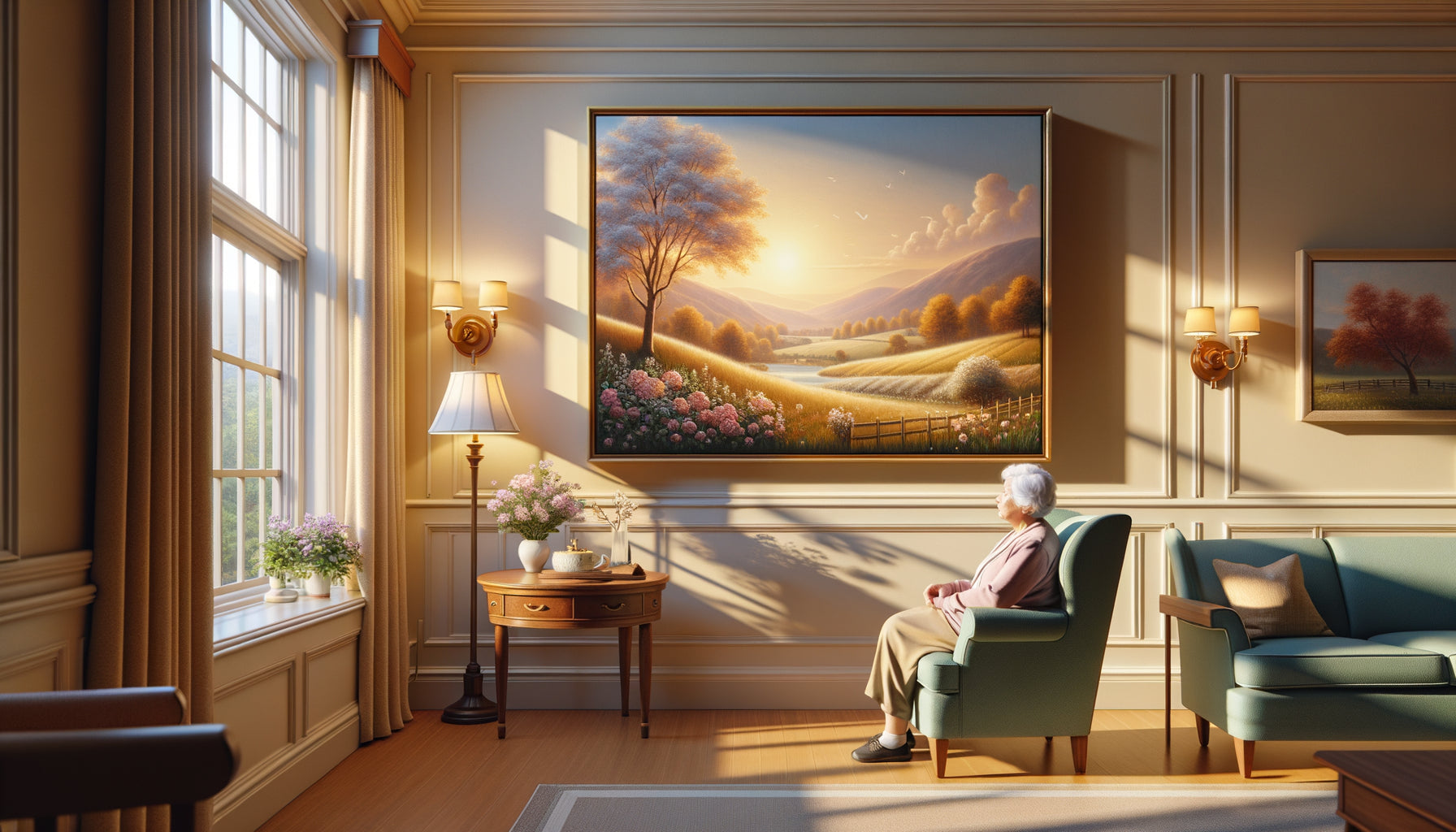
Imagine your loved one, comfortably seated in their armchair, gazing at a landscape that reminds them of Sundays at their grandparents' house. A subtle smile appears. For a few moments, the residence fades away, and an entire life returns, gentle and present. Nostalgic paintings are not windows to the past, but bridges between who we have been and who we remain.
Start by observing your loved one's personal photographs, listen to their spontaneous stories: you will find the themes that resonate. Then choose not the most beautiful painting, but the one that will tell their story, create their conversation, prolong their presence in the world. It is this attention that transforms a bare wall into a companion of life.
Frequently Asked Questions
Could nostalgic paintings risk making residents sad?
This is a common but unfounded concern when the works are well chosen. Positive psychology research demonstrates that healthy nostalgia, that which evokes happy memories, improves mood and strengthens self-esteem. The key lies in selection: prioritize joyful scenes, moments of conviviality, bright landscapes. Avoid images evoking loss, loneliness or mourning. A nostalgic painting depicting a lively market or children playing does not create sadness; it celebrates a richness of life. Residents themselves clearly distinguish between comforting nostalgia (“it was good”) and paralyzing melancholy (“everything is over”). Nostalgic paintings, when chosen with discernment, belong to the former category and become positive emotional companions.
How do I choose a nostalgic painting if I don't know my loved one's past well?
Excellent question that deserves a methodical approach. Start by browsing photo albums together noting recurring themes: urban or rural setting, seaside or mountains, professional activities. Listen carefully to spontaneous anecdotes: they reveal emotionally significant memories. If dialogue is difficult, consult other family members or ask caregivers which topics elicit positive reactions from your loved one. In the absence of specific information, opt for universal themes of the era: market scenes, neighborhood cafes, traditional French countryside landscapes. These generic but authentic images resonate with most people who lived in France in the 1930s-1960s. You can also start with a more neutral nostalgic painting and observe reactions: does it light up when he sees it? Does he tell stories? This first work will guide you towards more personalized choices.
What size painting to choose for a bedroom in a senior residence?
The optimal dimension depends on the available space and viewing distance. For a standard residence room (15-20m²), prioritize a medium format of 60x80 cm or 70x90 cm for the main painting. This size remains visible from the bed and armchair without dominating the limited space. If you want to create a small gallery, prefer several formats of 40x50 cm or 30x40 cm arranged harmoniously. In larger common areas, large-format nostalgic paintings (100x140 cm or more) create a real visual impact. Also consider the hanging height: in the bedroom, position the center of the painting at about 1.50 m from the floor, slightly lower if your loved one spends a lot of time sitting or lying down. Visibility from daily resting positions is paramount. Remember that residences often have specific rules regarding wall mounting: check with management before installation.