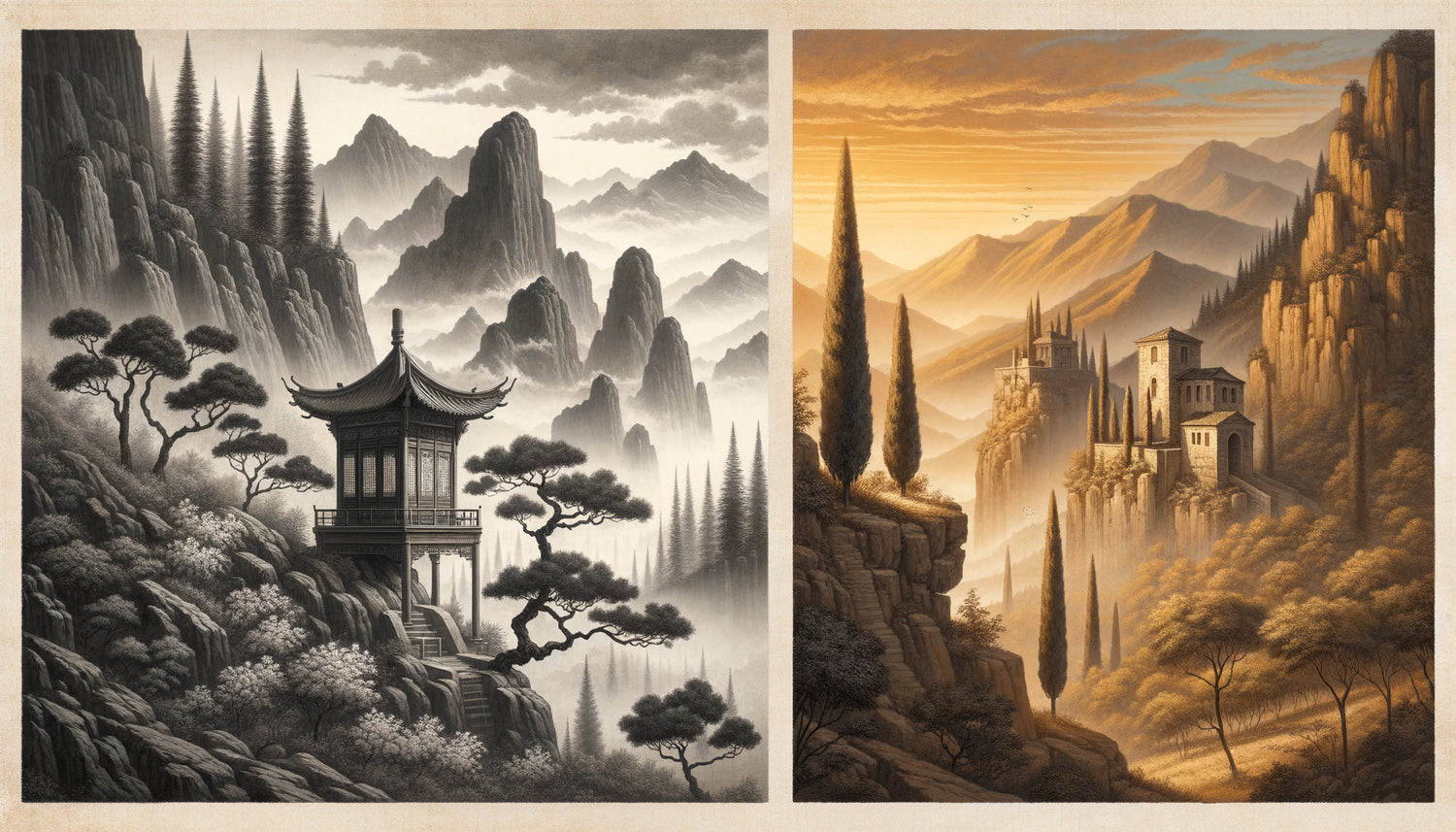
Imagine this scene: a small structure nestled in the hollow of a misty mountain, suspended between sky and earth. In a Chinese silk painting from the 11th century, as in an Italian canvas from the 16th century, this same motif appears: the hermitage, a solitary refuge dialoguing with the immensity of the landscape. Striking, isn't it? How have two civilizations separated by thousands of kilometers, without significant direct contact before the 17th century, developed this common fascination for this particular motif?
Here is what this artistic convergence reveals: a universal spiritual quest for contemplation, an architecture of retreat that transcends cultural boundaries, and a shared philosophy of harmony between man and nature. This kinship between Chinese and Italian art confronts us with an obvious fact: certain archetypes resonate beyond civilizations, as if the human soul were everywhere seeking the same refuges to recharge.
Yet, when faced with our contemporary paintings, we often lack this symbolic depth. We see a pretty house in a landscape, without perceiving the monumental philosophical weight it carries. This hermitage topos is not a decorative coincidence: it is a key that opens up to unsuspected dimensions of our relationship with the world.
Rest assured, this exploration requires no knowledge of art history. Simply a new look at these compositions that have crossed the centuries. And perhaps, a desire to rediscover how the space in your interior can dialogue with these same timeless aspirations for contemplative retreat.
The spiritual roots: when retreat becomes wisdom
In traditional Chinese art, the hermitage is part of a long Taoist and Buddhist tradition. From the Tang dynasty (618-907), scholar-painters like Wang Wei made mountain retreats an existential ideal. Shanshui (mountain and water painting) systematically integrates these modest structures perched, often barely visible, as if to emphasize the humility of man in the face of the cosmos.
These Chinese hermitages are never dominant in the composition. On the contrary, they blend into the mists, nestled between dizzying peaks, accessible by winding paths. This reduced scale is not a technical detail but a philosophical statement: man does not seek to conquer nature, but to dissolve harmoniously within it.
In parallel, Italian art develops its own relationship with the hermitage, but under the influence of Christian eremitism. The figures of Saint Francis of Assisi, Saint Jerome or Saint Anthony Abbot have popularized the image of the saint withdrawn into the wilderness. In Bellini, Mantegna or later Claude Lorrain, the hermitage becomes a recurring motif in landscapes: cave aménagée, small isolated chapel, cell carved into the rock.
However, a fundamental difference emerges. In Italian painting, even when withdrawn, the hermit maintains a link with Christian divinity. The Italian hermitage is often accompanied by religious symbols: cross, sacred book, meditative skull. It is less about merging with nature than finding in solitude a privileged space for prayer and penance.
The architecture of retreat: small structures, great meanings
Observe carefully these hermitages in Chinese landscapes: they are almost always of extremely simple construction. A thatched roof, a few pillars, sometimes just a simple rocky platform sheltered. This architectural modesty translates the Taoist concept of wuwei, non-action, absence of artifice.
Chinese painters of the Song dynasty (960-1279) perfected this art of suggesting rather than describing. The hermitage appears in a few economical brushstrokes, integrated into the mountain like a natural outgrowth. This economy of visual means reflects an economy of existential means: living with little, far from the complications of the world.
In Italian Renaissance art, the hermitage takes on more diverse forms but remains marked by rusticity. In Giorgione or in Venetian landscapes of the 16th century, these structures often feature appropriated ancient ruins, arranged caves, transformed shepherd's huts. There is a romantic dimension of noble decadence, a return to essentials through the vestiges of past grandeur.
Italian landscape masters of the 17th century, such as Salvator Rosa, will accentuate the dramatic character of these hermitages, placing them in wild and tormented environments. Architecture then becomes the focal point of a tension between civilization and raw nature, between human control and elemental forces.
Strategic placement in the composition
In both traditions, the placement of the hermitage obeys subtle rules. In Chinese art, it generally occupies the lower or middle third of the composition, never the inaccessible summit. This intermediate position suggests a spiritual path in progress, a progressive elevation rather than an immediate transcendence.
Italian landscape artists, influenced by linear perspective, often place the hermitage at the vanishing point or slightly offset, thus creating a depth that invites the eye to journey towards this refuge. This technical difference reveals two conceptions of the spiritual journey: circular and ascending for the Chinese, linear and directional for the Italians.

Nature as sanctuary: two visions, one aspiration
The topos of the hermitage rests on a fundamental premise shared by Chinese and Italian art: nature possesses a spiritual value superior to the corrupt city. This conviction runs through cultures with remarkable consistency.
In Chinese philosophy, particularly among Taoist and Confucian scholars dissenting from power, the mountain represents the place where one finds the Dao, the original principle. The hermitage is not an escape but a return: a return to authenticity, simplicity, cosmic harmony. Landscapes with hermitages do not show solitude as punishment, but as fulfillment.
Christian Italy shares this valorization of wild nature as a space of revelation. The Desert Fathers, the saintly hermits, established a tradition where natural retreat allows for purification of the soul and proximity to God. In landscapes by Patenier or the Flemish primitives influencing Italy, the holy hermitage contrasts with distant cities, often depicted as Babylonian and corrupt.
But be careful: the motivations differ subtly. The Chinese scholar retreats to cultivate his inner self and sometimes indirectly criticize an unjust power. The Christian saint retreats to combat temptations and draw closer to the divine through deprivation. Two forms of asceticism that produce surprisingly similar iconographies.
When two worlds converge without touching
This similarity between Chinese and Italian art raises a fascinating question: how can we explain this convergence without significant direct cultural contact before the 17th century?
Art historians invoke the concept of Jungian archetype: certain images emerge spontaneously in the human collective unconscious because they respond to universal psychological needs. The hermitage in the landscape would thus be a visual response to a common existential tension: the need for solitude in the face of social demands, the aspiration for austerity in the face of material complexity.
Other specialists prefer an anthropological explanation: all advanced agricultural civilizations have experienced periods of rapid urbanization creating, as a reaction, nostalgia for simple and natural life. Hermitages in artistic landscapes would then be imaginary compensations, psychological safety valves against urban alienation.
Some indirect contacts existed via the Silk Road, but they are too tenuous to explain this profound thematic convergence. Venetian travelers like Marco Polo brought back descriptions of China, but rarely precise aesthetic concepts. This trope developed in parallel, proof that the human mind takes similar paths when facing similar questions.
Late influence and mutual reception
In the 18th century, when exchanges intensify, Europe truly discovers Chinese aesthetics. Decorative chinoiserie seizes European courts. English gardens, influenced by descriptions of Chinese gardens, incorporate contemplative pavilions, picturesque bridges, decorative hermitages. But it is often a superficial, aesthetic reading that misses the original philosophical depth.
Conversely, Chinese scholars of the late Qing dynasty discover Western painting through the Jesuits. They are sometimes surprised to recognize in Italian landscapes this same quest for harmony between human architecture and natural immensity. Some modernist Chinese painters of the 20th century, trained in Europe, will create fascinating syntheses where the two traditions blend.

What these landscapes tell us today
In our era of hyperconnection and visual saturation, the topos of the hermitage in the landscape regains a disturbing relevance. These Chinese and Italian paintings speak of a rare luxury: chosen solitude, suspended time, space for contemplation.
Integrating a painting representing these landscapes with hermitages into your interior is inviting this meditative dimension into your daily life. It's not simply decoration, it's a window onto a philosophy of life. Every glance cast upon this small structure nestled in the immensity reminds us that there is another possibility, a saving retreat.
Contemporary interior designers are rediscovering this evocative power. In a minimalist living room, a large Chinese landscape painting with its hermitage barely visible creates a visual breath, a vanishing point for the eye and mind. In an office, a reproduction of an Italian landscape with an eremitic hermitage introduces a spiritual depth that salutarily contrasts with professional agitation.
Connoisseur art lovers are precisely seeking out these works for their ability to transform the atmosphere of a space. A landscape with a hermitage does not decorate a wall: it opens up an existential perspective. This explains their constant value on the art market, their presence in major museums, and their lasting influence on contemporary creation.
Transform your interior into a contemplative refuge
Discover our exclusive collection of landscape paintings that capture this timeless essence of retreat and harmony with nature.
Towards a new reading of your space
The next time you contemplate a landscape with hermitage, whether inspired by Chinese or Italian art, take a moment to identify the elements we have explored. Observe the scale of the structure in relation to the natural immensity. Notice its position within the composition. Feel the invitation to retreat that it silently formulates.
These paintings are not relics of the past, but always current proposals. They suggest to us that at the heart of contemporary chaos, we too can cultivate spaces of retreat – physical or mental. That our urban apartment becomes, through the grace of a well-chosen work, that point of balance between engagement with the world and the need for withdrawal.
The topos of the hermitage in Chinese and Italian art ultimately teaches us this: the most refined civilizations have always understood that true wealth sometimes lies in chosen austerity, in that small structure perched where the essential can finally reveal itself. And it is precisely this ancestral wisdom that you invite into your home by welcoming one of these landscapes onto your walls.
Frequently Asked Questions about Landscapes with Hermitages
Why does the hermitage appear so small in these landscapes?
This proportion is never accidental. In both Chinese and Italian art, the smallness of the hermitage compared to the natural immensity expresses a philosophy of humility. The message is clear: the accomplished man does not seek to dominate nature, but to find his rightful place in the cosmic order. This reduced scale also invites the viewer to a contemplative effort: one must search for the hermitage within the composition, just as the sage must seek the right path in the tumult of the world. It is precisely this discretion that gives these works their meditative power. When you hang such a painting in your home, this tiny detail paradoxically becomes the focal point of your daily meditation, a constant reminder of the value of retreat and simplicity.
Do Chinese and Italian hermitages have the same spiritual meaning?
They share a common aspiration for contemplative retreat, but with important nuances. The Chinese hermitage is rooted in a Taoist and Buddhist tradition where solitude allows one to find harmony with the Dao, the universal principle. It is a return to natural authenticity, often tinged with social criticism of imperial court corruption. The Italian hermitage, on the other hand, is anchored in the Christian tradition of eremitism: solitude there is a space for spiritual combat, penance and prayer. The holy hermit retreats not to merge with nature, but to draw closer to God through asceticism. Despite these theological differences, both traditions converge on an essential point: nature offers a sanctuary for the soul that urban civilization cannot provide. It is this universal aspiration that makes these paintings so powerful in our contemporary interiors.
How to integrate a landscape painting with hermitage into a modern decor?
These works possess a timelessness that blends remarkably well with contemporary interiors, especially if they prioritize minimalism and clean lines. In a living room with neutral tones, a large format Chinese landscape with hermitage creates visual and spiritual depth without weighing down the space. The trick is to treat it as a contemplative window rather than just a decorative element. Place it facing your favorite relaxation area – reading chair, meditation space, office corner. Italian landscapes with hermitages, often more dramatic, work beautifully in rooms with character: libraries, offices, bedrooms with a cocooning atmosphere. Avoid overloading the wall: these paintings need space to breathe, just like the hermitages they depict need natural immensity to reveal their meaning. A simple frame, in natural wood or matte black tones, reinforces their presence without competing with them.