Imagine a landscape where the earth trembles and exhales sulphurous vapors, where fire bursts from the entrails of the mountain in a spectacle both terrifying and sublime. Italian volcanoes have long haunted the European imagination, oscillating between divine threat and natural wonder. But at what precise moment did these giants of lava transition from the status of mystical phenomena to that of objects of rational observation and simultaneous artistic inspiration?
Here is what this unique convergence between science and art has brought: a new way of looking at nature, the emergence of the sublime landscape as a major artistic genre, and the birth of modern volcanology. Three revolutions that have transformed our relationship with the natural world.
For centuries, contemplating a volcano meant fearing the wrath of the gods. Scholars were content with ancient quotations, artists with conventional allegories. How to understand the moment when everything shifted, when direct observation replaced superstition, when the brush and notebook found themselves side by side facing the crater?
This transformation did not happen in a day. It is the result of a particular alchemy between nascent scientific curiosity and new aesthetic sensitivity, in a specific place: Southern Italy in the 18th century.
I invite you on this fascinating journey where Italian volcanoes became simultaneously laboratories and workshops, catalysts for an intellectual revolution that continues to influence our way of decorating our interiors with representations of the wild nature.
The Grand Tour: When European aristocracy discovers Vesuvius
In the 1730s, a social phenomenon radically transforms the approach to Italian volcanoes. The Grand Tour, this initiatory journey of young European aristocracy, begins to include Naples and its surroundings in its mandatory itinerary. Suddenly, Vesuvius is no longer an abstract threatening mention in Pliny's texts, but a tourist destination.
These wealthy young travelers, accompanied by their cultured tutors, are no longer content with visiting the Roman ruins. They want to experience the volcanic phenomenon, climb to the crater, feel the heat of the fumaroles, bring back samples of cooled lava as souvenirs. This fashion creates an unprecedented demand for accurate visual representations of Italian volcanoes.
Artists flock in. Pietro Fabris, a British painter based in Naples, begins to produce extraordinarily detailed watercolors of Vesuvius erupting. But his particularity? He works closely with William Hamilton, the British ambassador to Naples and obsessive observer of volcanic phenomena. For the first time, the artist's eye and that of the scientist converge before the same spectacle.
This collaboration produces in 1776 Campi Phlegraei, a revolutionary work where fifty-four illustrated plates document volcanic manifestations with unprecedented precision. Art no longer simply decorates science: it becomes its instrument of investigation. Colors, textures, and games of light in the pyroclastic flows are no longer mere embellishments but essential scientific data.
1748: Pompeii Resurrects and Changes Everything
The systematic discovery of Pompeii from 1748 onwards constitutes a cultural shockwave. Here is an entire city, frozen in its agony by Vesuvius in 79 AD, which gradually emerges from the ashes. The impact on the European imagination is colossal.
The volcano is no longer simply a spectacular natural phenomenon: it becomes an agent of history, capable of preserving or annihilating entire civilizations. This awareness simultaneously stimulates scientific study of past eruptions and artistic fascination with the destructive power of nature.
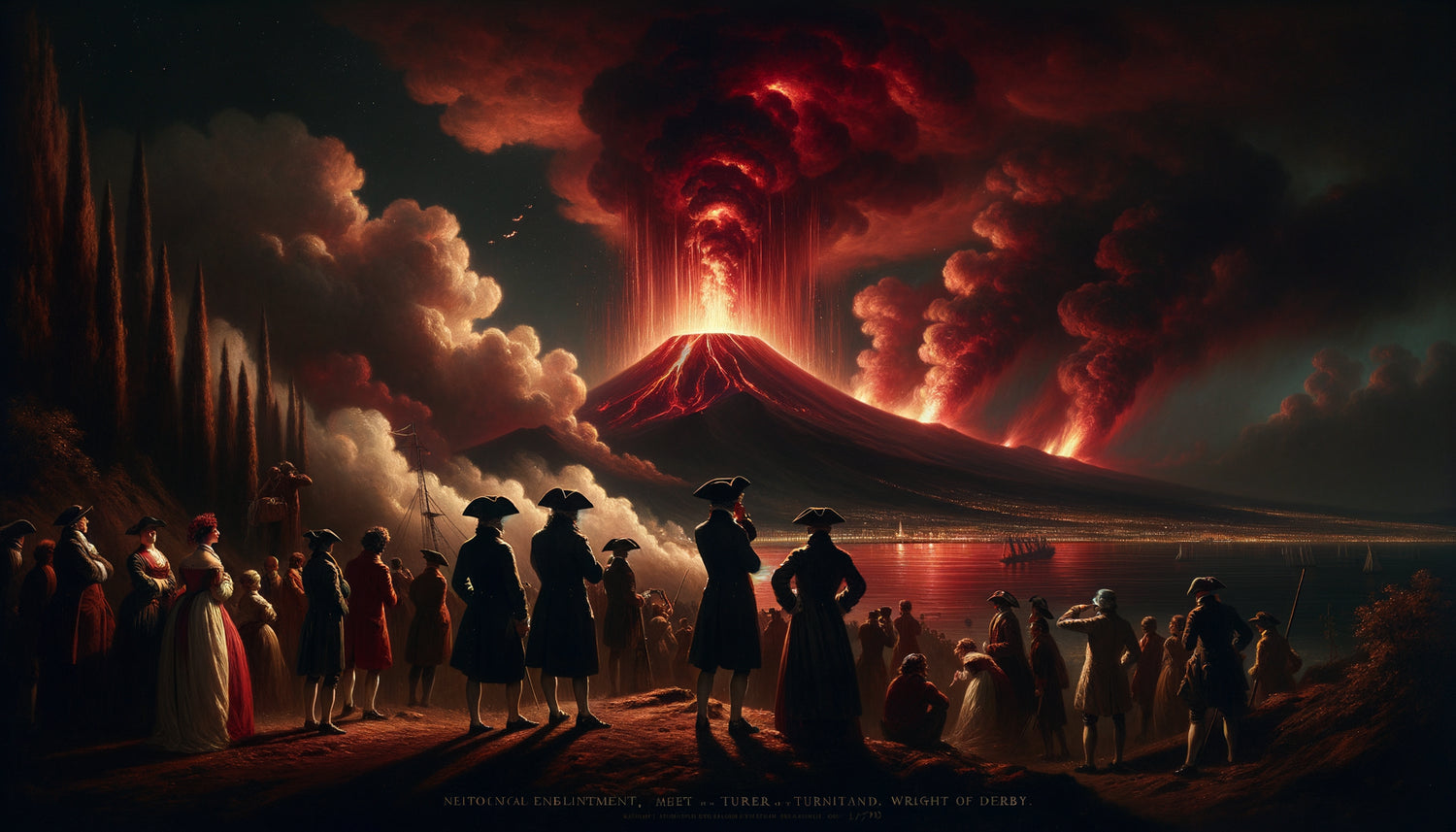
Painters multiply on the site. They no longer represent imaginary landscapes populated by mythological figures, but precise visual documents of exposed geology, layers of ash, petrified lava flows. Joseph Wright of Derby creates his famous painting of Vesuvius from Portici in 1774, where topographical accuracy is combined with a dramatic treatment of light that heralds romanticism.
Scientists, for their part, use the ancient testimonies discovered in the ruins to reconstruct the course of the historical eruption. This nascent volcanic archaeology requires precise visualization, a reconstruction process where the artist's controlled imagination becomes indispensable to the scientist's reasoning.

The Birth of the Sublime: When Terror Becomes Beauty
In 1757, Edmund Burke publishes A Philosophical Enquiry into the Origin of Our Ideas of the Sublime and Beautiful. This aesthetic theory will radically transform the representation of Italian volcanoes.
The sublime is that paradoxical emotion in the face of what overwhelms and terrifies us while also fascinating us.
Volcanoes perfectly embody this category. They are sublime by essence: dangerous, unpredictable, powerful, but magnificent. Artists realize that they can now paint terror as a legitimate subject, or even as the noblest expression of nature.
This aesthetic liberation coincides with advances in scientific observation. Déodat de Gratet de Dolomieu, Lazzaro Spallanzani, and then Alexandre von Humboldt multiply expeditions to Italian volcanoes in the 1780s-1800s. They measure, collect, classify. But all recognize that their textual descriptions are insufficient: they need artists to capture the phenomena they observe.
Humboldt, a universal scientist, explicitly theorizes this convergence. In his *Vues des Cordillères* (1810), he asserts that the artistic representation of nature is not merely an ornament but an epistemological necessity. One cannot understand a volcano without seeing it represented with accuracy and sensitivity. The science of Italian volcanoes becomes inseparable from their visual representation.
The volcanic workshop: Turner, Goethe, and others at the foot of the crater
In 1819, J.M.W. Turner made his first trip to Italy. He climbed Mount Vesuvius, and this experience transformed his art. His watercolors of the volcano no longer seek precise topographical description but attempt to capture the energetic essence of the phenomenon: the heat, the movement, the chromatic violence of the eruptions.
Simultaneously, Italian volcanologists such as Carlo Gemmellaro and Domenico Scinà published treatises where illustrations became increasingly sophisticated. Geological cross-sections, maps of lava flows, diagrams of eruptive plumes require both artistic and scientific mastery.
Goethe, during his trip to Italy (1786-1788), perfectly embodies this dual approach. An amateur mineralogist and poet, he climbed to the top of Mount Vesuvius with his notebook and watercolor box. His descriptions of the volcano inextricably blend rigorous scientific observation and aesthetic emotion. He measures, he classifies, but he feels and he paints.
This period saw the emergence of a new type of professional: the scientific illustrator specializing in volcanic phenomena. These artists master geology, understand eruptive processes, but also possess the talent necessary to make the invisible visible: internal dynamics, material flows, chemical transformations. Their works adorn cabinets of curiosities and bourgeois salons with equal legitimacy.

Vesuvius Observatory: the institutionalized convergence
In 1841, Ferdinand II of Bourbon founded the Vesuvius Observatory, the first permanent volcanological observatory in the world. This institution crystallizes the convergence between scientific and artistic approaches to Italian volcanoes.
The observatory does not merely install seismographs and collect samples. It systematically employs professional artists tasked with visually documenting each eruptive phase. These images are not mere decorative illustrations: they constitute primary scientific data, analyzed and compared from one eruption to another.
Successive directors of the observatory, such as Luigi Palmieri, were equally concerned with the aesthetic quality of representations as with their factual accuracy. They understood that scientific communication requires images capable of moving a cultured audience, sparking interest, and visually conveying what figures alone cannot transmit.
This approach permanently influences the representation of volcanoes in decorative art. Volcanic panoramas become sought-after elements for refined interiors, embodying both scientific modernity and a taste for sublime nature. Owning an accurate engraving of Mount Vesuvius erupting is to assert one's belonging to an enlightened elite, sensitive to both beauty and knowledge.
The contemporary legacy: when lava inspires our interiors
This historical convergence between science and art facing Italian volcanoes has created a vast visual heritage that continues to inspire contemporary decoration. The incandescent colors of lava flows, the dramatic contrasts between the blackness of slag and the red of magma, the organic shapes of volcanic projections have generated a aesthetics of fire and stone that is still alive.
Contemporary photographs of Stromboli or Etna perpetuate this dual requirement: to scientifically document a geological phenomenon while producing an emotionally powerful image. The best volcanologists are both rigorous technicians and sensitive artists, direct heirs to this tradition born in the 18th century.
In our interiors, hanging a representation of an Italian volcano is never a trivial gesture. It is summoning this long history of fascination, this tension between danger and beauty, this curiosity that drives humanity to observe closely what could destroy it. It is recalling that the most spectacular nature simultaneously requires the rigor of the scientist and the sensitivity of the artist to be fully understood.
Let the sublime power of volcanoes transform your space
Discover our exclusive collection of landscape paintings that capture this unique convergence between naturalistic precision and aesthetic emotion, for interiors that tell the story of our fascination with the wild nature.
Conclusion: The volcano as a mirror of our relationship to the world
The scientific and artistic convergence around Italian volcanoes in the 18th century is not merely an episode in cultural history. It represents a founding moment where humanity learned to look at nature with new eyes, simultaneously analytical and amazed.
Today, when you contemplate an image of Vesuvius or Etna, you inherit this double tradition. You see with the eyes of a scientist who understands geological mechanisms, and with those of an artist who feels the sublime. This richness makes volcanic representations particularly powerful elements for our living spaces.
Start by identifying in your interior a wall that deserves this dramatic intensity. A volcanic landscape is not decorative in the banal sense: it is transformative, it elevates the gaze and the spirit. Let this historical convergence between science and art continue to work its magic in your daily life.
FAQ : Your questions about Italian volcanoes in art and science
Why did Italian volcanoes specifically play this historical role?
Italian volcanoes, particularly Vesuvius and Etna, benefited from a unique accessibility in the 18th century. Naples was a major cultural capital, with developed scientific institutions and hosting an international artistic community. Vesuvius was located just a few hours' journey from the city center, allowing for repeated observations impossible for more isolated volcanoes. Furthermore, the discovery of Pompeii created a powerful emotional and historical link between these volcanoes and the cultivated European imagination. Etna, on the other hand, had been documented since antiquity and offered a fascinating regularity of eruptions. This unique combination of accessibility, visible volcanic activity, favorable cultural context and historical resonance made Italian volcanoes the natural laboratory where science and art learned to converge. No other volcanic site in the world brought together these conditions at the precise moment when modern scientific curiosity and the aesthetic sensitivity of the sublime emerged simultaneously in Europe.
How to choose an Italian volcano representation for my interior?
Choosing a volcanic representation for your space depends on the emotion you want to create and the dialogue you want to establish with your existing decor. Historical representations (18th or 19th century engravings) bring a cultural dimension and timeless elegance, perfect for classic or eclectic interiors that value historical depth. Contemporary photographs of nocturnal eruptions, with their incandescent reds and deep blacks, create dramatic focal points ideal for modern minimalist spaces where they can unleash all their visual power. Consider the scale: a volcano generally deserves a generous format that respects its natural monumentality. Also think about lighting: these images gain considerably from dedicated lighting that makes contrasts vibrate. Finally, reflect on the message: a violent eruption expresses raw power, while a dormant volcano evokes contained force, two very different energies for your space.
Does this science-art convergence still exist today in the representation of volcanoes?
Absolutely, and it is even more vibrant than ever, simply with different tools. Contemporary volcanic photographers such as the Krafft brothers (who died in 1991 on Mount Unzen) or Olivier Grunewald today perfectly embody this dual requirement. They work closely with volcanologists, deeply understand the phenomena they document, but at the same time create images of striking beauty that touch the general public. Modern technologies (drones, thermal cameras, time-lapse) allow for scientific visualizations that are also remarkable aesthetic works. Scientific institutions now explicitly value the visual quality of their communications, understanding that public awareness of volcanic phenomena comes as much from aesthetic emotion as from raw data. This tradition born with Italian volcanoes in the 18th century is therefore perpetuated, adapted to modern means but faithful to its fundamental principle: one can truly know nature only by combining analytical rigor and aesthetic sensitivity.