I spent fifteen years traversing the reserves of major European and Middle Eastern museums, consulting for private collectors seeking to enrich their collections with historical artworks. And each time I hold a 15th-century Persian miniature in my hands, then, a few rooms later, a Flemish landscape from the same era, I am struck by a fascinating revelation: clouds tell two radically opposed visions of the world. In Persian art, clouds float like stylized jewels, golden volutes suspended in a decorative sky. In Flemish art, they weigh down, accumulate, threaten or comfort with an almost palpable density. This difference is not merely a technical detail: it reveals fundamentally distinct aesthetic philosophies, spiritualities and relationships to nature. Here's what this comparison brings you: a deep understanding of two major pictorial traditions, keys to decoding the works you admire, and an inexhaustible source of inspiration for your own decorative sensibility. You might think that these subtleties are reserved for specialists, that distinguishing a Persian cloud from a Flemish cloud is beyond inaccessible erudition. Rest assured: once you have grasped the fundamental principles, you will never look at a painting in the same way again. I promise you that by the end of this article, you will know exactly why these two traditions represented the sky in such different ways, and how this knowledge can enrich your view of art.
The Persian cloud: a celestial ornament suspended in eternity
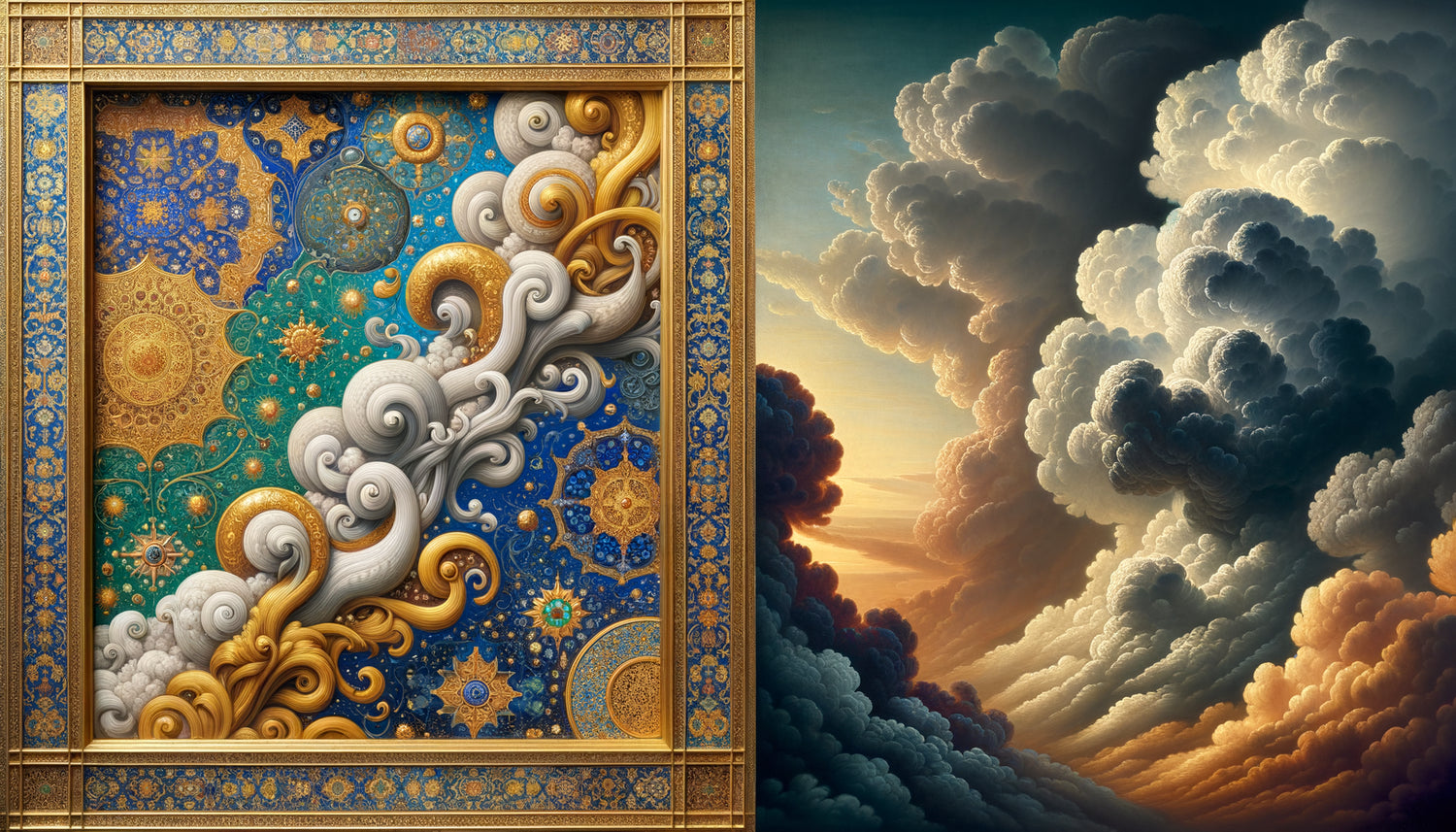
In Persian miniatures of the Timurid and Safavid dynasties, the cloud is never a meteorological phenomenon. It is an ornamental motif, a graphic sign that punctuates the composition like a golden comma in the manuscript of the sky. I have examined hundreds of folios from the Shahnameh or Nizami's Khamsé: clouds always appear in the form of sinuous volutes, undulating ribbons with clean contours, often enhanced with gold or lapis lazuli. Their shape sometimes resembles a crescent moon, sometimes a stylized flame, sometimes even a miniature dragon. This symbolic representation reflects the Persian conception of art: it is not about copying nature, but about transfiguring it. The Persian sky is a metaphysical space where divine harmony reigns. Clouds never cast shadows there, do not alter the light, do not portend any rain. They are decorative and immutable, suspended in an eternal present. This approach is rooted in an artistic tradition where perspective does not exist in the Western sense: space is flattened, hierarchical according to the narrative importance of elements, not according to their distance. Persian clouds therefore float on the same scale as the characters, creating a universe where the divine and the terrestrial coexist on the same pictorial plane.
When the Flemish capture the humidity of the Nordic sky
Now cross the Mediterranean and ascend to the Flanders of the 15th century. Here, Jan van Eyck, Rogier van der Weyden and their contemporaries revolutionize the representation of the sky. In their panels, Flemish clouds are complex, stratified atmospheric masses that seem to contain all the humidity of the Netherlands. I spent hours in front of The Ghent Altarpiece: the clouds are rendered with a quasi-scientific precision, showing different layers of condensation, subtle variations of gray, white and blue. This naturalist approach reflects the Flemish obsession with optical realism. Thanks to the perfection of oil painting technique, Flemish masters can create transparent glazes that mimic the real translucency of clouds. They intuitively understand atmospheric perspective: distant clouds are paler, less contrasted than those in the foreground. Their skies tell a meteorological story: one guesses the approaching storm, the clearing after the rain, the wind tearing through the cloud formations. This meticulous observation of nature is part of a spirituality that sees divine creation in every detail of the visible world. For the Flemish, representing a cloud faithfully is to honor God's work.

Two philosophies of light and space
The fundamental difference between these two traditions lies in their very conception of what an image is. Persian miniature art creates a symbolic space, an earthly paradise where every element is chosen for its beauty and meaning. The light there is uniform, golden, eternal. It comes from no specific source because it emanates from everywhere at once, manifestation of the divine presence. Persian clouds never disrupt this constant luminosity. They are transparent in a metaphysical sense: they let celestial light pass through without altering it. Conversely, Flemish art is part of an empirical observation approach. The light there has a source: often the setting or rising sun that pierces between the clouds. These latter become light modulators, creating areas of shadow and clarity, oblique rays that dramatize the scene. This approach reveals a different spirituality: God manifests himself in natural laws, in the physics of light and atmosphere. I have often noticed that collectors sensitive to abstraction and ornamentation prefer Persian compositions, while those seeking narrative emotion are drawn to Flemish skies.
The narrative role versus the decorative role
In a Persian miniature, the cloud is a visual punctuation mark. It defines spaces, separates narrative registers, guides the viewer's eye through the composition. Its stylized form is immediately recognizable, like a calligraphic character. In a Flemish painting, the cloud actively participates in the storytelling. A stormy sky heralds drama, a serene sky suggests divine peace. Flemish painters use cloud formations to create spatial depth: massive cumulus clouds in the foreground, wispy cirrus clouds on the horizon. This stratification creates the illusion of an infinite space, while the Persian space remains deliberately compressed, two-dimensional.
Contrasting pictorial techniques
The technique of the Persian miniature relies on applying opaque pigments, often enhanced with gold and silver, to a prepared paper. The outlines are sharp, traced with a fine brush or pen. The Persian cloud is constructed as a graphic object: outline first, then uniform color filling. Sometimes, floral or geometric motifs are incorporated into the cloud swirls, reinforcing their ornamental character. The Flemish technique is radically different. On a carefully prepared wooden panel, painters layer multiple transparent glazes of oil paint. A Flemish cloud may require ten to fifteen successive layers to achieve this vaporous quality, this imperceptible transition between illuminated and shaded areas. Some masters like Hugo van der Goes excelled in rendering cottony clouds, almost tactile. This technical approach reveals two relationships with time: the Persian miniature favors immediate clarity, Flemish painting cultivates gradual subtlety.

What these differences reveal about our relationship with art
Understanding why a Persian cloud resembles a golden jewel while a Flemish cloud evokes a suspended mass of water is accessing two complete worldviews. Persian art invites us to contemplate an ordered, harmonious universe where beauty lies in the stylization and repetition of perfect forms. It is an art of meditation, of quiet contemplation. Flemish art plunges us into the sensory experience of the world, its variations, its accidents, its changing light. It is an art of observation, of wonder at the complexity of reality. For your decorative choices, these two approaches offer radically different atmospheres. A reproduction of a Persian miniature will bring timeless elegance, ornamental serenity to your interior. A Flemish landscape will create contemplative depth, a window onto an atmospheric world. I have advised collectors who combine the two traditions in the same room: the contrast creates a fascinating dialogue between East and West, between abstraction and realism.
The legacy of these traditions in contemporary art
These two ways of representing clouds continue to influence contemporary artists. Painters who favor the decorative and graphic approach often draw, consciously or unconsciously, on the Persian heritage. Think of some works by Matisse or Klimt: their stylized skies, their repeated ornamental motifs evoke oriental miniatures. Conversely, hyperrealist artists or photographers who capture spectacular cloud formations extend the Flemish tradition of meticulous observation. In contemporary interiors, this duality is reflected in the choice between decorative abstraction and atmospheric realism. A painting with stylized clouds will work wonderfully in a clean, minimalist interior, where it will bring a touch of sophistication without overwhelming the space. A dense and dramatic Flemish sky will find its place in a more classic interior, creating a contemplative focal point.
Let the skies of the world transform your space
Discover our exclusive collection of landscape paintings that capture the magic of the skies, from stylized Persian compositions to contemplative Flemish atmospheres.
When you stand before your next artwork, take the time to observe how the artist has treated the sky. Is it an ornamental space where clouds dance like textile patterns? Or a dramatic atmosphere where cloud formations tell a meteorological story? This simple question will open the doors to a deep understanding of the work. Persian clouds will remind you that art can transform reality into decorative paradise, that beauty sometimes lies in simplification and stylization. Flemish clouds will teach you that meticulous observation is a form of spirituality, that each variation of gray holds a world of subtleties. Start today: visit a museum, browse an art book, observe the reproductions you already own. Look for clouds. Question them. They will reveal to you much more than pictorial techniques: they will tell you stories of civilizations, philosophies, looks cast on the same sky with such different eyes.
Frequently Asked Questions
Why don't Persian miniatures use perspective?
The question of perspective in Persian art reveals a different conception of representation. Persian miniaturists did not seek to create the illusion of a window on the world as European Renaissance artists did. Their goal was to present a symbolic and hierarchical vision of reality, where the narrative importance of an element determined its size and position, not its physical distance. This approach allows for several moments of a story to be told in the same composition, creating a rich and complex visual narration. Stylized clouds fit perfectly into this logic: they are not atmospheric objects located at a certain distance, but visual signs that structure the pictorial space. This absence of perspective creates a timeless, almost dreamlike space, which corresponds to the spiritual and poetic dimension of these works.
How did Flemish painters achieve such realistic skies?
The secret of Flemish skies lies in three revolutionary technical elements. First, the perfection of oil painting, which allows for transparent layers to be superimposed to create subtle transitions impossible with tempera. Next, an exceptional direct observation of nature for the time: these artists spent time studying cloud formations, variations in light, and atmospheric effects. Finally, an intuitive understanding of atmospheric perspective: they knew that air contains water vapor and particles that modify the perception of colors and contrasts with distance. Technically, a Flemish painter would begin with a precise preparatory drawing, then apply a clear base layer for the sky, on which he would superimpose multiple glazes to gradually build up the clouds. This method required considerable patience but produced results of striking realism that continue to amaze us six centuries later.
What style to choose to decorate a modern interior?
The choice between a Persian aesthetic and a Flemish approach depends entirely on the atmosphere you want to create. Compositions inspired by Persian art, with their stylized clouds and often golden and turquoise palette, work wonderfully in clean contemporary interiors. Their graphic and decorative character harmonizes with modern furniture with clean lines. They bring a touch of refined exoticism without visually weighing down the space. Conversely, landscapes with Flemish skies, with their atmospheric depth and more muted tones, create a contemplative focal point particularly suitable for relaxation spaces such as bedrooms or libraries. Their realism creates a virtual window that visually enlarges the room. A current trend is to mix influences: a large painting with a dramatic Flemish sky in a master room, accompanied by cushions or decorative objects with stylized Persian motifs. This dialogue between East and West, between abstraction and realism, creates a sophisticated visual richness that greatly enriches a contemporary interior.