Imagine a moment where you held in your hands a manuscript centuries old. On a page barely larger than a child's hand, an emerald and gold garden unfolds, so vibrant that you would swear to hear the murmur of fountains. The Persian miniatures of the Herat school, produced in the 15th century in present-day Afghanistan, reveal more than just artistic skill: they offer us a vision of the terrestrial paradise as conceived by the Timurid courts.
Here's what the garden in the Herat miniatures reveals: an architectured representation of the Islamic paradise, a space of royal power where nature is perfectly tamed, and a poetic vision where each flower, each tree carries a precise symbolism. These painted gardens are never mere decorations: they structure the pictorial space, frame literary scenes, and transform each page into a window open onto an ideal world.
Today, faced with the saturated imagery of our screens, we have lost this ability to marvel at a gracefully tamed space. We seek inspiration to create soothing interiors, but often ignore that the masters of Herat had already solved this equation six centuries ago.
Rest assured: understanding the role of the garden in these works requires no expertise in Islamic art history. You just need to learn to look at these green spaces as what they are: visual manifestos on harmony, structure and the meaning of the sacred in space.
I invite you on a journey through these miniaturized gardens, to discover how they can still inspire our interiors and our relationship with tamed nature.
The garden as a signature of the Herat school
The Herat school, under the patronage of Sultan Husayn Bayqara and his vizier Mir Ali-Shir Nava'i, transformed Persian miniature painting into an art of unparalleled sophistication. At the heart of this aesthetic revolution: the garden, treated not as a backdrop but as a protagonist in its own right.
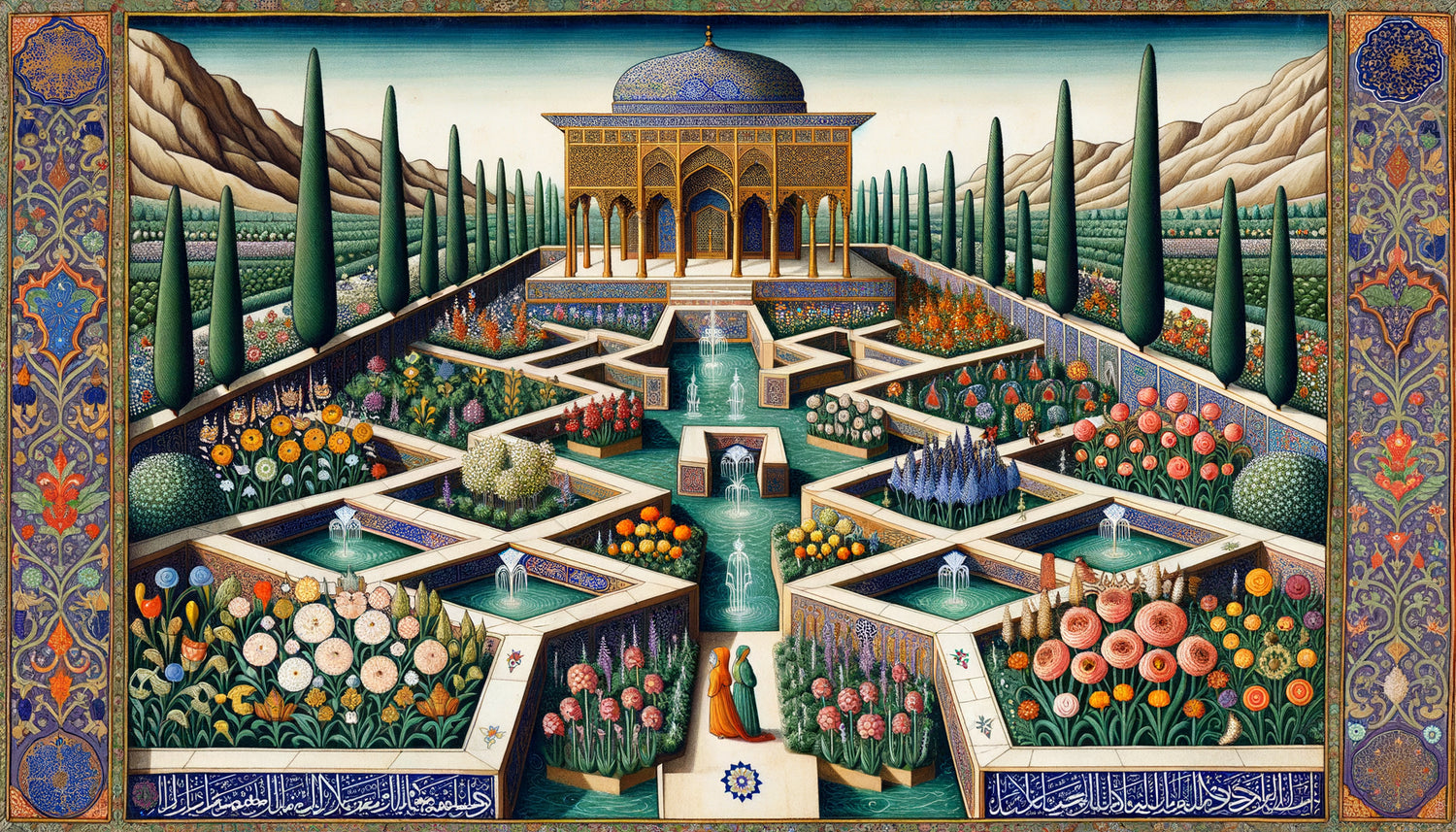
The masters of Herat, including the legendary Behzad, developed a representation of the garden radically different from their predecessors. Where earlier schools offered stylized landscapes, Herat introduces a rigorous vegetal architecture: geometric flowerbeds, straight irrigation canals, trees arranged according to perfect symmetries.
This approach reflects the Persian conception of the chahar bagh, the garden divided into four quadrants by waterways. In these miniatures, the garden becomes a metaphor for the ordered cosmos, where each element finds its place in a harmonious whole. The enclosure walls, often depicted in ochre brick or blue stone, delineate a space protected from external chaos.
When the garden becomes a visible paradise
The Persian word for garden, pardis, shares its root with the term paradise. This etymological kinship is never insignificant in the miniatures of Herat. Each painted garden embodies a vision of the Jannah, the Quranic paradise described as a garden where rivers of honey and milk flow.
Observe the fruit trees that dot these compositions: pomegranate trees laden with scarlet fruits, apple trees with elegantly curved branches, slender cypresses rising like green flames to the sky. Each carries a specific symbolism. The cypress evokes eternity through its persistent foliage. The pomegranate, with its countless seeds, symbolizes fertility and divine abundance.
The flowers also obey a codified language. Blue irises punctuate the meadows with a celestial glow, white and red roses converse in the flowerbeds, peonies unfurl their generous corollas. This lush vegetation is never disordered: it follows a visual choreography that guides the viewer's eye through the composition.
Water as a structuring element
In the Persian miniature gardens, water plays a cardinal role. Rectangular or octagonal basins, often at the center of the composition, reflect the sky and create a vertical dimension in these images. The canals that divide the space into geometric parcels are not mere ornaments: they recall the four rivers of the Koranic paradise.
The fountains, represented with astonishing architectural precision, bring movement and life. One can almost guess the crystalline sound of water flowing, a refreshing element in the arid climate of Central Asia. This aquatic presence transforms the garden into a civilized oasis, a triumph of human ingenuity over natural aridity.

The garden as a theater of literary scenes
The miniatures of the Herat school primarily illustrate poetic manuscripts: Nizami's Khamsa, Ferdowsi's Shah Nameh, or Jami's collections. In these narratives, the garden is never a mere backdrop: it is the privileged place for romantic encounters, royal audiences, contemplative moments.
Take the classic scene of Layla and Majnun, the tragic lovers of Persian literature. When Behzad represents them, he invariably places them in an enclosed garden, a space that is both intimate and symbolic. The trees surrounding them form a natural architecture, creating vegetal alcoves where exchanges take place. The garden becomes an accomplice to the lovers, a refuge from a hostile world.
Similarly, scenes of princely banquets unfold in lavish gardens. Sovereigns sit on thrones atop precious carpets laid directly on the flowering grass, surrounded by musicians and servants. The garden legitimizes royal power: it demonstrates the prince's ability to order nature, to create abundance where aridity naturally reigns.
A vegetal palette that defies time
The color in the gardens of Herat deserves particular attention. The pigments used – lapis-lazuli for deep blues, malachite for greens, vermillion for reds – have retained their brilliance through the centuries. This chromatic permanence echoes the very idea of eternal paradise.
Green naturally dominates, but in a surprising variety of shades. Tender and bright green meadows contrast with the dark green of cypresses, while the foliage of fruit trees declines a whole range of emeralds. This chromatic richness creates a remarkable visual depth despite the reduced format of the works.
Flowers bring colorful accents strategically placed. A parterre of red roses draws the eye to a central figure, blue irises create a vertical rhythm that balances the horizontal composition. Each touch of floral color seems to have been weighed, calculated for its visual impact.
Gold as divine light
In Persian miniatures from Herat, gold is not reserved for halos or architectural details. It sometimes nimbles the sky above the garden, transforming the atmosphere into a supernatural luminescence. This use of gold emphasizes the sacred character of the gardened space: it is not simply an earthly place, but a foretaste of celestial paradise.

The emotional perspective rather than the geometric one
A Western observer accustomed to Renaissance perspective might initially find these gardens of Herat strange. The trees in the background are not smaller than those in the foreground, canals do not converge towards a vanishing point, space seems tilted towards the viewer.
This inverted perspective obeys a different logic: it does not aim to create an illusion of depth, but to make all elements of the garden simultaneously visible. It is an omniscient, divine vision that embraces the entire gardened space as God contemplates his creation. Every flower, every tree deserves to be seen fully, without distance diminishing its importance.
This approach creates an immediate sense of intimacy with the garden. We are not distant spectators: we are invited to enter this space, to stroll mentally among the flowerbeds, to sit near the fountains. The miniatures of Herat act as portals to gardens that we can inhabit through imagination.
The Living Heritage of the Gardens of Herat
Five centuries after their creation, the Persian miniature garden paintings continue to influence our conception of harmonious spaces. Contemporary designers are rediscovering these principles: geometric division of space, structuring presence of water, thoughtful plant palette, enclosure that creates intimacy.
In our modern interiors, we can find this philosophy of a paradise garden. A floral arrangement is never arbitrary: as in the Herat miniatures, each flower can carry an intention, create a colorful balance, participate in an overall composition. Indoor plants, arranged with care, recreate this plant architecture on a small scale.
The idea of a garden as refuge resonates particularly strongly today. In a world saturated with stimuli, we yearn for these enclosed, ordered spaces where visible harmony reigns. The principles of Herat – soothing symmetry, the presence of water, domesticated vegetation – offer a timeless model for creating personal sanctuaries.
Transform your interior into a garden of contemplation
Discover our exclusive collection of landscape paintings that capture this timeless harmony between nature and architecture, to create in your home a space of serenity inspired by the Persian masters.
Your Own Domestic Paradise
The gardens of the miniatures of Herat teach us that paradise is not only a distant beyond: it is a state of harmony that we can cultivate here and now. These artists from the 15th century understood that a carefully ordered space, where each element finds its rightful place, soothes the mind and elevates the soul.
By contemplating these miniaturized gardens, we learn to see nature not as chaos to be dominated, but as a partner in creating beauty. Each tree planted with intention, each canal traced according to sacred geometry, each flower chosen for its color and symbolism: this is the living heritage of Herat.
Start modestly: observe how light plays in your living space, where a plant arrangement could create a soothing focal point, how an image of a harmonious garden could transform a wall into a window onto a more serene world. The masters of Herat have shown you the way to your own paradise.
Frequently Asked Questions about Gardens in Persian Miniatures
Why are gardens so prevalent in Herat miniatures?
Gardens occupy a central place in the miniatures of the Herat school because they embody the Islamic vision of paradise. In Persian culture and the Koran, paradise is described as a lush garden traversed by rivers, a striking contrast to the arid landscapes of Central Asia. Artists from Herat, working for refined princely courts, used the garden as a metaphor for royal power: the ability to create order and abundance where aridity naturally reigns. Moreover, these gardens served as an ideal setting for poetic and literary scenes that they illustrated, offering an intimate and symbolic space for romantic encounters, banquets, and contemplative moments. The garden was never simply a decorative backdrop but an essential narrative element that enriched the meaning of each scene.
How to recognize a typical garden of the Herat school?
A garden of the Herat school can be recognized by several distinctive characteristics. First, its rigorous geometric structure inspired by the traditional chahar bagh: the space is divided into regular sections by water channels or paths. Then, the systematic presence of water in the form of central basins, fountains, or irrigation canals that structure the composition. The plant palette is rich and symbolic: slender cypresses, identifiable fruit trees (pomegranates, apples), and flowerbeds dominated by roses, irises, and peonies. Colors remain vibrant thanks to precious pigments: bright greens, deep blues of lapis lazuli, vermilion reds. Finally, the particular perspective where all elements are visible simultaneously, without a decrease in size according to depth, creates this feeling of space that can be embraced with a single glance, like a divine view of a perfectly ordered earthly paradise.
Can we draw inspiration from Herat gardens to decorate our interiors today?
Absolutely, and in many ways! The aesthetic principles of the Herat gardens remain surprisingly relevant for creating harmonious interiors. You can adopt their approach to symmetry and geometry in the arrangement of your indoor plants or floral compositions. Their color palette – varied greens, deep blues, touches of red and gold – offers a sophisticated base for a decorative scheme. The idea of an enclosed garden translates into creating intimate corners in your living space, delimited by plants or screens. The presence of water, so important in these miniatures, can be evoked by an indoor fountain or even visual representations. Finally, integrating reproductions of Persian miniatures or paintings of landscapes inspired by this aesthetic literally transforms your walls into windows onto these paradisiacal gardens, bringing the contemplative serenity that the princes of Herat sought five centuries ago.