I discovered Oskar Kokoschka at an auction in Vienna twelve years ago. Before The Storm, I felt that particular vertigo that certain works provoke: the recognition of an emotion one believed to be unspeakable. His landscapes do not represent the world as it is, but as one feels it in our moments of inner chaos. The mountains undulate like waves, the skies swirl, the colors scream. This is what Kokoschka's tormented landscapes bring: unfiltered emotional liberation, an invitation to embrace the intensity of our own inner storms, and an artistic vision that transforms anxiety into raw beauty. You may wonder why an Austrian expressionist painter still fascinates contemporary collectors and decorators? Why his agitated canvases find their place in our modern interiors seeking authenticity? Rest assured: understanding Kokoschka is understanding a vital part of ourselves. I invite you to the universe of this artist who made torment a universal language.
A raw and vivid life: the roots of torment
To grasp why Kokoschka's landscapes vibrate with such intensity, one must delve into his biography. Born in 1886 in Pöchlarn, Kokoschka experiences both World Wars, sees Austria-Hungary collapse, survives a bullet wound to the head in 1915. But it is above all his passionate and destructive relationship with Alma Mahler, widow of the famous composer, that shapes his artistic expression.
Between 1912 and 1915, their tumultuous liaison pushes him to the brink of madness. Alma breaks up with him, Kokoschka enlists in the war as if to flee his pain. This period marks a turning point: his landscapes, already expressive, become truly tormented. Lines twist, perspectives distort, colors blaze. He no longer paints places, but geographic states of mind.
I was fortunate enough to study his sketchbooks at an exhibition in Prague. We see how a simple bridge over the Vltava transforms under his brush into a living, almost organic structure that seems to breathe and suffer. It is this ability to project human emotion onto the landscape that makes his work so powerful.
Expressionism as exorcism
Kokoschka belongs to the expressionist movement, but he is one of its most radical members. Where other expressionists stylize, he visceralizes. His landscapes are not simply deformed for aesthetic effect – they are tormented because they serve as receptacles for existential anguish.
Take Landscape of the Dolomites (1913): the mountains seem to convulse, the sky crashes down on the earth in a mixture of electric blues and blood reds. The touch is nervous, almost violent. One feels the stroke of the brush like a scratch on the canvas. This technique is not merely a stylistic choice – it is a psychological necessity.
Color as a cry
In my years of advising collectors, I’ve noticed that Kokoschka’s landscapes always provoke an immediate visceral reaction. His palettes adhere to no naturalist logic: a lake can be blood red, a sky sulfur yellow, a meadow violet. These chromatic choices express emotional intensity rather than visual reality.
This approach echoes our era where climate anxiety, social upheaval, and the search for meaning create an emotional climate similar to that of post-war Europe. This is why his works resonate with a disturbing modernity in our contemporary interiors.

Prague, London, Venice: geographies of the soul
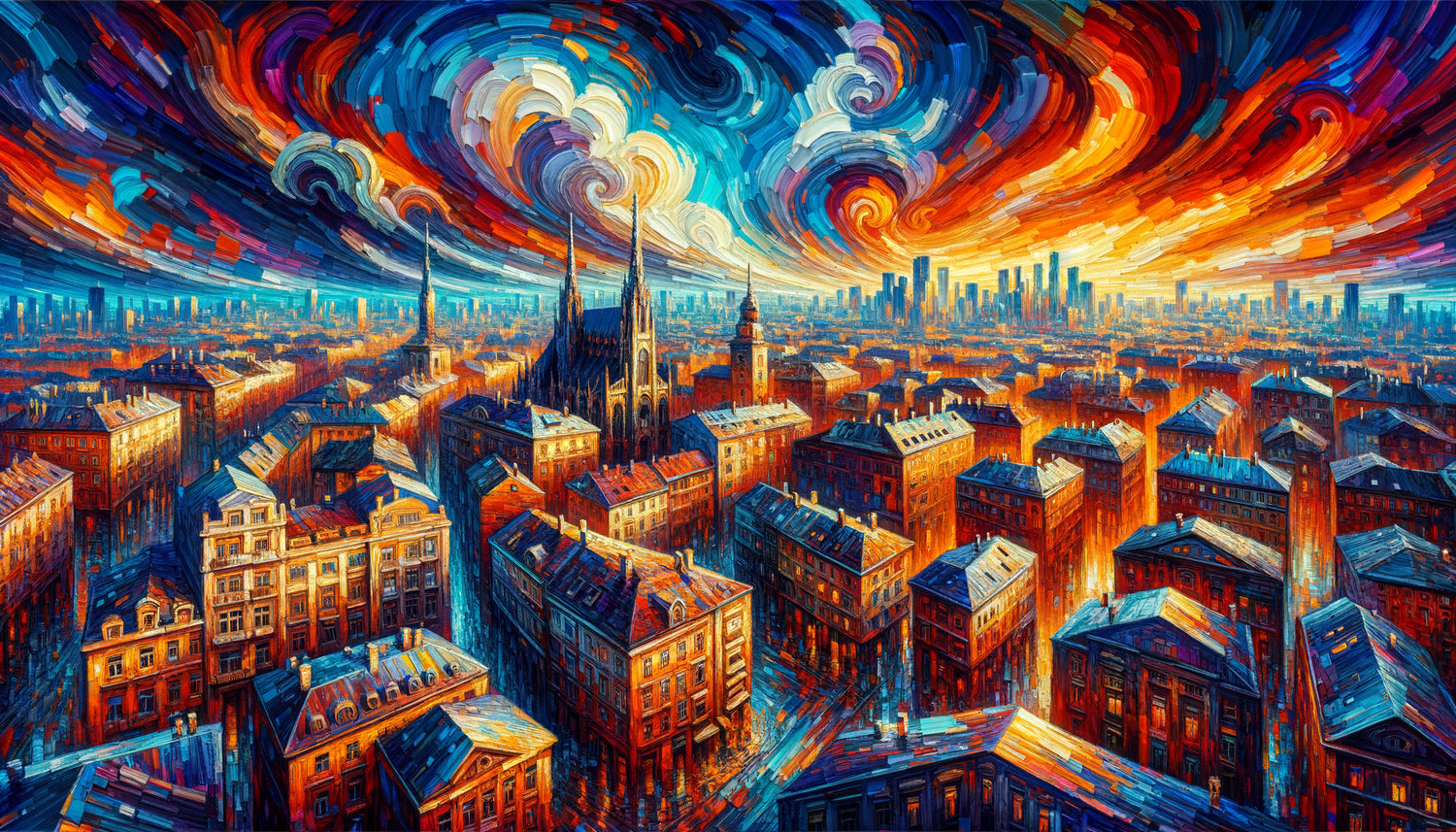
Kokoschka painted dozens of European cities, but none resemble a postcard. His Prague, the Charles Bridge (1934) transforms the Czech capital into a febrile organism. The Gothic towers stretch towards a tormented sky, the river carries unsettling reflections, historic architecture seems poised to collapse or take flight.
I compared his views of Prague with photographs from the time: the topographic resemblance is real, but Kokoschka injects a prophetic dimension. Painted in the 1930s, his urban landscapes visually anticipate the destruction to come. As if the artist perceived the underlying tensions of pre-Nazi Europe and projected them onto his canvases.
Exile as inspiration
Driven out by the nazis who qualify his art as “degenerate,” Kokoschka flees to Prague, then London. This perpetual exile further intensifies the torment of his landscapes. His views of London during the Blitz, of Edinburgh in the rain, of the misty Thames all bear the mark of an existential uprooting.
In my consultations for interior design projects, I often recommend reproductions of his exile landscapes for transitional spaces – entrances, hallways, offices. They perfectly express this contemporary mobility, this feeling of being always between two worlds.
The technique of torment: how Kokoschka paints the invisible
Technically, what makes these landscapes so tormented? Three major elements emerge from an analysis of his works.
First, the distorted perspective. Kokoschka often adopts dizzying bird's-eye views, as if observing from an airplane or a tower. This elevation creates a feeling of anxious overview, instability. The viewer never comfortably settles into the image.
Next, the gestural touch. Unlike the Impressionists who fragment light into delicate touches, Kokoschka applies paint with nervous, almost violent strokes. You can feel the speed of execution, emotional urgency. This apparent spontaneity is actually very controlled – the result of years of practice.
Finally, the dynamic composition. No line is static. Diagonals dominate, creating perpetual movement. Masses confront each other rather than balance each other. This compositional instability visually generates the feeling of torment that emanates from the whole.

Kokoschka in the contemporary interior
You might think that such emotional intensity is difficult to integrate into a living space. Think again. I have orchestrated several projects where reproductions of Kokoschka's landscapes create remarkable emotional anchor points.
In an industrial loft in Berlin, a large format of his Alpine Landscape with Church dialogues beautifully with the raw architecture – exposed concrete, metal structures. The torment of the landscape humanizes the industrial coldness, creating an unexpected balance.
In a renovated mansion house in Brussels, a triptych of his urban views rhythms a long hallway. The chromatic intensity and dynamism of the compositions transform a passageway into a true emotional gallery.
Balancing torment and everyday life
The secret? Don't try to « calm » Kokoschka with overly conservative decor. On the contrary, embrace the contrast. His tormented landscapes work wonderfully in clean, minimalist interiors, where they become the sole source of visual intensity. They create what I call a « fever point » – an element that raises the emotional temperature of the space without upsetting it.
For communal living rooms – living rooms, reception areas – prioritize medium formats. Intensity is dosed. For more intimate spaces – libraries, offices – dare to use large formats that wrap around the gaze and promote introspection.
Dare the intensity in your interior
Discover our exclusive collection of landscape paintings that capture the raw emotion and expressive power of the great masters, to transform your walls into true artistic statements.
The living legacy of a necessary torment
Kokoschka's landscapes remain tormented because they refuse the lie of the picturesque. At a time when travel photography and social networks smooth out reality in Instagram vignettes, his work reminds us that beauty can be violent, that authentic emotion is rarely comfortable.
This torment is not complacency or misery. It is a radical honesty to the complexity of the world and our inner lives. When looking at his convulsive Alps, his frenetic cities, his electric skies, we recognize our own agitation. And this recognition is profoundly cathartic.
In your living room, office or entrance hall, a landscape inspired by Kokoschka does not decorate – it dialogues. It questions, challenges, awakens. It refuses the passive role of decorative art to claim its primary function: to connect us to the raw power of human experience.
So yes, Kokoschka's landscapes are tormented. But isn't that precisely what we need in a world that constantly pushes us towards false tranquility and surface appeasement? His work allows us to fully inhabit our intensity, to transform our own torments into something visually, emotionally, deeply alive.