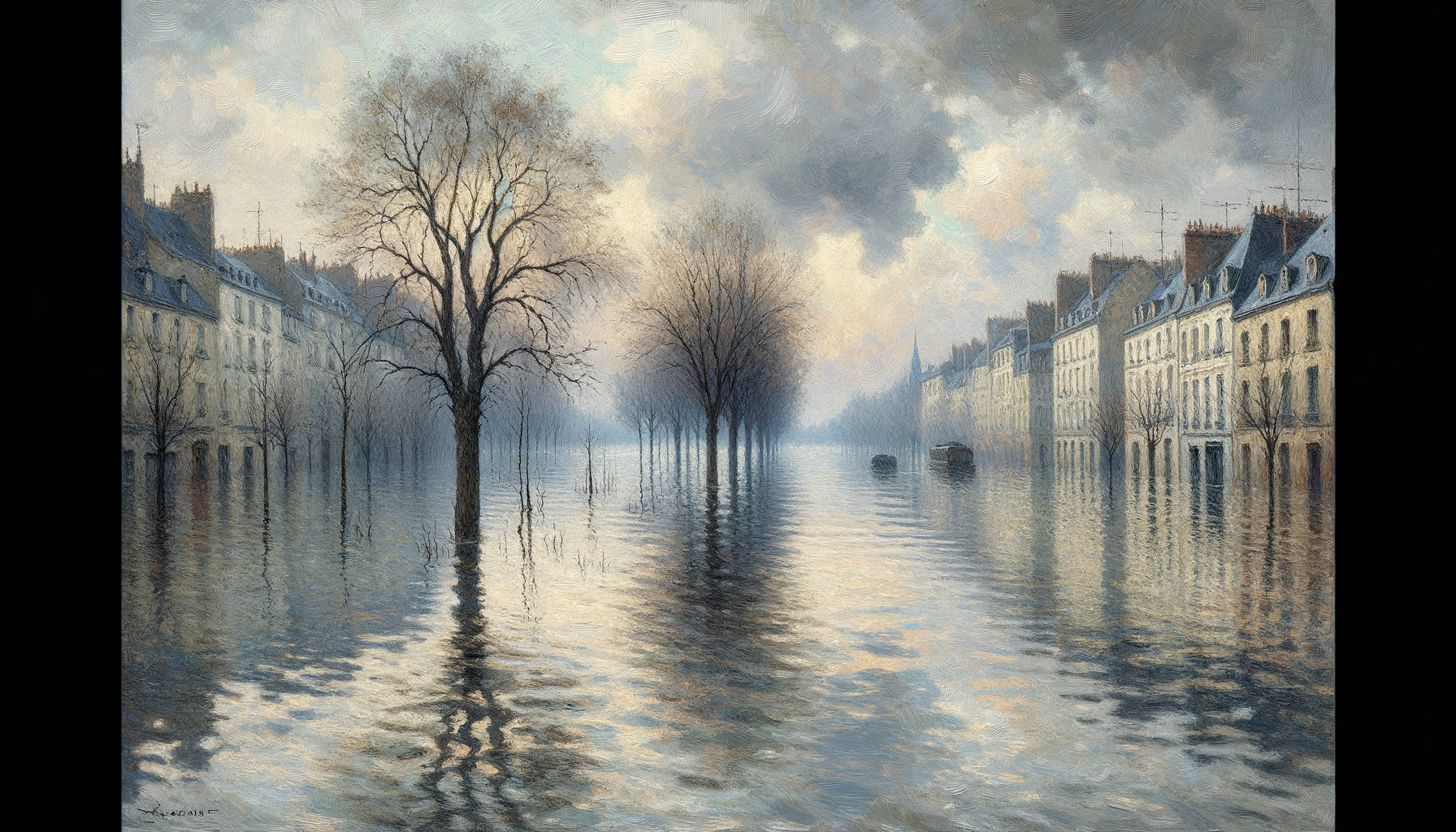
While browsing an auction in London, I discovered a small eighteenth-century mahogany cabinet. Inside, there were lenses, a tilted mirror and traces of dried ink. It was a painter's camera obscura from a Venetian master. Holding this instrument in my hands, I understood that Canaletto was not only a virtuoso of the brush: he was a scientific illusionist who had found the secret to capturing the soul of Venice with an almost photographic precision.
Here's what Canaletto’s mastery of the camera obscura reveals: a technical revolution that transformed light into architecture, a method for grasping impossible perspectives, and the art of sublimating reality while remaining faithful to its essence. For those seeking to understand how old masters created these hypnotic vedute that still adorn the most beautiful interiors, this exploration will open the doors to an eighteenth-century Venetian workshop.
Many admire Canaletto’s landscapes without grasping the technical genius behind this apparent simplicity. We see shimmering canals, majestic palaces, luminous skies, but we ignore the revolutionary optical device that made this unsettling accuracy possible. How could a painter simultaneously capture the perspective of the Grand Canal, the moving reflections of the water and the golden atmosphere of the Adriatic?
Rest assured: understanding Canaletto’s technique does not diminish the magic of his work. On the contrary, it reveals a complete artist, both a light engineer and a color poet, who used technology to better serve his artistic vision. Let's discover together the secrets of this fascinating process.
The camera obscura: Venice’s artificial eye
The camera obscura that Canaletto used was not a recent invention. This optical device had existed since the Renaissance, but the Venetian master perfected it with unparalleled skill. Imagine a dark wooden box, portable, equipped with a biconvex lens and a mirror tilted at 45 degrees projecting the image onto a translucent horizontal surface.
Contrary to popular belief, Canaletto did not copy the projected image blindly. He used it as a reference grid to capture the exact architectural proportions, the angles of the facades, the complex geometry of the bridges. Contemporary accounts describe how he installed his device on the quays, attracting the curiosity of passersby who did not understand how he could draw without looking directly at his subject.
This revolutionary method allowed him to solve the major puzzle of Venetian vedute: how to faithfully represent a city built on water, where every perspective is distorted by reflections, where architectural lines fragment in the canals? The camera obscura became his measuring instrument, his artistic theodolite.
The creative process in four steps
1. Light surveying
Canaletto meticulously chose his viewpoints. He favored the hours when the setting sun created those dramatic contrasts that bring his paintings to life. With his portable camera obscura, he explored different locations along the Grand Canal or in St. Mark's Square, seeking the angle that would reveal Venetian monumentality while preserving urban intimacy.
2. The preparatory drawing
On the translucent surface of his camera obscura, Canaletto quickly traced the guidelines: the horizon line, the vanishing points, the main outlines of the buildings. These sketches, some of which have survived, show a remarkable economy of lines. He only drew the geometric framework, the architectural skeleton onto which his colorist sensibility would be grafted.
3. Transfer to the workshop
Back in his workshop in the San Lio district, Canaletto transferred his sketches onto canvas using a proportional grid. This is where his true genius came into play: he adjusted perspectives, corrected optical lens distortions, and sometimes expanded the field of vision by combining several observations. The camera obscura provided him with optical truth; his art consisted of transforming it into emotional truth.
4. Pictorial sublimation
Finally came the magic of color. Canaletto applied his pigments in translucent layers, recreating that unique luminosity of the Adriatic that the camera obscura could not capture. He added characters, gondolas, and narrative details that brought the composition to life. The final result far transcended simple mechanical reproduction: it was an idealized veduta, truer than nature.

The secrets of perfect perspective
By analyzing Canaletto's paintings with modern tools, art historians have discovered irrefutable evidence of the use of the camera obscura. The vanishing lines converge with mathematical precision towards exact vanishing points. The proportions between distant buildings scrupulously respect the laws of atmospheric perspective.
But here lies the fascinating paradox: this technical accuracy never renders his Venetian landscapes cold or mechanical. Canaletto knew that the human eye does not see like a lens. We perceive space selectively, focusing on certain details while leaving others in a peripheral blur. He therefore reproduced this subjective vision while maintaining the geometric rigor provided by his optical device.
His contemporaries were amazed. The British collector Joseph Smith, his main patron, wrote that Canaletto's vedute gave the impression that one could physically enter the canvas, walk along the quays, touch the Istrian stone of the palaces. This sensation of spatial immersion was directly linked to the optical precision achieved thanks to the camera obscura.
When technology meets poetry
Was Canaletto's use of the camera obscura cheating? This question already agitated Venetian artistic circles in the 18th century. Some purists believed that a true artist should rely only on his eye and hand. Canaletto, pragmatic, considered his device as a simple tool, just like the compass or level used by architects.
What distinguishes his vedute from mere topographic surveys is precisely what he added beyond optical reproduction. He accentuated contrasts of light, dramatized skies, orchestrated street scenes like a stage director. The camera obscura offered him the geometric score; he composed the visual symphony.
In my research on 18th-century Venetian paintings, I was able to compare modern photographs taken from the same viewpoints as Canaletto. The resemblance is striking, but the painting always possesses something more: an amplified golden light, a denser atmosphere, a magnified architectural presence. This is proof that technology, however sophisticated, remains at the service of artistic vision.

The hidden legacy in your decor
Today, when you admire a Canaletto reproduction or a veduta inspired by his style in a contemporary interior, you are contemplating much more than a simple landscape. You are looking at the result of a technical revolution that foreshadowed photography two centuries ago, the culmination of a scientific and artistic quest to capture reality while sublimating it.
These urban landscapes possess a particular quality that makes them timeless: they combine architectural rigor with atmospheric poetry. This is why they fit equally well into classic and contemporary interiors. The geometric precision obtained via the camera obscura creates a soothing visual structure, while Canaletto's color sensitivity brings warmth and emotion.
For lovers of decorative art, understanding this technique changes your perspective. You appreciate these perfectly balanced lines, dizzying but never destabilizing perspectives, this light that seems to emanate from the canvas itself differently. It is the perfect union between 18th-century optical science and Venetian pictorial genius.
Let the magic of vedute transform your space
Discover our exclusive collection of landscape paintings that capture this same alliance between architectural precision and visual poetry, to create interiors where perspective becomes emotion.
The modern gaze on an 18th-century genius
Recent technological advances have made it possible to deepen our understanding of Canaletto's process. X-ray analyses reveal underlying construction grids, pentimenti that show how he adjusted the proportions provided by his camera obscura. Digital reconstructions demonstrate that he often widened the field of vision beyond what a single lens could capture, creating composite panoramas.
This hybrid approach, both scientific and intuitive, particularly resonates with our time. We live in the age of digital photography, Instagram filters, augmented reality. Like Canaletto, we constantly use technological tools to capture and embellish reality. His lesson remains relevant: technology never replaces artistic sensitivity, it liberates it.
Contemporary collectors are specifically looking for this quality in Venetian-inspired landscapes: a reassuring accuracy combined with an assumed idealization. This is what makes these works so effective in a modern interior. They anchor the space in a tangible architectural reality while opening a window onto a slightly magnified world, where the light is always golden and the perspectives always perfect.
Conclusion: see Venice through Canaletto's eyes
The camera obscura was not Canaletto's secret: it was his accomplice. It allowed him to capture the geometric framework of Venice, but it was his gaze that transformed these optical data into immortal masterpieces. Each veduta tells the story of a fascinating collaboration between man and machine, between scientific precision and artistic emotion.
Today, when you choose a work for your interior, you unconsciously perpetuate this heritage. You seek the same harmony between structure and sensitivity, between realism and idealization. Start by observing differently the urban landscapes that surround you: look for vanishing lines, imagine the viewpoints that would reveal their monumentality, note the moments when light transforms ordinary architecture. That's exactly what Canaletto did, with his camera obscura in hand, along the Venetian canals.
FAQ : Everything you need to know about Canaletto and the camera obscura
Did Canaletto systematically use the camera obscura for all his views?
No, and that's where the subtlety of his method lies. Canaletto mainly used the camera obscura to establish complex compositions with multiple buildings and difficult perspectives, particularly his large views of the Grand Canal or St. Mark's Square. For simpler scenes or quick studies, he relied on his trained eye and exceptional visual memory. Historians estimate that around 60 to 70% of his major views show traces of camera obscura use, but never as a simple mechanical copy. He used it as a geometric starting point, then deliberately moved away from it to create more dramatic or harmonious compositions. This selective approach proves that he perfectly mastered traditional techniques and only used the optical tool when it served his artistic vision.
How can you recognize the signs of camera obscura use in his paintings?
Several clues reveal the use of the camera obscura in Canaletto's views. First, exceptional geometric precision: architectural lines converge to vanishing points mathematically exact, something almost impossible to achieve with the naked eye. Then, some optical distortions characteristic of 18th-century lenses: a slight flattening of depths in certain areas, an unusual uniformity of sharpness from foreground to background. Modern X-ray analyses also reveal preparatory geometric construction grids, traced directly from the projected image. Finally, architectural details impossible to memorize with such accuracy: the precise number of windows, the exact proportions between distant elements, the specific angles of roofs. However, what distinguishes Canaletto from simple camera obscura users is that he systematically corrected this raw data to improve the final composition.
Does the use of a camera obscura diminish the artistic value of Canaletto's works?
Absolutely not, and here’s why this question is based on a fundamental misunderstanding. The artistic value of a work lies not in the raw technical difficulty, but in the aesthetic and emotional result. All great masters used tools and techniques to facilitate their work: Michelangelo used compasses and grid systems, Vermeer probably also the camera obscura, the Impressionists industrial paint tubes rather than artisanal pigments. What makes Canaletto’s genius is precisely his ability to transcend the tool. The camera obscura gave him an exact geometric base, but it was he who decided on the colors, the light, the atmosphere, the compositional adjustments, the narrative elements. Dozens of Venetian contemporary artists also used the camera obscura, but none produced vedute of comparable quality. The tool does not create art; the artist creates art with the tools at his disposal. This distinction is essential to fully appreciate Canaletto’s legacy.